Anti-Oedipus 1.1: Desiring-Production
Zotero Link: PDF
Author: Noah Christiansen
URL: https://medium.com/anti-oedipus/anti-oedipus-1-1-desiring-production-a5f62d8a7e8a
DOI:
Cite Key: christiansenAntiOedipus11DesiringProduction2025a
| File | created | modified | tags | type |
|---|
Abstract: In this section Gilles Deleuze and Félix Guattari explain the first synthesis of the unconscious.
Hypothesis::
Highlights
| Highlight Color | Meaning |
|---|---|
| Red | Disagree with Author |
| Orange | Definition |
| Yellow | Interesting Point by Author |
| Green | Important To Me |
| Blue | Other sources cited, related, examples |
| Magenta | Confused or questions |
| Purple | Section Heading |
Chapter 1.1: Desiring Production
Chapter 1.1: Desiring Production Page 3
Paragraph One
Paragraph One Page 3
The Unconscious as Production, Not Id
It is at work everywhere, functioning smoothly at times, at other times in fits and starts. It breathes, it heats, it eats. It shits and fucks. What a mistake to have ever said the id. (AO, 1) Page 3
Unlike Sigmund Freud’s conceptualization of the unconscious, Deleuze and Guattari challenge Freud’s oversimplification of the unconscious; they specifically criticize the restriction of the unconscious to a tripartite structure termed the id, ego, and superego. Freud introduced this structural model (id, ego, superego) in his essay Beyond 4/51 the Pleasure Principle, published in 1920, and further elaborated on this model in The Ego and the Id, published in 1923. Simply put, Freud’s conception of the id depicts the body’s instinctual processes as something primal or animalistic; it represents the instinctual drives that are present since birth (aggression, hunger, etc.). Page 3
Everywhere it is machines — real ones, not figurative ones: machines driving other machines, machines being driven by other machines, with all the necessary couplings and connections. (AO, 1) Page 4
The heart is inextricably linked to another vital organ: the lungs. And the lungs, in turn, are connected to yet another organ: the diaphragm. Of course, we could go on about the 5/51 the various organs that are directly connected to one another, but that would be unnecessary. The interconnectedness of these organs forms the basis of what we commonly refer to as the human body Page 4
Deleuze and Guattari’s use of the term ‘machines’ is not mere metaphor; it signifies actual machinery at work: Page 5
An organ-machine is plugged into an energy-source-machine: the one produces a flow that the other interrupts. (AO, 1) Page 5
These machines do not exist in isolation as they are part of a larger network, continuously producing or interrupting flows. Freud’s obsession with specific organ-machines, such as the penis-machine, vagina-machine, or anus-machine, overlooks the interconnectedness of these machines. These machines have always been interconnected — producing and interrupting flows. Page 5
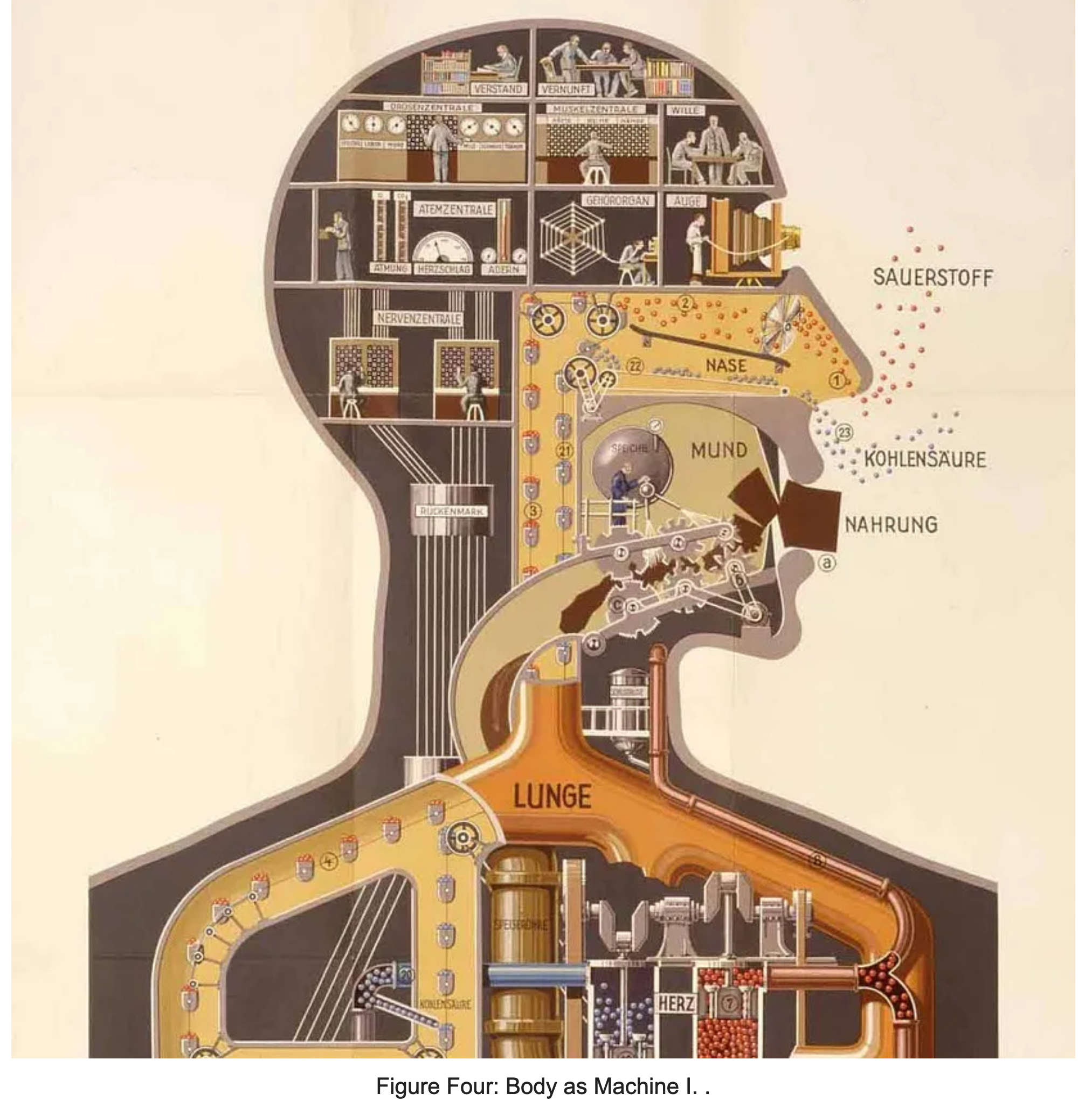
Deleuze and Guattari illustrate this with an example of the breast and mouth as machines, stating that “the breast is a machine that produces milk, and the mouth is a machine coupled to it” (AO, 1). Another specific example that Deleuze and Guattari isolate is the mouthmachine. This multifunctional machine serves various purposes, including eating, speaking, vomiting, breathing, and more Page 6
Expanding beyond the heart-machine, mouth-machine, and breast-machine, it becomes clear that there is no isolated ‘self.’ You are a conglomerate of machines that collectively identify themselves as you Page 7
Hence we are all handymen: each with his little machines. For every organ-machine, an energy-machine: all the time, flows and interruptions. (AO, 1–2) Page 7
- [N] Deleuze and Guattari view the unconscious not as Freud's "id" but as a pervasive, productive force.
- [N] This productive force is characterized by interconnected "machines" (real, not figurative) that constantly produce or interrupt flows.
- [N] Examples like the heart/lungs/diaphragm, breast/mouth, or even specific organ-machines demonstrate this coupling and flow.
- [N] There is no isolated self, but rather a collection of interconnected machines.
This section introduces Deleuze and Guattari's departure from Freudian psychoanalysis, proposing the unconscious as a dynamic, everywhere-present production characterized by the coupling of "desiring-machines" that produce and interrupt flows, rather than the static Freudian "id."
#on/unconscious #on/desiring-machines
The Solar Anus and Critiques of Freud/Idealism
Judge Schreber has sunbeams in his ass. A solar anus. And rest assured that it works: Judge Schreber feels something, produces something, and is capable of explaining the process theoretically. Something is produced: the effects of a machine, not mere metaphors. (AO, 2) Page 7
Deleuze and Guattari’s mentioning of Schreber’s “solar anus” seems to reference not only Schreber’s belief in God’s communication via rays, but it also alludes to two other (potential) aspects: 1. , because Freud focused extensively on the development of psychosexual stages (particularly emphasizing the ), the reference of Schreber’s “solar anus” interpreted as a criticism of Freud’s work. 2. , the “solar anus” a reference to philosophical work, . In this erotic text, Bataille employs vivid imagery to describe the sun as an anus. Page 8
- [N] The example of Judge Schreber's "solar anus" is used to emphasize that these machines and their productions are real, not just metaphorical.
- [N] This example critiques Freud's focus on psychosexual stages (like the anal stage) by presenting a non-oedipal, productive connection.
- [N] It also potentially alludes to Georges Bataille's philosophical concept, linking production and flow in a non-idealized way.
Deleuze and Guattari use the controversial example of Judge Schreber's "solar anus" to underscore the reality and productivity of desiring-machines, distinguishing their concept from mere metaphor and implicitly critiquing Freudian interpretations and idealist views of the body and desire.
Paragraph Two
Paragraph Two Page 8
The Schizophrenic as a Model of Desiring-Production
A schizophrenic out for a walk is a better model than a neurotic lying on the analyst’s couch. A breath of fresh air, a relationship with the outside world. (AO, 2; emphasis mine) Page 8
Lenz’s stroll, for example, as reconstructed by Buchner. This walk outdoors is different from the moments when Lenz finds himself closeted with his pastor, who forces him to situate himself socially, in relationship to the God of established religion, in relationship to his father, to his mother. While taking a stroll outdoors, on the other hand, he is in the mountains, amid falling snowfiakes, with other gods or without any gods at all, without a family, without a father or a mother, with nature. “What does my father want? Can he offer me more than that? Impossible. Leave me in peace.” (AO, 2) Page 9
- [N] "The schizophrenic's stroll outside positions the schizophrenic as part in parcel with nature, or rather nature as a process"
The schizophrenic’s stroll outside positions the schizophrenic as part in parcel with nature — or rather, . Page 9
- [N] missing word: nature as a process
Everything is a machine. Celestial machines, the stars or rainbows in the sky, alpine machines — all of them connected to those of [the] body. The continual whirr of machines (AO, 2). Page 9
“[Lenz] thought that it must be a feeling of endless bliss to be in contact with the profound life of every form, to have a soul for rocks, metals, water, and plants, to take into himself, as in a dream, every element of nature, like flowers that breathe with the waxing and waning of the moon.” (AO, 2) Page 10
It is erroneous to assume that the human body is a separate entity from nature. All machines are interconnected to one another just as a part is part and parcel with other parts. Page 11
[The schizophrenic] does not live nature as nature, but as a process of production. There is no such thing as either man or nature now, only a process that produces the one within the other and couples the machines together. (AO, 2; emphasis mine) Page 12
Returning to the heart-, breast-, and mouth-machine(s), it becomes clear that no organ exists in isolation from the others. Thus, the ensemble of organs that constitutes the schizophrenic is part of a constantly evolving network, where no single organ or group of organs maintains a fixed identity. As mentioned earlier, Deleuze and Guattari describe this interconnectedness as the “production of production” or the “connective synthesis.” This is the first synthesis of the unconscious. Page 12
- [N] The schizophrenic is presented as a model for understanding desiring-production because their experience demonstrates a direct, unmediated connection with the outside world (nature) as a process of production.
- [N] Unlike the neurotic constrained by familial/social structures (represented by Lenz with his pastor), the schizophrenic (Lenz walking outdoors) is immersed in nature as a universal process of interconnected machines.
- [N] The human body is not separate from nature but is part of this same process of production, with all machines (bodily, celestial, alpine) interconnected.
- [N] This interconnectedness and the process of production is called the "production of production" or the "connective synthesis," which is the first synthesis of the unconscious.
Deleuze and Guattari propose the schizophrenic experience, particularly their unmediated connection with nature as a process, as a better model for understanding desiring-production than the neurotic subject of psychoanalysis. This highlights the interconnectedness of all machines (human and natural) within a universal process called the connective synthesis, the first synthesis of the unconscious.
#on/schizophrenia #on/connective-synthesis
Paragraph Three
Paragraph Three Page 13
Desire and Repression
[...] But that is not so at all: Oedipus presupposes a fantastic repression of desiring-machines. (AO, 3; emphasis mine) Page 15
these desiring-machines are not inherently oedipalized; instead, desiring-machines are produced oedipally due to repression — not the other way around. Page 15
schizophrenia itself is a process of production. Page 19
- [N] Desiring-machines are not inherently defined by the Oedipus complex.
- [N] Instead, the Oedipus complex and oedipalized desire are a result of the repression of desiring-machines and their productive process.
- [N] Schizophrenia is also understood as a process of production, linked to this unmediated process of desiring-machines.
This section clarifies that desiring-machines and their production are primary, and the Oedipus complex is a result of their repression, not their inherent structure. Schizophrenia is understood as a state closer to this fundamental process of production.
Process Defined: Production, Recording, Consumption
This does not mean that we are attempting to make nature one of the poles of schizophrenia. What the schizophrenic experiences, both as an individual and as a member of the human species, is not at all any one specific aspect of nature, but nature as a process of production. (AO, 3) Page 19
First Definition of Process (found in the last sentence of the fourth paragraph): To formulate their first definition of the term “process,” Deleuze and Guattari examine the relationship between nature and industry: Page 20
It is probable that at a certain level nature and industry are two separate and distinct things: from one point of view, industry is the opposite of nature; from another, industry extracts its raw materials from nature; from yet another, it returns its refuse to nature; and so on. (AO, 3) Page 20
This brings to mind the common notion that people seek out nature to escape city life. From one perspective, the city appears at odds with nature, as it more often than not damages the environment in pursuit of economic growth. However, all buildings, streets, and infrastructure originate from the earth, and industrial waste returns to the earth in a continuous cycle. Therefore, it’s inaccurate to conclude that industry and nature are completely separate entities. [Page 20](zotero:// Supplied: 2025-06-03T06:05:27.060-04:00)
Here, we encounter three arbitrary distinctions — those of man-nature, industry-nature, and society-nature — which constitute the basis for the differentiation of production, distribution, and consumption. However, the separation of production, distribution, and consumption is fundamentally constructed under capitalism. Deleuze and Guattari contend that these distinctions are not natural or inherent divisions, but instead are shaped by the capitalist system. Page 21
But in general this entire level of distinctions [between production, distribution, and consumption], examined from the point of view of its formal developed structures, presupposes (as Marx has demonstrated) not only the existence of capital and the division of labor, but also the false consciousness that the capitalist being necessarily acquires, both of itself and of the supposedly fixed elements within an over-all process. (AO, 4; emphasis mine) Page 21
Firstly, capital is associated with production because production requires the creation of goods and services that are driven by ownership of capital or the means of production. Secondly, division of labor is associated with distribution because division of labor refers to how labor is divided amongst people in society. The division of labor plays a crucial role in how goods and services are distributed to consumers. Thirdly, false consciousness is associated with consumption because the misperception that individuals have about their economic conditions under capitalism is necessary in order for individuals to consume goods and services. False consciousness affects how people perceive their economic conditions, influencing their consumption patterns. To be extremely clear, Deleuze and Guattari are arguing that there is no fundamental difference between production, distribution, and consumption. Instead, these distinctions are constructed by capitalism. [Page 22](zotero:// Supplied: 2025-06-03T06:05:27.060-04:00)
For the real truth of the matter — the glaring, sober truth that resides in delirium — is that there is no such thing as relatively independent spheres or circuits: production is immediately consumption and a recording process, without any sort of mediation, and the recording process and consumption directly determine production, though they do so within the production process itself. (AO, 4) Page 23
Production, distribution, and consumption are three ways of viewing the same process. Similarly, when we analyze the three syntheses of the unconscious — production of production, production of recording, and production of consumption — it must be noted that the three syntheses are three ways of viewing the same process. Everything is production; production is immediately distribution which is immediately consumption; and the production falls back upon this process immediately: Page 23
Hence everything is production: production of productions, of actions and of passions; productions of recording processes, of distributions and of co-ordinates that serve as points of reference; productions of consumptions, of sensual pleasures, of anxieties, and of pain. Everything is production, since the recording processes are immediately consumed, immediately consummated, and these consumptions directly reproduced. (AO, 4) Page 24
Thus, the first definition of the term “process” is: production, recording (distribution), and consumption are one and the same process. Page 24
This is the first meaning of process as we use the term: incorporating recording and consumption within production itself, thus making them the productions of one and the same process. (AO, 4; emphasis mine) Page 24
- [N] Schizophrenia is understood not as being one pole of nature, but as experiencing nature as a process of production.
- [N] Arbitrary distinctions like man-nature or industry-nature, and the separation of production, distribution, and consumption, are constructs of capitalism.
- [N] Capitalism creates a "false consciousness" that sustains these divisions.
- [N] The fundamental reality, especially in "delirium" or the schizophrenic state, is that production, consumption, and recording are immediate and unified processes, not separate stages.
- [N] The first definition of "process" is the identity of production, recording (distribution), and consumption as one process.
Deleuze and Guattari argue that the perceived separation between nature/man/industry and between production/distribution/consumption are artificial constructs of capitalism. The true reality, exemplified by the schizophrenic experience, is that these are unified processes where production is immediately consumption and recording, and vice-versa. This unified flow constitutes the first definition of "process."
#on/process #on/capitalism #on/critique
Paragraph Five
Paragraph Five Page 25
Process Defined: Human=Nature (Producer-Product)
Second, we make no distinction between [hu]man and nature: the human essence of nature and the natural essence of [hu]man become one within nature in the form of production or industry, just as they do within the life of [hu]man as a species. (AO, 4) Page 25
Production or industry is a human endeavor just as much as it is part and parcel with nature, as nature. Page 25
Industry is then no longer considered from the extrinsic point of view of utility, but rather from the point of view of its fundamental identity with nature as production of [hu]man and by [hu]man. (AO, 4) Page 25
man is an equal and integral part of the production process. Human = Nature Page 26
Not [hu]man as the king of creation, but rather as the being who is in intimate contact with the profound life of all forms or all types of beings, who is responsible for even the stars and animal life, and who ceaselessly plugs an organ-machine into an energymachine, a tree into [their] body, a breast into [their] mouth, the sun into [their] asshole: the eternal custodian of the machines of the universe. (AO, 4) Page 26
This statement eloquently places humans — not humans as the center of the universe or top of an arbitrary hierarchy — in harmony with everything. Page 26
instead of demonizing Schreber and finding him ill, they celebrate the interconnectedness of machines, regardless of the unexpected connection — the sun-machine connects with the anus-machine. Page 27
Second Definition of Process: Page 27
This is the second meaning of process as we use the term: [hu]man and nature are not like two opposite terms confronting each other — not even in the sense of bipolar opposites within a relationship of causation, ideation, or expression (cause and effect, subject and object, etc.); rather, they are one and the same essential reality, the producer-product. (AO, 4–5; emphasis mine) Page 27
In this manner, humans are not merely the product, result, or effect of nature; rather, humans and nature share a “producer-product” relationship. To be clear, there is no Platonic, idealized category or form of human essence as humans are not above nature. When referring to Platonism, we are discussing transcendence — the belief that truth exists “out there” beyond nature or that there is a greater human essence to fulfill. Instead, nature and human as a process of production is akin to an immanent principle; immanence opposes transcendence. Page 28
- [N] The second definition of "process" is the identity of human and nature.
- [N] Human activity (like industry) is not separate from nature but is part of nature as a process of production.
- [N] Humans are not the "king of creation" but are an integral part of the universal machine coupling and flow, intimately connected to all forms of being.
- [N] The relationship is not one of cause and effect or subject and object, but a "producer-product" identity where human and nature are the same essential reality.
- [N] This concept is immanent, opposing transcendent ideas like Platonic forms or a human essence outside of nature.
The second definition of "process" posits the essential identity of human and nature, viewing both as integral parts of a universal, immanent process of production. Humans are not separate subjects acting upon an external nature but are producer-products within nature itself, continuously coupling with other machines.
#on/process #on/human-nature #on/immanence
Materialist Psychiatry and the Process as Non-Goal
Production as process overtakes all idealistic categories and constitutes a cycle whose relationship to desire is that of an immanent principle. (AO, 5) Page 28
Unlike psychoanalysis which posits desire in relation to transcendence (which we will discuss in 2.3–2.5), Deleuze and Guattari are concerned with a materialist psychiatry. Page 28
That is why desiring-production is the principal concern of a materialist psychiatry, which conceives of and deals with the schizo as Homo natura. (AO, 5) Page 28
Third Definition of Process: Page 29
[A materialist psychiatry] will be the case, however, only on one condition, which in fact constitutes the third meaning of process as we use the term: it must not be viewed as a goal or an end in itself, nor must it be confused with an infinite perpetuation of itself. (AO, 5; emphasis mine) Page 29
The process of production is not an end or goal in itself but rather a continuous, free-flowing process. For a materialist psychiatry to be effective, this process should not be halted. Attempts to either end or prolong the process of production results in the creation of artificial schizophrenics (also known as “clinical entities”) found in mental institutions. Individuals that we deem “mentally ill” in our society, are produced rather than innately ill. And, the production of these illnesses serves as the result of societal structures, cultural norms, and capitalism that impose certain expectations and pressures on individuals which result in the process being halted or prolonged indefinitely. [Page 29](zotero:// Supplied: 2025-06-03T06:05:27.060-04:00)
Putting an end to the process or prolonging it indefinitely — which, strictly speaking, is tantamount to ending it abruptly and prematurely — is what creates the artificial schizophrenic found in mental institutions: a limp rag forced into autistic behavior, produced as an entirely separate and independent entity. (AO, 5) Page 29
D. H. Lawrence says of love: “We have pushed a process into a goal. The aim of any process is not the perpetuation of that process, but the completion thereof. . . . The process should work to a completion, not to some horror of intensification and extremity wherein the soul and body ultimately perish.” (AO, 5) Page 30
This quote illustrates the idea that when we attempt to turn a natural process, such as love, into a fixed goal or aim, we distort what it is. Love doesn’t necessarily have a definitive end; it is completed the second it is undertaken; love ebbs and flows, serving as a continuous process. We should not abruptly stop loving or turn love into an end goal — if we do so, it will have massive ramifications. Schizophrenia is akin to love: Page 30
Schizophrenia is like love: there is no specifically schizophrenic phenomenon or entity; schizophrenia is the universe of productive and reproductive desiring-machines, universal primary production as “the essential reality of man and nature.” (AO, 5; emphasis mine) Page 30
- [N] A materialist psychiatry focuses on desiring-production as an immanent principle, treating the schizophrenic as Homo natura (man in nature).
- [N] The third definition of "process" is that it must not be treated as a goal or end but as a continuous flow.
- [N] Halting or indefinitely prolonging this process, often due to societal structures, creates the "artificial schizophrenic" or "clinical entity" found in institutions.
- [N] Like love, schizophrenia is not a fixed entity but the dynamic universe of desiring-production itself.
Deleuze and Guattari advocate for a materialist psychiatry centered on immanent desiring-production, treating the schizophrenic as integral to nature's processes. They define the third aspect of "process" as its nature as a continuous flow, not a goal. Attempting to fix or stop this process, often driven by societal forces, produces the pathological state of the clinical schizophrenic.
#on/materialist-psychiatry #on/process #on/schizophrenia
Paragraph Six
Paragraph Six Page 31
The Connective Synthesis: Binary Machines and Flows
Desiring-machines are binary machines, obeying a binary law or set of rules governing associations: one machine is always coupled with another. (AO, 5) Page 31
As mentioned earlier, the first synthesis of the unconscious isthe productive synthesis, also referred to as the production of production or the connective synthesis. Page 31
The productive synthesis, the production of production, is inherently connective in nature: “and . . .” “and then . . .” This is because there is always a flow-producing machine, and another machine connected to it that interrupts or draws off part of this flow (the breast — the mouth). (AO, 5; emphasis mine) Page 31
The use of “and ...” “and then ...” signifies the interconnectedness of machines that constantly emit and interrupt flows. Deleuze and Guattari use the example of the breast and the mouth: the breast emits a flow of milk, the mouth interrupts this flow. In this context, the interruption or drawing off of a flow by one machine is not a disruption but rather an integral part of the connective process. Page 31
This process of desiring-machines connecting, producing, and interrupting flows forms a linear series of binary connections. The production of a flow is linked to a machine that interrupts it, which in turn is connected to another machine. Page 32
And because the first machine is in turn connected to another whose flow it interrupts or partially drains off, the binary series is linear in every direction. (AO, 5) Page 32
- [N] Desiring-machines are "binary machines" because they operate through coupling, where one machine connects to another.
- [N] The connective synthesis involves machines producing flows and other machines interrupting or drawing off these flows (e.g., breast-mouth).
- [N] This creates a linear series of binary connections: Machine A produces flow, Machine B interrupts flow and produces another flow, Machine C interrupts that flow, and so on.
- [N] The structure is inherently connective, like "and... and then...".
Desiring-machines are described as binary and connective, constantly coupling with one another. This coupling involves the production and interruption of flows, forming linear series. This "connective synthesis" is the first synthesis of the unconscious.
#on/connective-synthesis #on/desiring-machines #on/binary
Desire as the Force of Coupling and Flow
Desire is the force responsible for the flow of all these machines Page 32
Desire constantly couples continuous flows and partial objects that are by nature fragmentary and fragmented. Desire causes the current to flow, itself flows in turn, and breaks the flows. (AO, 5) Page 32
Desire is the force responsible for the connection of machines, the production of flows from machines, and the interruption of flows by machines: Page 33
Desire constantly couples continuous flows and partial objects that are by nature fragmentary and fragmented. Desire causes the current to flow, itself flows in turn, and breaks the flows. (AO, 5) Page 33
“I love everything that flows, even the menstrual flow that carries away the seed unfecund.” Amniotic fluid spilling out of the sac and kidney stones; flowing hair; a flow of spittle, a flow of sperm, shit, urine that are produced by partial objects and constantly cut off by other partial objects, which in turn produce other flows, interrupted by other partial objects. (AO, 5–6) Page 35
- [N] Desire is the driving force behind the coupling of machines and the production/interruption of flows.
- [N] Desire connects continuous flows with "partial objects" (fragmentary parts of the body or machines).
- [N] Desire itself flows and also breaks flows, indicating its dynamic and disruptive nature.
- [N] Examples of flows include various bodily fluids and processes, highlighting the material and non-oedipal nature of desire.
Desire is defined as the fundamental force that drives the connective synthesis, coupling desiring-machines and initiating, maintaining, and interrupting the continuous flows between them. It operates through "partial objects" and is not limited to conventional notions of desire, encompassing all forms of energetic flow.
#on/desire #on/flows #on/partial-objects
Objects and Flows, Product/Producing Identity
In this manner, “every ‘object’ presupposes the continuity of a flow; every flow, the fragmentation of the object” (AO, 6). Simply put, an “object” is defined by its continuous flow; conversely, a flow disrupts and fragments the object due to its continuous movement. Page 35
Doubtless each organ-machine interprets the entire world from the perspective of its own flux, from the point of view of the energy that flows from it: the eye interprets everything — speaking, understanding, shitting, fucking — in terms of seeing. (AO, 6) Page 35
But a connection with another machine is always established, along a transverse path, so that one machine interrupts the current of the other or “sees” its own current interrupted. (AO, 6) Page 36
- [N] Objects and flows are interdependent: an object is defined by its continuous flow, while flows fragment objects.
- [N] Each organ-machine has its own perspective based on its specific flow (e.g., the eye interprets everything in terms of seeing).
- [N] Connections between machines happen transversely, where one machine interrupts the flow of another, demonstrating the interplay between production and interruption.
Objects are conceptualized in relation to flows; a continuous flow constitutes an object, while the flow itself fragments the notion of a fixed object. Organ-machines interact by connecting transversely, interrupting each other's flows as part of the ongoing process.
#on/partial-objects #on/flows #on/connective-synthesis
Paragraph Seven
Paragraph Seven Page 36
The Product/Producing Dynamic and Immanence
the relationship between partial objects and flows consists of a product/producing dynamic. The product is the producer; the producer is the product Page 36
Hence the coupling that takes place within the partial object-flow connective synthesis also has another form: product/producing. (AO, 6; emphasis mine) Page 36
The concept of product/producing aligns closely with the Spinozist perspective that God is nature, emphasizing immanence over transcendence. Instead of a transcendent God creating nature — where nature is deemed a product of God — Deleuze and Guattari find nature to act as both the producer and product simultaneously. Nature continuously produces itself while undergoing the process of production. Page 36
- [N] Baruch Spinoza
Producing is always something “grafted onto” the product; and for that reason desiringproduction is production of production, just as every machine is a machine connected to another machine. (AO, 6) Page 37
- [N] The connective synthesis involves a "product/producing" dynamic where the product and the producer are the same entity.
- [N] This concept resonates with Spinoza's philosophy of immanence, where nature (or God) is both the producer and the product, constantly producing itself.
- [N] Producing is "grafted onto" the product, reinforcing the idea that production is always production of production, like interconnected machines.
Within the connective synthesis, there's a "product/producing" identity, mirroring Spinoza's immanent view where nature is both producer and product. This dynamic underscores that production is always "production of production," as producing is inseparable from what is produced.
#on/product-producing #on/immanence #on/spinoza
Critiquing Idealist "Expression" via Art Brut and the Schizophrenic Table
We cannot accept the idealist category of “expression” as a satisfactory or sufficient explanation of this phenomenon. We cannot, we must not attempt to describe the schizophrenic object without relating it to the process of production. (AO, 6) Page 37
In this context, “expression” refers to idealist categorizations that posit a single factor as the sole expression of the schizophrenic object. This type of expression must be rejected as it does not relate the schizophrenic object to desiring-production. Page 37
According to Deleuze and Guattari, —“a series of monographs, issued periodically, containing reproductions of art works created by inmates of the psychiatric asylums of Europe” — understood the necessity of relating the schizophrenic object to desiring-production (AO, 6; footnote). Page 37
The Cahiers de I’art brut serves as a good illustration of relating the schizophrenic object to desiring-production: Page 37
The Cahiers de I’art brut are a striking confirmation of this principle, since by taking such an approach they deny that there is any such thing as a specific, identifiable schizophrenic entity. (AO, 6) Page 37
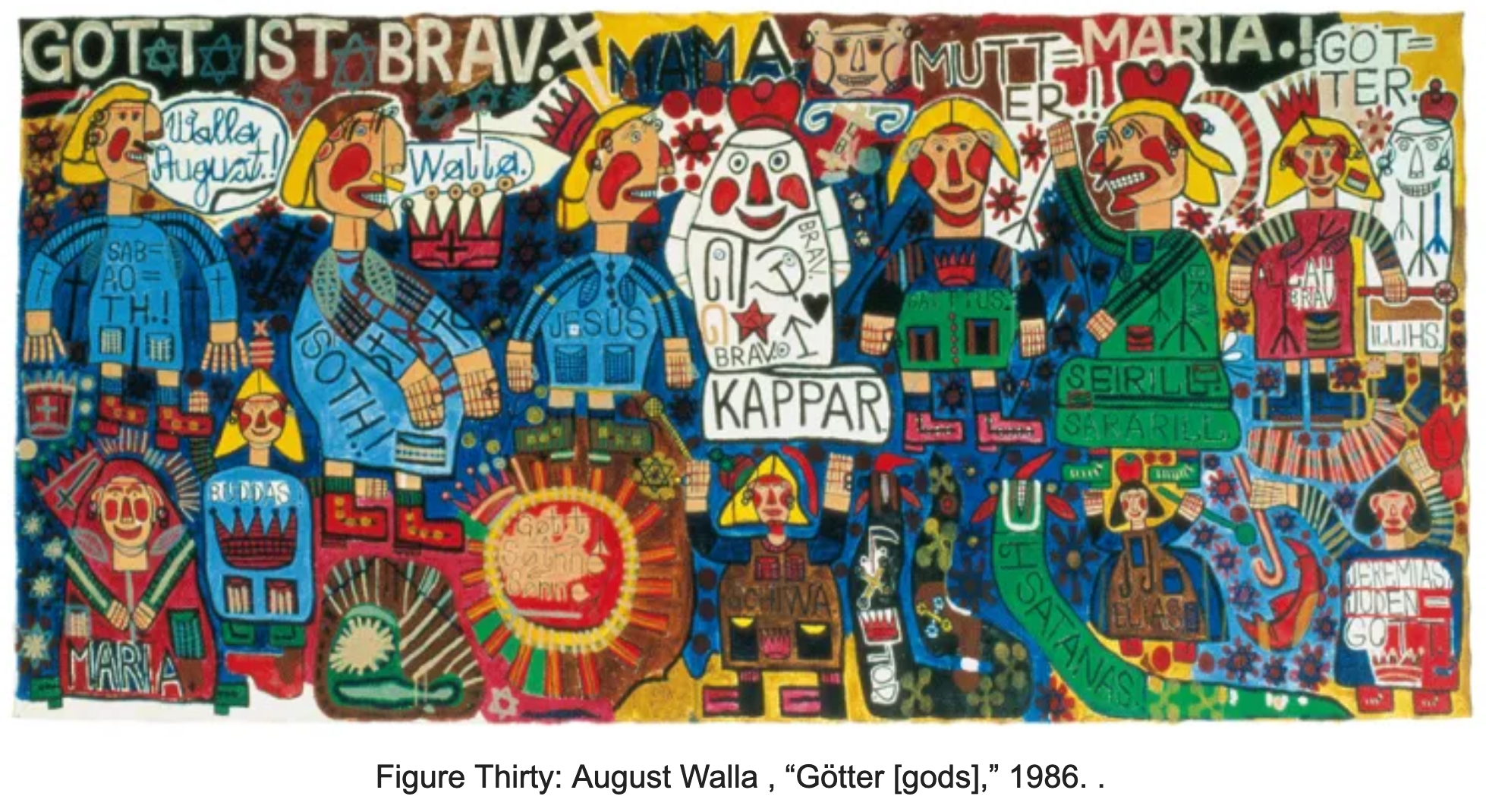
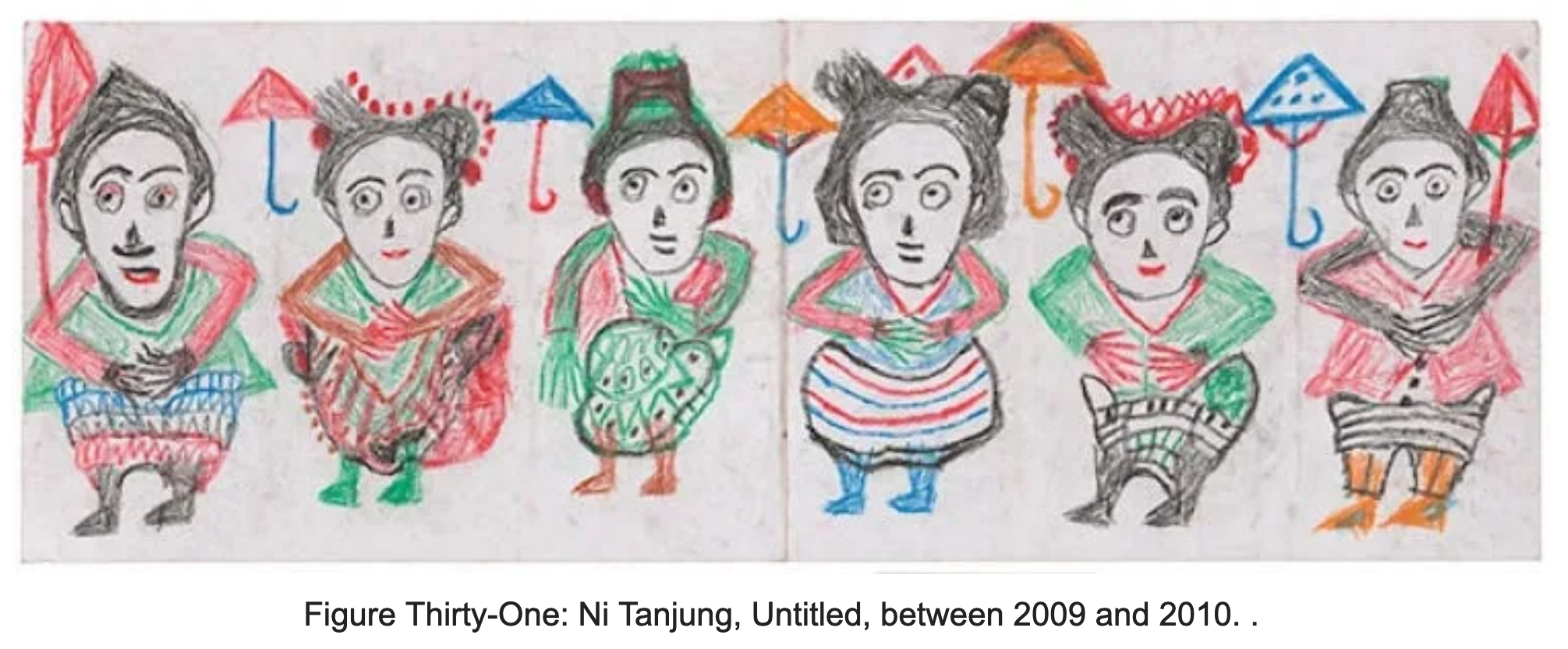
The concept of Art Brut stems from the French painter Jean Dubuffet who, from 1945, assembled a collection of objects created by the inmates of various psychiatric hospitals and prisons — solitary or outcast persons. In their creations, he saw “an entirely pure, raw artistic operation that the creator fully reinvents in all its phases , as spurred uniquely by his own impulses.” The idea of Art Brut is thus based on certain social characteristics and aesthetic peculiarities. Page 38
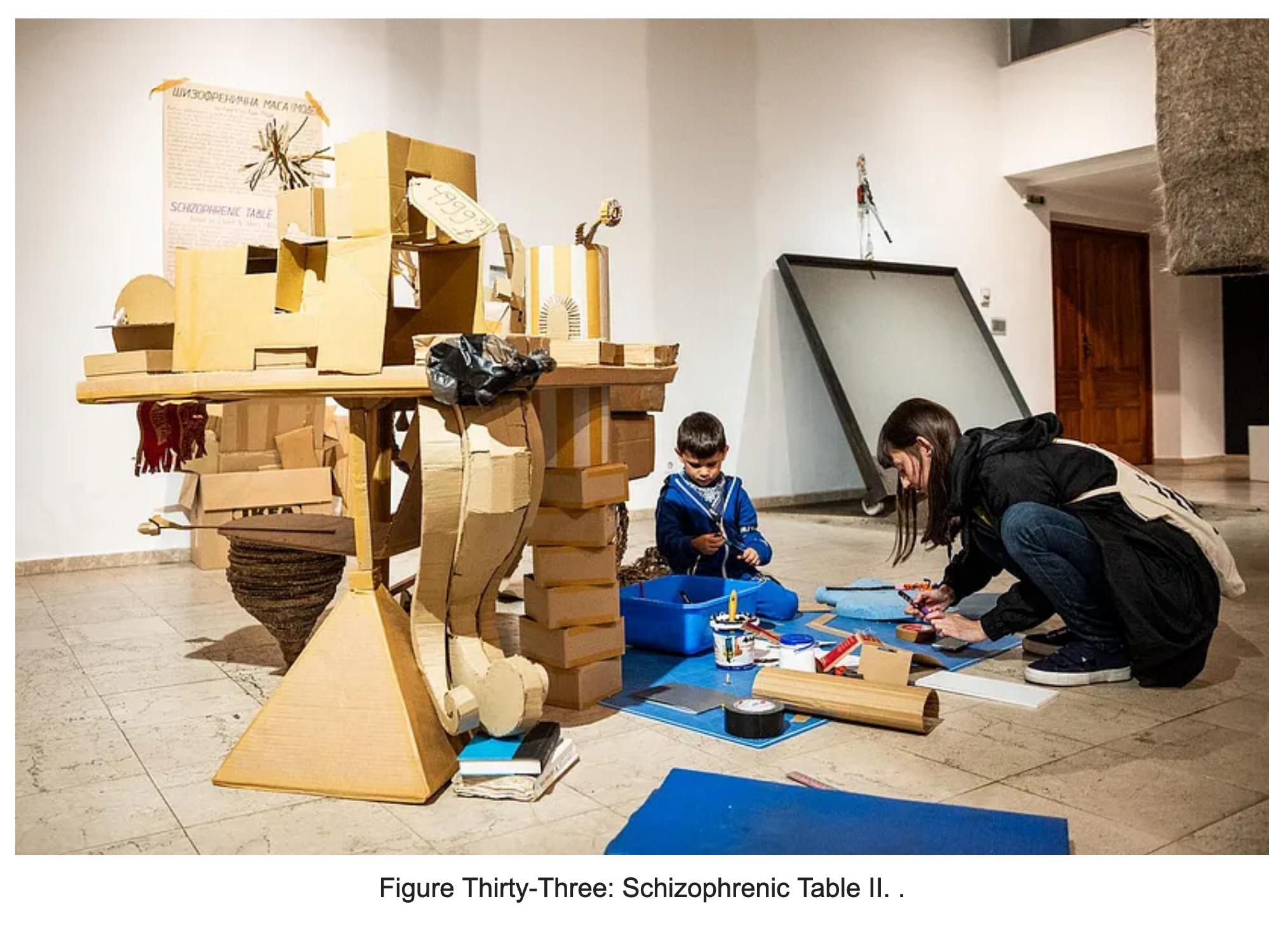
Or to take another example, Henri Michaux describes a schizophrenic table in terms of a process of production which is that of desire: “Once noticed, it continued to occupy one’s mind. It even persisted, as it were, in going about its own business. . . . The striking thing was that it was neither simple nor really complex, initially or intentionally complex, or constructed according to a complicated plan. Instead, it had been desimplified in the course of its carpentering. ... As it stood, it was a table of additions, much like certain schizophrenics’ drawings, described as ‘overstuffed,’ and if finished it was only in so far as there was no way of adding anything more to it, the table having become more and more an accumulation, less and less a table. ... It was not intended for any specific purpose, for anything one expects of a table. Heavy, cumbersome, it was virtually immovable. One didn’t know how to handle it (mentally or physically). Its top surface, the useful part of the table, having been gradually reduced, was disappearing, with so little relation to the clumsy framework that the thing did not strike one as a table, but as some freak piece of furniture, an unfamiliar instrument ... for which there was no purpose. A dehumanized table, nothing cozy about it, nothing ‘middle-class,’ nothing rustic, nothing countrified, not a kitchen table or a work table. A table which lent itself to no function, self-protective, denying itself to service and communication alike. There was something stunned about it, something petrified. Perhaps it suggested a stalled engine.” (AO, 6–7; emphasis mine) Page 39
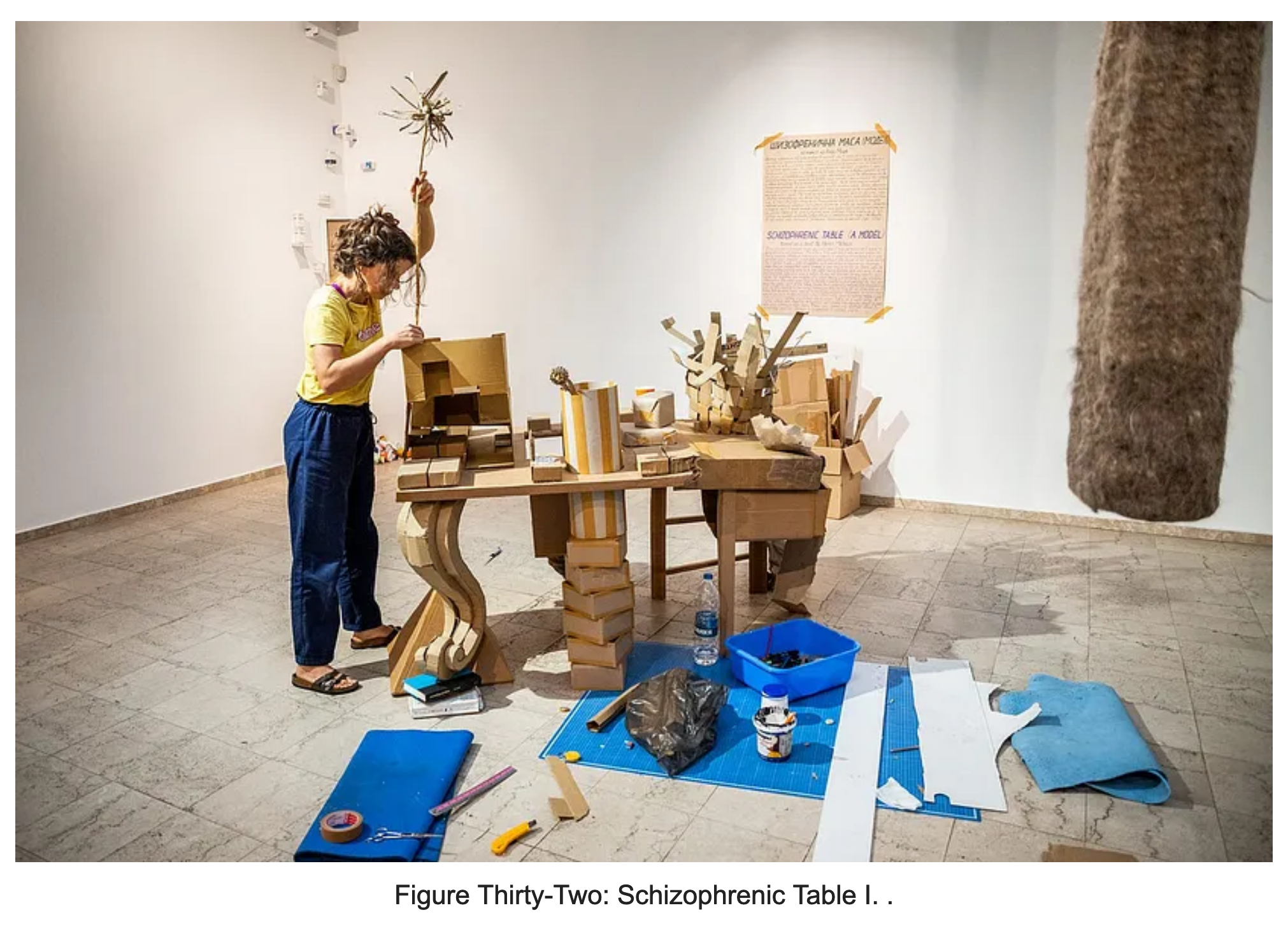
In Figure Thirty-Two, Nevena Ekimova presents her model of the schizophrenic table. The table appears to continually fill up, gather more items over time; yet it never remains stable as the surface of the table gradually reduces. This concept of the schizophrenic table underscores the persistent and relentless nature of desiring-production. It illustrates that desiring-production operates in a continuous cycle of connection, production, and interruption, without a clear end or completion. Page 40
- [N] Idealist "expression," which attributes phenomena like schizophrenia to a single cause, is rejected because it fails to account for the underlying process of desiring-production.
- [N] Art Brut ("raw art" by psychiatric patients) is seen as confirming the importance of relating the "schizophrenic object" to production, as it doesn't present a fixed, identifiable entity.
- [N] Henri Michaux's description of a "schizophrenic table" illustrates desiring-production as a continuous, accumulative process without a clear function or endpoint, resisting fixed form.
Deleuze and Guattari reject idealist explanations ("expression") that fail to link phenomena to the process of desiring-production. Art Brut and the concept of the "schizophrenic table" serve as examples demonstrating how this process manifests as continuous accumulation and transformation, resisting the idea of a fixed entity or final product.
#on/art-brut #on/schizophrenic-table #on/process
Paragraph Eight
Paragraph Eight Page 40
The Schizophrenic as Universal Producer / Bricoleur
The schizophrenic is the universal producer. There is no need to distinguish here between producing and its product. We need merely note that the pure “thisness” of the object produced is carried over into a new act of producing. The table continues to “go about its business.” The surface of the table, however, is eaten up by the supporting framework. The nontermination of the table is a necessary consequence of its mode of production. (AO, 7) Page 40
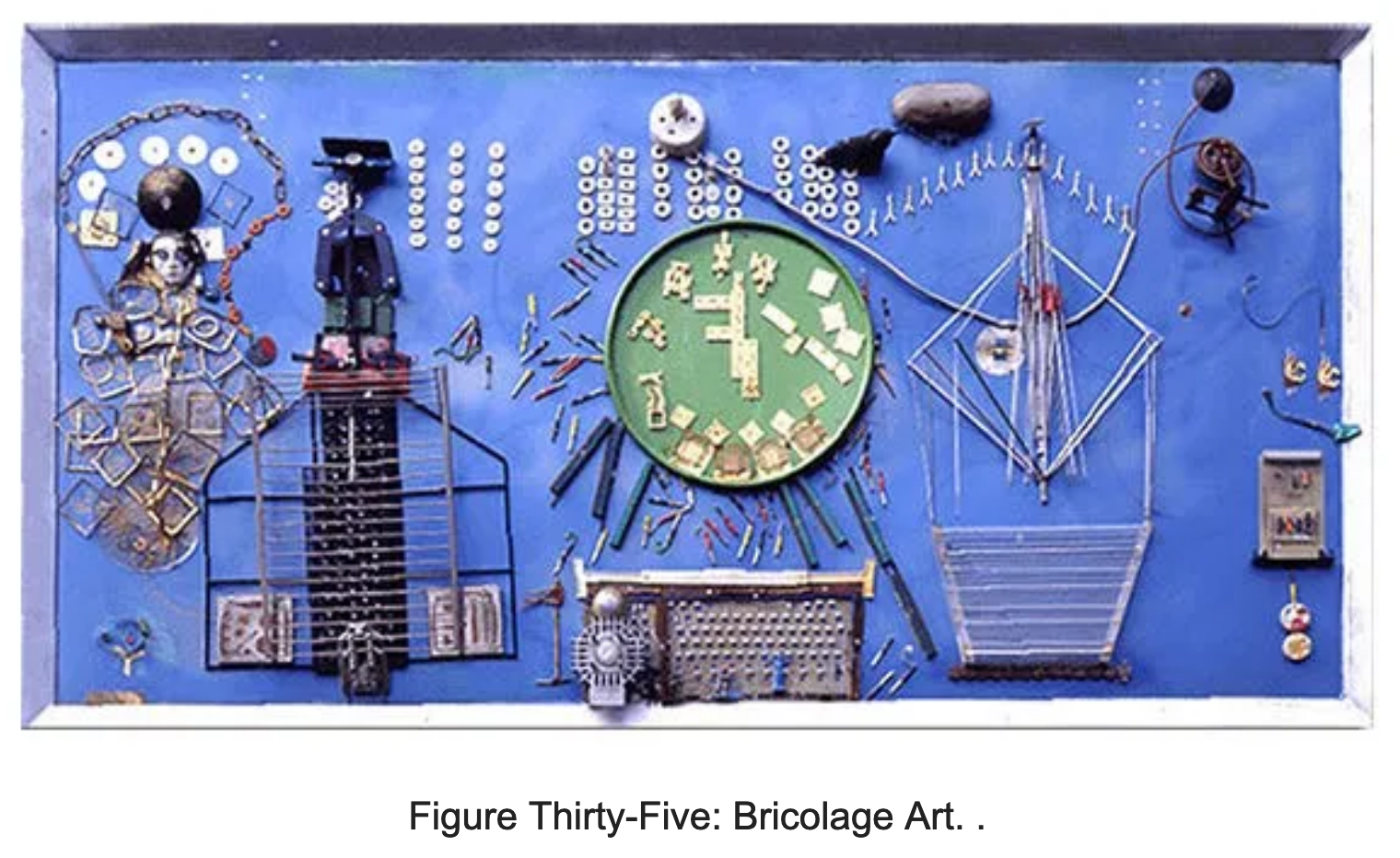
In traditional or primitive societies, a bricoleur (which is essentially defined as a jack-of-all-trades type of handyman) employs whatever tools and materials are at their disposal to craft something new. For the bricoleur, there is no fixed set of instructions to follow; instead, they improvise based on the resources at hand. Lévi-Strauss extends this analysis by arguing that mythology functions like that of a bricoleur. In contrast, western science functions like that of an engineer. Page 41
CIaude Levi-Strauss, The Savage Mind (Chicago: University of Chicago Press, 1966), p. 17: “The ‘bricoleur’ is adept at performing a large number of diverse tasks; but unlike the engineer, he does not subordinate each of them to the availability of raw materials and tools conceived and procured for the purpose of the project. His universe of instruments is closed and the rules of his game are always to make do with ‘whatever is at hand,’ that is to say with a set of tools and materials which is always finite and is also heterogeneous because what it contains bears no relation to the current project, or indeed to any particular project, but is the contingent result of all the occasions there have been to renew or enrich the stock or to maintain it with the remains of previous constructions or destructions.” Page 41
When Claude Levi-Strauss defines bricolage he does so in terms of a set of closely related characteristics: the possession of a stock of materials or of rules of thumb that are fairly extensive, though more or less a hodgepodge — multiple and at the same time limited; the ability to rearrange fragments continually in new and different patterns or configurations; and as a consequence, an indifference toward the act of producing and toward the product, toward the set of instruments to be used and toward the overall result to be achieved. (AO, 7) Page 42
In this context, Deleuze and Guattari draw a parallel between desiring-production and the concept of bricolage. By employing Lévi-Strauss’ concept of bricolage, they liken the schizophrenic to a bricoleur, emphasizing the continuous nature of schizophrenia. A bricoleur is a handyman; however, can one properly equate the joyous feeling a handyman gets when connecting machines to one another with the relationship a handyman has to their mother and father? Of course not; this feeling is just a characteristic of desiringproduction: Page 42
The satisfaction the handyman experiences when he plugs something into an electric socket or diverts a stream of water can scarcely be explained in terms of “playing mommy and daddy,” or by the pleasure of violating a taboo. The rule of continually producing production, of grafting producing onto the product, is a characteristic of desiring-machines or of primary production: the production of production. (AO,7) Page 42
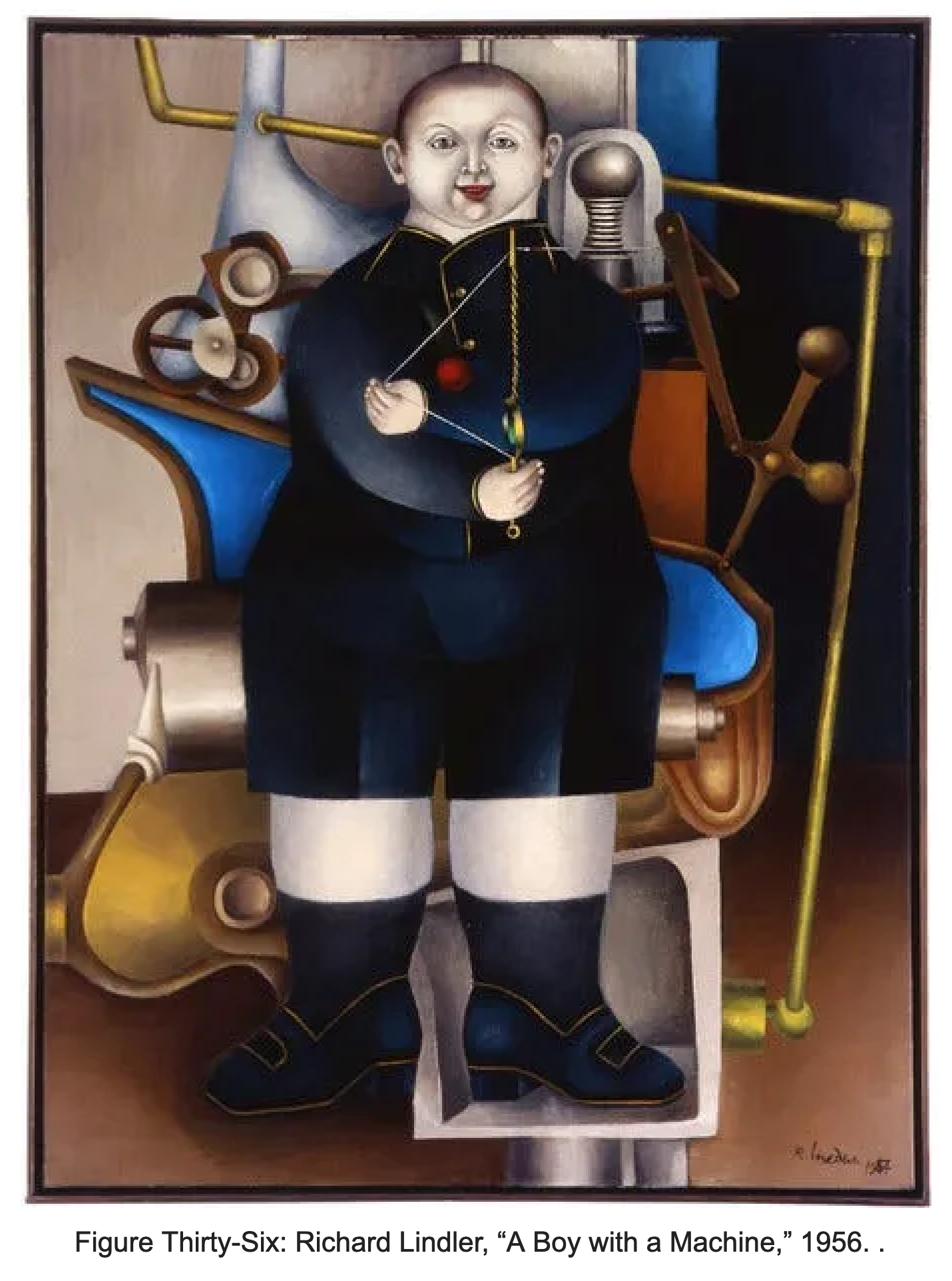
A painting by Richard Lindner, “Boy with Machine,” shows a huge, pudgy, bloated boy working one of his little desiring-machines, after having hooked it up to a vast technical social machine — which, as we shall see, is what even the very young child does. (AO, 7) Page 43
Here, we see Deleuze and Guattari begin to formulate an argument that challenges the oedipalization of young children; even young children are handy-people. Page 43
- [N] The schizophrenic is seen as the "universal producer" because their mode of being embodies the continuous process of production, where the product immediately becomes part of new production.
- [N] This process is likened to Lévi-Strauss's concept of the "bricoleur" (handyman).
- [N] Unlike the engineer who works with materials designed for a specific plan, the bricoleur works with a fixed but heterogeneous stock ("whatever is at hand"), constantly rearranging fragments without indifference to the final product or process itself.
- [N] Desiring-production shares characteristics with bricolage: using existing components, continuous rearrangement, and a focus on the act of connection itself, rather than a pre-defined goal or oedipal dynamics.
- [N] Even young children are seen as bricoleurs of desiring-machines, challenging the Freudian emphasis on oedipal development.
The schizophrenic is characterized as the "universal producer," embodying the continuous, non-teleological nature of desiring-production. This process is compared to Lévi-Strauss's concept of "bricolage," highlighting the creative use of available materials and constant rearrangement inherent in how desiring-machines connect and produce, which Deleuze and Guattari argue is fundamental even in young children, prior to oedipalization.
#on/schizophrenia #on/bricolage #on/desiring-production
Paragraph Nine
Paragraph Nine Page 43
The Body Without Organs: A Third Term and Antiproduction
Producing, a product: a producing/product identity. It is this identity that constitutes a third term in the linear series: an enormous undifferentiated object. (AO, 7) Page 43
desiring-machines operate in a binary series characterized by emissions and flows. Machines either emit a flow or interrupt one. However, the connection of machines, such as the breast-machine linking to the mouth-machine, constitutes an identity. And, as mentioned earlier, all machines are interconnected. Hence, even if momentarily and subtly, a sort of universal identity emerges. Page 44
Everything stops dead for a moment, everything freezes in place — and then the whole process will begin all over again. (AO, 7) Page 44
At this identity is constituted, the process restarts with machines emitting flows or interrupting them. However, this profound organization of the body by desiring-machines is one that the body finds unbearable. Page 44
“[...] From a certain point of view it would be much better if nothing worked, if nothing functioned. Never being born, escaping the wheel of continual birth and rebirth, no mouth to suck with, no anus to shit through.” (AO, 7) Page 44
It would seem, however, that the flows of energy are still too closely connected, the partial objects still too organic, for this to happen. (AO, 8) Page 45
“what would be required is a pure fluid in a free state, flowing without interruption, streaming over the surface of a full body” (AO, 8). Page 45
the desiring-machines are too integral or fresh to be reduced to a state of nothingness. Due to this, Deleuze and Guattari suggest that a fluidity over the surface of a full body is required. Page 45
Desiring-machines make us an organism; but at the very heart of this production, within the very production of this production, the body suffers from being organized in this way, from not having some other sort of organization, or no organization at all. (AO, 8) Page 45
the real enemy is the ; in particular, the transformation of one into an organism. The idea that one’s organs are inherently fixed, rather than in a state of flux, confines one to the rigid structure of an organism. However, the third term in the series 46/51 the one that constitutes identity — is not a stable identity, as this identity is always in a process of becoming. Page 45
- [N] missing word: organism
“An incomprehensible, absolutely rigid stasis” in the very midst of process, as a third stage: “No mouth. No tongue. No teeth . No larynx. No esophagus. No belly. No anus.” The automata stop dead and set free the unorganized mass they once served to articulate. (AO, 8) Page 46
Unlike the productive nature of desiring-machines, Deleuze and Guattari present the concept of the body without organs which is unproductive in nature Page 46
The full body without organs is the unproductive, the sterile, the unengendered, the unconsumable. (AO, 8) Page 46
Why the body without organs? Because there is no heart, no mouth, and no breast. Not figuratively, literally. All these organs are in a constant state of flux, perpetually changing, as everything is one body in a state of becoming. And if everything is in a state of becoming, how could one possibly identify an organ as something static, existing independently from everything else? The concept of the body with organs is drawn from Spinoza’s onesubstance model: everything is one substance, taking on different forms. In this context, the body without organs acts as a fluid surace, facilitating the breakdown of desiringmachines as they connect. Furthermore, the universal identity that arises through the connection of desiring-machines is elusive. As the body without organs constitutes this identity — and as the body without organs is in a constant state of flux — there is no stable identity to grasp. Page 46
Antonin Artaud discovered [the body without organs] one day, finding himself with no shape or form whatsoever, right there where he was at that moment. Page 47
- [N] The "producing/product" identity formed by coupled desiring-machines constitutes a third term in the linear series, an "enormous undifferentiated object."
- [N] This identity is fleeting, a momentary stasis before the process of production and interruption restarts.
- [N] The "body" finds the organized state created by desiring-machines unbearable, desiring a state of non-organization or fluidity.
- [N] This desire points towards the "body without organs," which is presented as the unproductive, sterile counterpart to desiring-machines.
- [N] The body without organs is not literal organlessness but represents a state of flux and un-organization, akin to Spinoza's single substance, resisting fixed identities and the rigid structure of a conventional "organism." It was explored by Antonin Artaud.
The identity formed by the coupling of desiring-machines creates a third term, an "enormous undifferentiated object." This state, which the body finds unbearable in its organized form, introduces the concept of the "body without organs." This is an unproductive state that resists the rigid organization of organs, representing a fluid, un-organized mass that arises from and opposes the connective synthesis.
#on/body-without-organs #on/connective-synthesis #on/organism
Desire, Death Instinct, and Antiproduction
The death instinct: that is its name, and death is not without a model. For desire desires death also, because the full body of death is its motor, just as it desires life, because the organs of life are the working machine. We shall not inquire how all this fits together so that the machine will run: the question itself is the result of a process of abstraction. (AO, 8) Page 48
In this context, Deleuze and Guattari are criticizing Freud’s concept of the death drive. Instead of agreeing with Freud’s theorization of desire being exclusively driven by death and destruction, Deleuze and Guattari propose that desire desires both life and death. They appear to associate the body without organs as breaking down the organ-machines (in a death-like fashion), and the organ-machines with life (as the organs are organic); they view death as the motor and the organ-machines as the machine. Page 48
- [N] Deleuze and Guattari critique Freud's death drive, arguing that desire desires both life and death.
- [N] Desiring-machines (associated with life and the working machine) are coupled with the body without organs (associated with death and the motor).
- [N] The process isn't about how life/death or machines/motor fit together in an abstract sense, but how they function in the concrete process of desiring-production.
Critiquing Freud's concept of the death drive, Deleuze and Guattari propose that desire encompasses both life and death. They associate desiring-machines with life and the working machine, and the body without organs with death and the motor, emphasizing their dynamic interplay within the process of production.
#on/death-instinct #on/desire #on/body-without-organs
Paragraph Ten
Paragraph Ten Page 48
Desiring-Machines Break Down and Antiproduction
Desiring-machines work only when they break down, and by continually breaking down. (AO, 8) Page 48
desiring-machines attach themselves to the body without organs (or rather, cling to the body without organs), while the body without organs consistently disrupts the organization of these desiring-machines. As a result, desiring-machines continue to break down and evolve, forming new connections and couplings with 49/51 other desiring-machines. Page 48
Judge Schreber “lived for a long time without a stomach, without intestines, almost without lungs, with a torn oesophagus, without a bladder, and with shattered ribs; he used sometimes to swallow part of his own larynx with his food, etc.” (AO, 8) Page 49
The body without organs is not productive in its pursuit of breaking down desiring-machines; the body without organs is nonproductive. Page 49
The body without organs is nonproductive; nonetheless it is produced, at a certain place and a certain time in the connective synthesis, as the identity of producing and the product: the schizophrenic table is a body without organs. The body without organs is not the proof of an original nothingness, nor is it what remains of a lost totality. (AO, 8) Page 49
The nonproductive nature of the body without organs does not assume that the body without organs is ‘nothing’ nor is the body without organs a lost object (we will learn more about this in Chapter 2.3). Instead, this non-productivity of the body without organs resists productive organization. At any rate, the body without organs is produced as the identity of the producing/product relationship in the connective synthesis. As partial objects connect to one another — and as all partial objects are interconnected — we see a surplus produced as the whole is greater than the sum of its parts. This surplus is the fluid identity that is the body without organs. Page 49
The body without organs is anti-representationalist. This concept challenges the idea of rigid or fixed representations that claim to define truth or capture the essence of reality. Instead of accepting dominant frameworks that attempt to define absolute truths, the body without organs exists without an image of itself: Above all, it is not a projection; it has nothing whatsoever to do with the body itself, or with an image of the body. It is the body without an image. This imageless, organless body, the nonproductive, exists right there where it is produced, in the third stage of the binary-linear series. It is perpetually reinserted into the process of production. The catatonic body is produced in the water of the hydrotherapy tub. (AO, 8) The last sentence mentioning the hydrotherapy tub seems to allude to the psychiatric treatment of the catatonic body. In this form of therapy, patients would spend extended periods of time submerged in water to soothe their nerves. Finally, Deleuze and Guattari end by stating: The full body without organs belongs to the realm of antiproduction; but yet another characteristic of the connective or productive synthesis is the fact that it couples production with antiproduction, with an element of antiproduction. (AO, 8) Page 50
the body without organs is produced by the syntheses while serving as a fundamental foundation for the syntheses operation. The body without organs is produced by the syntheses and, in a way, produces the syntheses. Page 51
- [N] Desiring-machines function through a process of continual breaking down and evolving, facilitated by their interaction with the body without organs.
- [N] The body without organs is nonproductive but is produced by the connective synthesis as the identity of the producing/product.
- [N] It is not a void or lost totality but a resistance to productive organization and representation (a body without an image).
- [N] The body without organs represents "antiproduction," which is coupled with production in the connective synthesis.
- [N] The body without organs is simultaneously produced by the syntheses and serves as a foundation for them.
Desiring-machines operate through continuous breakdown as they interact with the body without organs. The body without organs, while nonproductive, is produced within the connective synthesis as the identity between producer and product. It acts as a resistance to fixed organization and representation (antiproduction), which is paradoxically coupled with production itself within the first synthesis.
#on/body-without-organs #on/antiproduction #on/connective-synthesis
Defining Desire and Libido
Unlike Freudian psychoanalysis, whereby desire is understood in relation to sexual relations, Deleuze and Guattari define desire as a positive force that “constantly couples continuous flows and partial objects that are by nature fragmentary and fragmented” (AO 5). Page 51
the energy that the body without organs employs for these connections is what Deleuze and Guattari term ‘Libido’, signifying a profound redefinition of desire. Page 51
- [N] Desire is redefined as a positive, productive force that couples flows and partial objects, contrasting with Freud's psychoanalytic definition tied primarily to sexual relations.
- [N] The energy associated with the body without organs' interaction in these connections is termed 'Libido,' indicating a fundamental redefinition of this concept beyond its Freudian sexual context.
Concluding the section, Deleuze and Guattari explicitly redefine desire as a positive, connective, productive force, distinct from Freudian sexual desire. The energy driving the interactions involving the body without organs within this process is termed 'Libido,' signaling a broader concept of energy beyond psychosexual drives.