Anti-Oedipus: Capitalism and Schizophrenia
Zotero Link: PDF
Author: Felix Guattari,Gilles Deleuze
URL: = this.url
DOI:
Cite Key: deleuzeAntiOedipusCapitalismSchizophrenia2012
| File | created | modified | tags | type |
|---|
Abstract: Anti-Oedipus is a foundational text of schizoanalysis. Deleuze and Guattari critique traditional psychoanalysis (particularly the Oedipal complex) and argue that desire is not based on lack or fantasy but is a productive, material force connected to "desiring-machines." They analyze how social formations, especially capitalism, function by connecting and disconnecting these flows of desire and production, proposing a radical alternative to traditional understandings of the subject, mental illness, and social order.
Hypothesis:: Anti-Oedipus hypothesizes that desire is a productive, non-Oedipal force operating through "desiring-machines" connected to social and material flows, challenging psychoanalysis's focus on lack and the familial triangle as the primary structures of the unconscious and society.
- Critique of Psychoanalysis: Rejects the Oedipus complex as the central structure of desire and the unconscious; desire is not based on lack.
- Desiring-Production: Desire is a positive, productive force, operating through "desiring-machines" that connect and flow.
- Body Without Organs (BwO): A substratum upon which desiring-machines are inscribed and connected, representing pure potentiality before organization.
- Schizoanalysis: A counter-psychoanalysis that traces the flows of desire and the workings of desiring-machines, viewing schizophrenia as a process revealing the nature of desire.
- Social Machines: Society itself is a desiring-machine, organizing and channeling flows of desire through various historical "socius" (territorial, despotic, capitalist).
- Capitalism: A unique deterritorializing machine that decodes and flows, revealing the nature of desiring-production but also constantly reterritorializing and generating specific forms of pathology.
- Flows and Deterritorialization: Focuses on the flows of energy, matter, and desire, and the processes of coding, decoding, and deterritorialization.
Highlights
| Highlight Color | Meaning |
|---|---|
| Red | Disagree with Author |
| Orange | Definition |
| Yellow | Interesting Point by Author |
| Green | Important To Me |
| Blue | Other sources cited, related, examples |
| Magenta | Confused or questions |
| Purple | Section Heading |
| Grey | Look this up, dig into further |
Imported: 2025-06-03 2:24 am
PREFACE by Michel Foucault
PREFACE by Michel Foucault Page 13
Reading Anti-Oedipus as an Art and Political Guide
I think that Anti-Oedipus can best be read as an "art," in the sense that is conveyed by the term "erotic art," for example. Page 14
Questions that are less concerned with why this or that than with how to proceed. How does one introduce desire into thought, into discourse, into action? How can and must desire deploy its forces within the political domain and grow more intense in the process of overturning the established order? Ars erotica, ars theoretica, ars politica. Page 14
Last but not least, the major enemy, the strategic adversary is fascism (whereas Anti-Oedipus' opposition to the others is more of a tactical engagement). And not only historical fascism, the fascism of Hitler and Mussolini-which was able to mobilize and use the desire of the masses so effectively-but also the fascism in us all, in our heads and in our everyday behavior, the fascism that causes us to love power, to desire the very thing that dominates and exploits us. Page 15
This art of living counter to all forms of fascism, whether already present or impending, carries with it a certain number of essential principles which I would summarize as follows if I were to make this great book into a manual or guide to everyday life: • Free political action from all unitary and totalizing paranoia. • Develop action, thought, and desires by proliferation, juxtaposition, and disjunction, and not by subdivision and pyramidal hierarchization . • Withdraw allegiance from the old categories of the Negative (law, limit, castration, lack, lacuna), which Western thought has so long held sacred as a form of power and an access to reality. Prefer what is positive and multiple, difference over uniformity, flows over unities, mobile arrangements over systems. Believe that what is productive is not sedentary but nomadic. • Do not think that one has to be sad in order to be militant, even though the thing one is fighting is abominable. It is the connection of desire to reality (and not its retreat into the forms of representation) that possesses revolutionary force. e Do not use thought to ground a political practice in Truth; nor political action to discredit, as mere speculation, a line of thought. Use political practice as an intensifier of thought, and analysis as a multiplier of the forms and domains for the intervention of political action. eOo not demand of politics that it restore the "rights" of the individual, as philosophy has defined them. The individual is the product of power. What is needed is to "de-individualize" by means of multiplication and displacement, diverse combinations. The group must not be the organic bond uniting hierarchized individuals, but a constant genera-tor of de-individualization. e Do not become enamored of power. Page 16
- [N] Anti-Oedipus is an "art" for living and acting politically.
- [N] It's about "how to proceed": how desire functions in thought, discourse, and action, especially politically.
- [N] The main enemy is fascism, both historical and the fascism within us that desires domination.
- [N] Principles for this "art": avoid paranoia, proliferate/juxtapose/disjoin (not hierarchize), prefer positive/multiple/flows/nomadic, desire connected to reality is revolutionary, use practice to intensify thought and analysis to multiply action, de-individualize (group as generator of de-individualization), don't be enamored of power.
Foucault describes Anti-Oedipus as an "art" for living, thinking, and engaging politically. The book offers principles to combat fascism, particularly the fascism inherent in the desire for power and domination. These principles include embracing multiplicity, flow, and nomadism, while rejecting traditional notions of lack, hierarchy, and the isolated individual, advocating instead for desire's direct engagement with reality and the revolutionary potential of de-individualizing collective action.
INTRODUCTION by Mark Seam
INTRODUCTION by Mark Seam Page 17
The Anti-Ego and Ressentiment
"We must die as egos and be born again in the swarm, not separate and self-hypnotized, but individual and related." -Henry Miller, Sexus Page 17
For it is absolutely hopeless to think in terms of security, as Miller states in Sexus; "there is none. The man who looks for security, even in the mind, is like a man who would chop off his limbs in order to have artificial ones which will give him no pain or trouble" (page 428). No pain, no trouble-this is the neurotic's dream of a tranquilized and conflict-free existence. Page 18
The man of ressentiment, as Nietzsche explains, "loves hiding places, secret paths and back doors, everything covert entices him as his world, his security, his refreshment; he understands how to keep silent, how not to forget, Page 18
how to wait, how to be provisionally self-deprecating and humble:'2 Such a man, Nietzsche concludes, needs very much to believe in some neutral, independent "subject"-the ego-for he is prompted by an instinct of self-affirmation and self-preservation that cares little about preserving or affirming life, an instinct "in which every lie is sanctified. "3 This is the realm of the silent majority. And it is into these back rooms, behind the closed doors of the analyst's office, in the wings of the Oedipal theater, that Deleuze and Guattari weave their way, exclaiming as does Nietzsche that it smells bad there, and that what is needed is "a breath of fresh air, a relationship with the outside world." Page 19
- [N] Miller suggests dying as egos to be reborn in collectivity.
- [N] Seeking security is a neurotic dream.
- [N] Nietzsche's "man of ressentiment" hides, waits, needs the idea of the ego to sanctify lies driven by self-preservation instinct over life affirmation.
- [N] Anti-Oedipus goes into the "back rooms" of the ego/Oedipus, calling for a "breath of fresh air" and relationship with the outside.
The Introduction critiques the ego and the neurotic's desire for security, linking them to Nietzsche's concept of ressentiment. It argues that the ego is a construct needed by those driven by a self-preservation instinct that prioritizes lies over life. Deleuze and Guattari seek to escape this confined, "Oedipal theater" space and connect with the "outside world."
The Experience of Delirium
The Experience of Delirium Page 19
Unified Economy of Desire and Politics
While Deleuze and Guattari quote frequently from Marx and Freud, it would be an error to view Anti-Oedipus as yet another attempt at a Freud/Marx synthesis. For such an attempt always treats political economy (the flows of capital and interest) and the economy of the libido (the flows of desire) as two separate economies, even in the work of Reich, who went as far as possible in this direction. Deleuze and Guattari, on the other hand, postulate one and the same economy, the economy of flows. The flows and productions of desire will simply be viewed as the unconscious of the social productions. Behind every investment of time and interest and capital, an investment of desire, and vice versa. Page 20
They urge mankind to strip itself of all anthropomorphic and anthropological armoring, all myth and tragedy, and all existential-ism, in order to perceive what is nonhuman in man, his will and his forces, his transformations and mutations. Page 22
- [N] Anti-Oedipus is not a Freud/Marx synthesis treating political and libidinal economies separately.
- [N] It postulates one unified economy of flows where flows of desire are the unconscious of social productions.
- [N] They call to strip away anthropomorphic/anthropological views to see the nonhuman (will, forces, transformations) in man.
Deleuze and Guattari propose a single economy of flows, unifying political economy and the economy of desire. The flows of desire are seen as the unconscious of social productions, meaning investments of capital and interest are driven by underlying investments of desire. They advocate for discarding traditional anthropological views to perceive the nonhuman forces within humanity.
#on/unified-economy #on/desire #on/political-economy
Schizoanalysis and Collectivity
Schizoanalysis and Collectivity Page 22
Anti-Oedipal Politics, Schizoanalysis, and the Dissolution of Power
To be anti-oedipal is to be anti-ego as well as anti-homo, willfully attacking all reductive psychoanalytic and political analyses that remain caught within the sphere of totality and unity, in order to free the multiplicity of desire from the deadly neurotic and Oedipal yoke. For Oedipus is not a mere psychoanalytic construct, Deleuze and Guattari explain. Oedipus is the figurehead of imperialism, "colonization pursued by other means, it is the interior colony, and we shall see that even here at home ... it is our intimate colonial education." This internalization of man by man, this "oedipalization," creates a new meaning for suffering, internal suffering, and a new tone for life: the depressive tone. Now depression does not just come about one fine day, Anti-Oedipus goes on, nor does Oedipus appear one day in the Family and feel secure in remaining there. Depression and Oedipus are agencies of the State, agencies of paranoia, agencies of power, long before being delegated to the family. Oedipus is the figure of power as such, just as neurosis is the result of power on individuals. Oedipus is everywhere. Page 22
The first task of the revolutionary, they add, is to learn from the psychotic how to shake off the Oedipal yoke and the effects of power, in order to initiate a radical politics of desire freed from all beliefs. Such a politics dissolves the mystifications of power through the kindling, on all levels, of anti-oedipal forces-the schizzes-!lows-forces that escape coding, scramble the codes, and !lee in all directions: orphans (no daddy-mommy-me), atheists (no beliefs), and nomads (no habits, no territories). Page 23
To put it simply, as does Miller, "everybody becomes a healer the moment he forgets about himself." And Miller continues: "Reality is here and now, everywhere, gleaming through every re!lection that meets the eye Everybody is a neurotic, down to the last man and woman. The healer, or the analyst, if you like, is only a super-neurotic .... To be cured we must rise from our graves and throw off the cerements of the dead. Nobody can do it for another-it is a private affair which is best done collectively."5 Once we forget about our egos a non-neurotic form of politics becomes possible, where singularity and collectivity are no longer at odds with each other, and where collective expressions of desire are possible. Such a politics does not seek to regiment individuals according to a totalitarian system of norms, but to de-normalize and de-individualize through a multiplicity of new, collective arrangements against power. Its goal is the transformation of human relationships in a struggle against power. Page 23
There can be no revolutionary actions, Anti-Oedipus concludes, where the the relations between people and groups are relations of exclusion and segregation. Groups must multiply and connect in ever new ways, freeing up territorialities for the construction of new social arrangements. Page 24
The ultimate answer to neurotic dependencies on professionals is mutual self-care. Page 24
Such is the anti-oedipal strategy: if man is connected to the machines of the universe, if he is in tune with his desires, if he is "anchored," "he ceases to worry about the fitness of things, about the behavior of his fellow-men, about right or wrong and justice and injustice. If his roots are in the current of life he will float on the surface like a lotus and he will blossom and give forth fruit. . . . The life that's in hiin will manifest itself in growth, and growth is an endless, eternal process. The process is everything."u It is this process-of desiring-production-that Anti-Oedipus sets out to analyze. Page 25
If desire is repressed, it is because every position of desire, no matter how small, is capable of calling into question the established order of a society; not that desire is asocial; on the contrary. But it is explosive; there is no desiring-machine capable of being assembled without demolishing entire social sectors. Page 25
- [N] Being anti-oedipal means being anti-ego and anti-homo (unified, totalizing), freeing desire's multiplicity.
- [N] Oedipus is a figure of power and an "interior colony," an agency of the State, paranoia, and power, resulting in depression and neurosis.
- [N] Revolutionaries must learn from psychotics to shake off the Oedipal yoke and effects of power, initiating a politics of desire freed from belief.
- [N] This radical politics dissolves power mystifications via anti-oedipal forces (schizzes-flows) that escape/scramble codes (orphans, atheists, nomads).
- [N] Forgetting the ego enables non-neurotic politics where singularity and collectivity align.
- [N] Collective action should de-normalize/de-individualize via multiple arrangements against power, transforming relationships.
- [N] Revolutionary action requires connectivity, not exclusion; groups must multiply and connect to build new social arrangements.
- [N] Mutual self-care is the answer to neurotic dependencies.
- [N] The anti-oedipal strategy means being connected to universal machines/desires; being anchored in the "current of life" leads to growth (process is everything).
- [N] Desire is explosive and repressed because it questions the established order; it demolishes social sectors when assembled.
This section explores the anti-oedipal stance as a rejection of the ego and totalizing analyses, viewing Oedipus not just as a family complex but as an agency of State power and colonization. It advocates learning from psychotics to develop a radical politics of desire that is nomadic, deterritorializing, and challenges the established order through collective, de-individualizing arrangements and connections. The core of this politics is the explosive, reality-producing nature of desire itself.
#on/schizoanalysis #on/collectivity #on/anti-oedipus
1 THE DESIRING-MACHINES
'1 THEJ DESIRING-MACHINES Page 29
1 I Desiring-Production
1 I Desiring-Production Page 29
Desiring-Machines as Real Machines, Flows, and Interruptions
It is at work everywhere, functioning smoothly at times, at other times in fits and starts. It breathes, it heats, it eats. It shits and fucks. What a mistake to have ever said the id. Everywhere it is machines-real ones, not figurative ones: machines driving other rna· chines, machines being driven by other machines, with all the necessarl' couplings and connections. An organ-machine is plugged into all energy-source-machine: the one produces a flow that the other inter· rupts. The breast is a machine that produces milk, and the mouth ~ machine coupled to it. The mouth of the anorexic wavers betwee! several functions: its possessor is uncertain as to whether it is at eating-machine, an anal machine, a talking-machine, or a breathing machine (asthma attacks). Hence we are all handymen: each with hi~ little machines. For every organ-machine, an energy-machine: all thl Page 29
time, flows and interruptions. Judge Schreber* has sunbeams in his ass. A solar anus. And rest assured that it works: Judge Schreber feels something, produces something, and is capable of explaining the process theoretically. Something is produced: the effects of a machine, not mere metaphors. Page 30
Everything is a machine. Celestial machines, the stars or rainbows in the sky, alpine machinesall of them connected to those of his body. The continual whirr of machines. Page 30
- [N] Desiring-machines are real, not figurative; they are everywhere, coupled and connected.
- [N] They function through flows and interruptions (organ-machine plugged into energy-source-machine).
- [N] Examples include the breast/mouth, the anorexic mouth, Judge Schreber's solar anus (producing real effects).
- [N] Everything is interconnected machines (celestial, alpine, body).
The text asserts that desiring-machines are not metaphors but real, material processes operating everywhere, from biological functions to cosmic phenomena. These machines work through the coupling of flows and interruptions, constantly producing and connecting, as illustrated by examples like the body's organs or the seemingly bizarre experiences of someone like Judge Schreber.
#on/desiring-machines #on/flows
The Schizophrenic Model and the Outside World
A schizophrenic out for a walk is a better model than a neurotic lying on the analyst's couch. A breath of fresh air, a relationship with the outside world. Page 30
Lenz's stroll, for example, as reconstructed by Biichner. This walk outdoors is different from the moments when Lenz finds himself closeted with his pastor, who forces him to situate himself socially, in relationship to the God of established religion, in relationship to his father, to his mother. While taking a stroll outdoors, on the other hand, he is in the mountains, amid falling snowflakes, with other gods or without any gods at all, without a family, without a father or a mother, with nature. "What does my father want? Can he offer me more than that? Impossible. Leave me in peace." Page 30
- [N] The schizophrenic (outside, in process) is a better model than the neurotic (confined, focused on internal/familial issues).
- [N] The "outside world" provides a connection beyond social/familial/religious frameworks (Lenz example).
The text contrasts the schizophrenic, who is seen as connected to the outside world and process, with the neurotic confined by social and familial structures. The schizophrenic model is preferred for its direct engagement with reality, free from the constraints of established relationships and beliefs, illustrated by Lenz's experience outdoors compared to his interactions with his pastor.
#on/schizophrenia #on/neurosis #on/outside
The Producer-Product Identity and Process
There is no such thing as either man or nature now, only a process that produces the one within the other and couples the machines together. Producing-machines, desiring-machines everywhere, schizophrenic machines, all of species life: the self and the non-self, outside and inside, no longer have any meaning whatsoever. [Page 30](zotero://open-pdf/library/items/7rolled-content-skip="true">
For the ·eal truth of the matter-the glaring, sober truth that resides in delirium-IS that there is no such thing as relatively independent spheres or circuits: production is immediately consumption and a recording process (enregistrement*), without any sort of mediation, and the recording process and consump-tion directly determine production, though they do so within the production process itself. Hence everything is production: production of productions, of actions and of passions; productions of recording processes, of distributions and of co-ordinates that serve as points of reference; productions of consumptions, of sensual pleasures, of anxieties, and of pain. Everything is production, since the recording processes are immediately consumed, immediately consummated, and these consumptions directly reproduced. Page 32
This is the first meaning of process as we use the term: incorporating recording and consumption within production itself, thus making them the productions of one and the same process. Page 32
Second, we make no distinction between man and nature: the human essence of nature and the natural essence of man become one within nature in the form of production or industry, just as they do within the life of man as a species. Industry is then no longer considered from the extrinsic point of view of utility, but rather from the point of view of its fundamental identity with nature as production of man and by man.4 Not man as the king of creation, but rather as the being who is in intimate contact with the profound life of all forms or all types of beings, who is responsible for even the stars and animal life, and who ceaselessly plugs an organ-machine into an energy-machine, a tree into his body, a breast into his mouth, the sun into his asshole: the eternal custodian of the machines of the universe. Page 32
This is the second meaning of process as we use the term: man and nature are not like two opposite Page 32
terms confronting each other-not even in the sense of bipolar opposites within a relationship of causation, ideation, or expression (cause and effect, subject and object, etc.); rather, they are one and the same essential reality, the producer-product. Page 33
Production as process overtakes all idealistic categories and constitutes a cycle whose relationship to desire is that of an immanent principle. That is why desiring-production is the principal concern of a materialist psychiatry, which conceives of and deals with the schizo as Homo natura. Page 33
the third meaning of process as we use the term: it must not be viewed as a goal or an end in itself, nor must it be confused with an infinite perpetuation of itself. Page 33
D. H. Lawrence says of love: "We have pushed a process into a goal. The aim of any process is not the perpetuation of that process, but the completion thereof. ... The process should work to a completion, not to some horror of intensification and extremity wherein the soul and body ultimately perish." Page 33
- [N] Man and nature are not separate, but are a single process of production.
- [N] The self and non-self, inside and outside, lose meaning in this process.
- [N] Production is immediately consumption and recording; they are intertwined and determine each other within the process (1st meaning of process).
- [N] Everything is production (of productions, recordings, consumptions).
- [N] Man and nature are one essential reality: the producer-product (2nd meaning of process).
- [N] Man is intimately connected to all life, the "eternal custodian of the machines of the universe".
- [N] Desiring-production is an immanent process, the basis of a materialist psychiatry (schizo as Homo natura).
- [N] Process should work to completion, not infinite perpetuation or intensity (3rd meaning of process, citing Lawrence).
The text posits a fundamental identity between man and nature, both understood as a single process of production where traditional distinctions like self/non-self or inside/outside dissolve. This "producer-product" identity is central. Furthermore, production, consumption, and recording are seen as inseparable parts of the same continuous process, not distinct stages. This process-oriented view, which aims for completion rather than infinite perpetuation, forms the basis for a materialist understanding of desire and schizophrenia (Homo natura).
#on/producer-product #on/process #on/homo-natura
Schizophrenia as Universal Primary Production
Schizophrenia is like love: there is no specifically schizophrenic phenomenon or entity; schizophrenia is the universe of productive and reproductive desiring-machines, universal primary production as "the essential reality of man and nature." Page 33
The schizophrenic is the universal producer. There is no need to distinguish here between producing and its product. We need merely note that the pure "thisness" of the object produced is carried over into a new act of producing. Page 35
- [N] Schizophrenia is not a specific phenomenon but the universe of desiring-machines, universal primary production.
- [N] The schizophrenic is the universal producer; producing and product are not distinct ("thisness" of product leads to new producing).
Schizophrenia is redefined not as a disease entity, but as the fundamental reality of desiring-machines and universal primary production, the "essential reality of man and nature." The schizophrenic embodies this, constantly engaged in production where the distinction between the act of producing and the product is blurred, with each product leading directly into further production.
#on/schizophrenia #on/production #on/desiring-machines
Connective Synthesis, Partial Objects, and the Product/Producing Identity
The productive synthesis, the production of production, is inherently connective in nature: "and ... " "and then ... " This is because there is always a flow-producing machine, and another machine connected to it that interrupts or draws off part of this flow (the breast-the mouth). And because the first machine is in turn connected to another whose flow it interrupts or partially drains off, the binary series is linear in every direction. Desire constantly couples continuous flows and partial objects that are by nature fragmentary and fragmented. Desire causes the current to flow, itself flows in turn, and breaks the flows. Page 33
Every "object" presupposes the continuity of a flow; every flow, the fragmentation of the object. Doubtless each organ-machine interprets the entire world from the perspective of its own flux, from the point of view of the energy that flows from it: the eye interprets everything-speaking, understanding, shitting, fucking-in terms of seeing. But a connection with another machine is always established, along a transverse path, so that one machine interrupts the current of the other or "sees" its own current interrupted. Page 34
Hence the coupling that takes place within the partial object-flow connective synthesis also has another form: product/producing. Page 34
Producing is always something "grafted onto" the product; and for that'reason desiring-production is production of production, just, as every machine is a machine connected to another machine. Page 34
We cannot accept the idealist category of "expression" as a satisfactory or sufficient explanation of this phenomenon. We cannot, we must not attempt to describe the schizophrenic object without relating it to the process of production. Page 34
The satisfaction the handyman experiences when he plugs something into an electric socket or diverts a stream of water can scarcely be explained in terms of "playing mommy and daddy," or by the pleasure of violating a taboo. The rule of continually producing production, of grafting producing onto the product, is a characteristic of desiringmachines or of primary production: the production of production. Page 35
- [N] Productive synthesis is connective ("and...").
- [N] Machines connect to produce/interrupt flows (binary-linear series).
- [N] Desire couples continuous flows and fragmented partial objects.
- [N] Every "object" implies flow continuity; every flow implies object fragmentation.
- [N] The coupling results in a product/producing identity.
- [N] Producing is "grafted onto" the product (production of production).
- [N] Schizophrenic objects must be related to production process, not just "expression".
- [N] The "production of production" rule (grafting producing onto product) is key to desiring-machines.
Desiring-production operates through a "connective synthesis" ("and..."), linking machines that produce and interrupt flows in a binary-linear series. Desire couples continuous flows with fragmented partial objects, blurring the distinction between product and producing. The act of producing is seen as grafted onto the product, a constant "production of production." This material process cannot be explained by idealistic categories like "expression."
#on/connective-synthesis #on/partial-objects #on/production-of-production
Examples of Desiring-Machines
Cahiers de "art brut Page 34
Henri Michaux describes a schizophrenic table in terms of a process of production which is that of desire: "Once noticed, it continued to occupy one's mind. It even persisted, as it were, in going about its own business .... The striking thing was that it was neither simple nor really complex, initially or intentionally complex, or constructed according to a complicated plan. Instead, it had been desimplified in the course of its carpentering.... As it stood, it was a table of additions, much like certain schizophrenics' drawings, described as 'overstuffed,' and if finished it was only in so far as there was no way of adding anything more to it, the table having become more and more an accumulation, less and less a table.... It was not intended for any specific purpose, for anything one expects of a table. Heavy, cumbersome, it was virtually immovable. One didn't know how to handle it (mentally or physically). Its top surface, the useful part of the table, having been gradually reduced, was disappearing, with so little relation to the clumsy framework that the thing did not strike one as a table, but as some freak piece of furniture, an unfamiliar instrument ... for which there was no purpose. A dehumanized table, nothing cozy about it, nothing 'middle-class,' nothing rustic, nothing countrified, not a kitchen table or a work table. A table which lent itself to no function, Page 34
self-protective, denying itself to service and communication alike. There was something stunned about it, something petrified. Perhaps it suggested a stalJed engine.''1 Page 35
The table continues to "go about its business." The surface of the table, however, is eaten up by the supporting framework. The nontermination of the table is a necessary consequence of its mode of production. Page 35
"Boy with Machine," Page 35
- [N] Examples can be found in "art brut".
- [N] Michaux's description of a schizophrenic table illustrates the production process: it's a table of additions, overstuffed, defined by non-termination, becoming less a table and more an accumulation, denying itself to service.
Examples of desiring-machines can be found in contexts like "art brut." The description of a schizophrenic table highlights how an object can embody the process of desiring-production – constantly added to, becoming an accumulation rather than a functional form, defying purpose and completion, and embodying its own peculiar mode of production.
Transition to the Body Without Organs: Stasis and Death Instinct
Producing, a product: a producing/product identity. It is this identity that constitutes a third term in the linear series: an enormous undifferentiated object. Everything stops dead for a moment, everything freezes in place-and then the whole process will begin all over again. From a certain point of view it would be much better if nothing worked, if nothing functioned. Never being born, escaping the wheel of continual birth and rebirth, no mouth to suck with, no anus to shit through. Page 35
Desiring-machines make us an organism; but at the very heart of this production, within the very production of this production, the body suffers from being organized in this way, from not having some other sort of organization, or no organization at all. "An incomprehensible, absolutely rigid stasis" in the very midst of process, as a third stage: "No mouth. No tongue. No teeth. No larynx. No esophagus. No belly. No anus." The automata stop dead and set free the unorganized mass they once served to articulate. The full body without organs is the unproductive, the sterile, the unengendered, the unconsumable. Antonin Artaud discovered this one day, finding himself with no shape or form whatsoever, right there where he was at that moment. The death instinct: that is its name, and death is not without a model. For desire desires death also, because the full body of death is its motor, just as it desires life, because the organs of life are the working machine. Page 36
-
[N] Death instinct, body without organs (bwo)
-
[N] The producing/product identity forms a third term: an undifferentiated object where process stops.
-
[N] The body suffers from being organized by desiring-machines, desiring non-organization or no organization (rigid stasis).
-
[N] This stasis reveals the "full body without organs": unproductive, sterile, unengendered, unconsumable (Artaud).
-
[N] The death instinct relates to the full body without organs as the motor of desire, contrasting with organs of life as the working machine.
The continuous process of desiring-production contains within it a moment of stasis or "unproductive" arrest, where the producing/product identity collapses into an undifferentiated object. This reveals the "full body without organs" (BwO), a state of non-organization that the body simultaneously suffers from and desires. The BwO is linked to the death instinct, representing the sterile, unengendered potentiality contrasted with the functional organs of life.
#on/body-without-organs #on/death-instinct #on/stasis
The Body without Organs and Its Production
Desiring-machines work only when they break down, and by continually breaking down. Page 36
The body without organs is nonproductive; nonetheless it is produced, at a certain place and a certain time in the connective synthesis, as the identity of producing and the product: the schizophrenic table is a body without organs. The body without organs is not the proof of an original nothingness, nor is it what remains of a lost totality. Above all, it is not a projection; it has nothing whatsoever to do with the body itself, or with an image of the body. It is the body without an image. This imageless, organless body, the nonproductive, exists right there where it is produced, in the third stage of the binary-linear series. It is perpetually reinserted into the process of production. The catatonic body is produced in the water of the hydrotherapy tub. The full body without organs belongs to the realm of antiproduction; but yet another characteristic of the connective or productive synthesis is the fact that it couples production with antiproduction, with an element of antiproduction. Page 36
-
[N] Body without organs
-
[N] Desiring-machines function through breakdown.
-
[N] The BwO is nonproductive but is produced as the identity of producing/product in the connective synthesis (e.g., schizophrenic table).
-
[N] The BwO is not a projection, image, or residue of totality; it's an "imageless body" produced at a specific point.
-
[N] The BwO belongs to antiproduction but is coupled with production in the connective synthesis.
The Body without Organs is produced within the very process of desiring-production, specifically at the point where producing and product become identical. Although nonproductive itself, it is an element of "antiproduction" coupled with production. It is not an image or projection, but a real, albeit imageless, body produced in the process, perpetually reinserted into it. Desiring-machines, notably, function precisely through breakdowns, which relates to the appearance of the BwO.
#on/body-without-organs #on/antiproduction #on/production
2 I The Body without Organs
2 I The Body without Organs Page 37
The Body without Organs as Resistance
Beneath its organs it senses there are larvae and loathsome worms, and a God at work messing it all up or strangling it by organizing it. "The body is the body/it is all by itself/and has no need of organs/the body is never an organism/ organisms are the enemies of the body." Page 37
In order to resist organ-machines, the body without organs presents its smooth, slippery, opaque, taut surface as a barrier. In order to resist linked, connected, and interrupted flows, it sets up a counterflow of amorphous, undifferentiated fluid. In order to resist using words composed of articulated phonetic units, it utters only gasps and cries that are sheer unarticulated blocks of sound. Page 37
- [N] The body feels organs are enemies imposed by an organizing force ("God").
- [N] The body, by itself, doesn't need organs; it's never an organism.
- [N] The BwO resists organ-machines with its surface, resists flows with a counterflow, resists language with sound blocks.
The Body without Organs is characterized by its resistance to organic organization and the imposition of organs, seen as hostile forces. It resists desiring-machines and their flows by presenting a smooth, resistant surface and generating amorphous counterflows and unarticulated sounds, standing against the structured organism and articulated language.
#on/body-without-organs #on/resistance #on/organism
The Paranoiac Machine and the BwO
This is the real meaning of the paranoiac machine: the desiring-machines attempt to break into the body without organs, and the body without organs repels them, since it experiences them as an over-all persecution apparatus. Page 37
But in and of itself the paranoiac machine is merely an avatar of the desiring-machines: it is a result of the relation-ship between the desiring-machines and the body without organs, and occurs when the latter c:;m no longer tolerate these machines. Page 37
- [N] The paranoiac machine is the BwO repelling desiring-machines, experiencing them as persecution.
- [N] The paranoiac machine is an avatar of desiring-machines, resulting from the BwO's intolerance of them.
The paranoiac machine represents the conflictual relationship between desiring-machines and the Body without Organs. It is the process by which the BwO repels the invading desiring-machines, perceiving them as a persecutory force. Thus, paranoia is not a primary state but a product of this interaction when the BwO cannot tolerate the machines.
#on/paranoia #on/body-without-organs #on/desiring-machines
The Socius and Capital as Body without Organs/Recording Surface
the forms of social production, like those of desiring-production, involve an unengendered nonproductive attitude, an element of antiproduction coupled with the process, a full body that functions as a socius. This socius may be the body of the earth, that of the tyrant, or capital. This is the body that Marx is referring to when he says that it is not the product of labor, but rather appears as its natural or divine presupposition. Page 38
In a word, the socius as a full body forms a surface where all production is recorded, whereupon the entire process appears to emanate from this recording surface. Society con-structs its own delirium by recording the process of production; but it is not a conscious delirium, or rather is a true consciousness of a false movement, a true perception of an apparent objective movement, a true perception of the movement that is produced on the recording surface. Page 38
Capital is indeed the body without organs of the capitalist, or rather of the capitalist being. But as such, it is not only the fluid and petrified substance of money, for it will give to the sterility of money the form whereby money produces money. It produces surplus value, just as the body without organs reproduces itself, puts forth shoots, and branches out to the farthest corners of the universe. It makes the machine responsible for producing a relative surplus v!ilue, while embodying itself in the machine as fixed capital. Machines and agents cling so Page 38
closely to capital that their very functioning appears to be miraculated by it. Everything seems objectively to be produced by capital as quasi cause. Page 39
- [N] Capital, the BwO of the capitalist, the quasi-cause
What is specifically capitalist here is the role of money and the use of capital as a full body to constitute the recording or inscribing surface. But some kind of full body, that of the earth or the despot, a recording surface, an apparent objective movement, a fetishistic, perverted, bewitched world are characteristic of all types of society as a constant of social reproduction. Page 39
The body without organs, the unproductive, the unconsumable, serves as a surface for the recording of the entire process of production of desire, so that desiring-machines seem to emanate from it in the apparent objective movement that establishes a relationship between the machines and the body without organs. The organs are regenerated, "miraculated" on the body of Judge Schreber, who attracts God's rays to himself. Doubtless the former paranoiac machine continues to exist in the form of mocking voices that attempt to "de-miraculate" (demiraculer) the organs, the Judge's anus in particular. But the essential thing is the establishment of an enchanted recording or inscribing surface that arrogates to itself all the productive forces and all the organs of Page 39
production, and that acts as a quasi cause by communicating the apparent movement (the fetish) to them. So true is it that the schizo practices political economy, and that all sexuality is a matter of economy. Page 40
- [N] Social production also involves an element of antiproduction: the "socius" as a full body (earth, tyrant, capital).
- [N] The socius acts as a recording surface where production is inscribed, making the process appear to emanate from it (society's delirium).
- [N] Capital functions as the BwO of the capitalist, producing surplus value and acting as a quasi cause from which production seems to emanate.
- [N] A recording surface (socius/BwO) and apparent objective movement (fetish) are constants across different societies.
- [N] The BwO/recording surface attracts productive forces/organs and acts as a quasi cause, communicating the apparent movement (fetish).
- [N] Schizophrenia engages with political economy; sexuality is economy.
Just as desiring-production involves a nonproductive Body without Organs, social production involves a "socius" (earth, tyrant, capital) that functions as a full body and recording surface. This surface inscribes social production, making it appear as if production emanates from it, acting as a "quasi cause" (like capital in capitalism or the fetish). This mechanism of a recording surface and apparent movement is common across different social formations, highlighting the connection between desiring-production and political economy.
#on/socius #on/capital #on/recording-surface #on/quasi-cause
Disjunctive Synthesis and the Divine Energy of the BwO
But when the productive connections pass from machines to the body without organs (as from labor to capital), it would seem that they then come under another law that expresses a distribu-tion in relation to the nonproductive element as a "natural or divine presupposition" (the disjunctions of capital). Machines attach themselves to the body without organs as so many points of disjunction, between which an entire network of new syntheses is now woven, marking the surface off into co-ordinates, like a grid. The "either or ... or" of the schizophrenic takes over from the "and then": no matter what two organs are involved, the way in which they are attached to the body without organs must be such that all the disjunctive syntheses between the two amount to the same on the slippery surface. Whereas the "either/or" claims to mark decisive choices between immutable terms (the alternative: either this or that), the schizophrenic "either or ... or" refers to the system of possible permutations between differences that always amount to the same as they shift and slide about. Page 40
if what we term libido is the connective "labor" of desiring-production, it should be said that a part of this energy is transformed into the energy of disjunctive inscription (Numen). A transformation of energy. Page 41
The body without organs is not God, quite the contrary. But the energy that sweeps through it is divine, when it attracts to itself the entire process of production and server as its miraculate, enchanted surface, inscribing it in each and everyone of its disjunctions. Page 41
To anyone who asks: "Do you believe in God?" we should reply in strictly Kantian or Schreberian terms: "Of course, but only as the master of the disjunctive syllogism, or as its a priori principle (God defined as the Omnitudo realitatis, from which all secondary realities are derived by a process of division}." Page 41
Hence the sole thing that is divine is the nature of an energy of disjunctions. Page 41
Desiring-production forms a binary-linear system. The full body is introduced as a third term in the series, without destroying, however, the essential binary-linear nature of this series: 2, 1,2,1. Page 42
The full body without organs is produced as antiproduction, that is to say it intervenes within the process as such for the sole purpose of rejecting any attempt to impose on it any sort of triangulation implying that it was produced by parents. How could this body have been produced by parents, when by its very nature it is such eloquent witness of its own self-production, of its own engendering of itself? And it is precisely here on this body, right where it is, that the Numen is distributed and disjunctions are established, independent of any sort of projection. Page 43
The code of delirium or of desire proves to have an extraordinary fluidity. It might be said that the schizophrenic passes from one code to the other, that he deliberately scrambles all the codes, by quickly shifting from one to another, according to the questions asked him, never giving the same explanation from one day to the next, never invoking the same genealogy, never recording the same event in the same way. When he is more or less forced into it and is not in a touchy mood, he may even accept the banal Oedipal code, so long as he can stuff it full of all the disjunctions that this code was designed to eliminate. Page 43
The schizo maintains a shaky balance for the simple reason that the result is always the same, no matter what the disjunctions. Although the organ-machines attach themselves to the body without organs, the latter continues nonetheless to be without organs and does not become an organism in the ordinary sense of the word. It remains fluid and slippery. Agents of production likewise alight on Schreber's body and cling to it-the sunbeams, for instance, that he attracts, which contain thousands of tiny spermatozoids. Sunbeams, Page 43
birds, voices, nerves enter into changeable and genealogically complex relationships with God and forms of God derived from the godhead by division. But all this happens and is all recorded on the surface of the body without organs: even the copulations of the agents, even the divisions of God, even the genealogies marking it off into squares like a grid, and their permutations. The surface of this uncreated body swarms with them, as a lion's mane swarms with fteas. Page 44
- [N] Productive connections shift from machines to the BwO, governed by a law of distribution (disjunctions).
- [N] Machines attach to the BwO as points of disjunction, creating a network/grid on its surface.
- [N] The schizophrenic "either... or... or" replaces the connective "and then," referring to permutations where differences amount to the same.
- [N] Libido energy is transformed into disjunctive inscription energy (Numen).
- [N] The energy on the BwO is "divine" when it attracts production and serves as the recording surface (Numen).
- [N] God is the master of the disjunctive syllogism. The divine is the energy of disjunctions.
- [N] The BwO is produced as antiproduction, rejecting triangulation (parental origin) and witnessing its self-production.
- [N] Numen is distributed on the BwO, establishing disjunctions independent of projection.
- [N] The code of delirium/desire is fluid; the schizophrenic scrambles codes, accepts Oedipus only if filled with disjunctions.
- [N] The schizo maintains balance because results are same despite disjunctions.
- [N] The BwO remains fluid and organless despite attached organ-machines/agents (Schreber's body surface swarming with agents, genealogies, permutations).
The interaction of productive forces with the Body without Organs introduces a "disjunctive synthesis," replacing the simple connectivity ("and then") with an "either... or... or" logic of permutation and distribution. Energy from libido is transformed into this disjunctive energy (Numen), which is described as "divine" because it inscribes the process onto the BwO surface, acting as a quasi cause. The BwO, produced as antiproduction, rejects the notion of parental origin and affirms its self-production through this disjunctive distribution, maintaining its fluid state despite the attached "organs" and agents.
#on/disjunctive-synthesis #on/numen #on/body-without-organs
3 I The Subject and Enjoyment
3 I The Subject and Enjoyment Page 44
The Subject as a Residual Product of Recording and Consumption
Conforming to the meaning of the word "process," recording falls back on (se rabat sur) production, but the production of recording itself is produced by the production of production. Similarly, recording is followed by consumption, but the production of consumption is produced in and through the production of recording. This is because something on the order of a subject can be discerned on the recording surface. It is a strange subject, however, with no fixed identity, wandering about over the body without organs, but always remaining peripheral to the desiring-machines, being defined by the share of the product it takes for itself, garnering here, there, and everywhere a reward in the form of a becoming or an avatar, being born of the states that it consumes and being reborn with each new state. "It's me, and so it's mine .... " Page 44
- [N] Good lord
- [N] The subject is produced from the process of recording and consumption on the BwO. It's a non-fixed residue that wanders, defined by the states it consumes and through which it is reborn. Recording influences production, production of recording influences production of production, recording is followed by consumption, production of consumption happens through production of recording.
Just as a part of the libido as energy of production was transformed into energy of recording (Numen), a part of this energy Page 44
of recording is transformed into energy of consummation (Voluptas).* It is this residual energy that is the motive force behind the third synthesis of the unconscious: the conjunctive synthesis "so it's ... ," or the production of consumption. Page 45
- [N] Energy of recording (Numen) is transformed into energy of consummation (Voluptas).
- [N] Voluptas drives the third synthesis of the unconscious: the conjunctive synthesis ("so it's...") or the production of consumption.
The text introduces the subject not as a given entity, but as a product that emerges from the recording surface of the Body without Organs. This subject is a residue of the process, a nomadic figure with no fixed identity, defined by the states it consumes. Following the transformation of libido into Numen (recording energy), Numen is transformed into Voluptas (consummation energy), which drives the third synthesis, the conjunctive synthesis of consumption.
#on/subject #on/consummation #on/voluptas
The Celibate Machine and the Subject's New Alliance
Our point of departure was the opposition between desiring-machines and the body without organs. The repulsion of these machines, as found in the paranoiac machine of primary repression, gave way to an attraction in the miraculating machine. But the opposition between attraction and repulsion persists. It would seem that a genuine reconcili-ation of the two can take place only on the level of a new machine, functioning as "the return of the repressed." Page 45
Let us borrow the term "celibate machine" to designate this machine that succeeds the paranoiac machine and the miraculating machine, forming a new alliance between the desiring-machines and the body without organs so as to give birth to a new humanity or a glorious organism. This is tantamount to saying that the subject is produced as a mere residuum alongside the desiring-machines, or that he confuses himself with this third productive machine and with the residual reconciliation that it brings about: a Page 45
conjunctive synthesis of consummation in the form of a wonderstruck "So that's what it was!" Page 46
the celibate machine first of all reveals the existence of a much older paranoiac machine, with its tortures, its dark shadows, its ancient Law. The celibate machine itself is not a paranoiac machine, however. Everything about it is different: its cogs, its sliding carriage, its shears, needles, ma"gnets, rays. Even when it tortures or kills, it manifests something new and different, a solar force. In the second place, this transfiguration cannot be explained by the "miraculating" powers the machine possesses due to the inscription hidden inside it, though it in fact contains within itself the most impressive sort of inscriptions (cf. the recording supplied by Edison for Eve future). A genuine consumma-tion is achieved by the new machine, a pleasure that can rightly be called autoerotic, or rather automatic: the nuptial celebration of a new alliance, a new birth, a radiant ecstasy, as though the eroticism of the machine liberated other unlimited forces. Page 46
-
[N] Celibate Machine produces intensive quantities
-
[N] The celibate machine is a new machine that reconciles the opposition between desiring-machines (attraction) and the BwO (repulsion).
-
[N] It forms a new alliance between them, giving rise to a "new humanity" or "glorious organism."
-
[N] The subject is a residue produced alongside or confused with this celibate machine, experiencing the conjunctive synthesis ("So that's what it was!").
-
[N] The celibate machine differs from the paranoiac machine (reveals it but distinct, solar force, different parts).
-
[N] It achieves a genuine, autoerotic/automatic consummation, a radiant ecstasy, liberating unlimited forces.
The text introduces the "celibate machine" as the third type of machine, succeeding the paranoiac and miraculating machines. This machine resolves the conflict between desiring-machines and the Body without Organs, forging a "new alliance." The subject is closely tied to this machine, experiencing a form of automatic, radiant consummation. The celibate machine represents a reconciliation and a liberation of forces distinct from earlier modes.
#on/celibate-machine #on/subject #on/consummation
Intensive Quantities and the Body Without Organs as an Egg
There is a schizophrenic experience of intensive quantities in their pure state, to a point that is almost unbearable-a celibate misery and glory experienced to the fullest, like a cry suspended between life and death, an ihtense feeling of transition, states of pure, naked intensity stripped of all shape and form. These are often described as hallucinations and delirium, but the basic phenomenon of hallucination (I see, 1 hear) and the basic phenomenon of delirium (I think . .. ) presuppose an I feel at an even deeper level, which gives hallucinations their object and thought delirium its content-an "I feel that I am becoming a woman," "that I am becoming a god," and so on, which is neither delirious nor hallucinatory, but will project the halluci-nation or internalize the delirium. Delirium and hallucination are secondary in relation to the really primary emotion, which in the beginning Page 46
only experiences intensities, becomings, transitions. Page 47
They come from the two preceding forces, repulsion and attraction, and from the opposition of these two forces. Page 47
they are all positive in relationship to the zero intensity that designates the full body without organs. Page 47
In a word, the opposition of the forces of attraction and repulsion produces an open series of intensive elements, all of them positive, that are never an expression of the final equilibrium of a system, but consist, rather, of an unlimited number of stationary, metastable states through which a subject passes. The Kantian theory according to which intensive quantities fill up, to varying degrees, matter that has no empty spaces, is profoundly schizoid. Page 47
The body without organs is an egg: it is crisscrossed with axes and thresholds, with latitudes and longitudes and geodesic lines, traversed by gradients marking the transitions and the becomings, the destinations of the subject developing along these particular vectors. Nothing here is representative; rather, it is aHlife and lived experience: the actual, Jived emotion of having breasts does not resemble breasts, it does not represent them, any more than a predestined zone in the egg resembles the organ that it is going to be stimulated to produce within itself. Nothing but bands of intensity, potentials, thresholds, and gradi-ents. A harrowing, emotionally overwhelming experience, which brings the schizo as close as possible to matter, to a burning, Jiving center of matter: Page 47
" ... this emotion, situated outside of the particular point where the mind is searching for it ... one's entire soul flows into this emotion that makes the mind aware of the terribly disturbing sound of matter, and passes through its white-hot flame." Page 47
- [N] Schizophrenia involves experiencing pure intensive quantities, states of naked intensity (becomings, transitions).
- [N] Hallucinations and delirium are secondary to a primary "I feel" of intensity/becoming ("I feel I am becoming a woman").
- [N] Intensities arise from the opposition of attraction/repulsion forces.
- [N] Intensities are positive relative to the BwO's zero intensity.
- [N] The opposition yields an open series of positive, metastable intensive states through which the subject passes.
- [N] The BwO is described as an egg, crisscrossed with axes, gradients, thresholds, vectors of becoming/transition.
- [N] The BwO is the realm of pure life and lived experience (intensity), not representation.
- [N] This experience brings the schizo close to the "living center of matter."
Schizophrenia is characterized by the direct experience of "intensive quantities"—pure, naked intensities, becomings, and transitions that are primary compared to hallucinations or delirium. These intensities arise from the conflict of attractive and repulsive forces and constitute a series of positive, metastable states on the Body without Organs. The BwO is conceptualized as an "egg," a non-representational field crisscrossed by vectors and gradients, where the subject experiences these intensities as a harrowing, direct engagement with matter.
#on/intensive-quantities #on/body-without-organs #on/schizophrenia
The Subject's Vital Progression and Fortuitous Identity
How can we sum up this entire vital progression? Let us trace it along a first path (the shortest route): the points of disjunction on the body without organs form circles that converge on the desiring-machines; then the sUbject-produced as a residuum alongside the machine, as an appendix, or as a spare part adjacent to the machine-passes through all the degrees of the circle, and passes from one circle to another. This subject itself is not at the center, which is occupied by the machine, but on the periphery, with no fixed identity, forever decentered, defined by the states through which it passes. Thus the circles traced by Beckett's Unnamable: "a succession of irregular loops, now sharp and short as in the waltz, now of a parabolic sweep,"19 with Murphy, Watt, Mercier, etc., as states, without the family having anything whatsoever to do with all of this. Or, to follow a path that is more complex, but leads in the end to the same thing: by means of the paranoiac machine and the miraculating machine, the proportions of attraction and repulsion on the body without organs produce, starting from zero, a series of states in the celibate machine; and the subject is born of each state in the series, is continually reborn of the following state that determines him at a given moment, consuming-consummating all these states that cause him to be born and reborn (the lived state coming first, in relation to the subject that lives it). Page 48
Klossowski has admirably demonstrated in his commentary on Nietzsche: the presence of the Stimmung as a material emotion, constitutive of the most lofty thought and the most acute perception. "The centrifugal forces do not flee the center forever, but approach it once again, only to retreat from it yet again: such is the Page 48
nature of the violent oscillations that overwhelm an individual so long as he seeks only his own center and is incapable of seeing the circle of which he himself is a part; for if these oscillations overwhelm him, it is because each one of them corresponds to an individual other than the one he believes himself to be, from the point of view of the unlocatable center. As a result, an identity is essentially fortuitous, and a series of individualities must be undergone by each of these oscillations, so that as a consequence the fortuitousness of this or that particular individual-ity will render all of them necessary." Page 49
- [N] The subject's progression involves points of disjunction on the BwO converging on machines; the subject is a residue passing through states (Beckett's Unnamable).
- [N] The subject is peripheral to the machine, decentered, defined by transient states, not a fixed identity.
- [N] The subject is born/reborn from states produced on the BwO by the paranoiac/miraculating machines, consumed in the celibate machine.
- [N] Klossowski on Nietzsche explains violent oscillations related to centrifugal forces and an unlocatable center.
- [N] Identity is fortuitous; a series of individualities is undergone, making each particular individuality necessary.
The subject's "vital progression" is described as a trajectory across the Body without Organs, passing through states produced by the machines. This subject is a residual, decentered entity, peripheral to the machines and lacking a fixed identity, defined only by the states it traverses and consumes (like Beckett's characters). Drawing on Klossowski's reading of Nietzsche, the text emphasizes the fortuitous nature of individual identity and the necessity of undergoing a series of different "individualities" corresponding to these oscillations or states.
#on/subject #on/vital-progression #on/identity #on/nietzsche
4 I A Materialist Psychiatry
4 I A Materialist Psychiatry Page 50
Delirium as a Secondary Phenomenon
The famous hypothesis put forward by the psychiatrist G. de Clerambault seems well founded: delirium, which is by nature global and systematic, is a secondary phenomenon, a consequence of partial and local automatistic phenomena. Delirium is in fact character-istic of the recording that is made of the process of production of the desiring-machines; and though there are syntheses and disorders (affections) that are peculiar to this recording process, as we see in paranoia and even in the paranoid forms of schizophrenia, it does not constitute an autonomous sphere, for it depends on the functioning and the breakdowns of desiring-machines. Page 50
- [N] Delirium is secondary, a consequence of local automatisms (Clerambault hypothesis).
- [N] Delirium relates to the recording of desiring-machine production but is not autonomous; it depends on machine functioning/breakdowns.
Drawing on Clerambault, the text argues that delirium is a secondary phenomenon arising from local automatisms and the recording process of desiring-machine production. While characteristic of recording disorders like paranoia, delirium is not an independent psychological realm but is contingent upon the underlying processes and disruptions of desiring-machines.
#on/delirium #on/recording #on/clerambault
Defining a Materialist Psychiatry
Clerambault is the Feuerbach of psychiatry, in the sense in which Marx remarks: "Whenever Feuerbach looks at things as a materialist, there is no history in his works, and whenever he takes history into account, he no longer is a materialist." A truly materialist psychiatry can be defined, on the contrary, by the twofold task it sets itself: introducing desire into the mechanism, and introducing production into desire. Page 50
- [N] Clerambault is critiqued like Feuerbach for separating materialism and history/process.
- [N] A materialist psychiatry must integrate desire into mechanisms and production into desire.
A materialist psychiatry, unlike earlier approaches (like Clerambault's), does not separate material mechanisms from historical processes or production from desire. Its core task is to understand desire as a productive mechanism and to integrate this understanding into the analysis of mental phenomena.
#on/materialist-psychiatry #on/desire #on/production
Critiques of Traditional Psychiatry's Focus on the Ego
The theory of schizophrenia is formulated in terms of three concepts that constitute its trinary schema: dissociation (Kraepelin), autism (Bleuler), and space-time or being-in-the-world (Binswanger). Page 50
What is common to these three concepts is the fact that they all relate the problem of schizophrenia to the ego through the intermediary of the "body image"-the final avatar of the soul, a vague conjoining of the requirements of spiritualism and positivism. Page 51
The ego, however, is like daddy-mommy: the schizo has long since ceased to believe in it. He is somewhere else, beyond or behind or below these problems, rather than immersed in them. Page 51
There are those who will maintain that the schizo is incapable of uttering the word I, and that we must restore his ability to pronounce this hallowed word. All of which the schizo sums up by saying: they're fucking me over again. "I won't say I any more, I'll never utter the word again; it's just too damn stupid. Every time I hear it, I'll use the third person instead, if I happen to remember to. If it amuses them. And it won't make one bit of difference. "26 And if he does chance to utter the word I again, that won't make any difference either. He is too far removed from these problems, too far past them. Page 51
- [N] Traditional schizophrenia theories (Kraepelin, Bleuler, Binswanger) relate the problem to the ego via the "body image".
- [N] The schizo is beyond the ego, no longer believing in it ("daddy-mommy").
- [N] The schizo is beyond the problem of the "I", viewing attempts to restore it as oppression ("they're fucking me over again").
The text critiques traditional psychiatric approaches to schizophrenia (dissociation, autism, space-time) for centering the problem on the ego and the "body image." It argues that the schizophrenic has moved beyond the domain of the ego and the problematic of the "I," seeing attempts to force them back into this framework as oppressive, indicating that the core issue lies elsewhere.
#on/psychiatry #on/schizophrenia #on/ego #on/critique
Freud's View of Schizophrenia
Freud doesn't like schizophrenics. He doesn't like their resistance to being oedipalized, and tends to treat them more or less as animals. They mistake words for things, he says. They are apathetic, narcissistic, cut off from reality, incapable of achieving transference; they resemble philosophers-"an undesirable resemblance." Page 51
-
[N] 😂
-
[N] Freud disliked schizophrenics due to their resistance to Oedipal interpretation.
-
[N] He viewed them negatively (animal-like, apathetic, narcissistic, cut off, no transference) and saw an "undesirable resemblance" to philosophers.
The text notes Freud's negative view of schizophrenics, attributing it to their resistance to being interpreted through the Oedipal framework. Freud's dismissal of them as apathetic, narcissistic, and cut off from reality highlights the limitations of a psychoanalytic approach centered on the Oedipal drama when faced with phenomena that operate on different principles.
#on/freud #on/schizophrenia #on/oedipus
Psychoanalysis, Oedipus, and the Production of Desire
The great discovery of psychoanalysis was that of the production of desire, of the productions of the unconscious. But once Oedipus entered the picture, this discovery was soon buried beneath a new brand of idealism: a classical theater was substituted for the unconscious as a factory; representation was substituted for the units of production of the unconscious; and an unconscious that was capable of nothing but expressing itself-in myth, tragedy, dreams-was substituted for the productive unconscious. Page 52
-
[N] Oedipus is a farce, idealistic
-
[N] Psychoanalysis initially discovered the production of desire/unconscious productions.
-
[N] However, the introduction of Oedipus buried this discovery under idealism.
-
[N] The unconscious as a factory (production) was replaced by a classical theater (representation).
-
[N] The productive unconscious was replaced by an unconscious only capable of expression (myth, tragedy, dreams).
The text argues that psychoanalysis's initial crucial discovery was the productive nature of desire and the unconscious. However, by introducing the Oedipus complex, psychoanalysis regressed into idealism, replacing the model of the unconscious as a factory producing reality with a theatrical model based on representation, myth, and expression, thereby obscuring the unconscious's fundamental productivity.
#on/psychoanalysis #on/oedipus #on/desire #on/production
Schizophrenia as Process vs. Product/State
Let us re-member once again one of Marx's caveats: we cannot tell from the mere taste of wheat who grew it; the product gives us no hint as to the system and the relations of production. The product appears to be all the more specific, incredibly specific and readily describable, the more closely the theoretician relates it to ideal forms of causation, comprehension, or expression, rather than to the real process of production on which it depends. The schizophrenic appears all the more specific and recognizable as a distinct personality if the process is halted, or if it is made an end and a goal in itself, or if it is allowed to go on and on endlessly in a void, so as to provoke that "horror of ... extremity wherein the soul and body ultimately perish"27 (the autist). Kraepelin's celebrated terminal state ... But the moment that one describes, on the contrary, the material process of production, the specificity of the product tends to evaporate, while at the same time the possibility of another outcome, another end result of the process appears. Before being a mental state of the schizophrenic who has made himself into an artificial person through auti'Sm, schizophrenia is the process of the production of desire and desiring-machines. Page 52
- [N] Like Marx's wheat example, the psychiatric "product" (the specific traits of schizophrenia) doesn't reveal the production process.
- [N] Psychiatric specificity focuses on ideal forms or halted/endless process (e.g., autist, Kraepelin's terminal state).
- [N] Describing the material process of production makes product specificity evaporate and reveals other possible outcomes.
- [N] Schizophrenia is fundamentally the process of desire/desiring-machine production, not just a mental state or personality.
Analogous to Marx's point about the product not revealing the production system, the text argues that focusing on the specific symptoms or "states" of schizophrenia (the "product") obscures the underlying material process of desire and desiring-machine production. Traditional psychiatry fixates on this product, leading to concepts like the "terminal state," whereas a materialist view emphasizes the process itself, which is dynamic and open to multiple outcomes, existing prior to any fixed mental state or personality.
#on/schizophrenia #on/process #on/production #on/critique
Critiquing Desire as Lack/Fantasy and Affirming Desire as Production of Reality
To a certain degree, the traditional logic of desire is all wrong from the very outset: from the very first step that the Platonic logic of desire forces us to take, making us choose between prodllctiOlI and acqllisition. From the moment that we place desire on the side of acquisition, we make desire an idealistic (dialectical, nihilistic) conception, which causes us to look upon it as primarily a lack: a lack of an object, a lack of the real object. Page 53
Kant, for instance, must be credited with effecting a critical revolution as regards the theory of desire, by attributing to it "the faculty of being, through its representations, the cause of the reality of the objects of these representations."28 But it is not by chance that Kant chooses superstitious beliefs, hallucinations, and fantasies as illustrations of this definition of desire: as Kant would have it, we are well aware that the real object can be produced only by an external causality and external mechanisms; nonetheless this knowledge does not prevent us from believing in the intrinsic power of desire to create its own object-if only in an unreal, hallucinatory, or delirious form-or from representing this causality as stemming from within desire itself. The reality of the object, insofar as it is produced by desire, is thus a psychic reality. Hence it can be said that Kant's critical revolution changes nothing essential: this way of conceiving of produc-tivity does not question the validity of the classical conception of desire as a lack; rather, it uses this conception as a support and a buttress, and merely examines its implications more carefully Page 53
- [N] Immanuel Kant
Desire thus conceived of as production, though merely the production of fantasies, has been explained perfectly by psychoanalysis. On the very lowest level of interpretation, this means that the real object that desire lacks is related to an extrinsic natural or social production, whereas desire intrinsically produces an imaginary object that functions as a double of reality, as though there were a "dreamed-of object behind every real object," or a mental production Page 53
behind all real productions. Page 54
In a word, when the theoretician reduces desiring-production to a production of fantasy, he is content to exploit to the fullest the idealist principle that defines desire as a lack, rather than a process of production, of "industrial" production. Page 54
Clement Rosset puts it very well: every time the emphasis is put on a lack that desire supposedly suffers from as a way of defining its object, "the world acquires as its double some other sort of world, in accordance with the following line of argument: there is an object that desire feels the lack of; hence the world does not contain each and every object that exists; there is at least one object missing, the one that desire feels the lack of; hence there exists some other place that contains the key to desire (missing in this world). " Page 5 4
If desire produces, its product is rea. If desire is productive, it can be productive only in the real world and can produce only reality. Desire is the set of passive syntheses that engineer partial objects, flows, and bodies, and that function as units of production. The real is the end product, the result of the passive syntheses of desire as autoproduction of the unconscious. Desire does not lack anything; it does not lack its object. It is, rather, the subject that is missing in desire, or desire that lacks a fixed subject; there is no fixed subject unless there is repression. Desire and its object are one and the same thing: the machine, as a machine of a machine. Desire is a machine, and the object of desire is another machine connected to it. Hence the product is something removed or deducted from the process of producing: between the act of producing and the product, something becomes detached, thus giving the vagabond, nomad subject a residuum. The objective being of desire Page 54
- [N] 🔥
is the Real in and of itself. * There is no particular form of existence that can be labeled "psychic reality." As Marx notes, what exists in fact is not lack, but passion, as a "natural and sensuous object." Page 55
It is no use saying: We are not green plants; we have long since been unable to synthesize chlorophyll, so it's necessary to eat. ... Desire then becomes this abject fear of lacking something. But it should be noted that this is not a phrase uttered by the poor or the dispossessed. On the contrary, such people know that they are close to grass, almost akin to it, and that desire "needs" very few things-not those leftovers that chance to come their way, but the I'ery things that are continually taken from them-and that what is missing is not things a subject feels the lack of somewhere deep down inside himself, but rather the objectivity of man, the objective being of man, for whom to desire is to produce, to produce within the realm of the real. Page 55
Revolutionaries, artists, and seers are content to be objective, merely objective: they know that desire clasps life in its powerfully productive embrace, and reproduces it in a way that is all the more intense because it has few needs. Page 55
"From the little reading I had done I had observed that the men who were most in life, who were moulding life, who were life itself, ate little, slept little, owned little or nothing. They had no illusions about duty, or the perpetuation of their kith and kin, or the preservation Page 55
of the State .... The phantasmal world is the world which has never been fully conquered over. It is the world of the past, never of the future. To move forward clinging to the past is like dragging a ball and chain. " Page 56
- [N] Henry Miller - Sexus
Lack (manque)* is created, planned, and organized in and through social production. It is counterproduced as a result of the pressure of antiproduction; the latter falls back on (se rabat sur) the forces of production and appropriates them. It is never primary; production is never organized on the basis of a pre-existing need or lack (manque). It is lack that infiltrates itself, creates empty spaces or vacuoles, and propagates itself in accordance with the organization of an already existing organization of production.t The deliberate creation of lack as a function o{ market economy is the art of a dominant class. This involves deliberately organizing wants and needs (manque) amid an abundance of production; making all of desire teeter and fall victim to the great fear of not having one's needs satisfied; and making the object dependent upon a real production that is supposedly exterior to desire (the demands of rationality), while at the same time the production of desire is categorized as fantasy and nothing but fantasy. Page 56
- [N] Lack is a deliberate creation as a function of market economy
There is no such thing as the social production of reality on the one hand, and a desiring-production that is mere fantasy on the other. Page 56
As long as we are content to establish a perfect parallel between money, gold, capital, and the capitalist triangle on the one hand, and the libido, the anus, the phallus, and the family triangle on the other, we are engaging in an enjoyable pastime, but the mechanisms of money remain totally unaf-fected by the anal projections of those who manipUlate money. Page 56
- [N] Traditional desire logic is flawed by choosing acquisition over production, leading to the concept of desire as lack (idealistic).
- [N] Kant saw desire as causing reality of objects (via representations), but limited this to "psychic reality" (fantasy/hallucination), reinforcing desire as lack.
- [N] Psychoanalysis explained desire as fantasy production, treating the real object as external and desire's object as imaginary.
- [N] Reducing desiring-production to fantasy supports the idealist principle of desire as lack.
- [N] The emphasis on lack creates a "double world" where the desired object is missing from reality (Rosset).
- [N] Desire produces reality; it is productive in the real world.
- [N] Desire is passive syntheses functioning as production units; the Real is the product/result.
- [N] Desire doesn't lack an object; the subject is missing or lacks fixed identity in desire (until repression).
- [N] Desire and its object are the same: connected machines.
- [N] The product is a residue detached from production, forming the nomad subject.
- [N] The objective being of desire is the Real itself; there is no separate "psychic reality". Marx: not lack, but passion (natural/sensuous object).
- [N] Lack is created and organized by social production (antiproduction pressure).
- [N] Lack is never primary; production isn't based on pre-existing lack. Lack infiltrates existing production.
- [N] The deliberate creation of lack is an art of the dominant class/market economy (organizing wants amid abundance, fostering fear of needs unmet).
- [N] This creation of lack makes desire's object dependent on external "real" production, while desire's production is dismissed as fantasy.
- [N] There is no separation between social production of reality and desiring-production as fantasy.
- [N] Simply paralleling economic and psychic structures is superficial; desire directly invests the social field.
The text fundamentally critiques the traditional view of desire as a lack, arguing that this Platonic-Kantian-psychoanalytic tradition reduces desire to the production of mere fantasy or "psychic reality," thereby reinforcing an idealistic conception. Instead, it posits that desire is a productive force that produces reality itself. Desire does not lack an object; rather, the object is the connected machine, and the "subject" is a residue of this process. Crucially, lack itself is not primary but is deliberately created and organized by social production (the market economy) to control desire and maintain power structures, dismissing the real, productive nature of desire as mere fantasy. There is no separate psychic reality; desire directly invests the social field.
#on/desire #on/lack #on/production-of-reality #on/critique-of-psychoanalysis
The Social Field Immediately Invested by Desire
The truth of the matter is that social production is purely and simply desiring-production itself under determinate conditions. We maintain that the social field is immediately invested by desire, that it is the historically determined product of desire, and that libido has no need of any mediation or sublimation, any psychic operation, any transforma-tion, in order to invade and invest the productive forces and the relations of production. There is only desire and the social, and nothing else. Page 57
The fact there is massive social repression that has an enormous effect on desiring-production in no way vitiates our principle: desire produces reality. or stated another way, desiring-production is one and the same thing as social production. It is not possible to attribute a special form of existence to desire. a mental or psychic reality that is presumably different from tile material reality of social production Page 58
- [N] Social production is desiring-production under specific conditions.
- [N] The social field is immediately invested by desire; it's a product of desire.
- [N] Libido directly invests productive forces/relations without mediation (sublimation, etc.).
- [N] Only desire and the social exist.
- [N] Social repression affects desiring-production but doesn't negate that desire produces reality / is social production.
- [N] Desire has no special psychic reality distinct from material social reality.
The central thesis is that social production is desiring-production operating under specific historical conditions. Desire immediately invests the social field and its productive forces without needing psychological mediation like sublimation. There is no distinct "psychic reality" for desire separate from the material reality of social production; they are one and the same process, even under conditions of massive repression.
#on/social-field #on/desire #on/social-production
The Problem of Servitude and Mass Desire for Fascism
the fundamental problem of political philosophy is still precisely the one that Spinoza saw so clearly, and that Wilhelm Reich rediscovered: "Why do men fight for their servitude as stubbornly as though it were their salvation?" How can people possibly reach the point of shouting: "More taxes! Less bread!"? As Reich remarks, the astonishing thing is not that some people steal or that others occasional-ly go out on strike, but rather that all those who are starving do not steal as a regular practice, and all those who are exploited are not continually out on strike: after centuries of exploitation, why do people still tolerate being humiliated and enslaved, to such a point, indeed, that they actually want humiliation and slavery not only for others but for themselves? Page 57
no, the masses were not innocent dupes; at a certain point, under a certain set of conditions, they wanted fascism, and it is this perversion of the desire of the masses that needs to be accounted for,3 Page 57
-
[N] Reich
-
[N] The core problem: Why do men fight for servitude as if it were salvation (Spinoza, Reich)?
-
[N] Why do the exploited tolerate/want humiliation and slavery for themselves?
-
[N] The masses wanted fascism under certain conditions; this "perversion" of desire must be explained.
The text highlights the central problem in political philosophy, posed by Spinoza and Reich: the perplexing phenomenon of people desiring their own servitude. It questions why the exploited tolerate their conditions and, more critically, why they sometimes actively desire forms of oppression like fascism. Understanding this "perversion" of mass desire is presented as a key challenge.
#on/servitude #on/fascism #on/mass-desire #on/reich
Desiring-Machines and Social Machines as Identical (Regime Distinction)
Desiring-machines are not fantasy-machines or dream-machines. which supposedly can be distinguished from technical and social machines. Rather. fantasies are secondary expressions. deriving from the identical nature of the two sorts of machines in any given set of circumstances. Thus fantasy is never individual: it is group fantasy-as institutional analysist has successfully demonstrated. And if there is such a thing as two sorts of group fantasy, it is because two different readings of this identity are possible, depending upon whether the desiring-machines are regarded from the point of view of the great gregarious masses that they form. or whether social machines are considered from the point of view of the elementary forces of desire that serve as a basis for them. Hence in group fantasy the libido may invest all of an existing social field. including the latter's most repressive forms; or on the contrary, it may launch a counterinvestment whereby revolutionary desire is plugged into the existing social field as a source of energy. (The great socialist utopias of the nineteenth century function. for example, not as ideal Page 58
- [N] Group fantasy
models but as group fantasies-that is, as agents of the real productivity of desire, making it possible to disinvest the current social field, to "de institutionalize" it, to further the revolutionary institution of desire itself.) But there is never any difference in nature between the desiringmachines and the technical social machines. There is a certain distinc-tion between them, but it is merely a distinction of regime, * depending on their relationships of size. Except for this difference in regime, they are the same machines, as group fantasies clearly prove. Page 59
- [N] Desiring-machines are not distinct fantasy/dream machines from technical/social machines.
- [N] Fantasy is secondary, a group fantasy derived from the identical nature of desiring and social machines.
- [N] Group fantasy allows libido to invest the social field (even repressively) or launch counterinvestment (revolutionary desire).
- [N] Socialist utopias function as group fantasies, agents of desire's productivity.
- [N] Desiring-machines and technical/social machines are identical in nature, differing only in "regime" or scale.
The text asserts the fundamental identity between desiring-machines and technical/social machines. They are not distinct entities; their difference lies only in their "regime" or scale. Fantasy is understood not as individual delusion but as "group fantasy," a secondary manifestation that arises from this underlying identity. Group fantasies demonstrate how desire directly invests the social field, potentially leading to either conformist acceptance of repression or revolutionary counterinvestment.
#on/desiring-machines #on/social-machines #on/group-fantasy #on/regime
Contrasting Regimes of Desiring and Technical Machines
In the first place, technical machines obviously work only if they are not out of order; they ordinarily stop working not because they break down but because they wear out. Marx makes use of this simple principle to show that the regime of technical machines is characterized by a strict distinction between the means of production and the product; thanks to this distinction, the machine transmits value to the product, but only the value that the machine itself loses as it wears out. Desiring-machines, on the contra~y, continually break down as they run, and in fact run only when they are not functioning properly: the product is always an offshoot of production, implanting itself upon it like a graft, and at the same time the parts of the machine are the fuel that makes it run. Page 59
- [N] Technical machines work when not broken, stop when worn out; regime distinguishes means/product, machine transmits value lost by wear (Marx).
- [N] Desiring-machines work only when broken down; run only when not functioning properly.
- [N] For desiring-machines, product is grafted onto production; parts of machine are fuel.
- [N] Explanation: This highlight contrasts the operational logic of technical vs. desiring machines. Technical machines embody efficiency and predictable value transfer, functioning only when in good order. Desiring-machines, conversely, thrive on interruption and breakdown; their very operation is a constant state of disruption and reassembly, where the product isn't separate but an outgrowth of the ongoing, chaotic process, and the machine's components are consumed in its own functioning.
This passage highlights a key difference in the "regime" of technical machines versus desiring-machines. Technical machines are characterized by smooth, non-disrupted operation and wear-based depreciation (as described by Marx), with a clear separation between means and product. Desiring-machines, however, operate through constant breakdown and disruption; their functioning is inherently tied to not working "properly," and the product is inseparable from the process, with the machine components themselves acting as fuel.
#on/technical-machines #on/desiring-machines #on/regime #on/breakdown
Art as Desiring-Machine
Art often takes advantage of this property of desiring-machines by creating veritable group fantasies in which desiring-production is used to short-circuit social production, and to interfere with the reproductive function of technical machines by introducing an element of dysfunction. Arman's charred violins, for instance, or Cesar's compressed car bodies. More generally, Dali's method of critical paranoia assures the explosion of a desiring-machine within an object of social production. But even earlier, Ravel preferred to thr.ow his inventions entirely out of gear rather than let them simply run down, and chose to end his compositions with abrupt breaks, hesitations, tremolos, discordant notes, and unresolved chords, rather than allowing them to slowly wind down to a close or gradually die away into silence. Page 60
The artist is the master of objects; he puts before us shattered, burned, broken-down objects, converting them to the regime of desiring-machines, breaking down is part of the very functioning of desiring-machines; the artist presents paranoiac machines, miraculating-machines, and celibate machines as so many technical machines, so as to cause desiring-machines to undermine technical machines. Even more important, the work of art is itself a desiring-machine. The artist stores up his treasures so as to create an immediate explosion, and that is why, to his way of thinking, destructions can never take place as rapidly as they ought to. Page 60
- [N] Art uses group fantasies to short-circuit social production and disrupt technical machines.
- [N] Artists like Arman, Cesar, Dali, and Ravel exemplify this by creating dysfunction or abrupt breaks.
- [N] The artist is the master of objects, converting them to the desiring-machine regime by presenting them as shattered or broken.
- [N] The work of art itself is a desiring-machine aimed at immediate explosion.
Art serves as a vehicle for desiring-production to interrupt and undermine social production and technical machines by embracing dysfunction and breakdown. Artists act as masters of objects, transforming them into desiring-machines that embody these disruptive processes.
Differences in Regime and the Socius
From this, a second difference in regime results: desiring-machines produce antiproduction all by themselves, whereas the antiproduction characteristic of technical machines takes place only within the extrinsic conditions of the reproduction of the process (even though these conditions do not come into being at some "later stage"). That is why technical machines are not an economic category, and always refer back to a socius or a social machine that is quite distinct from these machines, and that conditions this reproduction. A technical machine is therefore not a cause but merely an index of a general form of social production: thus there are manual machines and primitive societies, hydraulic machines and "Asiatic" forms of society, industrial machines and capitalism. Page 60
Desiring-machines are both technical and social. It is in this sense that desiring-production is the locus of a primal psychic repression,33 whereas social production is where social repression takes place, and it is between the former and the latter that there occurs something that resembles secondary psychic repression in the "strictest" sense: the situation of the body without organs or its equivalent is the crucial factor here, depending on whether it is thi! result of an internal process or of an extrinsic condition (and thus affects the role of the death instinct in particular). Page 60
We can say that social production, under determinate conditions, derives primarily from desiring-production: which is to say that Homo natura comes first. But we must also say, more accurately, that desiring-production is first and foremost social in nature, and tends to free itself only at the end: which is to say that Homo historia comes first. Page 61
The social machine or socius may be the body of the Earth, the body of the Despot, the body of Money. It is never a projection, however, of the body without organs. On the contrary: the body without organs is the ultimate residuum of a deterritorialized socius. The prime function incumbent upon the socius, has always been to codify the flows of desire, to inscribe them, to record them, to see to it that no flow exists that is not properly clammed up, channeled, regulated. Page 61
- [N] Desiring-machines inherently produce antiproduction, unlike technical machines whose antiproduction depends on extrinsic conditions.
- [N] Technical machines are not economic categories but indices of social production forms, always linked to a distinct socius.
- [N] Desiring-machines are both technical and social; desiring-production is the site of primal psychic repression, social production of social repression.
- [N] The BwO's situation is key to secondary psychic repression, depending on whether it's an internal or extrinsic process result.
- [N] Social production derives from desiring-production (Homo natura first), but desiring-production is also primarily social, freeing itself later (Homo historia first).
- [N] The socius (Earth, Despot, Money) is a social machine, not a projection of the BwO.
- [N] The BwO is the deterritorialized residue of the socius.
- [N] The socius's main function is to codify, inscribe, and regulate flows of desire.
Desiring-machines differ from technical machines not only in operation (breakdown vs. wear) but also in their relation to antiproduction and the social. Desiring-machines inherently produce antiproduction, are technical and social, and are linked to primal psychic repression. Social production, while derived from desiring-production, involves social repression and relies on a distinct "socius" (Earth, Despot, Capital) that functions to codify and regulate desire's flows. The BwO is the deterritorialized residue of this socius.
#on/regime #on/socius #on/repression
Capitalism, Deterritorialization, and Subjectivity
When the primitive territorial machine proved inadequate to the task, the despotic machi/le set up a kind of overcoding system. But the capitalist machine, insofar as it was built on the ruins of a despotic State more or less far removed in time, finds itself in a totally new situation: it is faced with the task of decoding and deterritorializing the flows. Capitalism does not confront this situation from the outside, since it experiences it as the very fabric of its existence, as both its primary determinant and its fundamental raw material, its form and its function, and deliberately perpetuates it, in all its violence, with all the powers at its command. Its sovereign production and repression can be achieved in no other way. Capitalism is in fact born of the encounter of two sorts of flows: the decoded flows of production in the form of money-capital, and the decoded flows of labor in the form of the "free worker." Hence, unlike previous social machines, the capitalist machine is incapable of providing a code that will apply to the whole of the social field_ By substituting money for the very notion of a code, it has created an axiomatic of abstract quantities that keeps moving further and further in the direction of the de territorialization of the socius. Capitalism tends toward a threshold of decoding that will destroy the socius in order to make it a body without organs and unleash the flows of desire on this body as a deterritorialized field. Is it correct to say that in this sense schizophrenia is the product of the capitalist machine, as rnanicdepression and paranoia are the product of the despotic machine, and hysteria the product of the territorial machine'! Page 61
capitalism, through its process of production, produces an awesome schizophrenic accumula-tion of energy or charge, against which it brings all its vast powers of repression to bear, but which nonetheless continues to act as capital-ism's limit. For capitalism constantly counteracts, constantly inhibits this inherent tendency while at the same time allowing it free rein; it continually seeks to avoid reaching its limit while simultaneously tending toward that limit. Capitalism institutes or restores all sorts of residual and artificial, imaginary, or symbolic territorialities, thereby attempting, as best it can, to recode, to rechannel persons who have been defined in terms of abstract quantities. Everything returns or recurs: States, nations, families. That is what makes the ideology of capitalism "a motley painting of everything that has ever been be-lieved." The real is not impossible; it is simply more and more artificial. Page 62
The more the capitalist machine de territorializes , decoding and axiomatizing flows in order to extract surplus value from them, the more its ancillary apparatuses, such as government bureaucracies and the forces of law and order, do their utmost to reterritorialize, absorbing in the process a larger and larger share of surplus value. Page 63
The neurotic is trapped within the residual or artificial territorialities of our society, and reduces all of them (/es rabat toutes) to Oedipus as the ultimate territoriality-as reconstructed in the analyst's office and projected upon the full body of the psychoanalyst (yes, my boss is my father, and so is the Chief of State, and so are you, Doctor). Page 63
The pervert is someone who takes the artifice seriously and plays the game to the hilt: if you want them, you can have them-territorialities infinitely more artificial than the ones that society offers us, totally artificial new families, secret lunar societies. Page 63
As for the schizo, continually wandering about, migrating here, there, and everywhere as best he can, he plunges further and further into the realm of deterritorialization, reaching the furthest limits of the decomposition of the socius on the surface of his own body without organs. It may well be that these peregrinations are the schizo's own particular way of rediscovering the earth. The schizophrenic deliberately seeks out the very limit of capitalism: he is its inherent tendency brought to fulfillment, its surplus product, its proletariat, and its exterminating angel. He scrambles all the codes and is the transmitter of the decoded flows of desire. The real continues to flow. Page 63
Schizophrenia is desiring·production as the limit of social production. Desiring-production, and its difference in regime as compared to social production, are thus end points, not points of departure. Between the two there is nothing but an ongoing process of becoming that is the becoming of reality. And if materialist psychiatry may be defined as the psychiatry that introduces the concept of production into consideration of the problem of desire, it cannot avoid posing in eschatological terms the problem of the ultimate relationship between the analytic machine, the revolutionary machine, and desiringmachines. Page 63
- [N] Capitalism, unlike previous social machines (territorial, despotic), decodes and deterritorializes flows, functioning as the fabric of its existence.
- [N] Capitalism is born from the encounter of decoded money-capital and decoded free labor.
- [N] Capitalism cannot provide a total code; it uses an axiomatic of abstract quantities driving deterritorialization.
- [N] Capitalism tends towards a decoding threshold that would destroy the socius into a BwO and unleash flows of desire.
- [N] Schizophrenia is proposed as the product of the capitalist machine, similar to how mania/paranoia relate to the despotic, and hysteria to the territorial machine.
- [N] Capitalism produces a "schizophrenic accumulation" of energy, its limit, which it constantly represses but also tends towards.
- [N] Capitalism creates artificial reterritorialities (States, families) to recode deterritorialized persons.
- [N] Capitalist ancillary apparatuses (bureaucracies, police) reterritorialize the flows extracted by capitalism.
- [N] Neurotics are trapped in artificial territorialities and reduce them to Oedipus.
- [N] Perverts embrace artificial territorialities seriously.
- [N] Schizos plunge into deterritorialization on the BwO, reaching the limit of socius decomposition; they embody capitalism's inherent tendency and transmit decoded flows.
- [N] Schizophrenia is desiring-production as the limit of social production.
- [N] Desiring-production and social production are endpoints of an ongoing process of becoming reality, not points of departure.
Capitalism is characterized by its unique mode of decoding and deterritorializing flows (money-capital, free labor), tending towards a limit where the socius is dissolved into a Body without Organs and flows are unleashed. While capitalism constantly represses this tendency, it also creates artificial reterritorializations to contain it. Neurosis, perversion, and schizophrenia are presented as different modes of relating to these capitalist processes of territorialization and deterritorialization, with the schizophrenic embodying the furthest limit of deterritorialization and acting as a transmitter of decoded flows. Schizophrenia is seen as desiring-production at the limit of social production.
#on/capitalism #on/deterritorialization #on/schizophrenia
First Machine Interruption: Cutting into Flows (Connective Synthesis)
Every machine, in the first place, is related to a continual material flow (hyle) that it cuts into. It functions like a ham-slicing machine, removing portions* from the associative flow: the anus and the flow of shit it cuts off, for instance; the mouth that cuts off not only the flow of milk but also the flow of air and sound; the penis that interrupts not only the flow of urine but also the flow of sperm. Each associative flow must be seen as an ideal thing, an endless flux, flowing from something not unlike the immense thigh of a pig. The term hyie in fact designates the pure continuity that anyone sort of matter ideally possesses. Page 64
Far from being the opposite of continuity, the break or interruption conditions this continuity: it presupposes or defines what it cuts into as an ideal continuity. This is because, as we have seen, every machine is a machine of a machine. Page 64
But it is such only in relationship to a third machine that ideally-that is to say, relatively-produces a continuous, infinite flux: for example, the anus-machine and the intestine-machine, the intestine-machine and the stomach-machine, the stomach-machine and the mouth-machine, the mouth-machine and the flow of milk of a herd of dairy cattle ("and then ... and then ... and then .. .''). Page 64
every machine functions as a break in the flow in relation to the machine to which it is connected, but at the same time is also a flow itself, or the production of a flow, in relation to the machine connected to it. This is the law of the production of production. T Page 64
- [N] The first mode of desiring-machine operation relates to a continual material flow (hyle) that the machine cuts into.
- [N] Machines "slice off" portions from associative flows (e.g., anus cutting shit flow).
- [N] Hyle refers to the ideal continuity of matter.
- [N] Breaks/interruptions condition continuity, presupposing it as an ideal flux.
- [N] Machines are connected in series, where one machine's flow is cut by the next ("and then...").
- [N] Every machine is a break relative to the connected machine before it, and a flow relative to the machine after it.
- [N] This dynamic of breaking and flowing is the "law of the production of production."
The first fundamental operation of desiring-machines, related to the connective synthesis, involves cutting into continuous material flows (hyle). Breaks and interruptions are not opposite to continuity but condition it. Machines are connected in series, each acting as a break on a preceding flow and producing a flow for the subsequent machine, embodying the principle of the "production of production."
#on/desiring-machines #on/connective-synthesis #on/flows
The Body Without Organs and Counterproduction
It is only by means of the body without organs (eyes closed tight, nostrils pinched shut, ears Page 65
stopped up) that something is produced, counterproduced, something that diverts or frustrates the entire process of production. of which it is nonetheless still a part. Page 66
- [N] The BwO, through its state of non-organization (sensory blocking), produces or "counterproduces".
- [N] This counterproduction diverts or frustrates the production process, even while remaining a part of it.
The Body without Organs plays a role in the desiring-machine process by producing a counter-movement that can divert or frustrate production. This arises from its state of non-organization and resistance to being fully integrated into the productive flows.
#on/body-without-organs #on/antiproduction
Second Machine Interruption: Detachments from Heterogeneous Chains (Disjunctive Synthesis)
In the second place, every machine has a sort of code built into it, stored up inside it. This code is inseparable not only from the way in which it is recorded and transmitted to each of the different regions of the body, but also from the way in which the relations of each of the regions with all the others are recorded. Page 66
We owe to Jacques Lacan the discovery of this fertile domain of a code of the unconscious, incorporating the entire chain-or several chains-of meaning: a discovery thus totally transforming analysis. (The basic text in this connection is his La lettre volee [The Pur/oilled Letter].) But how very strange this domain seems, simply because of its multiplicity-a multiplicity so complex that we can scarcely speak of olle chain or even of one code of desire. The chains are called "signifying chains" (chaines signifiantes) because they are made up of signs, but these signs are not themselves signifying. The code resembles not so much a language as a jargon, an open-ended, polyvocal formation. The nature of the signs within it is insignificant, as these signs have little or nothing to do with what supports them. Or rather, isn't the support completely immaterial to these signs? The support is the body without organs. These indifferent signs follow no plan, they function at all levels and enter into any and every sort of connection; each one speaks its own language, and establishes syntheses with others that are quite direct along transverse vectors, whereas the vectors between the basic elements that constitute them are quite indirect. Page 66
No chain is homogeneous; all of them resemble, rather, a succession of characters from different alphabets in which an ideogram, a pictogram, a tiny image of an elephant passing by, or a rising sun may suddenly make its appearance. In a chain that mixes together phonemes, morphemes, etc., without combining them, papa's mustache, mama's upraised arm, a ribbon, a little girl, a cop, a shoe suddenly turn up. Each chain captures fragments of other chains from which it "extracts" a surplus value, just as the orchid code "attracts" the figure of a wasp: both phenomena demonstrate the surplus value of a code. Page 67
The recordings and transmissions that have come from the internal codes, from the outside world, from one region to another of the organism, all intersect, following the endlessly ramified paths of the great disjunctive synthesis. Page 67
The one vocation of the sign is to produce desire, engineering it in every direction. Page 67
These chains are the locus of continual detachments-schizzest on every hand that are valuable in and of themselves and above all must not be filled in. This is thus the second characteristic of the machine: breaks that are a detachment (coupures-dlilachemellls), which must not be confused with breaks that are a slicing off (coupures-prlilevemellls). The latter have to do with continuous fluxes and are related to partial objects. Schizzes have to do with heterogeneous chains, and as their basic unit use detachable segments or mobile stocks resembling building Page 67
blocks or flying bricks. We must conceive of each brick as having been launched from a distance and as being composed of heterogeneous elements: containing within it not only an inscription with signs from different alphabets, but also various figures, plus one or several straws, and perhaps a corpse. Cutting into the flows (Ie preievement du /lux) involves detachment of something from a chain; and the partial objects of production presuppose stocks of material or recording bricks within the coexistence and the'interaction of all the syntheses. Page 68
Every composition, and also every decomposi-tion, uses mobile bricks as the basic unit. Diaschisis and diaspasis, as Monakow put it: either a lesion spreads along fibers that link it to other regions and thus gives rise at a distance to phenomena that are incomprehensible from a purely mechanistic (but not a machinic) point of view; or else a humoral disturbance brings on a shift in nervous energy and creates broken, fragmented paths within the sphere of instincts. These bricks or blocks are the essential parts of desiringmachines from the point of view of the recording process: they are at once component parts and products of the process of decomposition that are spatially localized only at certain moments, by contrast with the nervous system, which is a great chronogeneous machine: a melody-producing machine of the "music box" type, with a nonspatiallocaliza-tion.35 Page 68
- [N] Machines contain internal codes for recording and transmitting relations.
- [N] Lacan's discovery of the code of the unconscious is acknowledged.
- [N] The unconscious code is a complex, polyvocal jargon of heterogeneous, non-signifying "signifying chains."
- [N] The Body without Organs is the support for these indifferent signs/chains.
- [N] Chains capture fragments/surplus value from others, like an orchid code attracting a wasp.
- [N] Recordings and transmissions intersect along paths of the disjunctive synthesis.
- [N] The sign's function is to produce desire.
- [N] Chains have continual detachments ("schizzes") which are valuable and should not be filled in.
- [N] "Detachments" are the second type of break, distinct from "slicing off" flows.
- [N] Detachments deal with heterogeneous chains using "flying bricks" or mobile segments.
- [N] These bricks are heterogeneous and can contain various elements (signs, figures, etc.).
- [N] Composition/decomposition use these mobile bricks (Diaschisis/Diaspasis).
- [N] Bricks are components and products of decomposition, localized momentarily.
The second operational mode of desiring-machines involves a code built into them, related to the recording process and the disjunctive synthesis. This code manifests as heterogeneous "signifying chains" or "flying bricks"—detachable segments that are polyvocal and constantly detaching ("schizzes"). These detachments, distinct from the slicing of flows, operate on the Body without Organs as their support and function to produce desire by enabling intersections and capturing surplus value across disparate elements.
#on/desiring-machines #on/disjunctive-synthesis #on/code
Third Machine Interruption: The Residual Break and the Subject (Conjunctive Synthesis)
The third type of interruption or break characteristic of the desiring-machine is the residual break (col/pure-reste) or residuum, which produces a subject alongside the machine, functioning as a part adjacent to the machine. And if this subject has no specific or personal identity, if it traverses the body without organs without destroying its indifference, it is because it is not only a part that is peripheral to the machine, but also a part that is itself divided into parts that corres- Page 68
pond to the detachments from the chain (dhachements de chaine) and the removals from the flow (prelevements de flux) brought about by the machine. Thus this subject consumes and consummates each of the states through which it passes, and is born of each of them anew, continuously emerging from them as a part made up of parts, each one of which completely fills up the body without organs in the space of an instant. Page 69
Like all the other breaks, the subjective break is not at all an indication of a lack or need (manque), but on the contrary a share that falls to the subject as a part of a whole, income that comes its way as something left over. (Here again, how bad a model the Oedipal model of castration is!) That is because breaks or interruptions are not the result of an analysis; rather, in and of themselves, they are syntheses. Syntheses produce divisions. Page 69
Let us consider, for example, the milk the baby throws up when it burps; it is at one and the same time the restitution of something that has been levied from the associative flux (restitution de pnilevement sur Ie flux associatif); the reproduction of the process of detachment from the signifying chain (reproduction de detachement sur la chaine signifiante); and a residuum (residu) that constitutes the subject's share of the whole. Page 69
The desiring-machine is not a metaphor; it is what interrupts and is interrupted in accordance with these three modes. The first mode has to do with the connective synthesis, and mobilizes libido as withdrawal energy (energie de prelevement). The second has to do with the disjunctive synthesis, and mobilizes the Numen as detachment energy (energie de detachemellt). The third has to do with the conjunctive synthesis, and mobilizes Voluptas as residual energy (ellergie residuel/e). It is these three aspects that make the process of desiring-production at once the production of production, the production of recording, and the production of consumption. To withdraw a part from the whole, to detach, to "have something left over ," is to produce, and to carry out real operations of desire in the material world. Page 69
- [N] The third break is the "residual break" or "residuum," producing a subject alongside the machine.
- [N] This subject lacks a fixed identity and is a part made of parts, corresponding to the detachments and removals from the machine's processes.
- [N] The subject consumes/consummates states, constantly being born/reborn from them.
- [N] Subjective breaks are not lack but a "share" or "leftover" for the subject.
- [N] Breaks/interruptions are syntheses that produce divisions, not results of analysis.
- [N] The example of a baby burping milk illustrates the three breaks: restitution of levied flow (connective), reproduction of chain detachment (disjunctive), and residuum for the subject (conjunctive).
- [N] Desiring-machines are real, interrupting in three modes: connective (Libido/withdrawal energy), disjunctive (Numen/detachment energy), and conjunctive (Voluptas/residual energy).
- [N] These three aspects constitute desiring-production as production of production, recording, and consumption.
- [N] Withdrawing, detaching, having leftover are real operations of desire.
The third mode of interruption, the "residual break," generates the subject as a residue of the desiring-machine process. This subject is a non-fixed entity constituted by parts detached from flows and chains, constantly consuming and being reborn from the states it traverses. These breaks are not indicative of lack but are productive syntheses that yield the subject's share. The three modes of interruption (connective, disjunctive, conjunctive) correspond to three forms of energy (Libido, Numen, Voluptas) and constitute the tri-fold nature of desiring-production: production of production, recording, and consumption.
#on/subject #on/conjunctive-synthesis #on/voluptas
6 I The Whole and Its Parts
6 I The Whole and Its Parts Page 70
Multiplicity, Parts, and Non-Totalizing Wholes
In desiring-machines everything functions at the same time, but amid hiatuses and ruptures, breakdowns and failures, stalling and short circuits, distances and fragmentations, within a sum that never succeeds in bringing its various parts together so as to form a whole. That is because the breaks in the process are productive, and are reassemblies in and of themselves. Disjunctions, by the very fact that they are disjunctions, are inclusive. Even consumptions are transitions, processes of becoming, and returns. Page 70
It is only the category of multiplicity, used as a substantive and going beyond both the One and the many, beyond the predicative relation of the One and the many, that can account for desiring-production: desiring-production is pure multiplicity, that is to say, an affirmation that is irreducible to any sort of unity. Page 70
We live today in the age of partial objects, bricks that have been shattered to bits, and leftovers. We no longer believe in the myth of the existence of fragments that, like pieces of an antique statue, are merely waiting for the last one to be turned up, so that they may all be glued back together to create a unity that is precisely the same as the original unity. We no longer believe in a primordial totality that once existed, or in a final totality that awaits us at some future date. We no longer believe in the dull gray outlines of a dreary, colorless dialectic of evolution, aimed at forming a harmonious whole out of heterogeneous bits by rounding off their rough edges. We believe only in totalities that are peripheral. And if we discover such a totality alongside various separate parts, it is a whole of these particular parts but does not totalize them; it is a unity of all of these particular parts but does not unify them; rather, it is added to them as a new part fabricated separately. Page 70
The body without organs is produced as a whole, but in its own particular place within the process of production, alongside the parts that it neither unifies nor totalizes. And when it operates on them, when it turns back upon them (se rabat sur elles), it brings about transverse communications, transfinite summarizations, polyvocal and transcursive inscriptions on its own surface, on which the functional breaks of partial objects are continually intersected by breaks in the signifying chains, and by breaks effected by a subject that uses them as reference points in order to locate itself. The whole not only Page 71
coexists with all the parts; it is contiguous to them, it exists as a product that is produced apart from them and yet at the same time is related to them. Page 72
- [N] Desiring-machines function amid breakdowns and fragmentations; parts never form a unified whole.
- [N] Breaks are productive reassemblies; disjunctions are inclusive; consumptions are transitions/returns.
- [N] Desiring-production is pure multiplicity, irreducible to unity.
- [N] We live in an age of partial objects/fragments, rejecting myths of original or final totality.
- [N] Totalities are peripheral; they are wholes of parts but do not totalize or unify them; they are added as new, separate parts.
- [N] The BwO is produced as a whole but doesn't unify or totalize the parts it coexists with.
- [N] The BwO enables transverse communications and inscriptions on its surface, where different types of breaks intersect.
- [N] The BwO is contiguous to parts, produced apart but related to them.
Desiring-production is characterized by pure multiplicity, functioning through fragments and breakdowns without forming traditional, totalizing wholes. Totalities are seen as peripheral additions rather than unifying structures. The Body without Organs, produced as a whole within the process, coexists with the partial objects and flows without organizing them into a unified organism, serving instead as a surface for their intersection and communication.
#on/multiplicity #on/totality #on/partial-objects
Critique of Psychoanalysis and Oedipal Imperialism
The psychoanalyst no longer says to the patient: ''Tell me a little bit about your desiring-machines, won't you?" Instead he screams: "Answer daddy-and-mommy when I speak to you!" Page 73
The unconscious is totally unaware of persons as such. Partial objects are not representa-tions of parental figures or of the basic patterns of family relations; they are parts of desiring-machines, having to do with a process and with relations of production that are both irreducible and prior to anything that may be made to conform to the Oedipal figure. Page 74
Strictly speaking, it is not true that a baby experiences his mother's breast as a separate part of her body. It exists, rather, as a part of a desiring-machine connected to the baby's mouth, and is experienced as an object providing a nonpersonal flow of milk, be it copious or scanty. A desiring-machine and a partial object do not represent anything. A partial object is not representative, even though it admittedly serves as a basis of relations and as a means of assigning agents a place and a function; but these agents are not persons, any more than these relations are intersubjective. They are relations of production as such, and agents of production and antiproduction. Page 75
But this is in fact the crux of the entire Oedipal problem: What are the precise forces that cause the Oedipal triangulation to close up? Under what conditions does this triangulation divert desire so that it flows across a Page 75
surface within a narrow channel that is not a natural conformation of this surface? How does it form a type of inscription for experiences and the workings of mechanisms that extend far beyond it in every direction? It is in this sense and this sense only that the child relates the breast as a partial object to the person of his mother, and constantly watches the expression on his mother's face. The word "relate" in this case does not designate a natural productive relationship, but rather a relation in the sense of a report or an account, an inscription within the over-aM process of inscription, within the Numen. From his very earliest infancy, the child has a wide-ranging life of desire-a whole set of nonfamilial relations with the objects and the machines of desire-that is not related to the parents from the point of view of immediate production, but that is ascribed to them (with either love or hatred) from the point of view of the recording of the process, and in accordance with the very special conditions of this recording, including the effect of these conditions upon the process itself (feedback). Page 76
"I remember that ever since I was eight years old, and even before that, 1 always wondeFed who 1 was, what I was, and why I was alive; I remember that at the age of six, on a house on the Boulevard de la Blancarde in Marseilles (number 29, to be precise), just as I was eating my afternoon snack-a chocolate bar that a certain woman known as my mother gave me-I asked myself what it meant to exist, to be alive, what it meant to be conscious of oneself breathing, and I remember that I wanted to inhale myself in order to prove that I was alive and to see if I liked being alive, and if so why." Page 76
- [N] Artaud
By boxing the life of the child up within the Oedipus complex, by making familial relations the universal Page 76
mediation of childhood, we cannot help but fail to understand the production of the unconscious itself. and the collective mechanisms that have an immediate bearing on the unconscious: in particular, the entire interplay between primal psychic repression, the desiring-machines, and the body without organs. For the Ilnconsciolls is an orphan, and produces itself within the identity of nature and man. The autoproduc-tion of the unconscious suddenly became evident when the subject of the Cartesian cogito realized that it had no parents, when the socialist thinker discovered the unity of man and nature within the process of production, and when the cycle discovers its independence from an indefinite parental regression. To quote Artaud once again: "I got no/papamummy." Page 77
By failing from the beginning to see what the precise nature of this desiring-production is, and how, under what conditions, and in response to what pressures, the Oedipal triangulation plays a role in the recording of the process, we find ourselves trapped in the net of a diffuse, generalized oedipalism that radically distorts the life of the child and his later development, the neurotic and psychotic problems of the adult, and sexuality as a whole. Page 77
Let us keep D.H. Lawrence's reaction to psychoanalysis in mind, and never forget it. In Lawrence's case, at least, his reservations with regard to psychoanalysis did not stem from terror at having discovered what real sexuality was. But he had the impression-the purely instinctive impression-that psychoanalysis was shutting sexuality up in a bizarre sort of box painted with bourgeois motifs, in a kind of rather repugnant artifical triangle, thereby stifling the whole of sexuality as production of desire so as to recast it along entirely different lines, making of it a "dirty little secret," the dirty little family secret, a private theater rather than the fantastic factory of Nature and Production. Lawrence had the impression thaI sexuality possessed more power or more potentiality than that. And though psychoanalysis may perhaps have managed to "disinfect the dirty little secret," the dreary, dirty little secret of Oedipus-the-modern-tyrant benefited very little from having been thus disinfected. Page 78
instead of participating in an undertaking that will bring about genuine liberation, psychoanalysis is taking part in the work of bourgeois repression at its most far-reaching level, that is to say, keeping European humanity harnessed to the yoke of daddy-mommy and making no effort to do away with this problem once and for all. Page 78
- [N] Psychoanalysis forces patients into a "daddy-mommy" framework.
- [N] The unconscious doesn't recognize persons; partial objects are parts of machines, not representations of family members.
- [N] Partial objects are not representative but are agents/relations of production/antiproduction (e.g., baby's experience of breast is a machine part, not a mother's body part).
- [N] The key Oedipal problem is how this triangulation diverts desire into a narrow channel, inscribing it as a "report" or "account" onto the Numen/recording surface, not as immediate production.
- [N] The child's relation to parents re: partial objects is based on this recording/ascription, not immediate production.
- [N] Boxing childhood desire into Oedipus makes us misunderstand the productive unconscious and collective mechanisms.
- [N] The unconscious is an "orphan," producing itself within the identity of nature and man.
- [N] The autoproduction of the unconscious is evident in Descartes' cogito, socialist thought (man/nature unity), and the independence from parental regression (Artaud: "I got no/papamummy").
- [N] Failing to grasp desiring-production and Oedipus's role in recording leads to generalized oedipalism distorting development and sexuality.
- [N] D.H. Lawrence saw psychoanalysis as confining sexuality to a bourgeois, artificial family triangle ("dirty little secret"), stifling its productive power.
- [N] Psychoanalysis participates in bourgeois repression by keeping people bound to the "daddy-mommy" yoke.
The text launches a forceful critique of psychoanalysis, arguing that its emphasis on the Oedipus complex and familial relations distorts the true nature of the unconscious and desire. It contends that partial objects are not representations of parents but parts of productive machines, and the unconscious is a productive "orphan" that bypasses parental mediation. Psychoanalysis is accused of trapping desire within an artificial, bourgeois "dirty little secret" and serving as an agent of repression rather than liberation by forcing individuals into a "daddy-mommy" framework that fails to grasp desire's real, collective, productive power.
#on/critique-of-psychoanalysis #on/oedipus #on/unconscious
PSYCHOANALYSIS AND FAMILIALISM: THE HOLY FAMILY
PSYCHO· ANAL YSIS --] AND FAMILIALISM: THE HOLY FAMILY Page 79
1 I The Imperialism of Oedipus
1 I The Imperialism of Oedipus Page 79
Oedipus as Idealism, Representation, and Psychoanalytic Repression
Structural interpretation makes Oedipus into a kind of universal Catholic symbol, beyond all the imaginary modalities. Page 80
Wouldn't it be better to schizophrenize-to schizophrenize the domain of the unconscious as well as the sociohistorical domain, so as to shatter the iron collar of Oedipus and rediscover everywhere the force of desiring, production; to renew, on the level of the Real, the tie between the analytic machine, desire, and production? For the unconscious itself is no more structural than personal, it does not symbolize any more than it imagines or represents; it engineers, it is machinic. Neither imaginary nor symbolic, it is the Real in itself, the "impossible real" and its production. Page 81
The desiring-machines pound away and throb in the depths of the unconscious: Irma's injection, the Wolf Man's ticktock, Anna's coughing machine, and also all the explanatory apparatuses set into motion by Freud, all those neurobiologico-desiring-machines. And the discovery of the productive unconscious has what appear to be two correlates: on the one hand, the direct confrontation between desiring-production and social production, between symptomological and collective formations, given their identical nature and their differing regimes; and on the other hand, the repression that the social machine exercises on desiringmachines, and the relationship of psychic repression with social repression. This will all be lost, or at least singularly compromised, with the establishment of a sovereign Oedipus. Page 82
The whole of desiringproduction is crushed, subjected to the requirements of representation, and to the dreary games of what is representative and represented in representation. And there is the essential thing: the reproduction of desire gives way to a simple representation, in the process as well as theory of the cure. The productive unconscious makes way for an unconscious that knows only how to express itself-express itself in myth, in tragedy, in dream. Page 82
The schizo-there is the enemy! Desiring-production is personalized, or rather personologized (personnologisee), imaginarized (imaginarisee), structuralized. (We have seen that the real difference or frontier did not lie between these terms, which are perhaps complementary.) Production is reduced to mere fantasy production, production of expression. The unconscious ceases to be what it is-a factory, a workshop-to become a theater, a scene and its staging. And not even an avant-garde theater, such as existed in Freud's day (Wedekind), but the classical theater, the classical order of representation. The psychoanalyst becomes a director for a private theater, rather than the engineer or mechanic who sets up units of production, and grapples with collective agents of production and antiproduction. Page 83
- [N] Oedipus is a farce, idealistic
- [N] The schizo-there is the enemy!
The desiring-machines are always there, but they no longer function except behind the consulting-room walls. Behind the walls or in the wings, such is the place the primal fantasy concedes to desiring-machines, when it reduces everything to the Oedipal scene.la They continue nevertheless to make a hellish racket. Even the psychoanalyst can't ignore them. He tends therefore to maintain an attitude of denial: all of that is surely true, but it is still daddy-mommy. Over the Page 83
consulting-room door is written, "Leave your desiring-machines at the door, give up your orphan and celibate machines, your tape recorder and your little bike, enter and allow yourself to be oedipalized." Everything foIlows from that, beginning with the untellable character of the cure, its interminable and highly contractual nature, flows of speech in exchange for flows of money. All that is needed is what is called a psychotic episode: after a schizophrenic flash, one day we bring our tape recorder into the analyst's office-stop!-with this insertion of a desiringmachine everything is reversed: we have broken the contract, we are not faithful to the major principle of the exclusion of a third party, we have introduced a third element-the desiring-machine in person.* Yet every psychoanalyst should know that, underneath Oedipus, through Oedipus, behind Oedipus, his business is with desiring-machines. At the beginning, psychoanalysts could not be unaware of the forcing employed to introduce Oedipus, to inject it into the unconscious. Then Oedipus feU back on and appropriated desiring-production as if all the productive forces emanated from Oedipus itself. The psychoanalyst became the carrier of Oedipus, the great agent of antiproduction in desire. The same history as that of Capital, with its enchanted, "miraculated" world. (Also at the beginning, said Marx, the first capitalists could not be unaware of ... ) Page 84
- [N] Structural interpretation makes Oedipus a universal symbol, losing its productive force.
- [N] It would be better to "schizophrenize" the unconscious and sociohistorical domains to find desiring-production again in the Real.
- [N] The unconscious is machinic and engineering, not symbolic, imaginary, or representative; it is the Real and its production.
- [N] The discovery of the productive unconscious showed direct links between desiring and social production and mutual repression.
- [N] The establishment of a sovereign Oedipus loses/compromises these insights.
- [N] Desiring-production is crushed by representation, reduced to fantasy/expression by Oedipus.
- [N] The productive unconscious (factory) is replaced by a theatrical unconscious (scene, representation).
- [N] Psychoanalysis becomes a private theater director rather than an engineer of production.
- [N] Desiring-machines are pushed "behind the walls" of the consulting room or Oedipal scene.
- [N] Psychoanalysis denies the presence of desiring-machines, reducing everything to "daddy-mommy".
- [N] The psychoanalytic cure is based on excluding desiring-machines ("Leave your desiring-machines at the door").
- [N] Introducing a desiring-machine breaks the psychoanalytic contract.
- [N] Psychoanalysis forces Oedipus onto the unconscious, becoming an agent of antiproduction.
- [N] This process parallels how Capital appropriates productive forces and creates an enchanted world.
The text intensifies its critique of psychoanalysis, arguing that the dominance of the Oedipus complex represents an "imperialism" that reduces the unconscious from a productive, machinic "factory" to a representational "theater." Psychoanalysis is seen as crushing desiring-production, forcing it into a narrow, familial framework, and becoming an agent of antiproduction that denies the real operation of desiring-machines. The true nature of the unconscious as the Real and its production is lost in this process of oedipalization, paralleling the mystification of production under capitalism.
#on/psychoanalysis #on/oedipus #on/representation
2 IThree Texts of Freud
2 IThree Texts of Freud Page 84
Critique of Freud's Oedipus and Castration
By joining sexuality to the familial complex, by making Oedipus into the criterion of sexuality in analysis-the test of orthodoxy par excellence-Freud himself posited the whole of social and.metaphysical relations as an afterward or a beyond that desire was incapable of investing immediately. He then became rather indifferent to the fact that this beyond derives from the familial complex through the analytical transformation of desire, or is signified by it in an anagogical symbolization. Page 86
Such is always the case with Freud. Something common to the two sexes is required, but something that will be lacking in both, and that will distribute the lack in two nonsymmetrical series, establishing the exclusive use of the disjunctions: you are girl or boy! Such is the case with Oedipus and its "resolution," different in boys and in girls. Such is the case with castration, and its relationship to Oedipus in both instances. Castration is at once the common lot-that is, the prevalent and transcendent Phallus, and the exclusive distribution that presents itself in girls as desire for the penis, and in boys as fear of losing it or refusal of a passive attitude. This something in common must lay the foundation for the exclusive use of the disjunctions of the unconscious-and teach us resignation. Resignation to Oedipus, to castration: for girls, renunciation of their desire for the penis; for boys, renunciation of male protest-in short, "assumption of one's sex."* This Page 87
something in common, the great Phallus, the Lack with two nonsuperimposable sides, is purely mythical; it is like the One in negative theology, it introduces lack into desire and causes exclusive series to emanate, to which it attributes a goal, an origin, and a path of resignation. Page 88
The contrary should be said: neither is there anything in common between the two sexes, nor do they cease communicating with each other in a transverse mode where each subject possesses both of them, but with the two of them partitioned off, and where each subject communicates with one sex or the other in another subject. Such is the law of partial objects. Nothing is lacking, nothing can be defined as a lack; nor are the disjunctions in the unconscious ever exclusive, but rather the object of a properly inclusive use that we must analyze. Page 88
- [N] Freud made Oedipus the test of sexual orthodoxy, positing social/metaphysical relations as external to desire's immediate investment.
- [N] Freud requires "something common" (the Phallus/Lack) in both sexes that is lacking, establishing exclusive disjunctions (girl or boy).
- [N] Oedipus/castration, via this mythical Phallus/Lack, introduce lack into desire and enforce resignation to sexual norms ("assumption of one's sex").
- [N] The concept of a common Phallus/Lack is mythical and theological ("the One in negative theology").
- [N] The reality is the opposite: nothing is common, sexes communicate transversely; partial objects allow subjects to possess both yet be partitioned.
- [N] Nothing is lacking; disjunctions are inclusive, not exclusive.
The text criticizes Freud for centering sexuality on the Oedipus complex and castration, arguing that this approach relies on a mythical notion of a common, lacking Phallus that forces desire into exclusive categories and requires resignation to predetermined sexual identities. This contrasts with the reality of desire operating through partial objects and inclusive disjunctions, allowing for transverse communication between the sexes without positing lack or a transcendental signifier.
#on/freud #on/oedipus #on/castration
Group Fantasy, Social Investment, and Revolutionary Potential
The terms of Oedipus do not form a triangle, but exist shattered into all corners of the social field-the mother on the instructor's knees, the father next to the colonel. Group fantasy is plugged into and machined on the socius. Being fucked by the socius, wanting to be fucked by the socius, does not derive from the father and mother, even though the father and mother have their roles there as subordinate agents of transmission or execution. Page 90
The imaginary dimension of the individual fantasy has a decisive importance over the death instinct, insofar as the immortality conferred on the existing social order carried into the ego all the investments of repression, the phenomena of identification, of "superegoization" and castration, all the resignation-desires (becoming a general; acquiring low, middle, or high rank), including the resignation to dying in the service of this order, whereas the drive itself is projected onto the outside and turned against the others (death to the foreigner, to those who are not of our own ranks !). The revolutionary pole of group fantasy becomes visible, on the Page 90
contrary, in the power to experience institutions themselves as mortal, to destroy them or change them according to the articulations of desire and the social field, by making the death instinct into a veritable institutional creativity. For that is precisely the criterion-at least the formal criterion-that distinguishes the revolutionary institution from the enormous inertia which the law communicates to institutions in an established order. As Nietzsche says; churches, armies, States-which of all these dogs wants to die? Page 91
There results a third difference between group fantasy and the so-called individual fantasy. The latter has as subject the ego, insofar as it is determined by the legal and legalized institutions in which it "imagines itself," to the point where, even in its perversions, the ego conforms to the exclusive use of the disjunctions imposed by the law (for example, Oedipal homosexuality). But group fantasy no longer has anything but the drives themselves as subject, and the desiring-machines formed by them with the revolutionary institutions. The group fantasy includes the disjunctions, in the sense that each subject, discharged of his personal identity but not of his singularities, enters into relations with others following the communication proper to partial objects: everyone passes into the body of the other on the body without organs. Page 91
Klossowski indicates to us the only means of bypassing the sterile parallelism where we flounder between Freud and Marx: by discovering how social production and relations of production are an institution of desire, and how affects or drives form part of the infrastructure itself. For they are part of it, they are present there in every way while creating within the economic forms their own repression, as well as the means for breaking this repression.· Page 91
The development of distinctions between group and individual fantasy shows sufficiently well, at last, that there is no individual fantasy. Instead there are two types of groups, subject-groups and subjugated groups, with Oedipus and castration forming the imaginary structure under which members of the subjugated groups are induced to live or fantasize individually their membership in the group. It must still be said that the two types of groups are perpetually shifting, a subject-group always being threatened with subjugation, a subjugated group capable in certain cases of being forced to take on a revolutionary role. Page 92
When we learn that the instructor, the teacher, is daddy, and the colonel too, and also the mother-when all the agents of social production and antiproduction are in this way reduced to the figures of familial reproduction-we can understand why the panicked libido no longer risks abandoning Oedipus, and internalizes it. The libido internalizes it in the form of a castrating duality between the subject of the statement (/'enonce) and the subject of the enunciation, as is characteristic of the pseudoindividual fantasy ("I, as a man, understand you, but as judge, as boss, as colonel or general, that is to say as the father, I condemn you"). But this duality is artificial, derived, and supposes a direct relationship proceeding from the statement to the collective agents of enunciation in the group fantasy. Page 92
- [N] Oedipal terms are scattered across the social field, not confined to the family triangle.
- [N] Group fantasy is directly "machined on the socius"; desire's social investment doesn't originate in familial figures.
- [N] "Individual fantasy" (based on the ego) reinforces the existing social order and its repressions.
- [N] Revolutionary group fantasy experiences institutions as mortal and uses the death instinct for institutional creativity.
- [N] Group fantasy has the drives/desiring-machines with revolutionary institutions as its subject, unlike individual fantasy (ego).
- [N] Group fantasy includes disjunctions; singularity persists but personal identity is discharged; communication happens via partial objects on the BwO.
- [N] Klossowski's point: social production is an institution of desire; affects/drives are infrastructure, creating repression and means to break it.
- [N] There is no individual fantasy, only group fantasy manifesting in subject-groups and subjugated groups (Oedipus as the structure for subjugated groups).
- [N] Groups constantly shift between subject and subjugated roles.
- [N] Reducing social agents to familial figures (pseudoindividual fantasy) traps libido in Oedipus.
- [N] Pseudoindividual fantasy is artificial and derived from the direct relationship to collective agents in group fantasy.
The text asserts that Oedipal dynamics are not primary but are scattered across the social field, which is directly invested by desire through "group fantasy." Unlike "individual fantasy" (which reinforces existing social order via the ego), group fantasy has the drives and desiring-machines as its subject and possesses a revolutionary potential to dismantle institutions by embracing the death instinct as creativity. The distinction between individual and group fantasy reveals that so-called individual fantasy, often structured by Oedipus, is merely a mode by which subjugated groups experience their collective membership, stemming from a misrecognition of desire's direct social investment.
#on/group-fantasy #on/social-field #on/revolutionary-potential
Critique of Psychoanalytic Treatment and Forced Oedipalization
there are qualitative factors in the desiring-economy that indeed present an obstacle to treatment, and Freud reproaches himself for not having taken them sufficiently into account. Page 93
flows ooze, they traverse the ttiangle, breaking apart its vertices. The Oedipal wad does not absorb these flows, any more than it could seal off a jar of jam or plug a dike. Against the walls of the triangle, toward the outside, flows exert the irresistible pressure of lava or the invincible oozing of water. Page 95
What are the most favorable conditions for the cure, it is asked? A flow that lets itself be plugged by Oedipus; partial objects that let themselves be subsumed under the category of a complete object, even if absent-the phallus of castration; breaks-flows that let themselves be projected onto a mythical space; polyvocal chains that let themselves be biunivocalized, linearized, suspended from a signifier; an unconscious that lets itself be expressed; connective syntheses that let themselves be taken in a global and specific use; disjunctive syntheses that let themselves be taken in an exclusive, restrictive use; conjunctive syntheses that let themselves be taken in a personal and segregative use. For what is the meaning of "so that was what this meant"? The crushing of the "so" onto Oedipus and castration. The sigh of relief: you see, the colonel, the instructor, the teacher, the boss, all of this meant that: Oedipus and castration, "all history in a new version." Page 95
- [N] The problems of psychoanalysis as treatment
We are not saying that Oedipus and castration do not amount to anything. We are oedipalized, we are castrated; psychoanalysis didn't invent these operations, to which it merely lends the new resources and methods of its genius. But is this sufficient to silence the outcry of desiring-production: We are all schizos! We are all perverts! We are all libidos that are too viscous and too fluid-and not by preference, but wherever we have been carried by the deterritorialized flows. What neurotic, provided he is somewhat serious, is not leaning against the rock of schizophrenia, a rock in this case mobile, aerolitic? Who does not haunt the perverse territorialities, beyond the kindergartens of Oedipus? Who does not feel in the flows of his desire both the lava and the water? And above all, what brings about our sickness? Schizophrenia itself, as a process? Or is it brought about by the frantic neuroticization to which we have been delivered, and for which psychoanalysis has Page 95
invented new means-Oedipus and castration? Is it schizophrenia as a process that makes us sick, or is it the self-perpetuation of the process in the void-a horrible exasperation (the production of the schizophrenicas-entity)? Or is it the confusion of the process with a goal (the production of the pervert-artifice), or the premature interruption of the process (the production of the neurotic analysis)? We are forcibly confronted with Oedipus and castration, we are reduced to them: either so as to measure us against that cross, or to establish that we cannot measure up to it. But in any case the harm has been done, the treatment has chosen the path of oedipalization, all cluttered with refuse, instead of the schizophrenization that must cure us of the cure. Page 96
- [N] Qualitative factors in the desiring-economy pose obstacles to psychoanalytic treatment.
- [N] Desiring flows inherently resist being contained by the Oedipal triangle.
- [N] The "favorable conditions for cure" in psychoanalysis involve forcing heterogeneous processes (flows, partial objects, chains, syntheses) to conform to Oedipal/castration logic and representation.
- [N] This conformity results in reducing complex reality ("all history") to Oedipus/castration ("so that was what this meant").
- [N] Oedipus and castration are real operations, but psychoanalysis uses them to force a specific outcome.
- [N] The fundamental truth is that desire is schizoid, perverse, fluid, and deterritorialized.
- [N] Sickness isn't caused by schizophrenia as a process, but by the neuroticization imposed by psychoanalysis (via Oedipus/castration).
- [N] Sickness also arises from distorted process: endless void (schizo-entity), confusing process/goal (pervert-artifice), premature interruption (neurotic analysis).
- [N] Psychoanalytic treatment forces oedipalization, which causes harm, instead of allowing "schizophrenization," which would cure.
This section critiques the therapeutic aims and methods of psychoanalysis, arguing that it actively works against the nature of desire. It posits that desiring flows inherently resist the Oedipal structure, and psychoanalytic "cure" is achieved only by forcing these complex, heterogeneous processes (flows, chains, syntheses) into a restrictive Oedipal-castration mold. The text asserts that people are naturally closer to the schizoid or perverse modes of desire (deterritorialized flows) and that the "sickness" treated by psychoanalysis is not inherent schizophrenia but the neuroticization imposed by the psychoanalytic process itself. True healing would involve "schizophrenization," moving beyond the Oedipal constraints.
#on/psychoanalytic-treatment #on/oedipalization #on/schizophrenization
Imported: 2025-06-22 12:34 pm
Proust's Exploration of Multiplicity and Molecularity
For what does in fact take place in In Search of Lost Time, one and the same story with infinite variations? It is clear that the narrator sees nothing, hears nothing, and that he is a body without organs, or like a spider poised in its web, observing nothing, but responding to the slightest sign, to the slightest vibration by springing on its prey. Everything begins with nebulae, statistical wholes whose outlines are Page 96
blurred, molar or collective formations comprising singularities distributed haphazardly (a living room, a group of girls, a landscape). Then, within these nebulae or these collectives, "sides" take shape, series are arranged, persons figure in these series, under strange laws of lack, absence, asymmetry, exclusion, noncommunication, vice, and guilt. Next, everything becomes blurred again, everything comes apart, but this time in a molecular and pure multiplicity, where the partial objects, the "boxes," the "vessels" all have their positive determinations, and enter into aberrant communication following a transversal that runs through the whole work; an immense flow that each partial object produces and cuts again, reproduces and cuts at the same time. More than vice, says Proust, it is madness and its innocence that disturb us. Page 97
-
[N] Proust
-
[N] Proust's novel illustrates the movement from vague "molar" collective formations to defined "sides" and "persons," structured by lack and prohibition.
-
[N] The process dissolves again into a "molecular" multiplicity of partial objects and flows, which communicate transversally.
-
[N] This molecular level is characterized by positive determinations and aberrant communication, contrasting with the lack-based molar level.
This section uses Proust's In Search of Lost Time as an example to illustrate how reality is processed, moving from blurred statistical wholes (molar) to defined structures based on lack and prohibition, and finally dissolving into a fluid, molecular multiplicity of partial objects and flows.
The Artist as Schizophrenic Explorer
If schizophrenia is the universal, the great artist is indeed the one who scales the schizophrenic wall and reaches the land of the unknown, where he no longer belongs to any time, any milieu, any school. Page 97
- [N] Great artists access a universal "schizophrenic" state, transcending conventional boundaries of time, place, and artistic movements.
The text posits that schizophrenia, understood as a universal state, is reached by the great artist who breaks free from conventional societal and artistic structures to explore the unknown.
Sexuality at Molar, Personal, and Molecular Levels
We are statistically or molarly heterosexual, but personally homosexual, without knowing it or being fully aware of it, and finally we are transsexual in an elemental, molecular sense. Page 98
- [N] Sexuality operates on multiple scales: "molar" refers to large-scale societal norms (like heterosexuality), "personal" relates to individual conscious/unconscious preferences (like latent homosexuality), and "molecular" refers to the fundamental, fluid level of desire-production that crosses traditional boundaries ("transsexual" in the sense of pure flow, not gender identity).
This highlight explains that sexuality exists simultaneously at different scales or levels: the societal/statistical (molar), the individual/psychological (personal), and the fundamental, fluid flow of desire (molecular).
Critique of Oedipus and the Proposal of Schizoanalysis
In reality, global persons-even the very form of persons-do not exist prior to the prohibitions that weigh on them and constitute them, any more than they exist prior to the triangulation into which they enter: desire receives its first complete objects and is forbidden them at one and the same time. Page 98
The only subject is desire itself on the body without organs, inasmuch as it machines partial objects and flows, selecting and cutting the one with the other, passing from one body to another, following connections and appropria-tions that each time destroy the factitious unity of a possessive or proprietary ego (anoedipal sexuality). Page 100
everywhere we encounter the analytic process that consists in extrapolating a transcendent and common something, but that is a common-universal for the sole purpose of introducing lack into desire, in situating and specifying persons and an ego under one aspect or another of its absence, and imposing an exclusive direction on the disjunction of the sexes. Page 100
This common, transcendent, absent something will be called phallus or law, in order to designate "the" signifier that distributes the effects of meaning throughout the chain and introduces exclusions there (whence the oedipalizing interpretations of Lacanism). This signifier acts as the formal cause of the triangulation-that is to say, makes possible both the form of the triangle and its reproduction: Oedipus has as its formula 3+1, the One of the transcendent phallus without which the terms considered would not take the form of a triangle. * It is as if the so-called signifying chain, made up of elements that are themselves nonsignifying-of polyvocal writing and detachable fragments-were the object of a special treatment, a crushing operation that extracted a detached object from the chain, a despotic signifier from whose law the entire chain seems consequently to be suspended, each link triangulated. Page 101
There we have a curious paralogism implying a transcendent use of the syntheses of the unconscious: we pass from detachable partial objects to the detached complete object, from which global persons derive by an assigning of lack. For example, in the capitalist code and its trinitary expression, money as detachable chain is converted into capital as detached object, which exists only in the fetishist view of stocks and lacks. Page 101
The same is true of the Oedipal code: the libido as energy of selection and detachment is converted into the phallus as detached object, the latter existing only in the transcendent form of stock and lack (something common and absent that is just as lacking in men as in women). It is this conversion that makes the whole of sexuality shift into the Oedipal framework: this projection of all the breaks-flows onto the same mythical locale, and a\l the nonsignifying signs into the same major signifier Page 101
"The effective triangulation makes it possible to assign sexuali-ty to one of the sexes. The partial objects have lost nothing of their virulence and efficacy. Yet the reference to the penis gives its full meaning to castration. Through it, all the external experiences linked to deprivation, to frustration, to the lack of partial objects take on meaning after the fact. All previous history is recast in a new version in the light of castration."1 Page 101
We do not deny that there is an Oedipal sexuality, an Oedipal heterosexuality and homosexuality, an Oedipal castration, as well as complete objects, global images, and specific egos. We deny that these are productions of the unconscious. Page 102
What is more, castration and oedipalization beget a basic illusion that makes us believe that real desiring-production is answerable to higher formations that integrate it, subject it to transcendent laws, and make it serve a higher social and cultural production; there then appears a kind of "unsticking" of the social field with regard to the production of desire, in whose name all resignations are justified in advance. Page 102
In reality the problem has nothing to do with pre-oedipal stages that would still revolve around an Oedipal axis, but rather with the existence and the nature of an anoedipal sexuality, an anoedipal heterosexuality and homosexuality, an anoedipal castration: the breaks-flows of desiring·production do not let themselves be projected onto a mythical locale; the signs of desire do not let themselves be extrapolated from a signifier; trans sexuality does not let any qualitative opposition between a local and nonspecific heterosexuality and a local and nonspecific homosexuality arise. Everywhere, in this reversion, the innocence of flowers instead of the guilt of conversion. Page 102
we are compelled to say that psychoanalysis has its metaphysics-its name is Oedipus. And that a revolution-this time materialist-can proceed only by way of a critique of Oedipus. by denouncing the illegitimate use of the syntheses of the unconscious as found in Oedipal psychoanalysis, so as to rediscover a transcendental unconscious defined by the immanence of its criteria, and a corresponding practice that we shall call schizoanalysis. Page 103
- [N] Global persons are constituted by prohibitions and the triangulation structure (Oedipus).
- [N] Desire receives and is forbidden its objects simultaneously within this triangulation.
- [N] The true subject is desire itself on the body without organs, which produces and cuts flows of partial objects, dissolving the ego.
- [N] Psychoanalysis extrapolates a transcendent, common element (Phallus/Law) to introduce lack into desire and create the ego and fixed sexual categories.
- [N] This transcendent signifier acts as the formal cause of the Oedipal triangulation (3+1).
- [N] Psychoanalysis commits a paralogism by moving from fluid partial objects to a fixed, detached object (Phallus/Capital) that assigns lack and constitutes persons.
- [N] This conversion projects the dynamic flows and signs of desire onto a mythical locale and major signifier (Phallus), creating the Oedipal framework.
- [N] Triangulation assigns sexuality and gives meaning to castration, reinterpreting history through its lens.
- [N] D&G argue that Oedipal structures (sexuality, castration, ego) exist but are NOT products of the unconscious; they are imposed upon the unconscious.
- [N] Oedipalization creates the illusion that desiring-production serves higher social/cultural goals, detaching the social field from desire.
- [N] The crucial point is the existence of anoedipal sexuality (heterosexuality, homosexuality, castration) based on breaks-flows, not projection onto myths or extrapolation from signifiers.
- [N] Anoedipal sexuality is characterized by the "innocence of flowers" (positive production) vs. the "guilt of conversion" (lack-based Oedipal framework).
- [N] Oedipus is the metaphysics of psychoanalysis; a materialist revolution requires a critique of Oedipus.
- [N] Schizoanalysis is proposed as a practice based on rediscovering a transcendental unconscious defined by immanence, rejecting psychoanalysis's illegitimate use of unconscious syntheses.
This extensive section lays out the core critique of psychoanalysis, arguing that the Oedipal complex, castration, and the ego are not inherent productions of the unconscious but are imposed upon it through mechanisms like triangulation, the introduction of lack, and the extrapolation of a transcendent signifier (Phallus/Law). D&G contrast this with the true nature of desiring-production as anoedipal, characterized by flows of partial objects on the body without organs, dissolving the ego. They propose schizoanalysis as a materialist alternative to psychoanalysis, focused on the immanence of the unconscious rather than its transcendent Oedipal interpretation.
#on/anti-oedipus #on/schizoanalysis
4 I The Disjunctive Synthesis of Recording
4 I The Disjunctive Synthesis of Recording Page 103
Familial and Religious Triangulation Restrict the Ego
In short, the familial triangulation represents the minimum condition under which an "ego" takes on the co-ordinates that differentiate it at one and the same time with regard to generation, sex, and vital state. And the religious triangulation confirms this result in another mode: thus in the trinity, the obliteration of the feminine image in favor of a phallic symbol demonstrates how the triangle displaces itself toward its own cause and attempts to integrate it. This time it is a matter of the maximum conditions under which persons are differentiated. Page 103
- [N] Psychoanalytic triangulation (familial, religious) establishes minimum and maximum conditions for differentiating the "ego" or "persons".
- [N] This triangulation structures identity around generation, sex, and vital state (familial) or integrates concepts like the feminine/phallic (religious trinity).
- [N] D&G are setting this up to contrast it with the schizophrenic process, which defies such fixed triangulation and differentiation. They see triangulation as restrictive.
This section introduces the psychoanalytic concept of triangulation (familial and religious) as a mechanism for differentiating the ego and persons, which D&G view as restrictive and ultimately contrasted with the schizophrenic process.
The Schizophrenic Logic of Inclusive Disjunction
Everywhere in psychoanalysis, in Freud, we have seen this taste for exclusive disjunctions assert itself. It becomes nevertheless apparent that schizophrenia teaches us a singular extra-Oedipal lesson, and reveals to us an unknown force of the disjunctive synthesis, an immanent use that would no longer be exclusive or restrictive, but fully affirmative, nonrestrictive, inclusive. A disjunction that remains disjunc-tive, and that still affirms the disjoined terms, that affirms them through-ou t their entire distance, without restricting one by the other or excluding the other from the one, is perhaps the greatest paradox. "Either ... or ... or," instead of "either/or." Page 104
The schizophrenic is dead or alive, not both at once, but each of the two as the terminal point of a distance over which he glides. He is child or parent, not both, but the one at the end of the other, like the two ends of a stick in a nondecomposable space. This is the meaning of the disjunctions where Beckett records his characters and the events that befall them: everything divides, but into itself. Even the distances are positive, at the same time as the included disjunctions. Page 104
He is not simply bisexual, or between the two, or intersexual. He is transsexual. He is trans-alivedead, trans-parentchild. He does not reduce two contraries to an identity of the same; he affirms their distance as that which relates the two as different. He does not confine himself inside contradictions; on the contrary, he opens out and, like a spore case inflated with spores, releases them as so many singularities that he had improperly shut off, some of which he intended to exclude, while retaining others, but which now become points-signs (points-signes),21 all affirmed by their new distance. The disjunction, being now inclusive, does not closet itself inside its own terms. On the contrary it is nonrestrictive. Page 105
- [N] Beautiful
Schreber is man and woman, parent and child, dead and alive: which is to say, he is situated wherever there is a singularity, 'in all the series and in all the branches marked by a singular point, because he is himself this distance that transforms him into a woman, and at its terminal point he is already the mother of a new humanity and can finally die. Page 105
That is why the schizophrenic God has so little to do with the God of religion, even though they are related to the same syllogism. In Le Baphomet Klossowski contrasts God as the master of the exclusions and restrictions that derive from the disjunctive syllogism, with an antichrist who is the prince of modifications, determining instead the passage of a subject through all possible predicates. I am God I am not God, I am God I am Man: it is not a matter of a synthesis that would go beyond the negative disjunctions of the derived reality, in an original reality of Man-God, but rather of an inclusive disjunction that carries out the synthesis itself in drifting from one term to another and following the distance between terms. Nothing is primal. It is like the famous conclusion to Molloy; "It is midnight. The rain is beating on the windows. It was not midnight. It was not raining."22 Nijinsky wrote: "I am God I was not God I am a clown of God; I am Apis. I am an Egyptian. I am a red Indian. I am a Negro. I am a Chinaman. I am a Japimese. I am a foreigner, a stranger. I am a sea bird. I am a land bird. I am the tree of Tolstoy. I am the roots of Tolstoy .... I am husband and wife in one. I love my wife. I love my husband. " Page 105
- [N] Psychoanalysis favors "exclusive disjunctions" ("either/or").
- [N] Schizophrenia reveals an "inclusive disjunction" ("Either... or... or") that is affirmative and non-restrictive, affirming disjoined terms across their distance.
- [N] The schizophrenic experiences states like dead or alive, child or parent, not as mutually exclusive or synthesized, but as distinct points affirmed across a distance (Beckett example).
- [N] The schizo is "transsexual," "trans-alivedead," etc., not reducing contraries but affirming their difference across distance; they release singularities rather than closing off contradictions.
- [N] Beautiful
- [N] Schreber exemplifies this, existing in multiple states simultaneously, becoming the distance that transforms him.
- [N] The schizophrenic experience is contrasted with the God of religion (exclusive logic); it is a "prince of modifications" passing through all possible predicates (Klossowski, Nijinsky examples).
This section defines the schizophrenic "inclusive disjunction" as an "Either... or... or" logic that affirms disjoined terms across their distance, contrasting it with the exclusive "either/or" found in psychoanalysis. Examples from Beckett, the concept of trans-states, Schreber, Klossowski, and Nijinsky illustrate this non-restrictive affirmation of difference and multiplicity.
#on/disjunction #on/schizophrenia #on/logic
Bypassing Genealogy and Authority on the Body without Organs
It would seem that the schizo liberates a raw genealogical material, nonrestrictive, where he can situate himself, record himself, and take his bearings in all the branches at once, on all sides. He explodes the Oedipal genealogy. Page 106
In any case, the question of a being superior to man and to nature does not arise here at all. Everything is on the body without organs, both what is inscribed and the energy that inscribes it. On the unengendered body, the nondecomposable distances are necessarily surveyed, while the disjoined terms are all affirmed. I am the letter and the pen and the paper. It was in this fashion that Nijinsky kept his diary: yes, I was my father and I was my son. Page 106
- [N] The schizo bypasses and "explodes" Oedipal genealogy, liberating "raw genealogical material" to situate themselves simultaneously across all branches.
- [N] This process operates on the "body without organs" (BwO), bypassing external authority or a superior being.
- [N] On the BwO, distances are surveyed and disjoined terms are affirmed, as exemplified by Nijinsky's sense of identity across different roles ("I was my father and I was my son").
This section explains how the schizophrenic process, by employing inclusive disjunction, bypasses traditional structures like Oedipal genealogy and concepts of a superior being. This liberation and affirmation of multiple states occur directly on the body without organs, which becomes the site of inscription and energy.
#on/bw/o #on/genealogy #on/authority
The Oedipus Complex as a Restrictive Double Bind
With the same movement the Oedipus complex inserts desire into triangulation, and prohibits desire from satisfying itself with the terms of the triangulation. It forces desire to take as its object the differentiated parental persons, and, brandishing the threats of the undifferentiated, prohibits the correlative ego from satisfying its desires with these persons, in the name of the same requirements of differentia-tion. But it is this undifferentiated that Oedipus creates as the reverse of the differentiations that it creates. Oedipus says to us: either you will internalize the differential functions that rule over the exclusive disjunctions, and thereby "resolve" Oedipus, or you will fall into the neurotic night of imaginary identifications. Page 107
- [N] The Oedipus complex uses triangulation to differentiate persons but simultaneously prohibits desire towards them, creating the "undifferentiated" as a threat and forcing a binary choice: internalize differentiation ("resolve" Oedipus) or fall into neurosis (Explanation for id0DZ5KCUZQ).
OedIpus is like the labyrinth, you only get out by re-entering it-or by making someone else enter it. Oedipus as either problem or solution is the two ends of a ligature that cuts off all desiring-production. The screws are tightened, nothing relating to production can make its way through any longer, except for a far-distant murmur. The unconscious has been crushed, triangulated, and confronted with a choice that is not its own. With all of the exits now blocked, there is no longer any possible use for the inclusive, nonrestrictive disjunctions. Parents have been found for the (orphan) unconscious! Page 107
Here we have the second paralogism of psychoanalysis. In short, the "double bind" is none other thall the whole of OediPlls. It is in this sense that Oedipus should be presented as a series, or an oscillation between two poles: the neurotic identification, and the internalization that is said to be normative. On either side is Oedipus, the double impasse. And if a schizo is produced here as an entity, this occurs for the simple reason that there is no other means of escaping this double path, where normality is no less blocked than neurosis, and where the solution offers no more of a way out than does the problem. Hence the schizo's withdrawal to the body without organs. Page 108
- [N] Oedipus functions as a "double bind" or "second paralogism," presenting a trap (neurotic identification vs. normative internalization) from which there is no escape within the Oedipal framework (Explanation for id0VZX4YJSM).
Freud writes: "Everything unfolds as if the essential were to go beyond the father, as if going beyond the father were always forbidden." This becomes even more clear when Freud elaborates the entire historico-mythical series: at one end the Oedipal bond is established by the murderous identification, at the other end it is reinforced by the restoration and internalization of paternal authority ("revival of the old state of things at a new level").26 Between the two there is latency-the celebrated latency-which is without doubt the greatest psychoanalytic mystification: this society of "brothers" who forbid themselves the fruits of the crime. and spend all the time necessary for internalizing. But we are warned: the society of brothers is very dejected, unstable, and dangerous, it must prepare the way for the rediscovery of an equivalent to parental authority, it must cause us to pass over to the other pole. Page 108
- [N] Freud's own description of the Oedipal series (murderous identification, latency, restoration of paternal authority) shows the mechanism for enforcing the prohibition against "going beyond the father" (Explanation for id0NB6MQYTZ).
As to those who refuse to be oedipaJized in one form or another, at one end or the other in the treatment, the psychoanalyst is there to call the asylum or the police for help. The police on our side !-never did psychoanalysis better display its taste for supporting the movement of social repression, and for participating in it with enthusiasm. Page 109
Oedipus is one of those things that becomes all the more dangerous the less people believe in it; then the cops are there to replace the high priests. Page 109
Oedipus is completely useless, except for tying off the unconscious on both sides. Page 109
- [N] Oedipus is a "ligature" that cuts off desiring-production and crushes the unconscious, preventing the use of inclusive disjunctions. It forces the unconscious into a fixed familial structure.
- [N] The "latency" period is seen as a "psychoanalytic mystification" used to prepare subjects for the reinternalization of authority after the initial rebellious phase.
- [N] Psychoanalysis actively supports social repression by pathologizing and enforcing oedipalization, even resorting to external authorities like the police or asylum for non-compliant individuals.
- [N] Oedipus remains effective even when not strictly believed, with societal forces like the police taking over the role of enforcing its structure previously held by religious authorities.
- [N] Ultimately, Oedipus is deemed useless by D&G except for its function in blocking and tying off the unconscious.
This extensive section critiques the Oedipus complex as a restrictive "double bind" or "second paralogism" that crushes the unconscious, cuts off desiring-production, and enforces a binary choice between neurosis and normative internalization. D&G argue that psychoanalysis actively supports this process of social repression, effectively capturing the unconscious and preventing its free operation. They highlight the Oedipal structure's uselessness beyond its function of containment.
#on/oedipus #on/psychoanalysis #on/critique #on/double/bind
Schizoanalysis Aims to De-oedipalize the Unconscious
The possibility of living beyond the father's law, beyond all law , is perhaps the most essential possibility brought forth by Freudian psychoanalysis. But paradoxically, and perhaps because of Freud, everything leads us to conclude that this release, made possible by psychoanalysis, will be achieved, is already being achieved, outside it. Page 109
It is not the purpose of schizoanalysis to resolve Oedipus, it does not intend to resolve it better than Oedipal psychoanalysis does. Its aim is to de-oedipalize the unconscious in order to reach the real problems. Page 109
orphan unconscious-indeed "beyond alllaw"-where the problem of Oedipus can no longer even be raised. Page 110
- [N] The potential to live "beyond all law" is a key insight from Freud but is being realized outside of psychoanalysis.
- [N] Schizoanalysis does not aim to resolve Oedipus but to actively "de-oedipalize" the unconscious.
- [N] The goal of schizoanalysis is to reach the "orphan unconscious," a state "beyond all law" where the problem of Oedipus becomes irrelevant.
This section introduces schizoanalysis as the alternative to psychoanalysis. Its goal is not to work within the Oedipal framework but to dismantle it and reach the "orphan unconscious," a state freed from the constraints of law and Oedipal triangulation, thereby addressing "real problems" beyond the psychoanalytic construct.
#on/schizoanalysis #on/de-oedipalization #on/orphan/unconscious #on/beyond/law
Oedipus: A Dualistic and Exclusive Swing
Everything takes place as if Oedipus of itself had two poles: one pole characterized by imaginary figures that lend themselves to a process of identification, and a second pole characterized by symbolic functions that lend themselves to a process of differentiation. But in any case we are oedipalized: if we don't have Oedipus as a crisis, we have it as a structure. Then the crisis is passed on to others, and the whole movement starts all over again. Such is the Oedipal disjunction, the swing of the pendulum, the exclusive inverse reasoning. Page 110
Oedipus as a structure is the Christian Trinity, whereas Oedipus as a crisis is a familial trinity insufficiently structured by faith: always the two poles in inverse proportion, Oedipus forever!* Page 110
As for us, that is why we were unable to posit any difference in nature, any border line, any limit at all between the Imaginary and the Symbolic, or between Oedipus-as-crisis and Oedipus-as-structure, or between the problem and its solution. It is solely a question of a correlative double impasse, a swing of a pendulum responsible for sweeping away the entire unconscious, and that continu-ously carries us from one pole to the other. A double pincer action that crushes the unconscious caught in its exclusive disjunction. Page 111
- [N] Oedipus operates through two poles: imaginary identification (crisis) and symbolic differentiation (structure).
- [N] Whether experienced as a crisis or present as a structure, Oedipus always results in oedipalization, trapping the unconscious in a repetitive swing between these poles.
- [N] Oedipus-as-structure is compared to the Christian Trinity, while Oedipus-as-crisis is a familial trinity, illustrating the consistent two-pole dynamic.
- [N] D&G argue there is no essential difference between the Imaginary and the Symbolic, or Oedipus-as-crisis and -as-structure; they form a continuous "double pincer action" that crushes the unconscious via exclusive disjunction.
This section argues that Oedipus functions as a dual-poled mechanism (Imaginary/Symbolic, crisis/structure) that constantly swings the unconscious between impasses. D&G see no fundamental difference between these poles; they together form a "double pincer" using exclusive disjunction to capture and crush the unconscious, regardless of the specific form it takes (familial or religious, crisis or structure).
#on/oedipus #on/imaginary #on/symbolic #on/structure #on/crisis
The True Distinction: Machinic Real vs. Mythic Structure
The true difference in nature is not between the Symbolic and the Imaginary, but between the real machinic (machinique) element, which constitutes desiring-production, and the structural whole of the Imagi-nary and the Symbolic, which merely forms a myth and its variants. The difference is not between two uses of Oedipus, but between the anoedipal use of the inclusive, nonrestrictive disjunctions, and the Oedipal use of exclusive disjunctions, whether this last use borrows from the paths of the Imaginary or the values of the Symbolic. Page 111
- [N] The fundamental difference is not between the Symbolic and the Imaginary domains within psychoanalysis.
- [N] The true distinction lies between the "real machinic element" (desiring-production) and the entire "structural whole" of the Imaginary and Symbolic, which is merely a myth.
- [N] The critical difference is between the "anoedipal use of inclusive, nonrestrictive disjunctions" (which allows desiring-production) and the "Oedipal use of exclusive disjunctions" (which restricts it), regardless of whether the Oedipal use employs Imaginary or Symbolic forms.
This section presents D&G's core thesis on the crucial distinction: not the psychoanalytic one between Imaginary and Symbolic, but the difference between the real realm of machinic desiring-production and the mythic structure created by the Imaginary/Symbolic complex. The essential conflict is between the anoedipal use of inclusive disjunction (which allows desiring-production) and the Oedipal use of exclusive disjunction (which suppresses it).
#on/desiring/production #on/machinic #on/myth #on/distinction #on/disjunction
Lacan's View on the Oedipus Myth
Lacan's word of caution concerning the Freudian myth of Oedipus, which "has no way of holding its own indefinitely in the forms of society where the tragic sense is increasingly lost ... : a myth cannot sustain itself when it supports no ritual, and psychoanalysis is not the Oedipus ritual. " Page 111
- [N] Lacan suggested that the Freudian myth of Oedipus might not persist indefinitely in contemporary society.
- [N] He argued that a myth requires a sustaining ritual, which psychoanalysis does not provide for Oedipus.
This section quotes Lacan, who expressed skepticism about the long-term viability of the Freudian Oedipus myth, noting its lack of a supporting ritual in modern society, which aligns with D&G's view of Oedipus as a transient, collapsing structure.
#on/lacan #on/oedipus #on/myth
5 I The Conjunctive Synthesis of Consumption-Consummation
5 I The Conjunctive Synthesis of Consumption-Consummation Page 112
The Body without Organs, Schizophrenia, and Intensive Realities
In the third synthesis, the conjunctive synthesis of consumption, we have seen how the body without organs was in fact an egg, crisscrossed with axes, banded with zones, localized with areas and fields, measured off by gradients, traversed by potentials, marked by thresholds. In this sense, we believe in a biochemistry of schizophrenia (in conjunction with the biochemistry of drugs), that will be progressively more capable of determining the nature of this egg and the distribution of field-gradient-threshold. It is a matter of relationships of intensities through which the subject passes on the body without organs, a process that engages him in becomings, rises and falls, migrations and displacements. Page 112
R. D. Laing is entirely right in defining the schizophrenic process as a voyage of initiation, a transcendental experience of the loss of the Ego, which causes a subject to remark: "I had existed since the very beginning ... from the lowest form of life [the body without organs) to the present time, ... I was looking ... -not looking so much as just feeling-ahead of me was lying the most horrific journey."3 Page 112
Here it is not a case of an hallucinatory experience nor of a delirious mode of thought, but a feeling, a series of emotions and feelings as a consummation and a consumption of intensive quantities, that form the material for subsequent hallucinations and deliriums. The intensive emotion, the affect, is both the common root and the principle of differentiation of deliriums and hallucinations. Page 112
everything commingles in these intense becomings, passages, and migrations-all this drift that Page 112
ascends and descends the flows of time: countries, races, families, parental appellations, divine appellations, geographical and historical designations, and even miscellaneous news items. (l feel that) I am becoming God, I am becoming woman, I was Joan of Arc and I am Heliogabalus and the Great Mongol, I am a Chinaman, a redskin, a Templar, I was my father and I was my son. Page 113
What is the nature of this order? The first things to be distributed on the body without organs are races, cultures, and their gods. The fact has often been overlooked that the schizo indeed participates in history; he hallucinates and raves universal history, and proliferates the races. All delirium is racial, which does not necessarily mean racist. It is not a matter of the regions of the body without organs "representing" races and cultures. The full body does not represent anything at all. On the contrary, the races and cultures designate regions on this body-that is, zones of intensities, fields of potentials. Phenomena of individualization and sexualization are produced within these fields. We pass from one field to another by crossing thresholds: we never stop migrating, we become other individuals as well as other sexes, and departing becomes as easy as being born or dying. Along the way we struggle against other races, we destroy civilizations, in the manner of the great migrants in whose wake nothing is left standing once they have passed throug Page 113
The body without organs closes round the deserted places. The theater of cruelty cannot be separated from the struggle against our culture, from the confrontation of the "races," and from Artaud's great migration toward Mexico, its forces, and its religions: individuations are produced only within fields of forces expressly defined by intensive vibrations, and that animate cruel personages only in so far as they are induced organs, parts of desiring-machines (mannequins).3 Page 113
every name in history is 1. " Page 114
Yet it was never a question of identifying oneself with personages, as when it is erroneously maintained that a madman "takes himself for so-and-so...." It is a question of something quite different: identifying races, cultures, and gods with fields of intensity on the body without organs, identifying personages with states that fill these fields, and with effects that fulgurate within and traverse these fields. Whence the role of names, with a magic all their own: there is no ego that identifies with races, peoples, and persons in a theater of representation, but proper names that identify races, peoples, and persons with regions, thresholds, or effects in a production of intensive quantities. The theory of proper names should not be conceived of in terms of representation; it refers instead to the class of "effects": effects that are not a mere dependence on causes, but the occupation of a domain, and the operation of a system of signs. This can be clearly seen in physics, where proper names designate such effects within fields of potentials: the Joule effect, the Seebeck effect, the Kelvin effect. History is like physics: a Joan of Arc effect, a HeliogabaIus effect-all the names of history, and not the name of the father. Page 114
Dark world, growing desert: a solitary machine hums on the beach, an atomic factory installed in the desert. But if the body without organs is indeed this Page 114
desert, it is as an indivisible, nondecomposable distance over which the schizo glides in order to be everywhere something real is produced, everywhere something real has been and will be produced. Page 115
now the real is a product that envelops the distances within intensive quantities. The indivisible is enveloped, and signifies that what envelops it does not divide without changing its nature or form. The schizo has no principles: he is something only by being something else. Page 115
simulation must be understood in the same way as we spoke of identification. It expresses those nondecomposable distances always enveloped in the intensities that divide into one another while changing their form. If identification is a nomination, a designation, then simulation is the writing corresponding to it, a writing that is strangely polyvocal, Hush with the real. It carries the real beyond its principle to the point where it is effectively produced by the desiring-machine. The point where the copy ceases to be a copy in order to become the Real and its artifice. Page 115
To seize an intensive real as produced in the coextension of nature and history, to ransack the Roman Empire, the Mexican cities, the Greek gods, and the discovered continents so as to extract from them this always-surplus reality, and to form the treasure of the paranoiac tortures and the celibate glories-all the pogroms of history, that's what I am, and all the triumphs, too, as if a few simple univocal events could be extricated from this extreme polyvocity: such is the "histrionism" of the schizophrenic, according to Klossowski's formula, the true program for a theater of cruelty, the mise-en-scene of a machine to produce the real. Page 115
the schizophrenic is closest to the beating heart of reality, to an intense point identical with the production of the real Page 115
"What belongs specifically to the schizophrenic patient is Page 115
that ... he experiences the vital biology of the body.... With respect to their experiencing of life, the neurotic patient and the perverted individual are to the schizophrenic as the petty thief is to the daring safecracker."3 Page 116
There is no ego at the center, any more than there are persons distributed on the periphery. Nothing but a series of singularities in the disjunctive network, or intensive states in the conjunctive tissue, and a transpositional subject moving full circle, passing through all the states, triumphing over some as over his enemies, relishing others as his allies, collecting everywhere the fraudulent premium of his avatars. Partial object: a well situated scar-ambiguous besides-is better proof than all the memories of childhood that the pretender lacks. The conjunctive synthesis can therefore be expressed: "So I am the king! So the kingdom belongs to me!" But this me is merely the residual subject that sweeps the circle and concludes a self from its oscillations on the circle. Page 116
- [N] The Body without Organs is a plane of intensities, fields, and potentials.
- [N] Schizophrenia is a process of intense becomings, migrations, and passages on the BwO.
- [N] The schizophrenic experiences history, races, and cultures not as representations but as zones of intensity on the BwO.
- [N] Names function as "effects" or designations of intensive regions/thresholds, not as identifiers for a stable ego.
- [N] Simulation/identification is a polyvocal process flush with the real, where the copy becomes the real.
- [N] The schizophrenic is a machine producing the intensive real, experiencing the "vital biology of the body" more deeply than neurotics.
- [N] The "subject" in this state is a series of singularities or intensive states, a residual effect of oscillations, not a central ego or distributed persons.
This section describes the schizophrenic experience through the concept of the Body without Organs as a field of intensities. It explains how history, races, cultures, and personal identities are not represented by the schizo but are lived as intensive zones and transitions on this body. The subject is seen not as a fixed ego but as a process of becoming, marked by simulation and the production of an intensive, non-representational reality, distinct from neurotic experience.
#on/bodywithoutorgans #on/schizophrenia
The Critique of Oedipus and the Social Unconscious
the utilization of the Lacanian concept of foreclosure leads to the forced oedipalization of the rebel: the absence of Oedipus is interpreted as a lack with regard to the father, a gaping hole in the structure; next, in the name of this lack, we are referred to the other Oedipal pole, the pole of imaginary identifications within the maternal undifferentiated. The law of the double bind operates relentlessly, ruthlessly, flinging us from one pole to the other, in such a way that what is foreclosed in the Symbolic must reappear in the Real in a hallucinatory form. But in this fashion the entire historicopolitical theme gets interpreted as a constellation of imaginary identifications depending on Oedipus, or on that which the subject "lacks" in order to become oedipalized. Page 118
Is the schizophrenic sick and cut off from reality because he lacks Oedipus, because he "is lacking" in something only to be found in Oedipus-or on the contrary is he sick by virtue of the oedipalization he is unable to bear, and around which everything combines in order to force him to submit (social repression even before psychoanalysis)? Page 119
Many different kinds of substances and materials, when killed, boiled, and pulverized, have the same effect. It was the beginnings of the development that favored the illusion: the simplicity of the beginning-consisting, for example, of cellular divisions---could lead one to believe in some sort of adequation between the inductor and what is induced. But we are well aware that, when considered in terms of its beginnings, a thing is always poorly judged because, in order to become apparent, it is forced to simulate structural states and to slip into states of forces that serve it as masks. What is more,from the beginning we can see that it makes use of masks in an entirely different manner, and that underneath the mask and by means of it, it already invests the terminal forms and the specific higher states whose integrity it will subsequently establish. Page 119
Such is the history of Oedipus: the parental figures are in no way organizers, but rather inductors or stimuli of varying, vague import that trigger processes of an entirely different nature, processes that are Page 119
endowed with what amounts to an indifference with regard to the stimulus. Page 120
There we have it-the incurable familialism of psychoanalysis, enclosing the unconscious within Oedipus, cutting off all vital flows. crushing desiring-production, conditioning the patient to respond daddy-mommy, and to always consume daddy-mommy. Page 120
Foucault was entirely right in saying that, in a certain sense, the psychoanalyst completed and perfected what the psychiatry of nineteenth-century asylums, with Pinel and Tuke, had set out to do: to fuse madness with a parental complex, to link it to "the half-real, half-imaginary dialectic of Page 120
the Family"; to constitute for the madman a microcosm symbolizing "the massive structures of bourgeois society and its values," relations of Family-Child, Transgression-Punishment, Madness-Disorder; to arrange things so that disalienation goes the same route as alienation, with Oedipus at both ends; to establish the moral authority of the doctor as Father and Judge, Family and Law; and finally to culminate in the following paradox: "While the victim of mental illness is entirely alienated in the real person of his doctor, the doctor dissipates the reality of the mental illness in the critical concept of madness." Page 121
The political, cultural, world-historical, and racial content is left behind, crushed in the Oedipal treadmill. This is because psychiatrists persist in treating the family as a matrix, or better still as a microcosm, an expressil'e milieu that provides its own justifications, and that-however capable of expressing the action of the alienating forces*-"mediates" them precisely by suppressing the true categories of production in the machines of desire. Page 123
If the living being resembles the world, this is true, on the contrary, insofar as it opens itself to the opening of the world; if it is a whole, this is true to the extent that the whole, of the world as of the living being, is always in the process of becoming, developing, coming into being or advancing, and inscribing itself within a temporal dimension that is irreducible and nonclosed. Page 124
- [N] Bergson
There is no Oedipal triangle: Oedipus is always open in an open social field. Oedipus opens to the four winds, to the four corners of the social field (not even 3+ 1, but 4+n). A poorly closed triangle, a porous or seeping triangle, an exploded triangle from which the flows of desire escape in the direction of other territories. Page 124
It is strange that we had to wait for the dreams of colonized peoples in order to see that, on the vertices of the pseudo triangle, mommy was dancing with the missionary, daddy was being fucked by the tax coIlector, while the self was being beaten by a white man. Page 124
The revolutionary is the first to have the right to say: "Oedipus? Never heard of it." For ·the disjointed fragments of Oedipus remain Page 124
stuck to all the corners of the historical social field, as a battlefield and not a scene from bourgeois t11ealer. Page 125
we formulate the following rule, which we feel to be applicable in all cases: the father and the mother exist only as fragments, and are never organized into a figure or a structure able both to represent the unconscious, and to represent in it the various agents of the collectivity; rather, they always shatter into fragments that come into contact with these agents, meet them face to face, square off with them, or settle the differences with them as in hand-to-hand combat. Page 125
The father, the mother, and the self are at grips with, and directly coupled to, the elements of the political and historical situation-the soldier, the cop, the occupier, the collaborator, the radical, the resister, the boss, the boss's wife-who constantly break all triangulations, and who prevent the entire situation from falling back on the familial complex and becoming internalized in it. In a word, the family is never a microcosm in the sense of an autonomous figure, even when inscribed in a larger circle that it is said to mediate and express. The family is by nature eccentric, decentered. Page 125
There is always an uncle from America; a brother who went bad; an aunt who took off with a military man; a cousin out of work, bankrupt, or a victim of the Crash; an anarchist grandfather; a grandmother in the hospital, crazy or senile. The family does not engender its own ruptures. Families are filled with gaps and transected by breaks that are not familial: the Commune, the Dreyfus Affair, religion and atheism, the Spanish Civil War, the rise of fascism, Stalinism, the Vietnam war, May '68-all these'things form complexes of the unconscious, more effective than everlasting Oedipus. And the unconscious is indeed at issue here. If in fact there are structures, they do not exist in the mind, in the shadow of a fantastic phallus distributing the lacunae, the passages, and the articulations. Structures exist in the immediate impossible real. Page 125
- [N] This is the moment it started to click for me #🔥
As Witold Grombrowicz says, the structuralists "search for their structures in culture. As for myself, I look for them in the immediate reality. My Page 125
way of seeing things was in direct relationship to the events of the times: Hitlerism, Stalinism, fascism .... I was fascinated by the grotesque and terrifying forms that surfaced in the sphere of the interhuman, destroying all that was held dear until then." Page 126
Schizoanalysis therefore does not hide the fact that it is a political and social psychoanalysis, a militant analysis: not because it would go about generalizing Oedipus in culture, under the ridiculous conditions that have been the norm until now. It is a militant analysis, on the contrary, because it proposes to demonstrate the existence of an unconscious libidinal investment of sociohistorical production, distinct from the conscious investments coexisting with it. Page 126
It is the function of the libido to invest the social field in uncon-scious forms, thereby hallucinating all history, reproducing in delirium entire civilizations, races, and continents, and intensely "feeling" the becoming of the world. There is no signifying chain without a Chinaman, an Arab, and a black who drop in to trouble the night of a white paranoiac. Page 126
Schizoanalysis sets out to undo the expressive Oedipal unconscious, always artificial, repressive and repressed, mediated by the family, in order to attain the immediate productive unconscious. Yes, the family is a stimulus-but a stimulus that is qualitatively indifferent, an inductor that is neither an organizer nor a disorganizer. Page 126
If there is indeed language (langage), it is on the side of the response, not the stimulus. Page 126
The Freudian blackmail is this: either you recognize the Oedipal character of infantile sexuality, or you abandon all positions of sexuality. Page 128
Go back through the course of the ages, you will never find a child caught in a familial order that is autonomous, expressive. or signifying. Even the nursing child, in his games as iri his feedings, his chains, and his meditations, is already caught up in an immediate desiring-production where the parents play the role of partial objects, witnesses, reporters. and agents. in a process that outflanks them on all sides, and places desire in an immediate relationship with a historical and social reality. It is true that nothing is pre-oedipal, and that we must take Oedipus back to the earliest age, but within the order of a repression of the unconscious. It is equally true that everything within the order of production is anoedipal, and that there are non-oedipal, anoedipal currents that begin as early as Oedipus and continue just as long, with another rhythm, in a different mode of operation, in another dimension, with other uses of syntheses that feed the autoproduction of the unconscious-the unconscious-as-orphan, the playful unconscious, the meditative and social unconscious. Page 128
Whence the magical formula that characterizes biunivocalization-the Hattening of the polyvocal real in favor of a symbolic relationship between two articulations: so that is what this meant. Everything is made to begin with Oedipus, by means of explanation, with all the more certainty as one has reduced everything to Oedipus by means of application. Page 129
Oedipus is always and solely an aggregate of destination fabricated to meet the requirements of an aggregate of departure constituted by a social formation. It can be applied to everything, in that the agents and relations of social production, and the libidinal investments corresponding to them, are made to conform to the figures of familial reproduction. In the aggregate of departure there is the social formation, or rather the social formations: the races, the classes, the continents, the peoples, the kingdoms, the sovereignties; Joan of Arc and the Great Mongol, Luther and the Aztec Serpent. In the aggregate of destination, there remains only daddy, mommy, and me. Page 129
Thus it must be said of Oedipus as well as of desiring-production: it is at the end, not at the beginning. But not at all in the same fashion. We have seen that desiring-production was the limit of social production, always thwarted in the capitalist formation: the body without organs at Page 129
the edge of the deterritorialized socius, the desert at the gates of the city. But it is urgent, it is essential that the limit be displaced, rendered inoffensive, and that it pass or seem to pass into the social formation itself. Schizophrenia or desiring-production is the boundary between the molar organization and the molecular mUltiplicity of desire; this limit of deterritorialization must now pass into the interior of the molar organization, and it must be applied to a factitious and subjugated territoriality. We are now able to surmise what Oedipus signifies: it displaces the limit, it internalizes the limit. Rather a society of neurotics than one successful schizophrenic who has not been made autistic. Oedipus, the incompara-ble instrument of gregariousness, is the ultimate private and subjugated territoriality of European man. (Moreover the displaced, exorcised limit or border shifts to the interior of Oedipus, between its two poles.) Page 130
Oedipus depends on this sort of nationalistic, religious, racist sentiment, and not the reverse: it is not the father who is projected onto the boss, but the boss who is applied to the father, either in order to tell us "you will not surpass your father," or "you will surpass him to find our forefathers." Lacan has demonstrated in a profound way the link between Oedipus and segregation. Not, however, in the sense where segregation would be a consequence of Oedipus, subjacent to the fraternity of the brothers once the father is dead. On the contrary, the segregative use is a precondition of Oedipus, to the extent that the social field is not reduced to the familial tie except by presupposing an enormous archaism, an incarnation of the race in person or in spirit: yes, I am one of you. Page 132
It is not a question of ideology. There is an unconscious libidinal investment of the social field that coexists, but does not necessarily coincide, with the preconscious investments, or with what the preconscious investments "ought to be." That is why, when subjects, individuals, or groups act manifestly counter to their class interests-when they rally to the interests and ideals of a class that their own objective situation should lead them to combat-it is not enough to say: they were fooled, the masses have been fooled. It is not an ideological problem, a problem of failing to recognize, or of being subject to, an illusion. It is a problem of desire, and desire is part of the infrastructure. Preconscious investments are made, or should be made, according to the interests of the opposing classes. But unconscious investments are made according to positions of desire and uses of synthesis, very different from the interests of the subject, individual or collective, who desires. Page 132
These investments of an unconscious nature can ensure the general submission to a dominant class by making cuts (coupures) and segregations pass over into a social field, insofar as it is effectively invested by desire and no longer by interests. A form of social production and reproduction, along with its economic and financial mechanisms, its political formations, and so on, can be desired as such, in whole or in part, independently of the interests of the desiring-subject. Page 132
It was not by means of a metaphor, even a paternal metaphor, that Hitler was able to sexually arouse the fascists. It is not by means of a metaphor that a banking or stock-market transaction, a claim, a coupon, a credit, is able to arouse people who are not necessarily bankers. And what about the effects of money that grows, money that produces more money? There are socioeconomic "complexes" that are also veritable complexes of the unconscious, and that communicate a voluptuous wave from the top to Page 132
the bottom of their hierarchy (the military-industrial complex). Page 133
ideology, Oedipus, and the phallus have nothing to do with this, because they depend on it rather than being its impetus. For it is a matter of flows, of stocks, of breaks in and fluctuations of flows; desire is present wherever something flows and runs, carrying along with it interested subjects-but also drunken or slumbering subjects-toward lethal desti-nations. Page 133
Hence the goal of schizoanalysis: to analyze the specific nature of the libidinal investments in the economic and political spheres, and thereby to show how, in the subject who desires, desire can be made to desire its own repression-whence the role of the death instinct in the circuit connecting desire to the social sphere. All this happens, not in ideology, but well beneath it. An unconscious investment of a fascist or reactionary type can exist alongside a conscious revolutionary investment. Inversely, it can happen-rarely-that a revolutionary investment on the level of desire coexists with a reactionary investment conforming to a conscious interest. In any case conscious and unconscious investments are not of the same type, even when they coincide or are superimposed on each other. We define the reactionary unconscious investment as the investment that conforms to the interest of the dominant class, but operates on its own account, according to the terms of desire, through the segregative use of the conjunctive syntheses from which Oedipus is derived: I am of the superior race. The revolutionary unconscious investment is such that desire, still in its own mode, cuts across the interest of the dominated, exploited classes, and causes flows to move that are capable of breaking apart both the segregations and their Oedipal applications-flows capable of hallucinating history, of reanimating the races in delirium, of setting continents ablaze. No, I am not of your kind, I am the outsider and the de territorialized, "1 am of a race inferior for all eternity .... I am a beast, a Negro."4 Page 133
The nomadic and polyvocal use of the conjunctive syntheses is in opposition to the segregatil'e and biunivocal use. Delirium has something like two poles, racist and racial, paranoiac-segregative and schizonomadic. And between the two, ever so many subtle, uncertain shiftings where the unconscious itself oscillates between its reactionary charge and its revolutionary potential. Page 133
- [N] Psychoanalysis forces oedipalization onto the schizophrenic, reducing complex historico-political themes to familial terms and imaginary identifications based on lack.
- [N] The question is whether madness stems from lacking Oedipus or from the inability to bear forced oedipalization.
- [N] Parental figures are indifferent "inductors" or stimuli, not organizers, for deeper processes.
- [N] Psychoanalysis is criticized for its "familialism," trapping the unconscious in Oedipus and cutting off desiring-production.
- [N] The family is treated by traditional psychiatry/psychoanalysis as a microcosm that suppresses the true categories of production in desiring-machines, crushing socio-historical content.
- [N] The Oedipal triangle is not a closed, autonomous structure; it is porous, exploded, and open to the wider social field and historical events.
- [N] Family members are fragmented and directly coupled to political and historical figures and events, which prevent triangulation and internalization.
- [N] Non-familial events (wars, political movements) create complexes in the unconscious more significant than Oedipus. Structures exist in the immediate real, not in the mind or a symbolic phallus.
- [N] Schizoanalysis is a political and social analysis demonstrating the existence of unconscious libidinal investments in socio-historical production, distinct from conscious interests.
- [N] The unconscious invests the social field, hallucinating history and races; desire has an immediate relationship with historical and social reality, bypassing the family as a necessary mediator.
- [N] Schizoanalysis seeks to move from the artificial, repressed Oedipal unconscious to the immediate, productive unconscious.
- [N] Desire is part of the infrastructure and can lead subjects to act against their apparent class interests by unconsciously investing in the dominant social forms and mechanisms.
- [N] Socioeconomic complexes can be desired as such, independent of individual interests, generating "voluptuous waves."
- [N] Ideology, Oedipus, and the phallus are effects, not causes, dependent on the flows of desire in the social field.
- [N] Schizoanalysis analyzes libidinal investments to show how desire can desire its own repression (death instinct), explaining reactionary unconscious investments (segregative use of syntheses -> Oedipus -> "I am of the superior race").
- [N] Revolutionary unconscious investment involves the nomadic/polyvocal use of syntheses, breaking segregations and Oedipal applications, hallucinating history in a revolutionary way ("I am of a race inferior...").
- [N] Delirium oscillates between a paranoiac-segregative (racist) pole and a schizonomadic (racial) pole, reflecting the oscillation between reactionary and revolutionary potential.
This extensive section critiques the psychoanalytic concept of Oedipus and its reliance on the family as a closed microcosm. It argues that Oedipus is not a fundamental structure but a repressive mechanism fabricated from disjointed fragments of the social field to internalize and domesticate the flows of desire. Schizoanalysis proposes a political and social unconscious, asserting that desire directly invests in socio-historical production, explaining phenomena like acting against class interest or the desire for oppressive systems, which are driven by libidinal flows and unconscious investments (reactionary or revolutionary) rather than just ideology or familial complexes.
#on/oedipuscritique #on/socialunconscious #on/schizoanalysis
Schizoanalytic Reading
For reading a text is never a scholarly exercise in search of what is signified, stiIlless a highly textual exercise in search of a signifier. Rather it is a productive use of the literary machine, a montage of desiring-machines, a schizoid exercise that extracts from the text its revolution-ary force. The exclamation "So it's ... !" Page 134
- [N] Reading is not about finding signified meaning or focusing solely on signifiers, but is a productive, schizoid process.
- [N] Reading a text involves treating it as a "literary machine" or a "montage of desiring-machines" to extract its revolutionary force.
This final section defines reading from a schizoanalytic perspective. It's not a passive or purely interpretive act focused on meaning or structure, but an active, productive use of the text as a machine to generate new connections and release its revolutionary potential, characterized by a moment of intense insight ("So it's...!").
#on/reading #on/schizoanalysis
6 I A Recapitulation of the Three Syntheses
Page: Page 134
Critique of Oedipus, God, and Belief in Psychoanalysis
Nietzsche says that what is important is not the news that God is dead, but the time this news takes to bear fruit. Page 134
He means that what takes so long in coming to consciousness is the news that the death of God makes no difference to the unconscious. Page 134
The announcement of the father's death constitutes a last belief, "a belief by virtue of nonbelief" about which Nietzsche says: ''This violence always manifests the need for a belief, for a prop, for a structure." Oedipus-as-str~ure. Page 135
Psychoanalysis cannot become a rigorous discipline unless it accepts putting belief in parentheses, which is to say a materialist reduction of Oedipus as an ideological form. It is not a matter of saying that Oedipus is a false belief. but rather that belief is necessarily something false that diverts and suffocates effective production. Page 135
The question of the father is like that of God: born of an abstraction, it assumes the link to be already broken between man and nature, man and the world, so that man mUst be produced as man by something exterior to nature and to man. Page 135
Nietzsche makes a remark completely akin to those of Marx or Engels: "We now laugh when we find 'Man and World' placed beside one another, separated by the sublime presumption of the little word 'and.' " Page 135
- [N] The significance of God's death lies in the time it takes to realize its irrelevance to the unconscious.
- [N] Belief in the father's death or Oedipus is a structural need, a "belief by virtue of nonbelief."
- [N] Rigorous psychoanalysis requires a materialist critique of Oedipus as an ideological form.
- [N] Belief is seen as false and hindering effective production.
- [N] The concept of the father/God is an abstraction based on separating humanity from nature.
This section critiques the theological and idealistic underpinnings of traditional psychoanalysis, particularly the concepts of Oedipus, the father, and belief. It argues for a materialist perspective that sees belief as a structure that hinders productive processes, rooted in an artificial separation of humanity from the world.
#on/CritiqueOfOedipus #on/Psychoanalysis
The Unconscious as Production and Use, Not Meaning
The organized body is the object of reproduction by generation; it is not its subject. The sole subject of reproduction is the unconscious itself, which holds to the circular form of production. Page 136
The unconscious poses no problem of meaning, solely problems of use. The question posed by desire is not "What does it mean?" but rather "How does it work?" How do these machines, these desiringmachines, work-yours and mine? With what sort of breakdowns as a part of their functioning? How do they pass from one body to another? How are they attached to the body without organs? What occurs when their mode of operation confronts the social machines? A tractable gear is greased, or on the contrary an infernal machine is made ready. What are the connections, what are the disjunctions, the conjunctions, what use is made of the syntheses? It represents nothing, but it produces. It means nothing, but it works. Desire makes its entry with the general collapse of the question "What does it mean?" No one has been able to pose the problem of language except to the extent that linguists and logicians have first eliminated meaning; and the greatest force of language was only discovered once a work was viewed as a machine, producing certain effects, amenable to a certain use. Malcolm Lowry says of his work: it's anything you want to be, so long as it works-"It works too, believe me, as I have found out"-a machinery.5o But on condition that meaning be nothing other than use, that it become a firm principle only if we have at our disposal immanent criteria capable of determining the legitimate uses, as opposed to the illegitimate ones that relate use instead to a hypothetical meaning and re-establish a kind of transcendence. Page 137
- [N] The unconscious is the subject of reproduction through a circular form of production, unlike the body.
- [N] The unconscious is concerned with problems of use and functioning ("How does it work?") rather than meaning.
- [N] Desire operates like a machine, focused on production and effects, not representation or signification.
- [N] The power of language is found when treated as a machine for use, not interpretation of meaning.
- [N] Meaning should be defined by immanent criteria of use, avoiding transcendent hypothetical meanings.
This section fundamentally redefines the unconscious away from traditional psychoanalytic interpretations focused on meaning and representation. It presents the unconscious and desire as productive machines concerned solely with functioning and use, emphasizing a materialist perspective where "it works" replaces "it means."
#on/DesiringMachines #on/Unconscious #on/UseVsMeaning
Schizoanalysis: A Materialist and Machinic Approach to the Unconscious
Schizoanalysis is at once a transcendental and a materialist analysis. It is critical in the sense that it leads the criticism of Oedipus, or leads Oedipus, to the point of its own self-criticism. It sets out to explore a transcendental unconscious, rather than a metaphysical one; an unconscious that is material rather than ideological; schizophrenic rather than Oedipal; nonfigurative rather than imaginary; real rather than symbolic; machinic rather than structural-an unconscious, finally, that is molecu- Page 137
lar, microphysical, and micrological rather than molar or gregarious; productive rather than expressive. Page 138
- [N] Schizoanalysis is a transcendental and materialist critique of Oedipus.
- [N] Its object is a material, schizophrenic, nonfigurative, real, machinic unconscious.
- [N] The unconscious explored is molecular, microphysical, and micrological, not molar or gregarious.
- [N] This unconscious is fundamentally productive, not expressive.
This section introduces schizoanalysis as a specific analytical method. It distinguishes itself by pursuing a materialist, transcendental approach to the unconscious, viewing it as a real, machinic, molecular force that is productive rather than symbolic or expressive, in contrast to the Oedipal/structural models of traditional psychoanalysis.
#on/Schizoanalysis #on/Unconscious
Critique of the Three Errors Concerning Desire: Lack, Law, and Signifier
The three errors concerning desire are called lack, law, and signifier. It is one and the same error, an idealism that forms a pious conception of the unconscious. And it is futile to interpret these notions in terms of a combinative apparatus (une combinatoire) that makes of lack an empty position and no longer a deprivation, that turns the law into a rule of the game and no longer a commandment, and the signifier into a distributor and no longer a meaning, for these notions cannot be prevented from dragging their theological cortege behind-insufficiency of being, guilt, signification. Structural interpretation challenges all beliefs, rises above all images, and from the realm of the mother and the father retains only functions, defines the prohibition and the transgression as structural operations. Page 139
From the moment lack is reintroduced into desire, all of desiringproduction is crushed, reduced to being no more than the production of fantasy; but the sign does not produce fantasies, it is a production of the real and a position of desire within reality. Page 139
From the moment desire is welded again to the law-we needn't point out what is known since time began: that there is no desire without law-the eternal operation of eternal repression recommences, the operation that closes around the unconscious the circle of prohibition and transgression, white mass and black mass; but the sign of desire is never a sign of the law, it is a sign of strength (puissance). And who would dare use the term "law" for the fact that desire situates and develops its strength, and that wherever it is, it causes flows to move and substances to be intersected ("I am careful not to speak of chemical laws, the word has a moral aftertaste")? Page 139
From Page 139 the moment desire is made to depend on the signifier, it is put back under the yoke of a despotism whose effect is castration, there where one recognizes the stroke of the signifier itself; but the sign of desire is never signifying, it exists in the thousands of productive breaks-flows that never allow themselves to be signified within the unary stroke of castration. It is always a point-sign of many dimensions, polyvocity as the basis for a punctual semiology. Page 140
- [N] Lack, law, and signifier are identified as the three idealist errors regarding desire, leading to a pious view of the unconscious.
- [N] These concepts carry theological baggage (insufficiency, guilt, signification) even in structural interpretations.
- [N] Reintroducing lack reduces desire to fantasy; desire is a production of the real.
- [N] Linking desire to the law reintroduces repression; desire is a sign of strength (puissance), not law.
- [N] Making desire dependent on the signifier imposes castration; desire exists in polyvocal, productive flows, not unary signification.
This section forcefully rejects the core psychoanalytic concepts of lack, law, and the signifier as errors that represent an idealist and theological misinterpretation of desire. It argues that desire is not defined by absence, commandment, or symbolic representation, but is a productive force operating in reality, characterized by strength, flows, and polyvocality.
#on/CritiqueOfDesire #on/LackLawSignifier
Practical Aim of Schizoanalysis: Engaging with Desiring-Machines
The practical problem of schizoanalysis is, then, to ensure the contrasting reversioll: restoring the syntheses of the unconscious to their immanent use. De-oedipalizing, undoing the daddy-mommy spider web, undoing the beliefs so as to attain the production of desiring-machines, and to reach the level of economic and social investments where the militant analysis comes into play. Nothing is accomplished as long as machines are not touched upon. Page 140
We must set up units of production, plug in desiring-machines. What takes place in this factory, what this process is, its spasms and its glories, its labors and its joys, still remain unknown. Page 141
- [N] The practical goal of schizoanalysis is to restore the immanent use of unconscious syntheses.
- [N] This involves de-oedipalizing and moving past beliefs to access desiring-machines and social investments.
- [N] Engaging directly with desiring-machines is crucial for practical analysis.
- [N] The task is to understand and utilize desiring-machines as units of production.
This final section outlines the practical application of schizoanalysis. It emphasizes moving beyond theoretical critique to directly engage with the reality of desiring-machines, de-oedipalizing the unconscious, and analyzing its connection to economic and social investments, positing that real change requires interaction with these productive "machines."
#on/SchizoanalysisPractice #on/desiringmachines
7 I Social Repression and Psychic Repression
7 I Social Repression and Psychic Repression Page 141
The Law Creates Guilt Through Fictitious Prohibitions (Displacement Paralogism)
The law tells us: You will not marry your mother, and you will not kill your father. And we docile subjects say to ourselves: so that's what I wanted! Will it ever be suspected that the law discredits-and has an interest in discrediting and disgracing-the person it presumes to be guilty, the person the law wants to be guilty and wants to be made to feel guilty? One acts as if it were possible to conclude directly from psychic repression the nature of the repressed, and from the prohibition the nature of what is prohibited. There we have a typical paralogism-yet another, a fourth paralogism that we shall have to call displacement. For what really takes place is that the law prohibits something that is Page 142
perfectly fictitious in the order of desire or of the "instincts," so as to persuade its subjects that they had the intention corresponding to this fiction. This is indeed the only way the law has of getting a grip on intention, of making the unconscious guilty. In short, we are not witness here to a system of two terms where we could conclude from the formal prohibition what is really prohibited. Instead we have before us a system of three terms, where this conclusion becomes completely illegitimate. Distinctions must be made: the repressing representation which performs the repression; the repressed representative, on which the repres-sion actually comes to bear; the displaced represented, which gives a falsified apparent image that is meant to trap desire. Page 143
Oedipal desires are not at all repressed, nor do they have any reason to be. They are nevertheless in an intimate relationship with psychic repression. but in a different manner. Oedipal desires are the bait. the disfigured image by means of which repression catches desire in the trap. If desire is repressed, this is not because it is desire for the mother and for the death of the father; on the contrary, desire becomes that only because it is repressed, it takes on that mask only under the reign of the repression that models the mask for it and plasters it on its face. Page 144
- [N] The law doesn't prohibit existing desires; it creates fictitious prohibitions to induce guilt and persuade subjects they had those intentions.
- [N] This is the "displacement" paralogism: concluding the nature of the repressed directly from the prohibition is illegitimate.
- [N] Psychic repression involves three terms: the repressing representation, the repressed representative (real desire), and the displaced represented (the faked, Oedipal image).
- [N] Oedipal desires are not repressed; they are the "bait" or "disfigured image" by which repression catches desire.
- [N] Desire becomes Oedipal only because it is repressed, not the other way around.
This section argues that conventional psychoanalytic interpretation of Oedipus as a repressed desire is flawed. The law and psychic repression operate not by prohibiting existing desires but by creating fictitious prohibitions (like incest) to induce guilt and create a "displaced represented" or "bait" (Oedipal desires) that traps real desire, making it appear as if the subject had these fictitious intentions all along.
#on/displacement #on/oedipus-critique
Oedipus is a Sham Image, a Product of Repression
Such is the nature of Oedipus-the sham image. Repression does not operate through Oedipus, nor is it directed at Oedipus. It is not a question of the return of the repressed. Oedipus is a factitious product of psychic repression. It is only the represented, insofar as it is induced by repression. Repression cannot act without displacing desire, without giving rise to a consequent desire, all ready, all warm for punishment, and without putting this desire in the place of the antecedent desire on which repression comes to bear in principle or in reality ("Ah, so that's what it was!"). Page 143
- [N] Oedipus is a "sham image" or "factitious product" of psychic repression, not something repression acts through or is directed at.
- [N] It is the "displaced represented" created by repression to stand in for the actual repressed desire.
- [N] Repression creates a "consequent desire" (Oedipal, ready for punishment) by displacing the actual "antecedent desire".
This passage reinforces the idea that Oedipus is an artificial construct. It is not the cause or target of repression but rather a manufactured effect, a false image that repression produces and uses to redirect or mask the real, repressed desires.
#on/oedipus-critique #on/psychic-repression
Oedipus is an Idea, Propaganda for Repression; the Unconscious is Impersonal
Oedipus is not a state of desire and the drives, it is an idea, nothing but an idea that repression inspires in us concerning desire; not even a compromise, but an idea in the service of repression, its propaganda, or its propagation. Page 143
- [N] DH Lawrence
... we realize that the unconscious contains nothing ideal, nothing in the least conceptual, and hence nothing in the least personal, since personality, like the ego, belongs to the conscious or mental-subjective self. So the first analyses are, or should be, so impersonal that the so-called human relations are not involved. The first relationship is neither personal nor biological-a fact which psychoanalysis has not succeeded in grasping. " Page 143
- [N] Oedipus is merely an idea that repression uses to frame desire, serving as propaganda for repression. It is not a real state of drives or desires.
- [N] The unconscious is impersonal; it contains nothing ideal, conceptual, or personal like the ego or personality.
- [N] Early relationships and analyses should be understood as impersonal and not based on conventional human/biological relations, a point missed by psychoanalysis.
This section characterizes Oedipus as purely an idea or propaganda tool serving the interests of repression, rather than a reflection of inherent desires. It also contrasts this with the impersonal nature of the unconscious and primary relationships, which conventional psychoanalysis fails to grasp by focusing on personal, familial dynamics.
#on/oedipus-critique #on/unconscious #on/psychoanalysis-critique
Desire is Revolutionary, Society Represses It
If a society is identical with its structures-an amusing hypothesis-then yes, desire threatens its very being. It is therefore of vital importance for a society to repress desire, and even to find something more efficient than repression, so that repression, hierarchy, exploitation, and servitude are themselves desired. It is quite troublesome to have to say such rudimentary things: desire does not threaten a society because it is a desire to sleep with the mother, but because it is revolutionary. And that does not at all mean that desire is something other than sexuality, but that sexuality and love do not live in the bedroom of Oedipus, they dream instead of wide-open spaces, and cause strange /lows to circulate that do not let themselves be stocked within an established order. Desire does not "want" revolution, it is revolutionary in its own right, as though involuntarily, by wanting what it wants. Page 144
- [N] Desire threatens society's structures and is therefore vital for society to repress.
- [N] Society needs to make repression, hierarchy, exploitation, and servitude desired for greater efficiency.
- [N] Desire is not threatening because it is Oedipal (incestuous/parricidal), but because it is inherently revolutionary.
- [N] Revolutionary desire doesn't mean non-sexuality; it means sexuality and love involve flows that resist being contained within established orders.
- [N] Desire is revolutionary not by wanting revolution, but simply by wanting what it wants, which inherently disrupts order.
This key passage asserts that the real threat desire poses to society is its inherent revolutionary nature, its capacity to generate flows that destabilize established structures, rather than any supposed Oedipal content. Society's goal is not just to repress desire but to make repression itself desired.
#on/desire #on/social-repression #on/revolutionary
Psychic Repression is Delegated by Social Repression via the Family, Creating Oedipus as a Displaced Image
The strength of Reich consists in having shown how psychic repression depended on social repression. Which in no way implies a confusion of the two concepts, since social repression needs psychic repression precisely in order to form docile subjects and to ensure the reproduction of the social formation, including its repressive structures. Page 146
Psychic repression distinguishes itself from social repression by the unconscious nature of the operation and by its result ("even the inhibition of revolt has become unconscious"), a distinction that ex-presses clearly the difference in nature between the two repressions. But a real independence cannot be concluded from this. Psychic repression is such that social repression becomes desired; it induces a consequent desire, a faked image of its object, on which it bestows the appearance of independence. Strictly speaking, psychic repression is a means in the service of social repression. What it bears on is also the object of social repression: desiring-production. But it in fact implies an original double operation: the repressive social formation delegates its power to an agent of psychic repression, and correlatively the repressed desire is as though masked by the faked displaced image to which the repression gives rise. Psychic repression is delegated by the social formation, while the desiring-formation is disfigured, displaced by psychic repression. Page 147
The family is the delegated agent of psychic repression, or rather the agent delegated to psychic repression; the incestuous drives are the disfigured image of the repressed. The Oedipus complex, the process of oedipalization, is therefore the result of this double operation. It is in one and the same movement that the repressive social production is replaced by the repressing family, and that the latter oDers a displaced image of desiring-production that represents the repressed as incestuous familial drives. Page 147
By placing the distorting mirror of incest before desire (that's what you wanted, isn't it?), desire is shamed, stupefied, it is placed in a situation without exit, it is easily persuaded to deny 'itself" in the name of the more important interests of civilization (what if everyone did the. same, what if everyone married his mother or kept his sister for himself? there would no longer be any differentiation, any exchanges possible). We must act quickly and soon. Incest, a slandered shallow stream. Page 148
Social production would need at its disposal, on the recording surface of the socius, an agent that is also capable of acting on, of inscribing the recording surface of desire. Such an agent exists: the family. It belongs essentially to the recording of social production, as a system of reproduction of the producers. And doubt-less, at the other pole, the recording of desiring-production on the body without organs is brought about through a genealogical network that is not familial: parents only intervene here as partial objects, flows, signs, and agents of a process that outflanks them on all sides. At most, the child innocently "relates" to his parents some part ·of the astonishing productive experience he is undergoing with his desire; but this experience is not related to them as such. Yet this is precisely where the operation arises. Under the precocious action of social repression, the family slips into and interferes with the network of desiring-genealogy; it assumes the task of alienating the entire genealogy; it confiscates the Numen (but see here, God is daddy). The desiring-experience is treated as if it were intrinsically related to the parents, and as if the family were its supreme law. Partial objects are subjected to the notorious law of totality-unity acting as "lacking." The disjunctions are subjected to the alternative of the undifferentiated or exclusion. Page 148
The family is therefore introduced into the production of desire and will perform a displacement, an unparalleled repression of desire commencing with the earliest age of the child. Social production delegates the family to psychic repression. And if the family is able in this manner to slip into the recording of desire, it is because the body without organs on which this recording is accomplished already exercises on its own account, as we have seen, a primal repression of Page 148
desiring-production. It falls to the family to profit from this, and to superimpose the repression that is properly termed secolldary, this being a function de!egated to the family or one to which the family is delesated. Page 149
psychic repression in the strict sense does not content itself with repressing real desiring-production, but offers a displaced apparent image of the repressed, by substituting a familial recording for the recording of desire. Desiring-production taken as a whole does not assume the well-known Oedipal figure except in the familial translation of its recording. Translation-betrayal. Page 149
But Oedipus takes shape in the family, not in the analyst's office, which merely acts as the last territoriality .. And Oedipus is not made by the Page 149
- [N] Psychic repression depends on social repression, serving as a means for social repression to create docile subjects and reproduce itself.
- [N] Psychic repression is unconscious and aims to make social repression desired. It acts on desiring-production.
- [N] Psychic repression involves a "double operation": social formation delegates power to a psychic repression agent, and repressed desire is masked by a faked, displaced image.
- [N] The family is the delegated agent of psychic repression.
- [N] Incestuous drives are the disfigured image of the repressed desire.
- [N] The Oedipus complex results from this double operation: social production replaced by the repressing family, and the family offering a displaced image (incestuous drives).
- [N] Incest serves as a "distorting mirror" to shame desire and persuade it to deny itself for "civilization's interests".
- [N] The family, as an agent of social production, slips into the desiring-genealogy (non-familial network on the body without organs) to alienate it and confiscate the 'Numen'.
- [N] The family treats desiring-experience as family-related, subjecting flows and partial objects to familial structures (totality-unity, undifferentiated/exclusion).
- [N] The family exploits the body without organs' primal repression to superimpose secondary psychic repression.
- [N] Psychic repression substitutes a familial recording for the recording of desire, creating the Oedipal figure through this "familial translation" (betrayal).
- [N] Oedipus is formed within the family, not in analysis.
This extensive section argues that psychic repression is a tool of social repression, delegated primarily to the family. The family actively interferes with the production of desire from an early age, displacing it and creating a false image (Oedipus/incestuous drives) that masks the true nature of repressed desire (desiring-production). This familial "translation" is how Oedipus is produced, serving the interests of social reproduction and making repression desired.
#on/social-repression #on/psychic-repression #on/family #on/oedipus-production #on/translation
Schizophrenia vs. Neurosis: Conflict of Recordings and Machines
the person capable of setting whole continents and cultures adrift. He is not suffering from a divided self or a shattered Oedipus, but on the contrary, from having been brought back to everything he had left. A drop in intensity to the body without organs = 0, autism: the schizo has no other means of reacting to this blocking of all his investments of reality, the barriers placed before him by the Oedipal system of social and psychic repression. As Laing says, they are interrupted in their journey. They have lost reality But when did they lose it? During the journey, or during the interruption of the journey? Page 150
It is the recording of desire on the increate body without organs, and the familial recording on the socius, that are in opposition throughout the two groups. The innate science in psychosis and the neurotic experimental sciences. The schizoid excentric circle and the neurosis triangle. Page 150
On a more general level, it is the two kinds of use made of synthesis that are in opposition. On the one hand there are the desiring-machines, and on the other the Oedipal-narcissistic machine. In order to under-stand the details of this struggle, it must be borne in mind that the family relentlessly operates on desiring-production. Inscribing itself into the recording process of desire, clutching at everything, the family performs a vast appropriation of the productive forces; it displaces and reorganiz-es in its own fashion the entirety of the connections and the hiatuses that characterize the machines of desire. It reorganizes them all along the lines of the universal castration that conditions the family itself ("a dead Page 150
rat's ass," said Artaud, "suspended from the ceiling of the sky"), but it also redistributes these breaks in accordance with its own laws and the requirements of social production. The inscription performed by the family follows the pattern of its triangle, by distinguishing what belongs to the family from what does not. It also cuts inwardly, along the lines of differentiation that form global persons: there's daddy, there's mommy, there you are, and then there's your sister. Cut into the How of milk here, it's your brother's turn, don't take a crap here, cut into the stream of shit over there. Retention is the primary function of the family: it is a matter of learning what elements of desiring-production the family is going to reject, what it is going to retain, what it is going to direct along the dead-end roads leading to its own undifferentiated (the miasma), and what on the contrary it is going to lead down the paths of a contagious and reproduceable differentiation. For the family creates at the same time its disgraces and its honors, the nondifferentiation of its neurosis and the differentiation of its ideal, which are distinguishable only in appearance. Page 151
The desiring-machines are at the door, they make everything shake when they enter. Moreover, what does not enter causes perhaps even more vibrations to be felt. The desiring-machines reintroduce or attempt to reintroduce their deviant cuts and breaks. The child feels the task required of him. But what is to be put into the triangle, how are selections to be made? The father's nose or the mother's ear-will that do, can that be retained, will that constitute a good Oedipal incision? And the bicycle horn? What is part of the family? It is the triangle's job to vibrate, to resonate, under the pressure of what it retains as much as what it thrusts aside. Resonance-here again, either muffled or public, disgraceful or proud-is the family's second function. The family is at the same time an anus that retains, a voice that resounds, and a mouth that consumes: its very own three syntheses, since it is a matter of connecting desire to the ready-made objects of social production. Page 151
- [N] The schizo reacts to the blocking of reality investments by the Oedipal system, retreating to the body without organs (autism). They lose reality during the interruption of the journey of desire.
- [N] Psychosis involves the recording of desire on the body without organs; neurosis involves the familial recording on the socius. These are opposing systems.
- [N] The conflict is between desiring-machines and the Oedipal-narcissistic machine.
- [N] The family operates on desiring-production, reorganizing its connections according to the "universal castration" and social production requirements.
- [N] The family performs "inscription" following its triangle pattern, distinguishing, retaining, and rejecting elements of desiring-production, creating differentiation (ideal) and non-differentiation (neurosis).
- [N] The family has functions like "retention" (deciding what to keep/reject from desiring flows) and "resonance" (vibrating based on what enters/is thrust aside).
- [N] The family operates like an "anus that retains, a voice that resounds, and a mouth that consumes," connecting desire to social objects.
This section contrasts the ways desire is recorded and processed, particularly the opposition between the Body without Organs (associated with psychosis) and the familial/socius recording (associated with neurosis). It describes the family as the "Oedipal-narcissistic machine" that actively reorganizes and inscribes desiring-production according to its triangular structure and social requirements, leading to different outcomes (psychosis or neurosis) based on how the desiring-machines interact with this familial blocking and filtering.
#on/schizophrenia #on/neurosis #on/body-without-organs #on/desiring-machines #on/family
Oedipus is Undecidable and Limited
Oedipus is strictly undecidable. It can be found everywhere all the more readily for being undecidable, and in this sense it is correct to say that Oedipus is strictly good for nothing. Page 152
Everything is not inscribed in Oedipus without everything at its extreme fleeing beyond the reach of Oedipus. Page 152
- [N] Oedipus is "strictly undecidable" and "good for nothing," easily applied everywhere precisely because it lacks clear definition.
- [N] While Oedipus may seem pervasive, desiring-production at its extreme escapes its reach.
These highlights briefly critique the concept of Oedipus, calling it undecidable and ultimately useless for truly grasping the dynamics of desire, much of which inherently lies beyond its limited framework.
#on/oedipus-critique #on/undecidable
The Actual Cause is Desiring-Production, Not Oedipus; Oedipus is Virtual and Reactional
Everything can be converted into neurosis, or warped out of shape into psychosis: it is therefore not in this fashion that the question must be posed. It would be inaccurate to maintain an Oedipal interpretation for the neuroses, and to reserve an extra-oedipal explanation for th Page 152
psychoses. There are not two groups, there is no difference in nature between neuroses and psychoses. For in any case desiring-production is the cause, the ultimate cause of both the psychotic subversions that shatter Oedipus or overwhelm it, and of the neurotic reverberations that constitute it. Such a principle takes on its full meaning if it is related to the problem of "actual factors." Page 153
We maintain that the cause of the disorder, neurosis or psychosis, is always in desiring-production, in its relation to social production, in their Page 154
different or conflicting regimes, and the modes of investment that desiring-production performs in the system of social production. The actual factor is desiring-production insofar as it is caught up in this relationship, this conflict, and these modalities. Nor is this factor either ulterior or privative. Being constitutive of the full life of desire, it is contemporary with the most tender age, and it accompanies this life with every step. It does not arise after Oedipus, it in no way presupposes an Oedipal organization, nor a pre-oedipal preorganization. On the contrary, it is Oedipus that depends 011 desirillg-productioll, either as a stimulus of olle form or another, a simple inductor through which the anoedipal organization of desiring-production is formed, beginning with early childhood, or as an effect of the psychic and social repression imposed on desiring-production by social reproduction by means of the family. The term "actual" is not used because it designates what is most recent, and because it would be opposed to "former" or "infantile"; it is used in terms of its difference with respect to "virtuaL." And it is the Oedipus complex that is virtual, either inasmuch as it must be actualized in a neurotic formation as a derived effect of the actual factor, or inasmuch as it is dismembered and dissoll'ed in a psychotic formation as the direct effect of this same factor. Page 155
It is indeed in this sense that the idea of the afterward seemed to us to be a final paralogism in psychoanalytic theory and practice; active desiring-production, in its very process, invests from the beginning a constellation of somatic, social, and metaphysical relations that do not follow after Oedipal psychological relations, but that on the contrary will be applied to the underlying Oec!ipal constellation defined by reaction, or else will exclude this constellation from the field of investment constituting their activity. Undecidable, virtual, reactive or reactional (reactionnel), such is Oedi-pus. It is only a reactional formation, a formation that results from a reaction to desiring-production. It is a serious mistake to consider this formation in isolation, abstractly, independently of the actual factor that coexists with it and to which it reacts. Page 155
Desiring-production has solely an actual existence; progressions and regressions are merely the effectuations of a virtuality that is always fulfilled as perfectly as it can be by virtue of the states of desire. Page 156
- [N] The distinction between neurosis (Oedipal) and psychosis (extra-Oedipal) is inaccurate; there is no difference in nature between them.
- [N] The ultimate cause of both neurosis and psychosis is desiring-production and its relation/conflict with social production.
- [N] The "actual factor" is desiring-production in this relationship; it exists from the beginning of life and doesn't follow Oedipus.
- [N] Oedipus depends on desiring-production, either as an inductor or as an effect of repression on desiring-production.
- [N] "Actual" refers to what is real and productive, contrasting with "virtual".
- [N] Oedipus is virtual (not actual), actualized as a derived effect in neurosis or dissolved as a direct effect in psychosis.
- [N] The idea of "afterward" (Nachträglichkeit) is a paralogism; desiring-production invests relations (somatic, social, metaphysical) from the beginning.
- [N] These initial investments apply to or exclude the reactional Oedipal constellation.
- [N] Oedipus is a "reactional formation," resulting from a reaction to desiring-production.
- [N] Desiring-production is always actual; progressions/regressions are just expressions of its virtuality.
This section fundamentally challenges the psychoanalytic view that Oedipus is a primary developmental stage or the root cause of neurosis/psychosis. It argues that desiring-production is the primary, "actual" cause from the beginning of life, and Oedipus is merely a secondary, "virtual," and "reactional" formation that arises as an effect of the repression applied to desiring-production, manifesting differently in neurosis and psychosis, but not fundamentally distinguishing them.
#on/desiring-production #on/actual-virtual #on/reactional-formation #on/psychoanalysis-critique
Treating Psychosis: Recognizing Actual Desire vs. Symbolic Satisfaction
Taking the example of the bodily cares administered to a schizophrenic-massages, baths, swathings-Gisela Pankow asks if it is a matter of reaching the invalid at the point of his regression, in order to give him indirect symbolic satisfactions that would allow him to resume a progression, to take up a progressive pace. It is not at all a question, she says, "of administering care that the schizophrenic presumably did not receive when he was a baby. It is a question of giving the patient tactile and other bodily sensations that lead him to a recognition of the limits of his body .... It is a question of the recognition of an unconscious desire, and not of this desire's satisfaction." Page 156
Recognizing the desire is tantamount to setting desiring-production back into motion on the body without organs, in the very place to which the schizo had retreated in order to silence and suffocate this production. This recognition of desire, this position of desire, this- Sign refers to an order of real and actual productivity that is not to be confused with an indirect or symbolic satisfaction, and that, in its stops as in its starts, is as distinct from a pre-oedipal regression as from a progressive restoration of Oedipus. Page 156
- [N] Gisela Pankow's bodily cares for schizophrenics aim not at symbolic satisfaction or addressing regression/progression, but at recognizing the limits of the body and recognizing unconscious desire.
- [N] Recognizing desire means setting desiring-production back into motion on the body without organs, contrasting with the schizo's retreat to suffocate it.
- [N] This recognition relates to real and actual productivity, distinct from symbolic satisfaction, and is not tied to pre-oedipal regression or Oedipal progression.
This section uses Gisela Pankow's therapeutic approach for schizophrenics as an example to illustrate a key point: effective intervention focuses on recognizing and reactivating the patient's actual desiring-production, particularly on the Body without Organs, rather than interpreting their state through the lens of symbolic satisfactions, developmental regressions, or Oedipal dynamics.
#on/schizophrenia #on/desiring-production #on/body-without-organs #on/therapy
9 I The Process
9 I The Process Page 156
Schizophrenia as Process and the Schizo Subject
Schizophrenia as a process is desiring-production, but it is this production as it functions at the end, as the limit of social production determined by the conditions of capitalism. It is our very own "malady," modern man's sickness. The end of history has no other meaning. In it the two meanings of process meet, as the movement of social production that goes to the very extremes of its deterritorializa- Page 156
tion, and as the movement of metaphysical production that carries desire along with it and reproduces it in a new Earth. ''The desert grows ... the sign is near." The schizo carries along the decoded flows, makes them traverse the desert of the body without organs, where he installs his desiring-machines and produces a perpetual outflow of acting forces. He has crossed over the limit, the schiz, which maintained the production of desire always at the margins of social production, tangential and always repelled. Page 157
The schizo knows how to leave: he has made departure into something as simple as being born or dying. But at the same time his journey is strangely stationary. in place. He does not speak of another world, he is not from another world: even when he is displacing himself in space, his is a journey in intensity, around the desiring-machine that is erected here and remains here. For here is the desert propagated by our world, and also the new earth, and the machine that hums, around which the schizos revolve, planets for a new sun. These men of desire-or do they not yet exist?-are like Zarathustra. They know incredible suffer-ings, vertigos, and sicknesses. They have their specters. They must reinvent each gesture. But such a man produces himself as a free man, irresponsible, solitary, and joyous, finally able to say and do something simple in his own name, without asking permission; a desire lacking nothing, a flux that overcomes barriers and codes, a name that no longer designates any ego whatever. He has simply ceased being afraid of becoming mad. He experiences and lives himself as the sublime sickness that will no longer affect him. Here, what is, what would a psychiatrist be worth? Page 157
- [N] Schizophrenia as process is desiring-production at capitalism's limit.
- [N] It's modern man's sickness, where social and metaphysical production meet.
- [N] The schizo carries decoded flows through the body without organs.
- [N] The schizo crosses the limit between desire production and social production.
- [N] The schizo's journey is one of intensity, stationary around the desiring-machine.
- [N] The schizo produces himself as free, irresponsible, solitary, joyous, acting simply.
- [N] Schizo desire lacks nothing, overcomes barriers/codes, has no ego designation.
- [N] The schizo is no longer afraid of madness, experiences it as sublime sickness.
- [N] #🔥
This section introduces schizophrenia not as a static clinical entity but as a dynamic "process" of desiring-production occurring at the limits of capitalist society. It describes the schizo subject as someone who traverses decoded flows, installs desiring-machines on the body without organs, and achieves a state of intense, free, and non-egoic existence that has moved beyond the fear of madness.
Rethinking Madness: Breakthrough vs. Breakdown (Laing)
"If the human race survives, future men will, I suspect, look back on our enlightened epoch as a veritable age of Darkness. They will presumably be able to savor the irony of this situation with more amusement than we can extract from it. The laugh's on us. They will see that what we call 'schizophrenia' was one of the forms in which, often through quite ordinary people, the light began to break through the cracks in our ali-tao-closed minds Madness need not be all breakdown. It may also be breakthrough .... The person going through ego-loss or transcendental experiences mayor may not become in different ways confused. Then he might legitimately be regarded as mad. But to be mad is not necessarily to be ill, notwithstanding that in our culture the two categories have become confused .... From the alienated starting point of our pseudo-sanity, everything is equivocal. Our sanity is not 'true' Page 157
sanity. Their madness is not 'true' madness. The madness of our patients is an artifact of the destruction wreaked on them by us and by them on themselves. Let no one suppose that we meet 'true' madness any more than that we are truly sane. The madness that we encounter in 'patients' is a gross travesty, a mockery, a grotesque caricature of what the natural healing of that estranged integration we call sanity might be. True sanity entails in one way or another the dissolution of the normal ego." Page 158
- [N] Laing suggests 'schizophrenia' might be a 'breakthrough', not just breakdown.
- [N] It can be light breaking through closed minds.
- [N] Our 'sanity' is often 'pseudo-sanity', and 'madness' in patients is an artifact of destruction.
- [N] True sanity involves dissolving the normal ego.
- [N] Laing, The Politics of Experience, pp. 129, 133, 138, 144. In a closely connected sense Michel Foucaull announced: "Perhaps one day one will no longer know clearly whal madness really was .... Artaud will belong to the ground of our language, and not to its rupture .... Everything that we experience today in the mode of the limit, or or strangeness, or of the unbearable, will have joined again with the serenity of the positive. And what for us currently designates this Exterior stands achance. one day of designating us .... Madness is breaking its kinship ties with mental illness, ... madness and mental illness are ceasing (0 belong to the same anthropological entity" ("La folie,l'absence d'oeuvre," L. Table ronde, May 1%4).
This section quotes R.D. Laing to challenge conventional views of schizophrenia, suggesting it can be a "breakthrough" that reveals the limitations of "pseudo-sanity." True sanity, according to Laing, involves the dissolution of the ego, implying that clinical madness might be a distorted artifact rather than a fundamental illness.
Turner's Paintings as Artistic Process and Breakthrough
The visit to London is our visit to Pythia. Turner is there. Looking at his paintings, one understands what it means to scale the wall, and yet to remain behind; to cause flows to pass through, without knowing any longer whether they are carrying us elsewhere or flowing back over us already. The paintings range over three periods. If the psychiatrist were allowed to speak here, he could talk about the first two, although they are in fact the most reasonable. The first canvases are of end-of-the-world catastrophes, avalanches, and storms. That's where Turner begins. The paintings of the second period are somewhat like the delirious reconstruction, where the delirium hides, or rather where it is on a par with a lofty technique inherited from Poussin, Lorrain, or the Dutch tradition: the world is reconstructed through archaisms having a modern function. But something incomparable happens at the level of the paintings of the third period, in the series Turner does not exhibit, but keeps secret. It cannot even be said that he is far ahead of his time: there is here something ageless, and that comes to us from an eternal future, or flees toward it. The canvas turns in on itself, it is pierced by a hole, a lake, a flame, a tornado, an explosion. The themes of the preceding paintings are to be found again here, their meaning changed. The canvas is truly broken, sundered by what penetrates it. All that remains is a background of gold and fog, intense, intensive, traversed in depth by what has just sundered its breadth: the schizo Everything becomes mixed and confused, and it is here that the breakthrough-not the breakdown--occurs. Page 158
- [N] Turner's paintings show causing flows to pass through while remaining behind.
- [N] His third period paintings represent an ageless 'eternal future'.
- [N] In the third period, the canvas is broken, everything mixes, signifying breakthrough.
- [N] This breakthrough contrasts with breakdown.
- [N] Beautiful example, find some Turner paintings and add a #🔥
Turner's paintings, particularly those from his third period, are used as an artistic analogy for the process of traversing flows and achieving a "breakthrough." Unlike the more conventional first two periods, the later works are described as ageless, intense, and marked by a breaking of the canvas, representing a movement beyond traditional representation towards a mixing of elements akin to the schizophrenic process.
#on/art #on/breakthrough #on/turner
Schizophrenia in Literature: Breaking Codes and Flows
Strange Anglo-American literature: from Thomas Hardy, from D. H. Lawrence to Malcolm Lowry, from Henry Miller to Allen Ginsberg and Jack Kerouac, men who know how to leave, to scramble the codes, Page 158
to cause flows to circulate, to traverse the desert of the body without organs. They overcome a limit, they shatter a wall, the capitalist barrier. And of course they fail to complete the process, they never cease failing to do so. The neurotic impasse again closes-the daddy-mommy of oedipalization, America, the return to the native land-or else the perversion of the exotic territorialities, then drugs, alcohol-or worse still, an old fascist dream. Never has delirium oscillated more between its two poles. But through the impasses and the triangles a schizophrenic flow moves, irresistibly; sperm, river, drainage, inflamed genital mucus, or a stream of words that do not let themselves be coded, a libido that is too fluid, too viscous: a violence against syntax, a concerted destruction of the signifier, non-sense erected as a flow, polyvocity that returns to haunt all relations. How poorly the problem of literature is put, starting from the ideology that it bears, or from the co-option of it by a social order. People are co-opted, not works, which will always come to awake a sleeping youth, and which never cease extending their flame. As for ideology, it is the most confused notion because it keeps us from seizing the relationship of the literary machine with a field of production, and the moment when the emitted sign breaks through this "form of the content" that was attempting to maintain the sign within the order of the signifier. Yet it has been a long time since Engels demonstrated, already apropos of Balzac, how an author is great because he cannot prevent himself from tracing flows and causing them to circulate, flows that split asunder the catholic and despotic signifier of his work, and that necessarily nourish a revolutionary machine on the horizon. That is what style is, or rather the absence of style-asyntactic, agrammatical: the moment when language is no longer defined by what it says, even less by what makes it a signifying thing, but by what causes it to move, to flow, and to explode-desire. For literature is like schizophrenia: a process and not a goal, a production and not an expression. Page 159
- [N] Anglo-American authors (Hardy, Lawrence, etc.) exemplify leaving, scrambling codes, causing flows, traversing the body without organs.
- [N] They overcome the capitalist barrier but often fail (fall back into neurosis/perversion).
- [N] Their work features schizophrenic flow: violence against syntax, destruction of the signifier, non-sense, polyvocity.
- [N] Literature is a machine tied to production, breaking the signifier.
- [N] Great authors trace flows that split the signifier and nourish a revolutionary machine (Engels on Balzac).
- [N] Style is defined by language moving/flowing/exploding (desire).
- [N] Literature, like schizophrenia, is process, not goal/expression.
- [N] Beautiful literature example #🔥
This section examines certain Anglo-American authors as exemplars of the schizophrenic process in literature. They attempt to break codes and traverse flows, challenging capitalist limits, though often failing. Their writing exhibits a "schizophrenic flow" characterized by violence against syntax and destruction of the signifier. Literature itself is defined as a process of production driven by desire, analogous to schizophrenia, rather than merely expression or ideology.
#on/literature #on/schizophrenia #on/desire
Conventional View: Art Between Oedipal Poles
The work of art is supposed to inscribe itself in this fashion between the two poles of Oedipus, problem and solution, neurosis and sublimation, desire and truth-the one regressive, where the work hashes out and redistributes the nonresolved conflicts of childhood, and the other prospective, by which Page 159
the work invents the paths leading toward a new solution concerning the future of man. Page 160
- [N] Art/work is conventionally seen between Oedipus poles: problem/solution, neurosis/sublimation.
- [N] One pole (regressive) revisits childhood conflicts.
- [N] The other pole (prospective) invents future solutions.
This brief section outlines a conventional psychoanalytic perspective on the work of art, viewing it as situated between the two poles of the Oedipal complex. According to this view, art serves both a regressive function (working through past conflicts) and a prospective one (inventing solutions for the future), framed by concepts like neurosis and sublimation.
#on/art #on/oedipus #on/neurosis
Artaud on Explosive Literature as Process
Artaud ·puts it well: all writing is so much pig shit-that is to say, any literature that takes itself as an end or sets ends for itself, instead of being a process that "ploughs the crap of being and its language," transports the weak, the aphasiacs, the illiterate. At least spare us sublimation. Every writer is a sellout. The only literature is that which places an explosive device in its package, fabricating a counterfeit currency, causing the superego and its form of expression to explode, as. well as the market value of its form of content. Page 160
- [N] Artaud sees conventional writing/literature (as an end) as "pig shit".
- [N] True literature is a process that "ploughs the crap of being and its language".
- [N] It should explode the superego, its expression, and its market value.
- [N] It involves placing an "explosive device" and fabricating "counterfeit currency".
- [N] #🔥
Presenting Artaud's radical critique, this section rejects conventional literature that aims for sublimation or serves as a finished product. Artaud argues for literature as a violent, explosive process that dismantles existing language, societal structures (superego), and market value, focusing instead on a raw engagement with being.
#on/artaud #on/literature #on/process
Critique of Psychoanalytic Views on Psychotic Language
A shrewd critic writes: one need understand nothing of the concept of the signifier "in order to declare absolutely that Artaud's language is that of a schizophrenic; the psychotic produces an involun-tary discourse, fettered, subjugated: therefore in all respects the con-trary of textual writing." But what is this enormous textual archaism, the signifier. that subjects literature to the mark of castration and sanctifies the two aspects of its Oedipal form? And who told this shrewd critic that the discourse of the psychotic was "involuntary, fettered, subjugated"? Not that it is more nearly the opposite, thank God. But these very oppositions are singularly lacking in relevance. Page 161
- [N] A critic claims Artaud's language is schizophrenic and psychotic discourse is involuntary/subjugated, unlike textual writing.
- [N] The authors question the reliance on the concept of the "signifier" in this critique.
- [N] They challenge the idea that psychotic discourse is involuntary/subjugated.
- [N] They find these standard psychoanalytic oppositions (voluntary/involuntary, subject/subjugated) irrelevant to psychotic discourse.
This section directly challenges a psychoanalytic critique of Artaud's language, which labels it as schizophrenic and psychotic discourse as involuntary. The authors question the foundational psychoanalytic concept of the "signifier" and reject the notion that psychotic language is inherently subjugated, finding such binary oppositions irrelevant to understanding it.
#on/critique #on/psychosis #on/language
Artaud: Schizophrenia, Literature, and Society
Artaud makes a sham-bles of psychiatry, precisely because he is schizophrenic alld not because he is not. Artaud is the fulfillment of literature, precisely because he is schizophrenic and not because he is not. It has been a long time since he broke down the wall of the signifier: Artaud the Schizo. From the depths of his suffering and his glory, he has the right to denounce what society makes of the psychotic in the process of decoding the flows of desire (Van Gogh, the Man Suicided by Society), but also what it makes of literature when it opposes literature to psychosis in the name of a neurotic or perverse recoding (Lewis Carroll, or the coward of belleslettres). Page 161
- [N] Artaud's schizophrenia enables him to challenge psychiatry and fulfill literature.
- [N] He broke down the "wall of the signifier".
- [N] He denounces society's treatment of psychotic decoding (Van Gogh).
- [N] He denounces society's treatment of literature via neurotic/perverse recoding (Lewis Carroll).
- [N] Artaud
Reaffirming Artaud's significance, this section argues that his radical impact on psychiatry and literature stems from his schizophrenia, which allowed him to break down the "wall of the signifier." It highlights his critique of how society treats psychosis (exemplified by Van Gogh) and how it domesticates literature through neurotic or perverse recoding (exemplified by Lewis Carroll).
#on/artaud #on/schizophrenia #on/literature
Responses to the Schizophrenic Limit: Neurosis, Perversion, Psychosis
Very few accomplish what Laing calls the breakthrough of this schizophrenic wall or limit: "quite ordinary people," nevertheless. But the majority draw near the wall and back away horrified. Better to fall back under the law of the signifier, marked by castration, triangulated in Oedipus. So they displace the limit, they make it pass into the interior of the social formation, between the social production and reproduction that they invest, and the familial reproduction that they fall back on, to which they apply all the investments. They make the limit pass into the interior of the domain thus described by Oedipus, between the two poles of Oedipus. They never stop involuting and evolving between these two poles. Oedipus as the last rock, and castration as the cavern: the ultimate territoriality, although reduced to the analyst's couch, rather than the decoded flows of desire that flee, slip away, and take us where? Such is neurosis, the displacement of the limit, in order to create a little colonial world of one's own. Page 161
But others want virgin lands, more truly exotic, families more artificial, societies more secret that they design and institute along the length of the wall, in the locales of perversion. Still others, sickened by the utensility (l'ustensilite) of Oedipus, but also by the shoddiness and aestheticism of perversions, reach the wall and rebound against it, sometimes with an extreme violence. Then they become immobile, silent, they retreat to the body without organs, still a Page 161
territoriality, but this time totally desert-like, where all desiringproduction is arrested, or where it becomes rigid, feigning stoppage: psychosis. Page 162
- [N] Few achieve the full schizophrenic breakthrough.
- [N] Most retreat from the limit back into the signifier, castration, Oedipus (neurosis).
- [N] Neurosis involves displacing the limit into a private "little colonial world" based on familial reproduction and Oedipus.
- [N] Perversion involves seeking artificial, exotic territorialities along the wall.
- [N] Psychosis involves rebounding violently against the wall and retreating to the body without organs.
- [N] The psychotic body without organs is a desert-like territoriality where desiring-production is arrested or rigidified.
- [N] Neurosis
- [N] Psychosis
This section describes how individuals respond to the proximity of the schizophrenic limit. Few achieve breakthrough; most retreat into various forms of territoriality. Neurosis is presented as a retreat into the Oedipal structure and a private "colonial world." Perversion seeks artificial territorialities, while psychosis involves a violent retreat to the body without organs, a desolate state where desiring-production is arrested.
#on/neurosis #on/perversion #on/psychosis
Process vs. Sickness: The Inverse Relationship
We no longer know if it is the process that must truly be called madness, the sickness being only disguise or caricature, or if the sickness is our only madness and the process our only cure. But in any case, the intimate nature of the relationship appears directly in inverse ratio: the more the process of production is led off course, brutally interrupted, the more the schizo-as-entity arises as a specific product. Page 162
- [N] It's unclear if the process is true madness (sickness a disguise) or sickness is true madness (process the cure).
- [N] The relationship is inverse: interrupting the process creates the "schizo-as-entity" product.
Reflecting on the distinction between schizophrenia as a fundamental process and clinical sickness, this section suggests an inverse relationship: the more the process is interrupted or derailed, the more the identifiable "schizo-as-entity" emerges as a distinct clinical product, blurring the lines between process as potential "madness" and sickness as potential "cure."
#on/process #on/sickness #on/schizophrenia
Schizophrenia as Universal Process and the Desiring-Machine
The relationships of neurosis, psychosis, and also perversion depend on the situation of each one with regard to the process, and on the manner in which each one represents a mode of interruption of the process, a residual bit of ground to which one still clings so as not to be carried off by the deterritorialized flows of desire. Neurotic territoriality of Oedipus, perverse territoriali-ties of the artifice, psychotic territoriality of the body without organs: sometimes the process is caught in the trap and made to turn about within the triangle, sometimes it takes itself as an end-in-itself, other times it continues on in the void and substitutes a horrible exasperation for its fulfillment. Each of these forms has schizophrenia as a foundation; schizophrenia as a process is the only universal. Schizophrenia is at once the wall, the breaking through this wall, and the failures of this breakthrough: "How does one get through this wall, for it is useless to hit it hard, it has to be undermined and penetrated with a file, slowly and Page 162
with patience, as I see it".64 What is at stake is not merely art or literature. For either the artistic machine, the analytical machine, and the revolutionary machine will remain in extrinsic relationships that make them function in the deadening framework of the system of social and psychic repression, or they will become parts and cogs of one another in the flow that feed's one and the same desiring-machine, so many local fires patiently kindled for a generalized explosion-the schiz and not the signifier. Page 163
- [N] Neurosis, perversion, psychosis are modes of interrupting the schizophrenic process by clinging to territorialities.
- [N] Neurotic territoriality is Oedipus; perverse is artifice; psychotic is the body without organs.
- [N] Schizophrenia as a process is the universal foundation: the wall, the breakthrough, and its failures.
- [N] Artistic, analytical, and revolutionary machines should join in the desiring-machine flow for a generalized explosion.
- [N] The focus is on the 'schiz', not the signifier.
- [N] #🔥
This concluding section synthesizes the discussion, positing schizophrenia as a universal process underlying neurosis, perversion, and psychosis, which are merely ways of interrupting or failing to traverse this process by clinging to specific territorialities (Oedipus, artifice, body without organs). It argues for a broader application, suggesting that artistic, analytical, and revolutionary endeavors should converge as parts of a single desiring-machine flow aimed at a generalized explosion focused on the "schiz," not the signifier.
#on/process #on/desiring-machine #on/schizophrenia
SAVAGES, BARBARIANS, CIVILIZED MEN
The Inscribing Socius and the Coding of Desire
1 I The Inscribing Socius Page 165
To code desire-and the fear, the anguish of decoded flows-is the business of the socius. Page 165
- [N] The role of the socius (the social body) is to code desire and manage the fear associated with flows that are not coded.
This section introduces the concept of the "inscribing socius," highlighting its primary function: to impose codes upon desire and manage the anxiety that arises from the potential for uncoded, free-flowing desire.
Capitalism and Decoded Flows
capitalism is the only social machine that is constructed on the basis of decoded flows, substituting for intrinsic codes an axiomatic of abstract quantities in the form of money. Capitalism therefore liberates the flows of desire, but under the social conditions that define its limit and the possibility of Page 165
its own dissolution, so that it is constantly opposing with all its exasperated strength the movement that drives it toward this limit. At capitalism's limit the de territorialized socius gives way to the body without organs, and the decoded flows throw themselves into desiringproduction. Hence it is correct to retrospectively understand all history in the light of capitalism, provided that the rules formulated by Marx are followed exactly. Page 166
capitalism has haunted all forms ofsociety, but it haunts them as their terrifying nightmare, it is the dread they feel of a flow that would elude their codes. Page 166
universal history is not only retrospective, it is also contingent, singular, ironic, and critical. Page 166
- [N] Capitalism is unique as a social machine based on decoded flows, using abstract money instead of inherent codes.
- [N] While capitalism liberates desire's flows, it inherently resists the movement towards its own limit and dissolution where flows are completely free.
- [N] At its extreme, capitalism gives way to the body without organs and desiring-production from these decoded flows.
- [N] Capitalism, with its potential for uncoded flows, was a source of fear for previous social formations.
- [N] History can be understood through the lens of capitalism, but this understanding should be seen as contingent and critical, not linear or predetermined.
This block describes capitalism as a social machine fundamentally different from others because it operates on decoded flows, particularly through money as an abstract quantity. While this liberates desire's potential, capitalism simultaneously fights against the ultimate dissolution into a state of completely free flows, a state that precedes the 'body without organs'. The authors suggest that the threat of such decoded flows haunted earlier societies and that history can be critically analyzed through this perspective.
#on/capitalism #on/decodedflows
The Primitive Territorial Machine and the Inscription on Bodies
The earth is the primitive, savage unity of desire and production. For the earth is not merely the multiple and divided object of labor, it is also the unique, indivisible entity, the full body that falls back on the forces of production and appropriates them for its own as the natural or divine precondition. Page 166
The territorial machine is therefore the first form of socius, the machine of primitive inscription, the "megamachine" that covers a social field. It is not to be confused with technical machines. In its simplest, so-called manual forms, the technical machine already implies an acting, a transmitting, or even a driving element that is nonhuman, and that extends man's strength and allows for a certain disengagement from it. The social machine, in contrast, has men for its parts, even if we view them with their machines, and integrate them, internalize them in an institutional model at every stage of action, transmission, and motricity. Hence the social machine fashions a memory without which there would be no synergy of man and his (technical) machines. The latter do not in fact contain the conditions for the reproduction of their process; they point to the social machines that condition and organize them, but also limit and inhibit their development. Page 167
Flows of women and children; I)l)WS of herds and of seed, sperm flows, flows of shit, menstrual flows: "orhing must escape coding. The primitive territorial machine, with its immobile motor, the earth, is already a social machine, a megamachine, 111,~t codes the flows of production, the flows of means of production, of producers and consumers: the full body of the goddess Earth gathers to itself the cultivable species, the agricultural implements, and the human Ingans. Page 168
The method of the primitive territorial machine is in this ":nse the collective investment of the organs; for flows are coded only to the extent that the organs capable respectively of producing and I.lfeaking them are themselves encircled, instituted as partial objects, distributed on the socius and attached to it. Page 168
The unities in question are never found in persons, but rather in series which determine the connections, disjunctions, and conjunctions of organs. That is why fantasies are group fantasies. It is the collective investment of the organs that plugs desire into the socius and assembles social production and desiring-production into a whole on the earth. Page 168
The unities in question are never found in persons, but rather in series which determine the connections, disjunctions, and conjunctions of organs. That is why fantasies are group fantasies. It is the collective investment of the organs that plugs desire into the socius and assembles social production and desiring-production into a whole on the earth. Page 168
The primitive territorial machine codes flows, invests organs, and marks bodies. To such a degree that circulating-exchanging-is a secondary activity in comparison with the task that sums up all the others: marking bodies, which are the earth's products. The essence of the recording, inscribing socius, insofar as it lays claim to the productive forces and distributes the agents of production, resides in these opera-tions: tattooing, excising, incising, carving, scarifying, mutilating, encircling, and initiating. Page 170
For it is a founding act-that the organs be hewn into the socius, and that the flows run over its surface-through which man ceases to be a biological organism and becomes a full body, an earth, to which his organs become attached, where they are attracted, repelled, miraculated, following the requirements of a socius. Page 170
- [N] The Earth is the primitive base where desire and production are unified, acting as a 'full body'.
- [N] The territorial machine is the initial form of the socius, a 'megamachine' that organizes the social field and people as its components.
- [N] Unlike technical machines, the social machine (megamachine) has humans as parts and creates a collective memory necessary for organizing technical production.
- [N] The primitive territorial machine codes all flows (biological, social, etc.), not letting anything escape its system, viewing the Earth as a 'full body' gathering everything.
- [N] Flows are coded in primitive societies by collectively 'investing' organs, distributing them as 'partial objects' across the social body.
- [N] Social unities and fantasies reside not in individuals but in how organs are connected and distributed within the social series; this collective organ investment links desire to the socius.
- [N] Marking bodies through tattooing, scarification, etc., is the core function of the primitive socius, prioritizing inscription over circulation/exchange.
- [N] This process of inscribing organs onto the socius transforms the biological organism into a 'full body' or 'earth' where organs function according to social dictates.
This section elaborates on the primitive territorial machine as the foundational form of the socius. It describes how this "megamachine" codes all flows and unifies desire and production under the sign of the Earth as a "full body." This coding occurs through the collective investment and inscription of organs onto the social body, a process of "marking" that transforms biological individuals into socially integrated parts, forming group fantasies and memory.
#on/primitivesocius #on/inscription
Cruelty, Memory, and the Inscribed Body
Nietzsche says: it is a matter of creating a memory for man; and man, who was constituted by means of an active faculty of forgetting (oubll), by means of a repression of biological memory, must create an other memory, one that is collective, a memory of words (paroles) and no longer a memory of things, a memory of signs and no longer of effects. This organization, which traces its signs Page 170
directly on the body, constitutes a system of cruelty, a terrible alphab",. Page 171
Cruelty has nothing to do with some ill-defined or natural ViOlell.,. that might be commissioned to explain the history of mankind; crueh)' ic the movement of culture that is realized in bodies and inscribed on th""". belaboring them. That is what cruelty means. This culture is not lk movement of ideology: on the contrary, it forcibly injects produclIuH into desire, and conversely, it forcibly inserts desire into social prot1u" tion and reproduction. For even death, punishment, and torture ;,. y desired, and are instances of production (compare the history ,,1 fatalism). It makes men or their organs into the parts and wheels of ilk social machine. The sign is a position of desire; but the first signs art lk territorial signs that plant their flags in bodies. And if one wants to C,dl this inscription in naked flesh "writing," then it must be said that Spec,;I. in fact presupposes writing, and that it is this cruel system of inscritt.i signs that renders man capable of language, and gives him a memory (,i the spoken word. Page 171
- [N] Drawing on Nietzsche, the creation of a collective human memory involves repressing biological memory and creating a memory of signs/words, inscribed directly onto the body.
- [N] This inscription system on the body constitutes a 'system of cruelty'.
- [N] Cruelty here is not natural violence but the cultural process of inscribing upon and shaping bodies.
- [N] This process connects desire to social production, making individuals and their organs parts of the social machine.
- [N] The initial signs are territorial, marked on bodies, and this 'cruel system' of bodily inscription is the basis for language and memory.
Building on Nietzsche, this section argues that human memory is not biological but a collective memory of signs inscribed onto the body. This inscription process is described as a "system of cruelty," which is not mere violence but the cultural act of shaping bodies and integrating them (and their organs) into the social production machine. This fundamental act of bodily inscription is presented as the precondition for language and collective memory.
#on/cruelty #on/memory #on/body
Anality, Abstract Libido, and the Oedipal Configuration
while in our societies the penis has occupied the position of a detached object distributing lack to the persons of both sexes and organizing the Oedipal triangle, it is the anus that in this manner detaches it, it is the anus that removes and sublimates the penis in a kind of Aufhebung that will constitute the phallus. Page 169
The libido is indeed the essence of desire; but when the libido becomes abstract quantity, the elevated and disinvested anus produces the global persons and the specific egos that serve this same quantity as units of measure. Artaud expresses it well: this "dead flit's ass suspended from the ceiling of the sky," whence issues the daddy-mommy-me triangle, "the uterine mother-father of a frantic anality," whose child is only an angle, this "kind of covering eternally hanging on something that is the self." Page 169
- [N] In contemporary society, the penis (as the phallus) structures desire and lack within the Oedipal triangle.
- [N] However, the authors suggest the anus plays a prior or foundational role in this, detaching and elevating the penis to the symbolic status of the phallus (an Aufhebung is a Hegelian term meaning a simultaneous preserving, cancelling, and lifting up).
- [N] Magenta Explanation: When libido (the energy of desire) becomes an abstract, quantifiable force, the anus, elevated and symbolically detached (disinvested from its literal function), becomes the point of origin for the formation of the 'person' and 'ego' as defined units, much like units of measurement for this abstract quantity. Artaud's quote illustrates this, suggesting the Oedipal triangle ('daddy-mommy-me') emerges from a state of "frantic anality," where the self is just a dependent part of this anal-originated structure. It flips the Freudian perspective, suggesting the organization around the phallus and Oedipus is predicated on a fundamental anal stage/organization that produces the very subjects (persons, egos) who participate in the Oedipal drama.
This section offers a reinterpretation of psychoanalytic concepts, suggesting the anus, rather than just the penis, plays a foundational role in constituting the phallus and structuring the Oedipal triangle. It posits that when libido becomes abstract quantity, the symbolically elevated anus becomes the origin point for the 'person' and 'ego' as quantifiable units serving this abstract force, drawing on Artaud to describe the Oedipal setup as stemming from this 'frantic anality'.
#on/psychoanalysis #on/bodywithoutorgans #on/oedipus
The immanent unity of the earth as the immobile motor gives way to a transcendent unity of an altogether different nature-the unity of the State; the full body is no longer that of the earth, it is the full body of the Despot, the Unengendered, which now takes charge of the fertility of the soil as well as the rain from the sky and the general appropriation of the productive forces. Hence the savage, primitive socius was indeed the only territorial machine in the strict sense of the term. And the functioning of such a machine consists in the following: the declension of alliance and filiation-declining the lineages on the body of the earth, before there is a State. Page 172
The continuity of the structure vertically through time is adequately expressed through the agnatic transmission of a patrilineage name. But the continuity of the structure laterally is not so expressed. Instead, it is maintained by a continuing chain of debt relationships of an economic kind .... It is the existence of these outstanding debts which assert the continuance of the affinal relationship. " Page 172
- [N] Complementary filiation
Filiation is administrative and hierarchical, but alliance is political and economic, and expresses power insofar as it is not fused with the hierarchy and cannot be deduced from it, and the economy insofar as it is not identical with administration. Filiation and alliance are like the two forms of a primitive capital: fixed capital or filiative stock, and circulat-ing capital or mobile blocks of debts. Page 172
Marxists are right to remind us that if kinship is domina.lf i" primitive society, it is determined as dominant by economic and politi..:,.1 factors. And if filiation expresses what is dominant while being iEcli determined, alliance expresses what is determinant, or rather the relLh .• of the determinant in the determinate system of dominance. Page 173
A kinship system is 110' " structure but a practice, a praxis, a method, and even a strategy. Page 173
A kinship system only appears closed to the extent that it is severed from the political and economic references that keep it open, and that make alliance something other than an arrangement of matrimonial classes and filiative lineages. Page 174
- [N] Marxists are right that kinship, while dominant in appearance, is determined by underlying economic and political factors. Alliance expresses these determinant forces that shape the social system.
- [N] Kinship is an active practice or strategy, not a static structure.
- [N] Kinship systems are open, maintained by political and economic relationships, not just internal arrangements.
The primitive socius functions as a territorial machine by organizing society through alliance and filiation inscribed on the body of the earth. Unlike the State which transcends the earth, the primitive socius is tied to it. Filiation provides vertical continuity through lineages, while alliance maintains lateral continuity through economic debt relationships. Alliance represents the political and economic forces that determine the social system, acting as a form of circulating capital, while filiation acts as fixed capital. Kinship is understood not as a structure but a dynamic practice kept open by its political and economic connections.
#on/primitivesocius #on/kinship
Flows, Coding, and Surplus Value
The great nomad hunter follows the flows, exhausts them in place, and moves on with them to another place. He reproduces in an accelerated fashion his entire filiation, and con-tracts it into a point that keeps him in a direct relationship with the ancestor or the god. Page 174
Such are the two characteristics of the hunter, the great paranoiac of the bush or the forest: real displacement with the flows and direct filiation with the god. It has to do with the nature of nomadic space, where the full body of the socius is as if adjacent to production; it has not yet brought production under its sway. The space of the encampment remains adjacent to that of the forest; it is constantly reproduced in the process of production, but has not yet appropriated this process. The apparent objective movement of inscription has not suppressed the real movement of nomadism. But a pure nomad does not exist; there is always and already an encampment where it is a matter of stocking-however little-and where it is a matter of inscribing and allocating, of marrying, and of feeding oneself. Page 174
there is always a pervert who succeeds the paranoiac or accompanies him-sometimes the same man in two situations: the bush paranoiac and the village pervert. Page 174
The flows must be the object of deductions (preievements) that constitute a minimum of stock, and the signifying chain must be the object of detachments (detachements) that constitute a minimum of mediations. A flow is coded insofar as detachments from the chain and deductions from the flows are effected in correspondence, united in a mutual embrace. Page 175
there does not exist a pure nomad who can be afforded the satisfaction of drifting with the flows and singing direct filiation, but always a socius waiting to bear down, already deducting and detaching. Page 175
There is a sort of vast cycle of Hows of production and chains of inscription, and a lesser cycle, between the stocks of filiation that connect or encaste (encastent) the flows, and the blocks of alliance that cause the chains to flow. Descent is at the same time flow of production and chain of inscription, stock of filiation and fluxion of alliance. Everything takes place as though the stock constituted a surface energy of inscription or recording, the potential energy of the apparent move-ment; but debt is the actual direction of this movement, a kinetic energy that is determined by the respective paths of the gifts and countergifts on the surface. Page 175
Surplus value of code is the primitive form of surplus value, inasmuch as it corresponds to Mauss's celebrated formula: the spirit of the thing given, or the force of circumstance that requires that gifts be reciprocated with interest, being territorial signs of desire and power (puissance), and principles of abundance and the fructification of wealth. Page 176
the detachments from the signifying chain, in accordance with the relations of alliance, engender surplus values of code at the level of the flows, whence are derived differences in status between the fiJiative lines (for example, the superior or inferior ranks of the givers and receivers of wives). The surplus value of code carries out the diverse operations of the primitive territorial machine: detaching segments from the chain, organizing selections from the flows, and allocating the portions due each person. Page 176
- [N] The nomad hunter represents a direct connection to the flows (real displacement) and the divine (direct filiation).
- [N] Nomadic life, while emphasizing flows, also involves encampments where inscription and allocation begin, meaning a pure nomad is theoretical.
- [N] The "bush paranoiac" embodies the nomadic displacement, while the "village pervert" represents the more settled activities of inscription and allocation.
- [N] Coding of flows requires taking deductions (forming stock) from flows and detachments (forming mediations) from signifying chains in coordination.
- [N] The primitive socius is always already engaging in the process of deducting and detaching from flows and chains.
- [N] Social dynamics involve cycles of production/inscription, where filiation stocks connect flows and alliance blocks connect chains. Stock represents potential inscription energy, while debt (gifts/countergifts) represents the kinetic energy directing movement.
- [N] Surplus value of code is the primitive form of surplus value, arising from the obligation to reciprocate gifts with interest, representing territorial signs of desire, power, and wealth generation.
- [N] Detachments from the signifying chain (via alliance relations) create surplus values of code in the flows, leading to status differences and the operations of the primitive machine (segment detachment, flow selection, allocation).
The primitive socius operates through cycles of production flows and inscription chains. Nomad hunters exemplify direct engagement with flows and filiation, but even their life involves encampments and beginnings of social organization. The coding of these flows is achieved through coordinated deductions (forming stock) from flows and detachments (forming mediations) from chains. This process generates a "surplus value of code," the primitive form of surplus value, which reinforces alliance relations and creates status differences within filiative lines.
#on/flows #on/coding #on/surplusvalue
Social Machines, Dysfunctions, and Cruelty
The presence of history in every social machine plainly appears in the disharmonies that, as Levi-Strauss says, "bear the unmistakable stamp of time elapsed." Page 177
it is in order to function that a social machine must not function well. Page 177
Here it becomes apparent that the social machine is identical with the desiring-machine. The social machine's limit is not attrition, but rather its misfirings; it can operate only by fits and starts, by grinding and breaking down, in spasms of minor explosions. The dysfunctions are an essential element of its very ability to function, which is not the least important aspect of the system of cruelty. The death of a social machine has never been heralded by a disharmony or a dysfunction; on the contrary, social machines make a habit of feeding on the contradictions they give rise to, on the crises they provoke, on the anxieties they engender, and on the infernal operations they regenerate. Capitalism has learned this, and has ceased doubting itself, while even socialists have abandoned belief in the possibility of capitalism's natural death by attrition. No one has ever died from contradictions. And the more it breaks down, the more it schizophrenizes, the better it works, the American way. Page 177
The segmentary machine mixes rivalries, conflicts, and ruptures throughout the variations of filiation and the fluctuations of alliance. The whole system evolves between two poles: that of fusion through opposition to other groups, and that of scission through the constant formation of new lineages aspiring to independence, with capitalization of alliances and filiation. From one pole to the other, all the misfirings and failures in a system that is constantly reborn of its own disharmonies. Page 178
- [N] Social machines are marked by historical disharmonies and require dysfunction to operate.
- [N] The social machine is a desiring-machine, functioning through breakdowns and misfirings, which are essential to its operation and part of its "system of cruelty."
- [N] Social machines, including capitalism, thrive on contradictions, crises, and anxieties, regenerating themselves through dysfunction rather than dying from it.
- [N] Segmentary social machines oscillate between fusion (group opposition) and scission (new lineage formation), constantly regenerating through their own internal conflicts and disharmonies.
Social machines are inherently historical and operate through dysfunction. Far from being signs of failure, breakdowns and misfirings are essential to their functioning, akin to desiring-machines operating via spasms and explosions. These systems, especially capitalism, feed on internal contradictions and crises, regenerating themselves through mechanisms of cruelty. Segmentary societies, for example, constantly shift between fusion and scission, their operation sustained by inherent rivalries and disharmonies.
#on/socialmachines #on/desiringmachines
Capitalism as Decoding, Classes as Negative
The primitive machine is not ignorant of exchange, commerce, and industry; it exorcises them, localizes them, cordons them off, encastes them, and maintains the merchant and the blacksmith in a subordinate position, so that the flows of exchange and the flows of production do not manage to break the codes in favor of their abstract or fictional quantities. And isn't that also what Oedipus, the fear of incest, is about: the fear of a decoded flow? Page 179
If capitalism is the universal truth, it is so in the sense that makes capitalism the negative of all social formations. It is the thing, the unnamable, the generalized decoding of flows that reveals a contrario the secret of all these formations, coding the flows, and even overcoding them, rather than letting anything escape coding. Page 179
The criteria that distinguish classes, castes, and ranks must not be sought in a fixity or a permeability, nor in a relative closing or opening; these criteria always reveal themselves to be deceptive, eminently misleading. But the ranks are inseparable from the primitive territorial coding process, just as castes are inseparable from the overcoding practiced by the imperial State, While classes are relative to the process of an industrial and commodity production decoded under the conditions of capitalism. All history can therefore be read under the sign of classes, but by observing the rules set forth by Marx, and bearing in mind that classes are the "negative" of castes and ranks. For it is certain that the regime of decoding does not signify the absence of organization, but rather the most somber organization, the harshest compatibility, with the axiomatic replacing the codes and incorporating them, always a contrario. Page 179
- [N] Primitive machines contain and subordinate economic flows to prevent them from breaking codes, contrasting with capitalism's decoding. The fear of incest/Oedipus is linked to the fear of decoded flows.
- [N] Capitalism represents a "universal truth" by being the negation of all other social formations; its generalized decoding reveals how others rely on coding/overcoding.
- [N] Ranks, castes, and classes correspond to different regimes of flow management: ranks under primitive coding, castes under State overcoding, and classes under capitalist decoding.
- [N] Classes are the "negative" form of castes and ranks, reflecting the decoded nature of capitalist production.
- [N] Capitalist decoding doesn't mean lack of organization, but a harsh one based on axiomatic quantification rather than qualitative codes.
Primitive social machines actively contain economic activities like exchange and production to maintain their codes, associating the breakdown of codes with fears like incest. Capitalism, conversely, is characterized by the generalized decoding of flows, acting as the "negative" of all other social formations and revealing their reliance on coding. Differences between ranks (primitive), castes (imperial), and classes (capitalist) reflect these different regimes of coding and decoding. Classes are thus the negative expression of earlier status systems, corresponding to the harsh organizational logic of capitalism's axiomatic.
#on/capitalism #on/decoding #on/classes
3 I The Problem of Oedipus
The Full Body, Filiation (Intensive/Extended), and Alliance (Extensive)
The full body of the earth is not without distinguishing characteristics. Suffering and dangerous, unique, universal, it falls back on production, on the agents and connections of production. But on it, too, everything is attached and inscribed, everything is attracted, miraculated. It is the basis of the disjunctive synthesis and its reproduc-tion: a pure force of filiation or genealogy, Numen. The full body is the unengendered, but filiation is the first character of inscription marked on this body. And we know the nature of this intensive filiation, this inclusive disjunction where everything divides, but into itself, and where the same being is everywhere, on every side, at every level, differing only in intensity. The same included being traverses indivisible distances on the full body, and passes through all the singularities, all the intensities of a synthesis that shifts and reproduces itself. It serves no purpose to recall that genealogical filiation is social rather than biological, for it is necessarily biosocial inasmuch as it is inscribed on the cosmic egg of the full body of the earth. It has a mythical origin that is the One, or rather the primitive one-two. Page 180
Each one intensively repeats the entire genealogy for himself. And everywhere it is the same, at both ends of the indivisible distance and on every side, a litany of twins, an intense filiation. Page 180
These are the two aspects of the full body: an enchanted surface of inscription, the fantastic law, or the apparent objective movement; but also a magical agent or fetish, the quasi cause. It is not content to inscribe all things, it must act as if it produced them. Page 180
Such is alliance, the second characteristic of inscription: alliance imposes on the productive connections the extensive form of a pairing of persons, compatible with the disjunctions of inscription, but inversely reacts on inscription by determining an exclusive and restrictive use of these same disjunctions. It is therefore inevitable that alliance be mythically represented as supervening at a certain moment in the filiative lines (although in another sense it is already there from time immemorial). Page 181
Alliances never derive from filiations, nor can they be deduced from them. But, this principle once established, we must distinguish between two points of view: the one economic and pOlitical, where alliance is there from time immemorial, combining and declining itself with the extended tiliative lineages that do not exist prior to alliances in a system assumed to be given in extended form; the other mythical, which shows how the extension of a system takes form and delimits itself, proceeding· from intense and primordial filiative lineages that necessarily lose their inclusive or nonrestrictive use. From this viewpoint the extended system is like a memory of alliance and of words, implying an active repression of the intense memory of filiation. For if genealogy and filiations are the object of an ever vigilant memory, it is to the degree that they are already apprehended in an extensive sense that they certainly did not possess before the determinations of alliances conferred it on them. On the contrary, as intensive filiations they become the object of a separate memory, nocturnal and biocosmic-the memory that indeed must suffer repression in order for the new extended memory to be established. Page 181
We can better understand why the problem does not in the least consist of going from filiations to alliances, or of deducing the latter from the former. The problem is one of passing from an intensive energetic order to an extensive system, which comprises both qualitative alliances and extended filiations. Page 181
It is a question of knowing how, starting from this primary intensity, it will be possible to pass to a system in extension where (I) the filiations will be filiations extended in the form of lineages, comprising distinc-tions of persons and of parental appellations; (2) the alliances will be at the same time qualitative relations, which the filiations presuppose as much as vice versa; (3) in short, the ambiguous intense signs will cease to be ambiguous and will become positive or negative. Page 182
This may be seen clearly in a passage from Levi-Strauss, explaining for the simple forms of marriage the prohibition of parallel cousins and the approbation of cross-cousins: each marriage between two lines A and B bears a (+) or (-) sign, according to whether this couple results from a woman being lost to or acquired by line A or B. In this regard it is not important whether the regime of filiation is patrilineal or matrilineal. In a patrilineal or patrilocal regime, for example, "related women are women lost; women brought in by marriage are women gained. Each family descended from these marriages thus bears a sign, which is determined, for the initial group, by whether the children's mother is a daughter or a daughter-in-law .... The sign changes in passing from the brother to the sister, since the brother gains a wife, while the sister is lost to her own family." But, as Levi-Strauss remarks, one also changes signs in passing from one generation to the next: "It depends upon whether, from the initial group's point of view, the father has received a wife, or the mother has been transferred outside, whether the sons have the right to a woman or owe a sister. Certainly, in real life this difference does not mean that half the male cousins are destined to remain bachelors. However, at all events, it does express the law that a man cannot receive a wife except from the group from which a woman can be claimed, because in the previous generation a sister or a daughter was lost, while a brother owes a sister (or a father, a daughter) to the outside world if a woman was gained in the previous generation.... The pivot-couple, formed by an A man married to a B woman, obviously has two signs, according to whether it is envisaged from the viewpoint of A, or that of B, and the same is true for children. It is now only necessary to look at the cousins' generation to establish that all those in the relationship (+ +) or (- -) are parallel to one another, while all those in the relationship (+ -) or (- +) are cross." Page 182
- [N] Great discussion about this part (at 55m) (QC: AO Ch. 3: The Problem of Oedipus)[https://www.youtube.com/watch?v=sDWRkpB7y2o&t=3338s]
- [N] This is an example discussing the process that involves intensities and signs. (territorializing?)
In the physical system in extension, something passes through that is of the nature of an energy flow (+ - or - +), something does not pass or remains blocked (+ + or - -), and something blocks, or on the contrary causes, passage. Something or someone. In this system in extension there is no primary filiation, nor is there a first generation or an initial exchange, but there are always and already alliances, at the same time as the filiations are extended, expressing both what must remain blocked in the filiation and what must pass through in the alliance. Page 183
The essential is not that the signs change according to the sexes and the generations, but that one passes from the intensive to the extensive, that is to say, from an order of ambiguous signs to an order of signs that are changing but determined. It is here that resorting to myth is indispensable, not because the myth would be a transposed or even an inverse representation of real relations in extension, but because only the myth can determine the intensive conditions of the system (the system of production included) in conformity with indigenous thought and practice. Page 183
- [N] Similar to socius conditioning production
- [N] Alliance imposes an extensive, paired form on productive connections and restricts the use of filiative divisions. Mythologically, it appears to supervene later, but is also considered immemorial in practice.
- [N] Alliance and filiation are co-existent in the extensive system; one is not derived from the other. The move is from an intensive order to an extensive system.
- [N] The transition from intensive to extensive involves transforming filiation into extended lineages with persons, establishing alliances as qualitative relations, and determining ambiguous signs as positive or negative.
- [N] Levi-Strauss's explanation of marriage signs illustrates how the extensive system involves flows (passing) and blockages based on gains/losses of women, determining relationships like cross-cousins (+/-).
- [N] The extensive system doesn't have a first generation but operates on established alliances and extended filiations that manage what passes and what is blocked.
- [N] The crucial passage is from ambiguous intensive signs to determined extensive signs, a process myth helps to condition according to indigenous thought.
The primitive socius's "full body" is the site of inscription, starting with intensive filiation (Numen) where beings exist as variations of intensity. Alliance is the second inscription, structuring productive connections into extensive pairings and restricting filiative divisions. The key theoretical problem is how societies move from this intensive, ambiguous order to an extensive system with discernible persons, extended lineages, and determined signs. This transition involves alliances and filiations mutually shaping each other within the extensive framework, where relations are defined by what flows and what is blocked, as illustrated by kinship algebra like Levi-Strauss's marriage rules. Myth plays a crucial role in structuring the intensive conditions for this transition.
#on/fullbody #on/filiation #on/alliance #on/intensities #on/extension
Myth, Intensive Interpretation, and the Dogon Example
Now this is indeed where the myth takes root, the myth that does not express but conditions. As Griaule relates it, the Yourougou, breaking into the piece of placenta he has stolen, is like the brother of his mother, with whom he is united by that fact: "This individual went away into the distance carrying with him a part of the nourishing placenta, which is to say a part of his own mother. He saw this organ as his own and as forming a part of his own person, in such a way that he identified himself with the one who gave birth to him. She was the matrix of the world, and he considered himself to be placed on the same plane as she from the viewpoint of the generations . ... He senses unconsciously his symbolic membership in his mother's generation and his detachment Page 183
- [N] Dogon People](https://www.crystalinks.com/dogon.html)
from the real generation of which he is a member.... Being, according to him, of the same substance and generation as his mother, he likens himself to a male twin of his genetrix, and the mythical rule of the union of two paired members proposes him as the ideal husband. Hence, in his capacity as pseudo brother to his genetrix, he should be in the position of his maternal uncle, the designated husband of this woman. " Page 184
Doubtless all the dramatis personae will be found to come into play from this point on: mother, father, son, mother's brother, son's sister. But it is evident and striking that these are not persons. Their names do not designate persons, but rather the intensive variations of a "vibratory spiraling movement," inclusive disjunctions, necessarily twin states through which a subject passes on the cosmic egg. Everything must be interpreted in intensity. The egg and the placenta itself, swept by an unconscious life energy "susceptible to augmentation and diminution." Page 184
The father is in no way absent. But Amma, the father and genitor, is himself a high intensive part, immanent to the placenta, inseparable from the twinness, which relates him to his feminine part. And if the Yourougou son carries away a part of the placenta in his turn, it is in an intensive relationship with another part that contains his own sister or twin sister. But, aiming too high, the part he carries away makes him the sister of his motber, who eminently replaces the sister, and to whom he becomes united by replacing Amma. In short, a whole world of ambiguous signs, included divisions and bisexual states. I am the son, and also my mother's brother and my sister's husband and my own father. Everything rests on the placenta, which has become the earth, the unengendered, the full body of antiproduction where the organspartial objects of a sacrificed Nommo are attached. It is because the placenta, as a substance common to the mother and the child, a common part of their bodies, makes it such that these bodies are not like cause and effect, but are both products derived from this same substance, in relation to which the son is his mother's twin: such is indeed the axis of the Dogan myth related by Griaule. Yes, I have been my mother and I have been my son. Page 184
- [N] The Dogon myth exemplifies how myth conditions social understanding, not just represents it.
- [N] The Yourougou myth shows figures like mother, father, son as intensive variations or states rather than discrete persons.
- [N] The myth emphasizes the intensive relationship and shared substance (placenta) that makes the son a "twin" of his mother and potentially occupy multiple roles simultaneously (son, mother's brother, father).
Myths, like the Dogon Yourougou myth, are understood as actively conditioning social reality rather than passively representing it. These myths describe intensive states and ambiguous relationships, where figures like mother, father, and son are not distinct persons but rather intensive variations or "twin states" on the cosmic full body (the placenta/earth). This intensive interpretation reveals a world of included divisions and fluid identities, where a single being can simultaneously embody multiple relations, derived from shared substance like the placenta.
#on/myth #on/dogon #on/intensive
Incest Prohibition and the Extensive System
hi short, a somatic system in extension can constitute itself only insofar as the filiations become extended, correlatively to lateral alliances that become established. It is through the prohibition of incest with the sister that the lateral alliance is sealed; it is through the prohibition of incest with the mother that the filiation becomes extended. There we find no repression of the father, no foreclosure of the name of the father. Page 185
We must conclude that, strictly speaking, incest does not and cannot exist. We are always on this side of incest, in a series of intensities that is ignorant of discernible persons; or else beyond incest, in an extension that recognizes them, that constitutes them, but that does not constitute them without rendering them impossible as sexual partners. One can commit incest only after a series of substitutions that always moves us away from it, that is to say, with a person who is equivalent to the mother or the sister only by virtue of not being either: she who is discernible as a possible spouse. Such is the meaning of preferential marriage: the first incest that is permitted. But it is not by chance that this kind of marriage rarely occurs, as though it were still too close to the nonexistent impossible (for example, the preferential Dogon marriage with the uncle's daughter, she being equivalent to the aunt, who is herself equivalent to the mother). Page 186
- [N] The formation of an extensive social system depends on establishing extended filiations alongside lateral alliances.
- [N] The prohibition of incest with the sister establishes lateral alliances, while the prohibition with the mother extends filiation lines.
- [N] Incest cannot exist in a strict sense because it involves either the realm of intensities (no discernible persons) or the extensive system (persons rendered impossible as partners).
- [N] What is called incest in practice is always a substituted relation with someone equivalent to the forbidden figure, but only discernible as a partner precisely because they are not the original. Preferential marriage is an example of this substituted, "first permitted incest."
The shift to an extensive social system relies on establishing alliances alongside extended filiations, a process linked to incest prohibition. Prohibiting sister-incest secures lateral alliances, while prohibiting mother-incest extends filiation. Properly speaking, incest is impossible: in the realm of intensities there are no persons, and in the extensive system, forbidden persons are rendered impossible partners. What appears as incest is a substituted relation within the extensive system, such as preferential marriage to an equivalent relative.
#on/incest #on/incestprohibition #on/extension
Incest as Limit and Displaced Desire
Incest is a pure limit. Provided that two false beliefs concerning the limit are avoided: one that makes the limit a matrix or an origin, as though the prohibition proved that the thing was "/irst" desired as such; another that makes the limit a structural function, as though the supposedly "fundamental" relationship between desire and law were manifested in transgression. It is necessary to recall once more that the law proves nothing about an original reality of desire because it essentially disfigures the desired; and that the trangression proves nothing about a functional reality of the law because, far from being a mockery of the law, it is itself derisory in relation to what the law prohibits in reality (the reason why revolutions have nothing to do with transgressions). Page 187
In short, the limit is neither a this-side-of nor a beyond: it is the boundary line between the twoIncest, that slandered shallow stream-always crossed already or not yet crossed. For incest is like this motion, it is impossible. And it is not impossible in the same sense that the Real would be impossible, but quite the contrary, in the sense that the Symbolic is. Page 187
The possibility of incest would require both persons and names-son, sister, mother, brother, father. Now in the incestuous act we can have persons at our disposal, but they lose their names inasmuch as these names are inseparable from the prohibition that proscribes them as partners; or else the names subsist, and designate nothing more than prepersonal intensive states that could just as well "extend" to other persons, as when one calls his legitimate wife "mama," or one's sister his ",,:ife. Page 187
We are reminded how illegitimate it is to conclude from the prohibition anything regarding the nature of what is prohibited; for the prohibition proceeds by dishonoring the guilty, that is to say, by inducing a disfigured or displaced image of the thing that is really prohibited or desired. [ndeed, this is how social repression prolongs itself by means of a psychic repression without which it would have no grip on desire. What is desired is the intense germinal How, where one would look in vain for persons or even functions discernible as father, mother, son, sister, etc., since these names only designate intensive variations on the full body of the earth determined as the germen. Page 188
lung is therefore entirely correct in saying that the Oedipus complex signifies something altogether different from itself, and that in the Oedipal relation the mother is also the earth, and incest is an infinite renaissance. (He is wrong only in thinking that he has thus "transcended" sexuality.) Page 188
The somatic complex refers to a germinal implex. Incest refers to a this-side-of that cannot be represented as such in the complex, since the complex is an element derived from this this-side-of. Incest as it is prohibited (the form of discernible persons) is employed to repress incest as it is desired (the substance of the intense earth). The intensive germinal How is the representative of desire; it is against this How that the repression is directed. The extensive Oedipal figure is its displaced represented (Ie represellte deplace), the lure or fake image, born of repression, that comes to conceal desire. It matters little that this image is "impossible": it does its work from the moment that desire lets itself be caught as though by the impossible itself. You see, that is what you wanted! However it is this conclusion, going directly from the repression to the repressed, and from the prohibition to the prohibited, that already implies the whole paralogism of social repression. Page 188
- [N] Example of paralogism of displacement?
- [N] Incest is a limit; don't mistake the prohibition for proof of prior desire or transgression for structural function. The law disfigures desire; transgression is irrelevant to the true prohibition.
- [N] Incest is impossible like the Symbolic, being the boundary between intensive (this-side-of) and extensive (beyond).
- [N] Incest requires discernible persons/names, but the act dissolves these or reveals them as intensive states, showing the concept's illogic.
- [N] Concluding about prohibited desire from the prohibition is illegitimate; the law creates a disfigured image to repress the real object of desire: the intense germinal flow.
- [N] Jung is correct that Oedipus refers to something else (mother=earth, incest=renaissance), related to intensive flows, though he misunderstands sexuality.
- [N] The Oedipal complex is a result, not the origin. Prohibited incest (discernible persons) represses desired incest (intense flow). The Oedipal figure is a fake image (displaced represented) that hides the real desire (germinal flow). This misattribution of the repressed is the core paralogism of repression.
Incest functions as a pure limit, not an origin or a structural function. The prohibition disfigures the true object of desire (the intense germinal flow) and imposes an extensive logic of persons and names that dissolves in the act. The Oedipus complex is seen as a "displaced represented" – a misleading image created by repression that serves to conceal the real, non-personal object of desire (the intensive flow). This constitutes a paralogism where the false, prohibited image is mistaken for the actual desired object.
#on/incest #on/limit #on/desire #on/repression #on/paralogism
Coding Flows, Surplus Value, and Territorial Representation
The germinal flow is such that it amounts to the same to say that everything would pass or flow with it, or on the contrary, that everything would be blocked. For the flows to be codable, their energy must allow itself to be quantified and qualified; it is necessary that selections from the flows be made in relation to detachments from the chain: something must pass through but something must also be blocked, and something must block and cause to pass through. Now this is possible only in the system in extension that renders persons discernible, that makes a determinate use of signs, an exclusive use of the disjunctive syntheses, and a conjugal use of the connective syntheses. Page 189
Such is indeed the meaning of the incest prohibition conceived as the establishment of a physical system in extension: one must look in each case for the part of the flow of intensity that passes through, for what does not pass, and for what causes passage or prevents it, according to the patrilateral or matrilateral nature of the marriages, according to the patrilineal or matrilineal nature of the lineages, according to the general regime of the extended filiations and the lateral alliances. Page 189
What is prolonged, what comes to a halt, what is detached, and the different relationships according to which these actions and passions are distributed, help us to understand the formation mechanism of the surplus value of code as an indispensable element of any coding of flows. Page 190
We are now able to outline the various instances of territorial representation in the primitive socius. In the first place, the germinal influx of intensity conditions all representation: it is the representative of desire. But if it is termed representative, this is because it is equivalent to the noncodable, noncoded, or decoded flows. In this sense it implies, in its own way, the socius's limit, the limit or the negative of every socius; the repression of this limit is possible only to the extent that the representative itself undergoes a repression. This repression determines what part of the influx will pass through and what will not in the system in extension, what will remain blocked or stocked in the extended filiations, and on the contrary, what will move and flow following the relations of alliance, in such a way that the systematic coding of the flows will be carried out. We call this second instance-the repressing representation itself-alliance, since the filiations become extended only in terms of lateral alliances that measure their variable segments. Whence the importance of these "local lines" that Leach has identified-and which, two by two, organize the alliances and arrange (machine) the marriages. Wherever men meet and assemble to take wives for Page 190
themselves, to negotiate for them, to share them, etc., one recognizes the perverse tie of a primary homosexuality between local groups, between brothers-in-law, co-husbands, childhood partners. Page 191
Alliance can never be deduced from the lines of filiation through the intermediary of Oedipus; on the contrary, alliance articulates them, impelled by the action of the local lines and their non-oedipal primary homosexuality. And if it is true that there exists an Oedipal or filiative homosexuality, this should be understood merely as a secondary reaction to this group homosexuality, non-oedipal at first. Page 191
As for Oedipus in general, it is not the repressed-that is, the representative of desire, which is on this side of and completely ignorant of daddy-mommy. Nor is it the repressing representation, which is beyond, and which renders the persons discernible only by subjecting them to the homosexual rules of alliance. Incest is only the retroactive effect of the repressing representation on the repressed representative: the representation disfigures or displaces this representative against which it is directed; it projects onto the representative, categories, rendered discernible, that it has itself established; it applies to the representative terms that did not exist before the alliance organized the positive and the negative into a system in extension-the representation reduces the representative to what is blocked in this system. Hence Page 191
Oedipus is indeed the limit, but the displaced limit that now passes into the interior of the socius. Oedipus is the baited image with which desire allows itself to be caught (That's what you wanted! The decoded Hows were incest!). Then a long story begins, the story of oedipalization. But to be exact, everything begins in the mind of Laius, the old group homosexual, the pervert, who sets a trap for desire. For desire is that, too: a trap. Territorial representation comprises these three instances: the repressed representative, the repressing representation, and the displaced represented. Page 192
- [N] To code germinal flows, they must be quantified/qualified through selections and detachments, managing passage and blockage. This is only possible in an extensive system with discernible persons and determined rules.
- [N] Incest prohibition is key to establishing this extensive system, defining what parts of intensity flow or are blocked according to alliance and filiation rules.
- [N] The mechanisms of flow management (prolonged, halted, detached) contribute to the surplus value of code.
- [N] Territorial representation has three instances: 1) The repressed representative (germinal influx/desire) which is the non-coded limit. 2) The repressing representation (alliance) which structures the extensive system and codes flows. Local groups/lines are the agents of this repression/coding.
- [N] The negotiation and exchange involved in alliance between local groups constitutes a primary, non-oedipal homosexuality, a "perverse tie."
- [N] Alliance, driven by this group homosexuality, articulates filiations; Oedipal homosexuality is a secondary reaction.
- [N] Oedipus is neither the repressed (desire) nor the repressing (alliance). It's the displaced represented – a disfigured image created by the repressing representation (alliance) projected onto the repressed representative (desire). It reduces the raw desire to what is blocked by the extensive system.
- [N] Oedipus is a displaced limit entering the socius, a trap image for desire initiated by figures like Laius (representing group homosexuality). The three instances of territorial representation are the repressed representative (desire), the repressing representation (alliance), and the displaced represented (Oedipus).
Coding intensive flows requires converting them into an extensive system that regulates passage and blockage through selection and detachment, forming surplus value of code. This is structured by alliance and filiation under the incest prohibition. Primitive territorial representation operates in three layers: the intense, uncodable germinal influx (repressed representative of desire), the alliance system (repressing representation) which imposes extensive order and is driven by primary group homosexuality, and Oedipus (displaced represented) which is a disfigured image of desire created by repression and projected onto the limited, extensive framework.
#on/codingflows #on/representation #on/alliance #on/oedipus
4 I Psychoanalysis and Ethnology
Primitive Praxis, Schizoanalysis, and Colonization
Primitive families constitute a praxis, a politics, a strategy of alliances and filiations; formally. they are the driving elements of social reproduction; they have nothing to do with an expressive microcosm Page 192
Our definition of schizoanalysis focused on two aspects: the destruction of the expressive pseudo forms of the unconscious, and the discovery of desire's unconscious investments of the social field. It is from this point of view that we must consider many primitive cures; they are schizoanalysis in action. Page 193
Ndembu Page 193
- [N] Ndembu Tribe
Rather than everything being reduced to the name of the father, or that of the maternal grandfather, the latter opened onto all the names of history. Instead of everything being projected onto a grotesque hiatus of castration, everything was scattered in the thousand breaks-flows of the chieftainships, the lineages, the relations of colonization. The whole interplay of races, clans, alliances, and filiations, this entire historical and collective drift: exactly the opposite of the Oedipal analysis, when it stubbornly crushes the content of a delirium, when it stuffs it with all its might into "the symbolic void of the father." Page 194
The colonizer says: your father is your father and nothing else, or your maternal grandfather-don't mistake them for chiefs; )'ou can go .have yourself triangulated in your corner, and place your house between those of your paternal and Page 194
maternal kin; your family is your family and nothing else; sexual reproduction no longer passes through those points, although we rightly need your family to furnish a material that will be subjected to a new order of reproduction. Yes, then, an Oedipal framework is outlined for the dispossessed primitives: a shantytown Oedipus. Page 195
Both are true: the colonized resists oedipalization, and oedipalization tends to close around him again. Page 195
"The condition of the colonized can lead to a reduction in the humanization of the universe, so that any solution that is sought will be a solution on the scale of the individual and the restricted family, with, by way of consequence, an extreme anarchy or disorder at the level of the collective: an anarchy whose victim will always be the individual-with the exception of those who occupy the key positions in such a system, namely the colonizers, who, during this same period when the colonized reduce the universe, will tend to extend it." Page 195
Oedipus is something like euthanasia within ethnocide. The more social reproduction escapes the members of the group, in nature and in extension, the more it falls back on them, or reduces them to a restricted and neuroticized familial reproduction whose agent is Oedipus. Page 195
Oedipus is always colonization pursued by other means, it is the interior colony, and we shall see that even here at home, where we Europeans are concerned, it is our intimate colonial education. Page 196
The capitalist style has been described by D. H. Lawrence: "our democratic, industrial order of things whose style is my-dear-little-lamb-I-want-to-see-mommy." Page 203
Oedipus is indeed a limit or a displaced represented, but precisely in such a way that each member of the group is always on this side of or beyond, without ever occupying the position (Kardiner has understood this very well in the formula we cited). It is colonization that causes Oedipus to exist, but an Oedipus that is taken for what it is, a pure oppression, inasmuch as it assumes that these Savages are deprived of the control over their own social production, that they are ripe for being reduced to the only thing they have left, the familial reproduction imposed on them being no less oedipalized by force than it is alcoholic or sickly. Page 204
Oedipus is never a cause: it depends on a previous social investment of a certain type, capable of falling back on (se rabattre sur) family determinations. Page 204
Oedipus begins in the mind of the father. And the beginning is not absolute: it is only constituted starting from investments of the social historical field that are effected by the father. Page 204
if it appears that Oedipus is an effect, this is because it forms an aggregate of destination (the family become microcosm) on which capitalist production and reproduction fall back. The organs and the agents of the latter no longer pass through a coding of flows of alliance and filiation, but through an axiomatic of decoded flows. Consequently, the capitalist formation of sovereignty will need an intimate colonial formation that corresponds to it, to which it will be applied, and without which it would have no hold on the productions of the unconscious. Page 205
- [N] Primitive families are political/economic praxis and agents of social reproduction, not just microcosms.
- [N] Schizoanalysis aims to dismantle false representations of the unconscious and study desire's direct investments in the social field, as seen in primitive cures like those of the Ndembu.
- [N] Primitive cures disperse issues across historical/collective flows (lineages, colonization relations) instead of reducing them to familial figures, contrasting sharply with Oedipal analysis.
- [N] Colonization imposes a restricted, Oedipal familial framework on the colonized, reducing their universe and creating a "shantytown Oedipus."
- [N] Colonization causes Oedipus to function as an oppression, reducing social reproduction to a neuroticized family level for the dispossessed, serving as an "interior colony."
- [N] Oedipus is an effect, dependent on prior social investments that fall back onto family, often originating from the father's investments in the social field.
- [N] Capitalism, using a decoded axiomatic instead of codes like alliance/filiation, requires a corresponding intimate colonial formation (Oedipus) to capture the unconscious.
Primitive societies function through family praxis as social reproduction. Schizoanalysis aligns with certain primitive healing practices by focusing on the social investments of desire rather than familial interpretations. Colonization actively imposes a restricted, Oedipal framework on the colonized, reducing their social universe and rendering Oedipus a tool of oppression and ethnocide – an "interior colony." Oedipus is thus understood not as a universal cause but an effect and displaced limit arising from specific social investments, particularly under capitalism, which utilizes it as a means of controlling the unconscious productions in the absence of traditional codes.
#on/schizoanalysis #on/colonization #on/oedipus
Oedipus, Interpretation, and the Unconscious as Productive
How can one say that Oedipus makes us speak in our own name, when one also goes on to say that its resolution teaches us "the incurable inadequacy of being" and universal castration? Page 197
On the side of the universal there are two poles: one-outdated, it would seem-that makes of Oedipus an original affective constellation, and that constitutes an extreme position arguing that Oedipus was a real event whose effects were transmitted through phylogenetic heredity. And the other pole, which makes Oedipus into a structure, a pole whose extreme position argues the possibility of discovering the structure in fantasy, in relation to biological prematuration and neoteny. Two very different conceptions of the limit, one as original matrix, the other as structural function. Page 197
Oedipus-as-universal recommences the old metaphysical operation that consists in interpreting negation as a deprivation, as a lack: the symbolic lack of the dead father, or the Great Signifier. Interpretation is our modern way of believing and of being pious. Page 197
But the repressed is not first of all the Oedipal representation. What is repressed is desiring-production. It is the part of this production that does not enter into social production or reproduction. It is what would introduce disorder and revolution into the socius, the noncoded flows of desire. The part that passes, on the contrary, from desiringproduction to social production forms a direct sexual investment of this social production, without any repression of a sexual nature of the symbolism and the corresponding affects, and above all, without any reference to an Oedipal representation that could be held to be originally repressed or structurally foreclosed. Page 199
The animal in us is not merely the object of a preconscious investment determined by interest, but the object of a libidinal investment of desire that only secondarily derives an image of the father from desiring-production. The same holds true for the libidinal investment of food, wherever a fear of going hungry is evident, or a pleasure at not being hungry, and this investment refers only secondarily to an image of the mother. Page 199
As for Oedipus, it is another way of coding the uncodable, of codifying what eludes the codes, or of displacing desire and its object, a way of entrapping them. Page 199
it is not at the weakest point-the primitives-that Oedipus must be attacked, but at the strongest point, at the level of the strongest link, by revealing the degree of dis figuration it implies and brings to bear on desiring-production, on the syntheses of the unconscious, and on libidinal investments i1l our cultural and social milieu. Page 201
Schizoanalysis foregoes all interpretation because it foregoes discovering an unconscious material: the unconscious does not mean anything. On the other hand the unconscious constructs machines, which are machines of desire, whose use and functioning schizoanalysis discovers in their immanent relationship with social machines. The unconscious does not speak, it engineers. It is not expressive or representative, but productive. A symbol is nothing other than a social machine that functions as a desiring-machine, a desiring-machine that functions within the social machine, an investment of the social machine by desire. Page 206
The only unitiesmultiplicities that functionalism must know are the desiring-machines themselves and the configurations they form in all the sectors of a field of production (the "total fact''). A magical chain brings together plant life, pieces of organs, a shred of clothing, an image of daddy, formulas and words: we shall not ask what it means, but what kind of machine is assembled in this manner-what kind of flows and breaks in the flows, in relation to other breaks and other flows. Page 207
Analyzing the symbolism of the forked branch among the Ndembu, Victor Turner shows that the names given to them form a part of a chain that mobilizes the species and the properties of the trees from which the branches are taken, as well as the names of these species in turn, and the technical procedures with which they are treated. Page 207
Selections are made from signifying chains no less than from material flows. The exegetical meaning (what is said about the thing) is only one element among others, and is less important than the operative use (what is done with the thing) or the positional functioning (the relationship with other things in one and the same complex), according to which the symbol is never in a one-to-one relationship with what it means, but always has a mUltiplicity of referents, being "always multivocal and polysemous." Page 207
is it necessary to open sexuality and libidinal investment onto the determinations of a sociohistorical field, where the economic, the political, and the religious are things that are invested by the libido for themselves, and not the derivatives of a daddy-mommy? Page 209
In the first instance one studies large molar aggregates, large social machines-the economic, the political, etc.-and this entails searching for what they mean by applying them to an abstract familial whole that is thought to contain the secret of the libido: in this way, one remains in the framework of representation. Page 209
In the second instance one goes beyond these large aggregates, including the family, toward the molecular elements that form the parts and wheels of desiring-machines. One searches for the way in which these machines function, for how they invest and underdetermine (subdeterminellt) the social machines that they constitute on a large scale. One then reaches the regions of a productive, molecular, micrological, or microphysical unconscious that no longer means or represents anything. Page 209
Sexuality is no longer regarded as a specific energy that unites persons derived from the large aggregates, but as the molecular energy that places molecules-partial objects (libido) in connection, that organizes inclusive disjunctions on the giant molecule of the body without organs (numen), and that distributes states of being and becoming according to domains of presence or zones of intensity (voluptas). For desiring-machines are precisely that: the microphysics of the unconscious, the elements of the microunconscious. But as such they never exist independently of the historical molar aggregates, of the macroscopic social formations that they constitute statistically. In this sense, there is only desire and the social. Page 209
Beneath the conscious investments of economic, political, religious, etc., formations, there are unconscious sexual investments, microinvestments that attest to the way in which desire is present in a social field, and joins this field to itself as the statistically determined domain that is bound to it. Desiringmachines function within social machines, as though they maintained their own regime in the molar aggregates that they form at the level of large numbers. Symbols and fetishes are manifestations of desiringmachines. Sexuality is by no means a molar determination that is representable in a familial whole; it is the molecular underdetermination functioning within social and secondarily familial aggregates that trace desire's field of presence and its field of production: an entire nonOedipal unconscious that will only produce Oedipus as one of its Page 209
secondary statistical formations ("complexes"), at the end of a history bringing into play the destiny of social machines, their regime compared to that of desiring-machines. Page 210
- [N] The claim that Oedipus makes us speak in our own name is contradicted by the idea it teaches "incurable inadequacy."
- [N] Universal Oedipus theories often fall into metaphysical interpretations of negation as lack ("symbolic lack").
- [N] The real repressed is desiring-production (noncoded flows), not the Oedipal representation.
- [N] Libidinal investments (e.g., in animals, food) are primary, with familial images (father, mother) being secondary derivations.
- [N] Oedipus is a mechanism for coding the uncodable, displacing desire to entrap it.
- [N] Critique of Oedipus should focus on its disfiguring effect on desire in our own cultural context.
- [N] Schizoanalysis rejects interpretation; the unconscious doesn't mean, it produces machines of desire functioning within social machines. Symbols show this productive investment.
- [N] Functional analysis focuses on desiring-machines and their configurations in production fields, not interpreting meaning, but understanding mechanical assembly and flow relations.
- [N] Symbolism is multivocal; operative use and positional functioning are more important than simple meaning.
- [N] Sexuality and libidinal investment should be examined in relation to the sociohistorical field directly, not reduced to familial origins.
- [N] A representational approach studies molar aggregates (social machines) through the lens of a familial microcosm.
- [N] A schizoanalytic approach moves to molecular elements (desiring-machines), studying how they function, invest, and underdetermine molar aggregates, reaching a productive, micrological unconscious.
- [N] Sexuality is molecular energy connecting partial objects (libido) and organizing intensive states on the body without organs (numen), forming the microphysics of the unconscious (desiring-machines), which function within molar social formations. There is only desire and the social.
- [N] Unconscious sexual microinvestments show how desire is present in and shapes the social field. Sexuality is molecular underdetermination in social/familial aggregates, creating desire's production field. A non-Oedipal unconscious produces Oedipus as a secondary statistical formation.
Psychoanalysis, particularly in its Oedipal framework, is critiqued for reducing complex social and desiring processes to familial representation and interpreting negation as lack. Schizoanalysis offers an alternative, viewing the unconscious not as something that means but something that produces desiring-machines that operate within and underdetermine social machines. The real repressed is desiring-production, not Oedipal representations. Sexuality is understood as molecular energy and micro-investments in the social field, with familial figures and Oedipus being secondary formations or mechanisms for coding and displacing desire. Schizoanalysis studies the functional relationship between desiring-machines and social machines, analyzing flows, breaks, and connections rather than symbolic meanings, revealing a non-Oedipal unconscious that gives rise to Oedipus as a statistical outcome.
#on/schizoanalysis #on/unconscious #on/desiringmachines #on/interpretation
The Five Limits of the Socius
Oedipus is a limit. Page 201
In the first place, desiring-production is situated at the Page 201
limits of social production; the decoded Hows, at the limits of the codes and the territorialities; the body without organs, at the limits of the socius. We shall speak of an absoillte limit every time the schizo-flows pass through the wall, scramble all the codes, and deterritorialize the socius: the body without organs is the deterritorialized socius, the wilderness where the decoded flows run free, the end of the world, the apocalypse. Page 202
- [N] Absolute limit = schizophrenia
Secondly, however, the relative limit is no more nor less than the capitalist social formation, because the latter engineers (machine) and mobilizes Hows that are effectively decoded, but does so by substituting for the codes a quantifying axiomatic (une axiomatique comptable) that is even more oppressive. With the result that capitalism-in conformity with the movement by which it counteracts its own tendency-is continually drawing near the wall, while at the same time pushing the wall further way. Schizophrenia is the absolute limit, but capitalism is the relative limit. Page 202
- [N] Relative limit = capitalism
Thirdly, there is no social formation that does not foresee, or experience a foreboding of, the real form in which the limit threatens to arrive, and which it wards off with all the strength it can command. Whence the obstinacy with which the formations preceding capitalism encaste the merchant and the technician, preventing flows of money and Hows of production from assuming an autonomy that would destroy their codes. Such is the real limit. Page 202
- [N] Real limit
For example, the Bohannans describe the Tiv economy, which codes three kinds of flows: consumer goods, prestige goods, and women and children. When money supervenes, it can only be coded as an object of prestige, yet merchants use it to lay hold of sectors of consumer goods traditionally held by the women: all the codes vacillate. Doubtless, to begin with money and to finish with money is an operation that cannot be expressed in terms of a code; seeing the trucks that leave loaded with export goods, "the Tiv elders deplore this situation, and know what is happening, but do not know where to place their blame"27-a harsh reality. Page 202
fourthly, this limit inhibited from the interior was already projected onto a primordial beginning, a mythical matrix as the imaginary limit. How can this nightmare be imagined: the invasion of the socius by noncoded Hows that move like lava? An irrepressible wave of shit, as in the Fourbe myth; or the intense germinal influx, the this-sideof incest, as in the Yourougou myth, which introduces disorder into the world by acting as the representative of desire. Page 202
- [N] Imaginary limit
the fifth and last instance, the importance of the task of displacing the limit: causing it to pass into the interior of the socius, in the middle, between a beyond of Page 202
alliance and a filiative this-side-of, between a representation of alliance and the representative of filiation, as one attempts to tame the dreaded forces of a river by digging an artificial river bed, or by diverting it into a thousand shallow little streams. Oedipus is this displaced limit. Yes, Oedipus is universal. But the error lies in having believed in the following alternative: either Oedipus is the product of the social repression-psychic repression system, in which case it is not universal; or it is universal, and a position of desire. In reality, it is universal because it is the displacement of the limit that haunts all societies, the displaced represented (Ie represente deplace) that disfigures what all societies dread absolutely as their most profound negative: namely, the decoded flows of desire. Page 203
- [N] Displaced limit
- [N] Desiring-production, decoded flows, and the body without organs exist at the limits of the socius.
- [N] The absolute limit is when schizo-flows break codes and deterritorialize the socius, represented by the body without organs or schizophrenia.
- [N] The relative limit is capitalism, which handles decoded flows via an oppressive axiomatic, constantly approaching but pushing away the absolute limit.
- [N] The real limit is the form of threat a society wards off, like pre-capitalist societies containing merchant/production flows.
- [N] The imaginary limit is the mythical projection of this dread onto a primordial origin, like noncoded flows appearing as lava or incestuous influx.
- [N] The displaced limit, Oedipus, internalizes this external threat by diverting desire's flow into a controlled, disfigured channel within the socius, making it universal as a mechanism of displacement.
The socius is bordered by multiple limits: the absolute limit of desiring-production as deterritorialized flow (schizophrenia/body without organs); the relative limit of capitalism managing decoded flows via an axiomatic; the real limit which societies actively defend against (e.g., pre-capitalist suppression of free commerce); and the imaginary limit, a mythical projection of the dreaded noncoded flows. Oedipus functions as the fifth limit, the displaced limit, internalizing the threat by channeling desire into a controlled, disfigured form within the social order. Its universality stems from its role as this displaced represented, a mechanism for managing the absolute dread of decoded flows.
#on/limits #on/socius #on/capitalism #on/oedipus #on/desire
5 I Territorial Representation
Social Representation and Repression Across Formations
While representation is always a social and psychic repression of desiring-production, it should be borne in mind that this repression is exercised in very diverse ways, according to the social formation considered. The system of representation comprises three elements that vary in depth: the repressed representative, the repressing representation, and the displaced represented. But the agents (les instances) that come to carry them into effect are themselves variable; there are migrations in the system. We see no reason for believing in the universality of one and the same apparatus of sociocultural repression (refoulement). One can speak instead of a coefficient of affinity that varies in degree between social machines and desiring-machines, according to whether their respective regimes are more or less similar; according to whether the desiring-machines have a greater or lesser chance of causing their connections and interactions to pass into the regime of the social machines; according to whether the social machines execute more or less of a movement of detachment (decollement) in relation to the desiring-machines; and whether the death-carrying ele-ments remain caught in the machinery of desire, encasted in the social machine, or on the contrary join together to form a death instinct that extends throughout the social machine, crushing desire. Page 210
The principal factor in each of these respects is the type or genus of social inscription, its alphabet, its characteristics: the inscription on the socius is in fact the agent of a secondary psychic repression, or repression "in the proper sense of the term," that is necessarily situated in relation to the desiring-inscription of the body without organs, and in relation to the primary repression that the latter already performs in the domain of desire-a relation that is essentially variable. Page 210
- [N] Social and psychic repression of desiring-production varies depending on the social formation.
- [N] The system of representation involves variable elements: repressed representative, repressing representation, displaced represented, and variable agents.
- [N] There is no universal apparatus of sociocultural repression; the degree of affinity between social and desiring-machines determines repression styles.
- [N] The type of social inscription on the socius is the primary agent of secondary psychic repression, related variably to the body without organs and primary repression of desire.
Representation acts as a mechanism of social and psychic repression of desire, but its form and effectiveness vary across different social formations. This variation depends on the type of social inscription used on the collective body (the socius) and the relationship between social and desiring-machines.
#on/representation #on/repression #on/social-formations #on/inscription
Society as Inscriptive: Debt, Alliance, and Desire
Society is not exchangist, the socius is inscriptive: not exchanging but marking bodies, which are part of the earth. We have seen that the regime of debt directly resulted from this savage inscription. For debt is the unit of alliance, and alliance is representation itself. It is alliance that codes the flows of desire and that, by means of debt, creates for man a memory of words (paroles). Page 211
Desire knows nothing of exchange, it knows only theft and gift, at times the one within the other under the effect of a primary homosexuality. Page 212
the essential thing seemed to us to be, not exchange and circulation, which closely depend on the requirements of inscription, but inscription itself, with its imprint of fire, its alphabet inscribed in bodies, and its blocks of debts. The soft structure would never function, would never cause a circulation, without the hard machinic element that presides over inscriptions. Page 214
- [N] Primitive society is inscriptive, marking bodies rather than being based on exchange.
- [N] Debt arises directly from social inscription and serves as the unit of alliance.
- [N] Alliance codes the flows of desire and, through debt, creates a memory of words.
- [N] Desire operates through theft and gift, not exchange.
- [N] Inscription (marking bodies, blocks of debt) is the essential hard machinic element that enables the social structure to function.
Unlike societies based on exchange, primitive societies are founded on inscription, physically marking bodies as part of the earth. This inscription directly generates debt, which functions as the basis of alliance and codes the flows of desire, creating collective memory. Desire operates fundamentally through giving and taking, not through systems of exchange.
#on/inscription #on/debt #on/alliance #on/desire #on/primitive-societies
The Magic Triangle of Territorial Representation
This is indeed what must be called a debt system or territorial representation: a voice that speaks or intones, a sign marked in bare flesh, an eye that extracts enjoyment from the pain; these are the three sides of a savage triangle forming a territory of resonance and retention, a theater of cruelty that implies the triple independence of the articulated voice, the graphic hand, and the appreciative eye. Such is the manner in which territorial representation organizes itself at the surface, still quite close to a desiring-machine of eye-hand-voice. A magic triangle. Everything in this system is active, acted upon, or reacted to: the action of the voice of alliance, the passion Page 215
- [N] Another day example is the Māori practice of Ta Moko (facial tattooing). See Gemini for full example or look up.
of the body of filiation, the reaction of the eye evaluating the declension of the two. Page 216
- [N] Territorial representation is a debt system structured around a "savage triangle": voice (alliance), marked flesh (filiation), and the eye (enjoyment/evaluation of pain).
- [N] This "magic triangle" operates as a theater of cruelty, involving the active voice, the passive body being marked, and the reactive eye evaluating the process.
Territorial representation functions through a core structure, described as a "savage" or "magic triangle." This triangle consists of the voice (associated with alliance), markings on the body (associated with filiation), and the eye, which plays a crucial role in perceiving and reacting to the pain associated with bodily inscription, creating a system of resonance and retention.
#on/territorial-representation #on/magic-triangle #on/debt-system #on/cruelty
Debt, Inscription, and the Formation of Collective Memory
Man must constitute himself through the repression of the intense germinal influx. the great biocosmic memory that threatens to deluge every attempt at collectivity. But at the same time, how is a new memory to be created for man-a collective memory of the spoken word and of alliances that declines the alliances with the extended filiations, that endows him with faculties of resonance and retention, of selection (prelb'ement) and detachment, and that effects in this way the coding of the flows of desire as a condition of the socius? The answer is simple, it is debt-open. mobile, and finite blocks of debt: this extraordinary composite of the speaking voice, the marked body, and the enjoying eye. All the stupidity and the arbitrariness of the laws, all the pain of the initiations, the whole perverse apparatus of repression and education, the red-hot irons, and the atrocious procedures have only this meaning: to breed man,* to mark him in his flesh, to render him capable of alliance, to form him within the debtor-creditor relation, which on both sides turns out to be a matter of memory-a memory straining toward the future. Page 216
Far from being an appearance assumed by exchange. debt is the immediate effect or the direct means of the territorial and corporal inscription process. Debt is the direct result of inscription. Page 216
- [N] The constitution of man involves repressing intense biocosmic memory.
- [N] Collective memory (of alliances and spoken word) is created through debt, which codes flows of desire and forms the socius.
- [N] Initiations and painful procedures mark bodies, making individuals capable of alliance and forming them in a debtor-creditor relation, creating memory oriented towards the future.
- [N] Debt is the immediate effect and direct means of territorial and corporal inscription, not a product of exchange.
The formation of collective memory and the "breeding" of man in primitive societies occur through debt, which is the direct outcome of bodily and territorial inscription. This process, involving painful initiations and markings, represses intense flows of desire and establishes individuals within debtor-creditor relationships essential for the social order and its memory.
#on/debt #on/inscription #on/memory #on/socius #on/initiation
Debt, Pain, and Primitive Justice
the terrible equation of debt: injury done = pain to be suffered. How does one explain, he asks, that the criminal's pain can serve as an "equivalent" of the harm he has done? How can one "pay back" with suffering? An eye must be invoked that extracts pleasure from the event (this has nothing to do with vengeance): something that Nietzsche himself calls the evaluating eye, or the eye of the gods who enjoy cruel spectacles, "and in punishment there is so much that is festive !"37 So much is pain part of an active life and an obliging gaze. The equation injury = pain has nothing exchangist about it, and it shows in this extreme case that the debt itself had nothing to do with exchange. Page 217
Simply stated, the eye extracts from the pain it is contemplating a surplus value of code that compensates the broken relationship between the voice of alliance that the criminal has wronged, and the mark that had not sufficiently penetrated his body. The crime, a rupture of the phonographic connec-tion, re-established by the spectacle of the punishment: as primitive justice, territorial representation has foreseen everything. Page 217
- [N] In primitive justice, the equation "injury done = pain to be suffered" is not based on exchange.
- [N] The "evaluating eye" extracts pleasure from pain, viewing punishment as festive.
- [N] The eye extracts a "surplus value of code" from the spectacle of punishment's pain.
- [N] This surplus value compensates for the rupture caused by the crime between the voice of alliance and the body's mark, re-establishing the connection.
Primitive justice, as part of the territorial debt system, does not treat punishment as an exchange equivalent to the crime. Instead, it involves an "evaluating eye" that gains pleasure and extracts a "surplus value of code" from the pain of punishment. This process repairs the social connection (between alliance/voice and body/mark) broken by the crime, demonstrating that debt and justice in this context are rooted in inscription and spectacle, not exchange.
#on/primitive-justice #on/debt #on/pain #on/inscription #on/cruelty
The External Origin of the State and the End of Primitive Coding
Coding pain and death, it has foreseen everything-except for the way its own death would come to it from without. "They come like fate, without reason, consideration, or pretext; they appear as lightning appears, too terrible, too convincing, too sudden, too different even to be hated. Their work is an instinctive creation and imposition of forms; they are the most involuntary, unconscious artists there are-wherever they appear something new arises, a ruling structure that lives, in which parts and functions are delimited and coordinated, in which nothing whatever finds a place that has not first been assigned a 'meaning' in relation to the whole. They do not know what guilt, responsibility, or consideration are, these born organizers; they exemplify that terrible artist's egoism that has the look of bronze and knows itself justified to all eternity in its 'work,' like a mother in her child. It is not in them that the Page 217
'bad conscience' developed, that goes without saying-but it would not have developed if a tremendous quantity of freedom had not been expelled from the world, or at least from the visible world, and made as it were latent under their hammer blows and artist's violence."38 It is here that Nietzsche speaks of a break, a rupture, a leap. Who are these beings, they who come like fate? ("Some pack of blond beasts of prey, a conqueror and master race which, organized for war and with the ability to organize, unhesitatingly lays its terrible claws upon a populace perhaps tremendously superior in numbers but still formless .... "39) Even the most ancient African myths speak to us of these blond men. They are the founders of the State. Nietzsche will come to establish the existence of other breaks: those of the Greek city-state, Christianity, democratic and bourgeois humanism, industrial society, capitalism, and socialism. But it could be that all these-in various ways-presuppose this first great hiatus, although they all claim to repel and to fill it. It could be that, spiritual or temporal, tyrannical or democratic, capitalist or socialist, there has never been but a single State, the State-as-dog that "speaks with flaming roars."'o And Nietzsche suggests how this new socius proceeds: a terror without precedent, in comparison with which the ancient system of cruelty, the forms of primitive regimentation and punishment, are nothing. A concerted destruction of all the primitive codings, or worse yet, their derisory preservation, their reduction to the condition of secondary parts in the new machine, and the new apparatus of repression (refoulement). All that constituted the essential element of the primitive inscription machine-the blocks of mobile, open, finite debts, "the parcels of destiny"-finds itself taken into an immense machinery that renders the debt infinite and no longer forms anything but one and the same crushing fate: "the aim now is to preclude pessimisti-cally, once and for all, the prospect of a final discharge; the aim now is to make the glance recoil disconsolately from an iron impossibility."·1 The earth becomes a madhouse. Page 218
- [N] Primitive representation, despite coding pain and death, did not foresee the external force that would bring about its demise.
- [N] Nietzsche describes the founders of the State as violent, form-imposing forces ("blond beasts") who arrive suddenly like fate.
- [N] The founding of the State represents a fundamental break or rupture with previous social formations.
- [N] The State introduces an unprecedented terror compared to primitive cruelty.
- [N] The State destroys primitive codings or reduces them to secondary parts in a new machine.
- [N] The mobile, finite debts ("parcels of destiny") of the primitive inscription machine are replaced by an immense machinery that renders debt infinite, creating a crushing, inescapable fate.
- [N] This process expels freedom, making it latent, and turns the earth into a "madhouse."
The section concludes by describing the violent external force that breaks apart the primitive territorial machine: the founding of the State. Characterized as a sudden, form-imposing power that operates through unprecedented terror, the State destroys or subordinates primitive codings and transforms finite, mobile debt into infinite, inescapable debt, fundamentally altering the social landscape.
#on/state #on/rupture #on/terror #on/infinite-debt #on/primitive-coding
The Sign System of Territorial Representation: Voice, Graphism, and the Eye
In the first place, territorial representation is made up of two heterogeneous elements, voice and graphism: the former is like the representation of words constituted in lateral alliance, while the latter is like the representation of things-of bodies-established in extended filiation. The former acts on the latter, while the latter reacts on the former, each element having its own particular force that is connoted along with that of the other, so as to perform the great task of germinal intense repression. What is repressed, in fact, is the full body as the foundation of the intense earth, which must yield its place to the socius in extension, into which the intensities in question pass or fail to pass. Page 229
Jean-Fran«ois Lyotard has attempted to describe such a system in another context, where the word has only a designating function but does not of itself constitute the sign; what becomes a sign is rather the thing or body designated as such, insofar as it reveals an unknown facet described on it, traced by the graphism that responds to the word. The gap between the two elements is bridged by the eye, which "sees" the word without reading it, inasmuch as it appraises the pain emanating from the graphism applied to the flesh itself: the eye jumps. Page 230
The magic triangle with its three sides-voice-audition, graphism-body, eye-pain-thus seems to us to be an order of connotation, a system of cruelty where the word has an essentially designating function, but where the graphism itself constitutes a sign in conjunction with the thing designated, and where the eye goes from one to the other, extracting and measuring the visibility of the one against the pain of the other. Page 230
when one considers the whole of territorial representation, one is struck by the complexity of the networks with which it covers the socius: the chain of territorial signs is continually jumping from one element to another; radiating in all directions; emitting detachments wherever there are flows to be select-ed; including disjunctions; consuming remains; extracting surplus values; connecting words, bodies, and sufferings, and formulas, things, and affects; connoting voices, graphic traces, and eyes, always in a poly-vocal usage-a way of jumping that cannot be contained within an order of meaning, still less within a signifier. Page 230
"Words are not Ihings. but as soon as there is a word. the object designated becomes a sign, which means preCisely that it conceals a hidden content within its manifest identity, and that it reserves another (ace for another view (ocused on it • which perhaps will never be seenn_but which in return will be viewed in the word itself. Page 230
- [N] Territorial representation is composed of voice (representing words/alliance) and graphism (representing things/bodies/filiation). These interact, connoting each other.
- [N] This system aims to repress the intense "full body" of the earth, shifting intensities to the extended socius.
- [N] Lyotard describes a system where the word designates, the marked body becomes the sign, and the eye links them by appraising the pain of the mark.
- [N] The "magic triangle" (voice-audition, graphism-body, eye-pain) functions as an "order of connotation," where the word designates, graphism and the designated thing form the sign, and the eye relates them via pain and visibility.
- [N] Territorial representation creates complex, poly-vocal networks of signs that jump between elements, connecting words, bodies, and affects, and cannot be reduced to an order of meaning or a signifier.
- [N] Words designate, but the designated object becomes a sign, revealing hidden content and new facets, which are then seen in the word itself.
This section details the surface organization of territorial representation, highlighting the interplay between voice (representing alliance/words) and graphism (representing filiation/bodies). This system, operating as an "order of connotation" or "system of cruelty," uses the "magic triangle" of voice, marked body, and eye to manage intensities and repress the primal energy of the earth. It forms complex, poly-vocal networks of non-signifying signs that link disparate elements but do not operate according to principles of meaning or a centralized signifier.
#on/territorial-representation #on/sign-system #on/voice-graphism #on/connotation #on/magic-triangle
6 I The Barbarian Despotic Machine
The Founding of the Barbarian Despotic Machine
The founding of the despotic machine or the barbarian socius can be summarized in the following way: a new alliance and direct filiation. The despot challenges the lateral alliances and the extended filiations of the old community. He imposes a new alliance system and places himself in direct filiation with the deity; the people must follow. Page 218
The despot is the paranoiac Page 219
It might be said that the ancient complementarity has shifted to form a new socius: no longer the bush paranoiac and the encampment or village perverts, but the desert paranoiac and the town perverts. Page 219
every time the categories of new alliance and direct filiation are mobilized, we are talking about the imperial barbarian formation or the despotic machine. And this holds true whatever the context of this mobilization, whether in a relationship with preceding empires or not, since throughout these vicissitudes the imperial formation is always defined by a certain type of code and inscription that is in direct opposition to the primitive territorial codings. Page 219
It is this force of projection that defines paranoia, this strength to start again from zero, to objectify a complete transformation: the subject leaps outside the intersections of aIIiance-filiation, installs himself at the limit, at the horizon. in the desert, the subject of a deterritorialized knowledge that links him directly to God and connects him to the people. Page 220
It is exactly in this way that Marx defines Asiatic production: a higher unity of the State establishes itself on the foundations of the primitive rural communities, which keep their ownership of the soil. while the State becomes the true owner in conformity with the apparent objective movement that attributes the surplus product to the State, assigns the productive forces to it in the great projects undertaken, and makes it appear as the cause of the collective conditions of appropriation. Page 220
- [N] The despotic machine is founded on a new alliance (despot with people) and direct filiation (despot with deity), replacing old community structures.
- [N] The despot is characterized by paranoia, allowing him to project a new reality, start from zero, leap beyond old structures, and establish deterritorialized knowledge linking him to God and the people.
- [N] The imperial formation is defined by codes and inscriptions opposing primitive ones, always based on new alliance and direct filiation.
- [N] This structure resembles Marx's "Asiatic production," where the State forms a higher unity over existing communities, becoming the effective owner and appropriating surplus product.
The Barbarian Despotic Machine is founded through a violent rupture, imposing a new social order based on a direct link between the despot (as a paranoiac figure) and the divine/people, replacing or subordinating the lateral alliances and extended filiations of primitive communities. This imperial formation establishes a new type of inscription and control, creating a higher State unity that appropriates the surplus of the land and labor, reminiscent of "Asiatic production."
#on/despotic-state #on/founding #on/alliance #on/filiation #on/paranoia #on/asiatic-production
The Body of the Despot and the State Megamachine
The full body as socius has ceased to be the earth, it has become the body of the despot, the despot himself or his god. The prescriptions and prohibitions that often render him almost incapable of acting make of him a body without organs. Page 220
It is the social machine that has profoundly changed: in place of the territorial machine, there is the "megamachine" of the State. a functional pyramid that has the despot at its apex, an immobile motor, with the bureaucratic apparatus as its lateral surface and its transmission gear. and the villagers at its base, serving as its working parts. Page 220
This conversion crosses through all the syntheses: the synthesis of production, with the hydraulic machine and the mining machine; the synthesis of inscription, with the accounting machine, the writing machine, and the monument machine; and finally the synthesis of consumption, with the upkeep of the despot, his court, and the bureaucratic caste. Page 221
- [N] The social "full body" transitions from the earth (in territorial societies) to the body of the despot or his god.
- [N] The despot's body, despite prohibitions, functions as a "body without organs" in this context.
- [N] The social machine is replaced by the State "megamachine," structured as a pyramid with the despot at the apex, bureaucracy as transmission, and villagers as working parts.
- [N] This shift affects all social syntheses: production, inscription (writing, accounting, monuments), and consumption.
The advent of the despotic State replaces the territorial machine with a "megamachine." The collective "full body" shifts from the earth to the body of the despot, who functions as a symbolic "body without organs" at the apex of a hierarchical pyramid. This new structure, encompassing bureaucracy and the populace, reorganizes all social functions from production and inscription to consumption.
#on/socius #on/body-without-organs #on/megamachine #on/despotic-state
Overcoding and the Integration of Primitive Elements
"They come like fate, ... they appear as lightning appears, too terrible, too sudden."4 Page 221
The wheels of the territorial lineage machine subsist, but are no longer anything more than the working parts of the State machine. The objects, the organs, the persons, and the groups retain at least a part of their intrinsic coding, but these coded flows of the former regime find themselves overcoded by the transcendent unity that appropriates surplus value. The old inscription remains, but is bricked over by and in the inscription of the State. The blocks subsist, but have become encasted and embedded bricks, having only a controlled mobility. The territorial alliances are not replaced, but are merely allied with the new alliance; the territorial filiations are not replaced, but are merely affiliated with the direct filiation. Page 222
so true is it. said Nietzsche, that what is called the evolution of a thing is "a succession of more or less profound, more or less mutually independent processes of subduing, plus the resistances they encounter, the attempts at transfor-mation for the purpose of defense and reaction, and the results of successful counteractions. " Page 222
- [N] The arrival of the State is sudden and terrible.
- [N] Primitive territorial machines are not destroyed but subsumed as working parts within the State machine.
- [N] Old intrinsic codings and flows are "overcoded" by the State's transcendent unity, which appropriates surplus value.
- [N] Old inscriptions and debt blocks remain but are "bricked over" or "encasted" within the State's system, losing their autonomy.
- [N] Primitive alliances and filiations are not replaced but are merely allied/affiliated with the new system.
- [N] This process exemplifies Nietzsche's idea of evolution as a series of subduings, resistances, and counteractions.
The despotic State, upon its violent emergence, does not simply erase the preceding territorial social machine. Instead, it integrates the old structures as subordinate components. Primitive codings, inscriptions, alliances, and filiations are "bricked over" and "overcoded" by the State's transcendent unity, which extracts surplus value, effectively transforming the old system into mere working parts of the new "megamachine."
#on/overcoding #on/despotic-state #on/primitive-codings #on/integration #on/subordination
Infinite Debt and the Overcoding Essence of the State
In a word, money-the circulation of money-is the means for rendering the debt infinite. And that is what is concealed in the two acts of the State: the residence or territoriality of the State inaugurates the great move-ment of deterritorialization that subordinates all the primitive filiations to the despotic machine (the agrarian problem); the abolition of debts or their accountable transformation initiates the duty of an interminable service to the State that subordinates all the primitive alliances to itself (the problem of debts). The infinite creditor and infinite credit have replaced the blocks of mobile and finite debts. There is always a monotheism on the horizon of despotism: the debt becomes a debt of existence, a debt of the existence of the subjects themselves. Page 223
The despotic State, such as it appears in the purest conditions of "Asiatic" production, has two correlative aspects: on the one hand it replaces the territorial machine, it forms a new de territorialized full body; on the other hand it maintains the old territorialities, integrates them as parts or organs of production in the new machine. Page 224
What is pro-duced on the body of the despot is a connective synthesis of the old alliances with the new, and a disjunctive synthesis that entails an overflowing of the old filiations into the direct filiation, gathering all the subjects into the new machine. Page 224
And finally, from this appropriation there results the way in which the conjunction of the two parts is implemented and the respective portions are distributed to the higher proprietary unity and to the propertied communities, to the overcoding process and to the intrinsic codes, to the appropriated surplus value and to the usufruct put into use, to the State machine and to the territorial machines. Page 224
Hence the State is not primeval, it is an origin or an abstraction, it is the original abstract essence that is not to be confused with a beginning. Page 224
As for the subaggregates themselves, the primitive territorial ma-chines, they are the concrete itself, the concrete base and beginning, but their segments here enter into relationships corresponding to the essence, they assume precisely this form of bricks that ensures their integration into the higher unity, and their distributive operation, consonant with the great collective designs of this same unity: major work projects, extortion of surplus value, tributes, generalized servi-tude. Page 225
The imperial inscription counter sects all the alliances and filiations, prolongs them, makes them converge into the direct filiation of the despot with the deity, and the new alliance of the despot with the people. All the coded flows of the primitive machine are now forced into a bottleneck, where the despotic machine overcodes them. Overcoding is the opera-tion that constitutes the essence of the State, and that measures both its continuity and its break with the previous formations: the dread of flows of desire that would resist coding, but also the establishment of a new inscription that overcodes, and that makes desire into the property of the sovereign, even though he be the death instinct itself. Page 225
It is overcoding that impoverishes the earth for the benefit of the deterritorialized full body, and that on this full body renders the movement of debt infinite. Page 225
- [N] Money facilitates the rendering of debt infinite.
- [N] The State's actions (territoriality, debt transformation) create a movement of deterritorialization, subordinating primitive filiations and alliances and replacing finite debts with infinite ones.
- [N] Despotism tends towards monotheism, making debt a debt of existence.
- [N] The despotic State forms a new deterritorialized full body while integrating old territorialities as production parts.
- [N] The despot's body produces a synthesis integrating old and new alliances/filiations, drawing subjects into the new machine.
- [N] The State appropriates surplus value and distributes portions, integrating primitive units as "bricks" into its higher unity for collective projects and servitude.
- [N] The State is an abstract essence/origin, not a beginning, while primitive machines are the concrete base transformed into bricks.
- [N] Imperial inscription overcodes primitive flows, converging them into direct filiation and the new alliance.
- [N] Overcoding is the essence of the State, dreading uncoded desire but establishing an inscription that makes desire the sovereign's property.
- [N] Overcoding benefits the deterritorialized State body by impoverishing the earth and making debt infinite.
The Barbarian Despotic State operates through overcoding, which is its fundamental essence. This process deterritorializes and subordinates primitive structures, converting finite debts into an infinite debt of existence, often linked to monotheism. The State, as a transcendent abstraction, integrates primitive elements ("bricks") into its "megamachine" to appropriate surplus value and enforce servitude. This overcoding makes desire the property of the sovereign and impoverishes the material realm for the benefit of the State's deterritorialized body, rendering debt boundless.
#on/infinite-debt #on/overcoding #on/despotic-state #on/deterritorialization #on/surplus-value
7 I Barbarian or Imperial Representation
Royal Incest and the Migration of Representation
The wilderness, land of betrothal. All the Hows converge on a man such as this, all the alliances find themselves countersected by this new alliance that overcodes them. Endogamous marriage outside the tribe places the hero in a position to overcode all the endogamous marriages in the tribe. Page 226
The hero is always sitting astride two groups, the one where he leaves to find his sister, the other where he returns to find his mother again. The purpose of this double incest is not to produce a flow, not even a magic flow, but to overcode all the existing flows, and to ensure that no intrinsic code, no underlying flow escapes the overcoding of the despotic machine; hence it is by virtue of his sterility that he guarantees the general fecundity.52 The marriage with the sister is on the outside, it is the wilderness ordeal, it expresses the spatial divergence from the primitive machine; it provides the old alliances with an outcome; it founds the new alliance by effecting a generalized appropriation of all the alliance debts. The marriage with the mother is the return to the tribe; it expresses the temporal divergence from the primitive machine (the difference between the generations); it constitutes the direct filiation that results from the new alliance, by effecting a generalized accumulation of filiative stock. Both marriages are essential to the overcoding, as the two ends of a tie for the despotic knot. Page 227
In the imperial formation, incest has ceased being the displaced represented of desire to become the repressing representation itself. Page 227
With incest's new position in the imperial formation, we are therefore speaking only of a migration in the in-depth elements of representation, which will render the latter more foreign, more ruthless, more definitive, or more "infinite" with respect to desiring-production. But this migration would never be possible if there did not occur correlatively a considerable change in the other elements of representation, those elements that operate on the surface of the inscribing socius. Page 228
- [N] The imperial hero overcodes existing flows and alliances through a new alliance.
- [N] The double incest (sister/mother) is a key operation of overcoding, not for producing flows, but to subordinate all flows to the despotic machine and appropriate alliance debts and filiative stock.
- [N] In imperial formation, incest functions as the repressing representation itself, a migration making representation more "infinite" and severe for desiring-production.
- [N] This shift in incest's role accompanies changes in the surface elements of representation (voice/graphism).
Imperial representation is characterized by the symbolic act of royal incest, which functions not as a manifestation of desire but as a core operation of overcoding. This double incest (with sister and mother) signifies the appropriation of old alliances and filiations, binding them into the new despotic structure and making incest the repressing representation itself. This migration in the function of incest makes imperial representation more absolute ("infinite") compared to primitive systems.
#on/imperial-representation #on/incest #on/overcoding #on/repressing-representation #on/migration
Writing, the Crushing of the Triangle, and Subordination
What changes singularly in the surface organization of representa-tion is the relationship between the voice and graphism: it is the despot who establishes the practice of writing (the most ancient authors saw this clearly); it is the imperial formation that makes graphism into a system of writing in the proper sense of the term. Legislation, bureauc-racy, accounting, the collection of taxes, the State monopoly, imperial justice, the functionaries' activity, historiography: everything is written in the despot's procession. Page 228
graphism in one and the same movement begins to depend on the voice, and induces a mute voice from on high or from the beyond, a voice that begins to depend on graphism. It is by subordinat-ing itself to the voice that writing supplants it. Page 228
All this finds itself overwhelmed in a new destiny, with the despotic machine and imperial representation. In the first place, graphism aligns itself on the voice, falls back on the voice, and becomes writing. At the same time it induces the voice no longer as the voice of alliance, but as that of the new alliance, a fictitious voice from beyond that expresses itself in the flow of writing as direct filiation. Page 231
Then there occurs a crushing of the magic triangle: the voice no longer sings but dictates, decrees; the graphy no longer dances, it ceases to animate bodies, but is set into writing on tablets, stones, and books; the eye sets itself to reading. Page 231
The triangle has become the base for a pyramid, all of whose sides cause the vocal, the graphic, and the visual to converge toward the eminent unity of the despot. If we call the order of representation in a social system a plane of consistency (plan de consistance), it is evident that this plane has changed, that it has become a plane of subordination and no longer one of connotation. Page 231
- [N] The imperial formation establishes writing as a system (legislation, bureaucracy, etc.), profoundly changing the voice-graphism relationship.
- [N] Graphism aligns with and becomes subordinate to the voice, leading to writing.
- [N] Writing induces a fictitious, transcendent voice (from on high/beyond) that expresses itself through writing as direct filiation.
- [N] This crushes the "magic triangle" of primitive representation: voice dictates, graphy is written, eye reads.
- [N] The system shifts from a "plane of connotation" to a "plane of subordination," where vocal, graphic, and visual elements converge toward the despot's unity.
A key change in imperial representation is the shift from inscription to writing, established by the despot. This subordinates graphism to the voice, inducing a transcendent, fictitious voice that dictates through writing. The "magic triangle" is crushed, replaced by a hierarchical structure where elements converge towards the despot, and the social plane of representation becomes one of subordination rather than connotation.
#on/writing #on/graphism #on/voice #on/magic-triangle #on/subordination #on/imperial-representation
The Rise of the Signifier and the Plane of Subordination
in the second place, is the essential: the flattening of the graphy onto the voice has made a transcendent object jump outside the chain-a mute voice on which the whole chain now seems to depend, and in relation to which it becomes linearized. The subordination of graphism to the voice induces a fictitious voice from on high which, inversely, no longer expresses itself except through the writing signs that it emits (revelation). Page 231
It is perhaps at this juncture that the question "What does it mean?" begins to be heard, and that problems of exegesis prevail over problems of use and efficacy. In place of segments of the chain that are always detachable, a detached partial object on which the whole chain depends; in place of a polyvocal graphism flush with the real, a biunivocalization forming the transcendent dimension that gives rise to a linearity; in place of nonsignifying signs that compose the networks of a territorial chain, a despotic signifier from which all the signs uniformly flow in a deterritorialized flow of writing. Page 232
Writing-the first deterritorialized flow, drinkable on this account: it flows from the despotic signifier. For what is the signifier in the first instance? What is it in relation to the nonsignifying territorial signs, when it jumps outside their chains and imposes-superimposes-a plane of subordination on their plane of immanent connotation? The signifier is the sign that has become a sign of the sign, the despotic sign having replaced the territorial sign, having crossed the threshold of deterritorialization; the signifier is merely the deterritorialized sign itself. The sign made letter. Desire no longer dares to desire, having become a desire of desire, a desire of the despot's desire. The mouth no longer speaks, it drinks the letter. The eye no longer sees, it reads. The body no longer allows itself to be engraved like the earth, but prostrates itself before the engravings of the despot, the region beyond the earth, the new full body. Page 232
- [N] Explanation of Magenta Highlight
id0W44RIAQM: When writing (graphism) is made subordinate to the voice, a transcendent object appears: a "mute voice from on high." This detached voice, which only expresses itself through writing (like divine revelation), becomes the central authority that organizes and linearizes the entire system of representation. - [N] Explanation of Magenta Highlight
id0ZCMLR85H: This shift from graphism-body to voice-writing creates a fundamental change in how signs work. Instead of interconnected, polyvocal (multiple meanings/uses), non-signifying primitive signs rooted in the real, there is now a single, detached object (the signifier) that imposes a linear structure. This despotic signifier is the source from which all signs uniformly derive their meaning ("What does it mean?"), and it replaces the complex networks of primitive connotation with a system of linear subordination. - [N] Writing is presented as the first deterritorialized flow, emanating from the despotic signifier.
- [N] The signifier is defined as a sign that has become a "sign of the sign," a deterritorialized sign (the "sign made letter") that overcodes the territorial signs.
- [N] The shift to the signifier transforms desire into "desire of desire," specifically desire for the despot's desire.
- [N] Human faculties are reoriented: the mouth drinks the letter (doesn't speak freely), the eye reads (doesn't see freely), and the body prostrates before the despot's inscriptions instead of being inscribed itself.
The subordination of writing to the voice in the despotic machine leads to the emergence of the Signifier: a transcendent, detached object (the despot/god) that becomes the source of authority and meaning. This Signifier imposes a linear order on the system of representation, replacing the complex, poly-vocal networks of primitive signs with a hierarchical structure based on signification. This process deterritorializes flows and reorients desire and the body towards the authority of the despotic Signifier.
#on/signifier #on/deterritorialization #on/subordination #on/writing #on/desire
Signifier Dominance and Linguistic Servitude
Ferdinand de Saussure does not merely emphasize the following; that the arbitrariness of language establishes its sovereignty, as a servitude or a generalized slavery visited upon the "masses." It has also been shown that two dimensions exist side by side in Saussure: the one horizontal, where the signified is reduced to the value of coexisting minimal terms into which the signifier decomposes; but the other vertical, where the signifier is elevated to the concept corresponding to the acoustic image-that is, to the voice, taken in its maximum extension, which recomposes the signifier ("value" as the opposite of the coexisting terms, but also the "concept" as the opposite of the acoustic image). In short, the signifier appears twice, once in the chain of elements in relation to \Chich the signified is always a signifier for another signifier, and a second time in the detached object on which the whole of the chain depends, and that spreads over the chain the effects of signification. There is no phonologi-calor even phonetic code operating on the signifier in the first sense, without an overcoding effected by the signifier itself in the second sense. Page 233
It is curious, therefore, that one can show so well the servitude of the masses with respect to the minimal elements of the sign within the immanence of language, without showing how the domination is exercised through and in the transcendence of the signifier. Page 233
Jean Nougayrol describes just such a situation: "For the Sumerians, [a given sign1 is water; the Sumerians read this sign a, which signifies water in Sumerian. An Akkadian comes along and asks his Sumerian master: what is this sign? The Sumerian replies: that's a. The Akkadian takes this sign for a, and on this point there is no longer any relationship between the sign and water, which in Akkadian is called mu .... I believe that the presence of the Akkadians determined the phoneticization of the writing system ... and that the contact of two peoples is almost necessary before the spark of a new writing can spring forth."5 Page 234
- [N] Saussure shows the arbitrariness of language imposing a "servitude" on users.
- [N] Saussure's model includes both a horizontal dimension (signifier/signified chain) and a vertical dimension where the signifier is elevated to a concept/voice, acting as a detached object that overcodes the chain and creates signification effects.
- [N] The text critiques Saussure for not fully accounting for how domination occurs through the transcendence of the signifier, despite noting linguistic servitude.
- [N] The Sumerian/Akkadian example illustrates how linguistic contact and the loss of direct sign-thing relationship can lead to phoneticization and a new writing system (implying a move towards a system less grounded in immediate designation and more open to signifier dynamics).
The text draws on Saussure to show how language, under the dominance of the signifier, imposes a form of servitude. It identifies a dual nature in Saussure's model – a horizontal chain and a vertical, transcendent signifier – arguing that domination is wielded through this transcendent signifier's overcoding effect. An example of linguistic shift highlights how sign systems move away from direct designation towards phoneticization, enabling new forms of writing and control.
#on/signifier #on/linguistics #on/saussure #on/servitude #on/overcoding
The Master Signifier and Despotic Overcoding
But this master signifier remains what it was in ages past, a transcendent stock that distributes lack to all the elements of the chain, something in common for a common absence, the authority that channels all the breaks-flows into one and the same locus of one and same cleavage: the detached object, the phallus-and-castration, the bar that delivers over all the depressive subjects to the great paranoiac king. 0 signifier, terrible archaism of the despot where they still look for the empty tomb, Page 234
the dead father, and the mystery of the name! Page 235
The signifier as the repressing representation, and the new displaced represented that it induces, the famous metaphors and metonymy-all of that constitutes the overcoding and delerrilorialized despotic machine. Page 235
- [N] The master signifier is a transcendent entity that imposes lack and channels flows/breaks into a single cleavage point.
- [N] This master signifier is identified with concepts like the detached object, phallus-and-castration, the bar, the great paranoiac king, the empty tomb, the dead father, and the mystery of the name.
- [N] The signifier functions as the repressing representation in the despotic machine.
- [N] Metaphors and metonymy are processes induced by the signifier, constituting the overcoding and deterritorialized nature of the despotic machine.
The master signifier in the despotic machine is a transcendent, archaic authority that imposes lack and structures desire through a central cleavage point, often linked to symbols like the phallus or the dead father. This signifier acts as the primary repressing representation, employing mechanisms like metaphor and metonymy to achieve its overcoding and deterritorializing effects.
#on/master-signifier #on/despotic-machine #on/lack #on/overcoding #on/deterritorialization
Incest, Signifier, Signified, and the Despot's Body
The despotic signifier has the effect of overcoding the territorial chain. The signified is precisely the effect of the signifier, and not what it represents or what it designates. The signified is the sister of the borders and the mother of the interior. Sister and mother are the concepts that correspond to the great acoustic image, to the voice of the new alliance and direct filiation. Incest is the very operation of overcoding at the two ends of the chain in all the territory ruled by the despot, from the borders to the center: all the debts of alliance are converted into the infinite debt of the new alliance, and all the extended filiations are subsumed by direct filiation. Incest or the royal trinity is therefore the whole of the repressing representation insofar as it initiates the overcoding. The system of subordination or signification has replaced the system of connotation. To the extent that graphism is flattened onto the voice-the graphism that, not so long ago, was inscribed flush with the body-body representation subordinates itself to word representation: sister and mother are the voice's signifieds. But to the extent that this flattening induces a fictitious voice from on high that no longer expresses itself except in the linear flux, the despot himself is the signifier of the voice that, along with the two signifieds, effects the overcoding of the whole chain. What made incest impossible-namely, that at times we had the appellations (mother, sister) but not the persons or the bodies, while at other times we had the bodies, but the appella-tions disappeared from view as soon as we broke through the prohibitions they bore-has ceased to exist. Incest has become possible in the wedding of the kinship bodies and family appellations, in the union of the signifier with its signifieds. Page 235
For what is at stake in the overcoding effected by incest is the following: that all the organs of all the subjects, all the eyes, all the mouths, all the penises, all the vaginas, all the ears, and all the anuses become attached to the full body of the despot, as though to the peacock's tail of a royal train, and that they have in this body their own intensive representatives. Royal incest is inseparable from the intense multiplication of organs and their inscription on the new full body. Page 236
- [N] The despotic signifier overcodes the territorial chain, producing the signifieds.
- [N] The signifieds ("sister of the borders," "mother of the interior") are effects of the signifier, corresponding to the voice of the new alliance/filiation.
- [N] Incest (royal trinity) is the operation of overcoding that converts alliance debts into infinite debt and subsumes filiations under direct filiation, acting as the repressing representation.
- [N] The system of signification replaces connotation; body representation is subordinated to word representation (sister/mother as voice's signifieds).
- [N] The despot is the signifier of the voice that, with the signifieds, overcodes the chain.
- [N] Incest, previously impossible due to the disconnect between appellations and bodies, becomes possible in the despotic system through the union of the signifier with its signifieds.
- [N] Incest aims to attach all subjects' organs to the despot's body, making them intensive representatives on the new full body.
The despotic signifier overcodes the social field, defining the signifieds (like 'sister' and 'mother' in the context of the new alliance and filiation) as its effects. Royal incest embodies this overcoding operation, transforming debt and subsuming primitive relations, thereby becoming the core repressing representation in the system of signification. This process attaches the subjects' bodies and organs to the despot's own body as intensive representatives, consolidating power on this new 'full body.'
#on/signifier #on/signified #on/overcoding #on/incest #on/despot #on/body-politics
From Primitive Influx to Privatized Reflux: Artaud's Heliogabalus
the despot is nothing more than this "dead rat's ass suspended from the ceiling of the sky." .The organs begin by detaching themselves from the despotic body, the organs of the citizen risen up against the tyrant. Then they will become those of private man, they will become privatized after the model and memory of the disgraced anus, ejected from the social field-the obsessive fear of smelIing bad. The entire history of primitive coding, of despotic overcoding, and of the decoding of private man turns on these movements of flows: the intense germinal influx, the surflux of royal incest, and the reflux of excrement that conducts the dead despot to the latrines, and conducts us all to today's "private man"-the history sketched out by Artaud in his masterpiece Heliogabale. The entire history of the graphic flux goes from the flood of sperm in the tyrant's cradle, to the wave of shit in his sewer tomb-"all writing is so much pig shit," all writing is this simulation, sperm and excrement. Page 237
- [N] Explanation of Magenta Highlight
id09CTXFHE2: This passage uses the figure of the Emperor Heliogabalus, as interpreted by Artaud, to illustrate a history of social organization through the lens of bodily flows and their inscription/coding. It traces a trajectory from the intense, unmediated flows of primitive societies ("intense germinal influx"), through the forced, artificial flows generated by despotic overcoding ("surflux of royal incest"), to the fragmented, repressed flows characteristic of modern "private man" ("reflux of excrement"). The "dead rat's ass" image symbolizes the ultimate fate or reduction of the despotic body and its authority. Organs detach from the despot's body, are first re-appropriated by the citizen against the tyrant, and finally become the privatized organs of individuals, haunted by bodily shame ("obsessive fear of smelling bad"), echoing the "disgraced anus" ejected from the social field. Writing itself is linked to this history of flows, seen cynically as a simulation oscillating between vital force (sperm) and waste (excrement).
Drawing on Artaud's Heliogabalus, the text outlines a history of social coding via bodily flows: from the intense influx of primitive desire, through the overcoding 'surflux' of royal incest under despotism, to the 'reflux' of excrement symbolizing the privatization and decoding of the body in modern man. The despot's body becomes a site of this struggle, culminating in the detaching and privatization of organs and a cynical view of writing as mere simulation.
#on/artaud #on/heliogabalus #on/flows #on/body-politics #on/privatization #on/writing
Despotic Law and the Regime of Terror
the regime is not milder; the system of terror has replaced the system of cruelty. Page 237
but it is now bricked into the State apparatus, which at times organizes it and at other times tolerates or limits it, in order to make it serve the ends of the State, and to subsume it under the higher superimposed unity of a Law that is more terrible. Page 238
The imperial barbarian law possesses instead two features that are in opposition to those just mentioned-the two features that Kafka so forcefully developed: first, the paranoiac-schizoid trait of the law (metonymy) according to which the law governs nontotalizable and nontotalized parts, partitioning them off, organizing them as bricks, measuring their distance and forbidding their communication, hence-forth acting in the name of a formidable but formal and empty Unity, eminent, distributive, and not collective; and second, the maniacal depressive trait (metaphor) according to which the law reveals nothing and has no knowable object, the verdict having no existence prior to the penalty, and the statement of the law having no existence prior to the verdict. The trial by ordeal presents these two traits in a raw state. Page 238
Overcoding is the essence of the law, and the origin of the new sufferings of the body. Punishment has. ceased to be a festive occasion, from which the eye extracts a surplus value in the magic triangle of alliance and filiations. Punishment becomes a vengeance, the vengeance of the voice, the hand, and the eye now joined together on the despot-the vengeance of the new aIliance, whose public character does not spoil the secret: "I will bring down upon you the Page 238
avenging sword of the vengeance of alliance." Page 239
the law is the invention of the despot himself: it is the juridical form assumed by the infinite debt. Page 239
As Nietzsche says when he shows precisely how punishment becomes a vengeance in the imperial formations, a "tremendous quantity of freedom" must have "been expelled from the world, or at least from the visible world, and made as it were latent under their hammer blows and artists' violence."5 Page 239
the detached object that hovers over each subject, as though the social machine had come unstuck from its desiring-machines: death, the desire of desire, the desire of the despot's desire, a latency inscribed in the bowels of the State apparatus. Better not a sole survivor than for a single organ to flow outside this apparatus or slip away from the body of the despot. This is because there is no other necessity (no other fatum) than that of the signifier in its relationships with its signifieds: such is the regime of terror. Page 239
The order of law as it appears in the imperial formation, and as it will evolve later, indeed have something in common: the indifference to designation. It is in the nature of the law to signify without designating anything. Page 240
It is the crushing of the old code, it is the new relationship of signification, it is the necessity of this new relationship established in the overcoding process, that refers designations to the arbitrary (or that lets them subsist in the form of bricks held over from the old system). Page 240
Vengeance and ressentiment: not the beginning of justice, to be sure, but its becoming and its destiny in the imperial formation as Nietzsche analyzes it. And according to his prophecy, wouldn't the State itself be that dog which wants to die? But that is also reborn from its ashes. For it is this whole constellation of the new alliance-the imperialism of the signifier, the metaphoric or metonymic necessity of the signifieds, with the arbitrary of the designations-that ensures the maintenance of the system, and sees to it that the name is succeeded by another name, one dynasty by another, without changing the signifieds, and without a collapse of the wall of the signifier. This is why the order of latency in the African, Chinese, Egyptian, and other empires was that of rebellions and constant secessions, and not that of revolution. Here again, death will have to be felt from within, but it will have to come from without. Page 241
- [N] The despotic regime institutes terror, replacing primitive cruelty.
- [N] Primitive practices are integrated into the State apparatus and a more terrible Law.
- [N] Imperial law has Kafkaesque characteristics: paranoiac-schizoid (governing partitioned, non-totalizable parts via metonymy under a formal Unity) and maniacal depressive (law reveals nothing, verdict precedes penalty, via metaphor).
- [N] Overcoding is the essence of despotic law, causing new forms of suffering.
- [N] Punishment changes from a festive occasion (extracting surplus value) to vengeance, specifically the vengeance of the new alliance centered on the despot.
- [N] Law is the despot's invention, the juridical manifestation of infinite debt.
- [N] A large amount of freedom is suppressed ("expelled") and made latent by the State's violence (Nietzsche).
- [N] The regime of terror is defined by the signifier's necessary relationship with its signifieds and the hovering detached object (death, desire of desire), ensuring no element escapes the State apparatus.
- [N] Despotic law is indifferent to designation, signifying without designating, crushing old codes and making designations arbitrary.
- [N] Vengeance and ressentiment are the destiny of justice in this formation.
- [N] The stability of the imperial system (succession of dynasties without collapse) is ensured by the new alliance constellation: signifier imperialism, signified necessity, arbitrary designations.
- [N] This system led to rebellions/secessions, not revolutions, as radical change had to come from outside.
Despotic law, the juridical form of infinite debt invented by the despot, institutes a regime of terror distinct from primitive cruelty. Characterized by Kafkaesque paranoiac-schizoid and maniacal depressive traits, this law operates through overcoding, transforming punishment into vengeance and suppressing freedom. The system's stability rests on the supremacy of the signifier and its relationship with the signifieds, which renders designations arbitrary and prevents fundamental internal change, limiting resistance to rebellion rather than revolution.
#on/despotic-law #on/terror #on/overcoding #on/vengeance #on/infinite-debt #on/signifier #on/kafka #on/nietzsche
The Migration of Oedipus and the Internalization of Debt
It is true that Oedipus begins its cellular, ovular migration in the system of imperial representation: from being at first the displaced represented of desire, it becomes the repressing representation itself. The impossible has become possible; the unoccupied limit now finds itself occupied by the despot. Oedipus has received its name, the clubfooted despot committing double incest through overcoding, with his sister and his mother as body representations subjected to verbal representation. Moreover, Oedipus is in the process of establishing each of the formal operations that will make it all possible: the extrapolation of a detached object; the double bind of overcoding or royal incest; the biunivocalization, application, and linearization of the chain between masters and slaves; the introduction of the law into desire, and of desire into the law; the terrible latency with' its afterward or its after-the-event. All the parts of the five paralogisms thus seem to be ready. Page 241
Desire is by no means an interplay between a son, a mother, and a father. Desire institutes a libidinal investment of a State machine that overcodes the territorial machine and, with an additional turn of the screw, represses the desiring-machines. Incest derives from this investment and not the reverse. At first it brings into play only the despot, the sister, and the mother: it is the overcoding and repressing representation. The father intervenes only as the representative of the old territorial machine, but the sister is the representative of the new alliance, and the mother is the representative of direct filiation. Father and son are not yet born. All sexuality functions in terms of the conjoined operations of machines, their internecine struggle, their superposition, their interlocking arrangements. Page 242
The Oedipus complex, as it is called by psychoanalysis, will be born of latency, after latency, and it signifies the return of the repressed under conditions that disfigure, displace, and even decode desire. Page 242
The Oedipal cell will have to complete its migration; it must no longer be content to pass from the state of the displaced represented to that of repressing representation; rather, from being the repressing representation, it will have to finally become the representative of desire itself. And it must become the latter by virtue of being the displaced Page 242
represented. The debt must not only become an infinite debt, it will have to be internalized and spiritualized as an infinite debt (Christianity and what foHows). The father and the son will have to take form-that is, the royal triad must "masculinize" itself-and this must occur as a direct consequence of the infinite debt that is now internalized. Page 243
- [N] Oedipus begins its "migration" in imperial representation, shifting from being a displaced represented of desire to the repressing representation itself.
- [N] The despot embodies Oedipus through double incest (sister/mother overcoding), establishing operations like the detached object, linearization, and the interrelation of law and desire.
- [N] Desire is primarily a libidinal investment in the State machine and its overcoding, not a familial drama between father/mother/son. Incest derives from this State investment.
- [N] The initial Oedipal figures are the despot, sister, and mother, representing overcoding/repression (new alliance, direct filiation); father and son are not central at this stage.
- [N] Sexuality is understood in terms of machine operations and their interactions.
- [N] The Oedipus complex (as psychoanalysis describes it) is a later development, born of latency, representing a disfigured return of the repressed.
- [N] The Oedipal cell must complete its migration to become the representative of desire itself (as a displaced represented).
- [N] This requires infinite debt to be internalized (spiritualized, e.g., in Christianity).
- [N] The father and son figures emerge later, representing a "masculinization" of the royal triad, resulting from this internalized infinite debt.
The Oedipus complex, as analyzed by psychoanalysis, is not a universal constant but begins its "migration" within the imperial formation. Here, embodied by the incestuous despot, Oedipus functions as the repressing representation, an effect of the libidinal investment in the State machine and its overcoding operations. The familial triad of father, mother, and son is not primary; rather, it emerges later, particularly with the internalization of infinite debt, as the Oedipal structure completes its migration to become the representative of desire itself.
#on/oedipus #on/migration #on/imperial-representation #on/incest #on/desire #on/infinite-debt #on/psychoanalysis
8 I The Urstaat
The Primordial Urstaat and the Impact of Private Property
The State was not formed in progressive stages; it appears fully armed, a master stroke executed all at once; the primordial Urstaat, the eternal model of everything the State wants to be and desires. Page 243
private property brings about an internalization of the creditor-debtor relation in the relations of opposed classes. Page 244
For what do private property, wealth, commodities, and classes signify? The breakdown of codes. The appearance, the surging forth of now decoded flows that pour over the socius, crossing it from one end to the other. The State can no longer be content to overcode territorial elements that are already coded, it must invent specific codes for flows that are increasingly deterritorialized, which means: putting despotism in the service of the new class relations; integrating the relations of wealth and poverty, of commodity and labor; reconciling market money and money from revenues; everywhere stamping the mark of the Urstaat on the new state of things. And everywhere, the presence of the latent model that can no longer be equaled, but that one cannot help but imitate. The Egyptian's melancholy warning to the Greeks echoes through history: "You Greeks will never be anything but children!" Page 244
- [N] The State (Urstaat) emerges fully formed, not gradually.
- [N] Private property internalizes creditor-debtor relations within classes.
- [N] Private property and class relations signify a breakdown of social codes.
- [N] The State must create new codes for deterritorialized flows.
- [N] Despotism serves the new class structure.
- [N] The Urstaat model is constantly imitated in the new state of things.
The primordial Urstaat appears fully formed as an eternal model for the State. The emergence of private property introduces class conflict through internalized debt relations and breaks down existing social codes. The modern State responds by inventing new codes for decoded flows, using despotism to serve the new class structure, while perpetually referencing the original Urstaat model.
#on/Urstaat #on/private-property
The Abstract Origin vs. Concrete Beginning of the Despotic State
What is transected, supersected, or overcoded by the despotic State is what comes before-the territorial machine, which it reduces to the state of bricks, of working parts henceforth subjected to the cerebral idea. In this sense the despotic State is indeed the origin, but the origin as an abstraction that must include its differences with respect to the concrete beginning. Page 245
the imperial myth of the origin expresses something else: the divergence of this beginning from the origin itself, the divergence of the extension from the idea, of the genesis from the order and the power (the new alliance), and also what repasses from filiation to alliance, what is taken up again by filiation. Page 245
- [N] The despotic State overcodes prior structures (territorial machine).
- [N] The despotic State is an origin, but an abstract one distinct from the concrete beginning.
- [N] Imperial myths highlight the divergence between the concrete beginning (genesis) and the abstract origin (idea/order/power).
The despotic State overcodes previous territorial formations, establishing itself as an origin, but one that is abstract rather than concrete. This distinction between the abstract origin (idea, order) and the concrete beginning (genesis, extension) is reflected in imperial myths.
The Despotic State as an Abstract, Conditioning Horizon (The Urstaat in the Head)
It is useless to compose the list of differences after the manner of conscientious historians: village communes here, industrial societies there, and so on. The differences could be determining only if the despotic State were one concrete formation among others, to be treated comparatively. But the despotic State is the abstraction that is realized-in imperial formations, to be sure-only as an abstraction (the overcoding eminent unity). It assumes its immanent concrete existence only in the subsequent forms that cause it to return under other guises and conditions. Being the common horizon for what comes before and what comes after, it conditions universal history only provided it is not on the outside, but always Page 246
off to the side, the cold monster that represents the way in which history is in the "head," in the "brain"-the Urstaat. Page 247
- [N] The despotic State is an abstraction realized as such in imperial forms.
- [N] It finds concrete existence only in later social formations.
- [N] It acts as a common horizon, conditioning universal history from within, not outside.
- [N] The Urstaat is the abstract model ("cold monster") representing history in the "head" or "brain."
The despotic State functions less as a specific historical formation and more as an enduring abstraction—the Urstaat—that conditions universal history from within as a conceptual horizon. This abstract model is realized only as an abstraction in imperial forms and gains concrete existence only in subsequent social systems, representing history as an idea in the collective "head."
The Becoming of the State: From Abstract Unity to Concrete and Spiritualized Form
The State was first this abstract unity that integrated subaggregates functioning separately; it is now subordinated to a field of forces whose flows it co-ordinates and whose autonomous relations of domination and subordination it ex-presses. It is no longer content to overcode maintained and imbricated territorialities; it must constitute, invent codes for the decoded flows of money, commodities, and private property. It no longer of itself forms a ruling class or classes; it is itself formed by these classes, which have become independent and delegate it to serve their power and their contradictions, their struggles and their compromises with the dominated classes. It is no longer the transcendent law that governs fragments; it must fashion as best it can a whole to which it will render its law immanent. It is no longer the pure signifier that regulates its signifieds; it now appears behind them, depending on the things it signifies. It no longer produces an overcoding unity; it is itself produced inside the field of decoded flows. As a machine it no longer determines a social system; it is itself determined by the social system into which it is incorporated in the exercise of its functions. In brief, it does not cease being artificial, but it becomes concrete, it "tends to concretization" while subordinat-ing itself to the dominant forces. Page 247
Again and again we come upon the monstrous paradox: the State is desire that passes from the head of the despot to the hearts of his subjects, and from the intellectual law to the entire physical system that disengages or liberates itself from the law. A State desire, the most fantastic machine for repression, is still desire-the subject that desires and the object of desire. Desire-such is the operation that consists in always stamping the mark of the primordial Urstaat on the new state of things, rendering it immanent to the new Page 247
system insofar as possible, making it interior to this system. As for the rest, it will be a question of starting again from zero: the founding of a spiritual empire there where forms exist under which the State can no longer function as such in the physical system. Page 248
These are the two aspects of a becoming of the State: its internalization in a field of increasingly decoded social forces forming a physical system; its spiritualization in a sllpraterrestrial field that increasingly overcodes, forming a metaphysical system. The infinite debt must become internalized at the same time as it becomes spiritua-Iized. The hour of bad conscience draws nigh; it will also be the hour of the greatest cynicism, "that repressed cruelty of the animal-man made inward and scared back into himself, the creature imprisoned in the 'state' so as to be tamed. " Page 248
- [N] The State evolves from an abstract overcoding unity to being determined by concrete social forces and classes.
- [N] It shifts from transcendent law to immanent law within the social system.
- [N] The State is produced within the field of decoded flows, its function determined by the social system.
- [N] The State is seen as desire, imprinting the Urstaat's mark on new systems, seeking immanence.
- [N] A spiritual empire emerges where the State cannot function physically.
- [N] The State's "becoming" involves internalization into a physical system and spiritualization into a metaphysical system.
- [N] This process of internalization/spiritualization is linked to internalized infinite debt, bad conscience, and cynicism.
The State undergoes a transformation ("becoming") from an abstract, transcendent unity to a concrete entity subordinate to and determined by decoded social forces and dominant classes. Concurrently, it acts as a form of desire, attempting to immanentize the Urstaat's mark onto the new system. This becoming bifurcates into internalization within the physical system of social forces and spiritualization into a metaphysical realm, tying into concepts of internalized debt, bad conscience, and cynicism.
#on/State-transformation #on/desire
I The Civilized Capitalist Machine
9 I The Civilized Capitalist Machine Page 248
Time and the Birth of Capitalism
There is a great difference in this respect between the despotic age and the capitalist age. For the founders of the State come like lightning; the despotic machine is synchronic while the capitalist machine's time is diachronic. The capitalists appear in succession in a series that institutes a kind of creativity of history, a strange menagerie: the schizoid time of the new creative break. Page 249
The dissolutions are defined by a simple decoding of flows, and they are always compensated by residual forces or transformations of the State. Death is felt rising from within and desire itself becomes the death instinct, latency, but it also passes over into these flows that carry the seeds of a new life. Decoded flows-but who will give a name to this new desire? Flows of property that is sold, flows' of money that circulates, flows of production and means of production making ready in the shadows, flows of workers becoming deterritorialized: the encounter Page 249
of all these flows will be necessary, their conjunction, and their reaction on one another-and the contingent nature of this encounter, this conjunction, and this reaction, which occur one time-in order for capitalism to be born, and for the old system to die this time from without, at the same time as the new life begins and desire receives its name. Page 250
The schizophrenic voyage is the only kind there is. (Later this will be the American meaning of frontiers: something to go beyond, limits to cross over, flows to set in motion, noncoded spaces to enter.) Page 250
- [N] Capitalism's time is diachronic, unfolding historically, unlike the synchronic despotic state.
- [N] Capitalism is born from a contingent encounter and conjunction of decoded flows (property, money, production, workers).
- [N] The encounter of these flows leads to the death of the old system and the emergence of new life/desire.
- [N] The "schizophrenic voyage" is presented as the way forward, involving transcending limits and entering noncoded spaces, akin to the American idea of frontiers.
Capitalism emerges from the contingent encounter and conjunction of decoded flows like property, money, production, and labor, marking a diachronic break from previous synchronic social machines. This process ushers in a new form of desire and is likened to a "schizophrenic voyage" that seeks to push beyond established limits.
Conjunction and Production in the Capitalist Machine
By simplifying a lot, we can say that the savage territorial machine operated on the basis of connections of production, and that the barbarian despotic machine was based on disjunctions of inscription derived from the eminent unity. But the capitalist machine, the civilized machine, will first establish itself on the conjunction. When this occurs, the conjunction no longer merely designates remnants that have escaped coding, or consummations-consumptions as in the primitive feasts, or even the "maximum con-sumption" in the extravagance of the despot and his agents. When the conjunction moves to the fore in the social machine, it seems on the contrary that it ceases to be tied to enjoyment or to the excess consumption of a class, that it makes luxury itself into a means of investment, and reduces all the decoded flows to production, in a "production for production's sake" that rediscovers the primitive connections of labor, on condition---on the sole condition-that they be Page 250
linked to capital and to the new deterritorialized full body, the true consumer from whence they seem to emanate (as in the pact with the devil that Marx describes-the "industrial eunuch": so it's your fault if ... ) Page 251
- [N] The capitalist machine is based on the conjunction of flows.
- [N] Unlike earlier machines tied to consumption or inscription, the capitalist conjunction reduces flows to "production for production's sake".
- [N] This production is linked to capital, which acts as the deterritorialized "full body" and the "true consumer".
Unlike previous social machines, the capitalist machine is fundamentally based on the conjunction of decoded flows, reducing them to "production for production's sake" under the aegis of capital, which functions as the deterritorialized "full body" and ultimate consumer.
#on/socialmachine #on/production
Marx's Core Elements: Worker and Capital
At the heart of Capital, Marx points to the encounter of two "principal" elements: on one side, the de territorialized worker who has become free and naked, having to sell his labor capacity; and on the other, decoded money that has become capital and is capable of buying it. Page 251
For the free worker: the de territorialization of the soil through privatization; the decoding of the instruments of production through appropriation; the loss of the means of consumption through the dissolution of the family and the corporation; and finally, the decoding of the worker in favor of the work itself or of the machine. Page 251
And for capital: the deterritorialization of wealth through monetary abstraction; the decoding of the flows of production through merchant capital; the decoding of States through financial capital and public debts; the decoding of the means of production through the formation of industrial capital; and so on. Page 251
- [N] Capitalism is founded on the encounter between the deterritorialized worker and decoded money (capital).
- [N] The worker is deterritorialized/decoded through privatization of land, appropriation of tools, dissolution of family/corporations, and decoding into labor capacity itself.
- [N] Capital is deterritorialized/decoded through monetary abstraction of wealth, merchant capital decoding production flows, financial capital decoding states/debts, and industrial capital decoding means of production.
Following Marx, the emergence of capitalism is defined by the encounter of the deterritorialized worker selling their labor capacity and decoded money transformed into capital capable of buying it. Both the worker and capital undergo processes of deterritorialization and decoding across various domains (land, tools, wealth, states, etc.).
#on/marx #on/deterritorialization
The Age of Cynicism and Capital Accumulation
It is no longer the age of cruelty or the age of terror, but the age of cynicism, accompanied by a strange piety. (The two taken together constitute humanism: cynicism is the physical immanence of the social field, and piety is the maintenance of a spiritualized Urstaat; cynicism is capital as the means of extorting surplus labor, but piety is this same capital as God-capital, whence all the forces of labor seem to emanate.) This age of cynicism is that of the accumulation of capital-an age that implies a period of time, precisely for the conjunction of all the decoded and deterritorialized flows. Page 251
- [N] The capitalist age is characterized by cynicism and piety, together forming a unique "humanism".
- [N] Cynicism represents the immanence of the social field and capital as a means of surplus labor extraction.
- [N] Piety represents the spiritualized State and capital as "God-capital" from which labor seems to originate.
- [N] The age of capital accumulation is necessary for the conjunction of decoded and deterritorialized flows.
The current capitalist era is marked by a combination of cynicism (immanence, exploitation) and piety (spiritualized State, capital as source of labor), which constitutes a form of humanism. This age necessitates the accumulation of capital and the conjunction of decoded flows.
Industrial Capital and the New Social Full Body
capitalism or its break, the conjunction of all the decoded and deterritorialized flows, cannot be defined by commercial capital or by financial capitalthese being merely flows among other flows and elements among other elements-but rather by industrial capital. Page 252
capitalism doesn't begin, the capitalist machine is not assembled, until capital directly appropriates production, and until financial capital and merchant capital are no longer anything but specific functions corresponding to a division of labor in the capitalist mode of production in general. One then re-encounters the production of productions, the production of recordings, and the production of consumptions-but precisely in this conjunction of de-coded flows that makes of capital the new social full body, whereas commercial and financial capitalism in its primitive forms merely installed itself in the pores of the old socius without changing the old mode of production. Page 252
- [N] Industrial capital, not just commercial or financial, defines capitalism's emergence.
- [N] The capitalist machine is assembled when capital directly appropriates production.
- [N] Financial and merchant capital become mere functions within this new mode of production.
- [N] The conjunction of decoded flows makes capital the new "social full body," unlike earlier forms that merely co-existed with the old socius.
Capitalism proper is defined by industrial capital's direct appropriation of production, relegating commercial and financial capital to functional roles. This conjunction of decoded flows establishes capital as the new social full body, fundamentally changing the mode of production unlike earlier forms of capital.
#on/industrialcapital #on/socialbody
From Quantitas to the Differential Relation (Filiative Capital)
First, simple exchange inscribes commercial products as particular quanta of a unit of abstract labor. It is abstract labor, posited in the exchange relation, that forms the disjunctive synthesis of the apparent movement of commodities, since the abstract labor is divided into qualified pieces of labor to which a given determinate quantum corresponds. But it is only when a "general equivalent" appears as money that one enters into the reign of the quantitas. which can have all sorts of particular values or be worth all sorts of quanta. Page 252
the capitalist machine begins when capital ceases to be a capital of alliance to become a filiative capital. Capital becomes filiative when money begets money, or value a surplus value-"value in process, money in process, and, as such, capital. ... Value ... suddenly presents itself as an independent substance, endowed with a motion of its own, in which money and commodities are mere forms which it assumes and casts off in turn. Nay more: instead of simply representing the relations of commodities, it enters now, so to say, into relations with itself. It differentiates itself as original value from itself as surplus-value; as the father differentiates himself qua the son, yet both are one and of one age: for only by the surplus-value of £10 does the £100 originally advanced become capital. " Page 253
We are no longer in the domain of the quantum or of the quantitas, but in that of the differential relation as a conjunction that defines the immanent social field particular to capitalism, and confers on the abstraction as such its effectively concrete value, its tendency to concretization. The abstraction has not ceased to be what it is, but it no longer appears in the simple quantity as a variable relation between independent terms; it has taken upon itself the independence, the quality of the terms and the quantity of the relations. The abstract itself posits the more complex relation within which it will develop "like" something concrete. Page 253
It is from the fluxion of decoded Haws, from their conjunction, that the filiative form of capital, x+dx, results. The differential relation expresses the fundamental capitalist phenomenon of the transformation of the surplus value of code into a surplus value of flux. The fact that a mathematical appearance here replaces the old code simply signifies that one is witnessing a breakdown of the subsisting codes and territorialities for the benefit of a machine of another species, functioning in an entirely different way. Page 254
- [N] Simple exchange involves abstract labor and the "quantitas" when money acts as a general equivalent.
- [N] Capitalism truly begins with "filiative capital," where value begets surplus value ("value in process").
- [N] The capitalist social field is defined by a differential relation (x+dx), not just quantitas.
- [N] This differential relation is a conjunction of decoded flows and transforms surplus value of code into surplus value of flux.
- [N] The emergence of this mathematical/differential logic signifies a breakdown of old codes for a new machine.
Capitalism moves beyond the simple quantification of exchange (quantitas) to a system of "filiative capital" based on the differential relation (x+dx). This differential relation, born from the conjunction of decoded flows, transforms surplus value from being tied to fixed codes to being a surplus value of flux, marking a fundamental break from previous social machines.
Capital as Dead Labour
"Capital is dead labour, that vampire-like, only lives by sucking living labour, and lives the more, the more labour it sucks." Page 254
- [N] Capital is described as "dead labour" that sustains itself by absorbing "living labour".
A quote from Marx highlights capital's vampiric nature, feeding on living labor.
Money Signs and Economic Power
In the one case, there are impotent money signs of exchange value, a How of means of payment relative to consumer goods and use values, and a one-to-one relation between money and an imposed range of products ("which I have a right to, which are my due, so they're mine''); in the other case, signs of the power of capital, Haws of financing, a system of differential quotients of production that bear witness to a prospective force or to a long-term evaluation, not realizable hie et /lunc, and· functioning as an axiomatic of abstract quantities. In the one case, money represents a potential break-deduction in a flow of consumption; in the other case, it [Page 254](zotero://open-pdf/library/items/76E D34GP?page=254&annotation=T9T9DN6F)
represents a break-detachment and a rearticulation of economic chains directed toward the adaptation of fiows of production to the disjunctions of capital. Page 255
- [N] There are two distinct forms of money signs: impotent signs of exchange value tied to consumption vs. powerful signs of capital tied to financing and production.
- [N] Consumption-oriented money represents a deduction in consumption flow.
- [N] Capital-oriented money represents a detachment and rearticulation of production chains.
The text distinguishes between impotent money signs primarily used for consumption and powerful signs of capital that function through financing and rearticulation of production chains, reflecting different relations to economic flows.
The Bank's Control and Investment of Desire
In a sense, it is the bank that controls the whole system and the investment of desire. Page 256
-
[N] Need clarification on this. Answer: The text suggests that the banking system, through its control of monetary flows and financing, fundamentally shapes and directs the economic activities and desires within the capitalist system.
-
[N] The bank exerts control over the entire capitalist system.
-
[N] The bank influences the investment of desire.
The bank is presented as the central controller of the capitalist system, influencing both economic activity and the direction of desire through its management of flows.
Capitalism's Internal Limit and Expansive Immanence
The tendency'S only limit is internal, and it is continually going beyond it, but by displacing this limit-that is, by reconstituting it, by rediscovering it as an internal limit to be surpassed again by means of a displacement; thus the continuity of the capitalist process engenders itself in this break of a break that is always displaced, in this unity of the schiz and the flow. In this respect already the field of social immanence" as revealed under the withdrawal and the transformation of the Urstaat, is continually expanding, and acquires a consistency entirely its own, which shows the manner in which capitalism for its part was able to interpret the general principle according to which things work well only providing they break down, crises being "the means immanent to the capitalist mode of production." If capitalism is the exterior limit of all societies, this is because capitalism for its part has no exterior limit, but Page 256
only an interior limit that is capital itself and that it does not encounter, but reproduces by always displacing it. Page 257
- [N] Capitalism's limit is solely internal (capital itself).
- [N] It overcomes its internal limit by constantly displacing and reconstituting it ("break of a break").
- [N] This process generates the continuity of capitalism and shows the unity of schiz and flow.
- [N] The field of social immanence under capitalism is continually expanding and gaining consistency.
- [N] Capitalism interprets crises as immanent means for its functioning ("things work well only providing they break down").
- [N] Capitalism is the exterior limit of all other societies because it has no exterior limit itself, only an internal one it perpetually displaces.
Capitalism's limits are internal (capital itself) and are constantly displaced, creating a dynamic continuity ("break of a break"). This allows the field of social immanence to expand. Capitalism uniquely thrives on crises, viewing breakdowns as inherent means of operation, and unlike other societies, it has no external limit, making it the ultimate exterior limit for others.
Capitalism Creates Machines, Innovation Driven by Profit
it is not machines that have created capitalism, but capitalism that creates machines, and that is constantly introducing breaks and cleavages through which it revolu-tionizes its technical modes of production. Page 259
The true axiomatic is that of the social machine itself, which takes the place of the old codings and organizes all the decoded Rows, including the flows of scientific and technical code, for the benefit of the capitalist system and in the service of its ends. Page 259
An innovation is adopted only from the perspective of the rate of profit its investment will offer by the lowering of production costs; without this prospect. the capitalist will keep the existing equipment, and stand ready to make a parallel investment in equipment in another area. Page 259
Thus the importance of human surplus value remains decisive, even at the center and in highly industrialized sectors. What determines the lowering of costs and the elevation of the rate of profit through machinic surplus value is not innovation itself, whose value is no more measura-ble than that of human surplus value. It is not even the profitability of the new technique considered in isolation, but its effect on the over-al Page 259
profitability of the firm in its relationships with the market and with commercial and financial capital. Page 260
in general, the introduction of innovations always tends to be delayed beyond the time scientifically necessary, until the moment when the market forecasts justify their exploitation on a large scale. Page 260
In brief, the flows of code that are "liberated" in science and technics by the capitalist regime engender a machinic surplus value that does not directly depend on science and technics themselves, but on capital-a surplus value that is added to human surplus value and that comes to correct the relative diminution of the latter, both of them constituting the whole of the surplus value of flux that characterizes the system. Page 260
- [N] Capitalism creates machines and constantly revolutionizes its technical production modes.
- [N] The capitalist social machine's axiomatic organizes decoded flows (including scientific/technical) for its own ends.
- [N] Innovation is adopted based on potential profit and lowering production costs, not its intrinsic value or isolated profitability.
- [N] The impact of innovation on overall firm profitability in relation to market and capital determines its adoption.
- [N] Innovation introduction is often delayed until market forecasts support large-scale exploitation.
- [N] Flows of scientific/technical code generate "machinic surplus value," driven by capital, adding to human surplus value to form the total surplus value of flux.
Capitalism drives the creation and revolution of technology, not the other way around. The capitalist social machine's axiomatic organizes all decoded flows, including scientific and technical knowledge, for the purpose of profit. Innovation adoption depends on its contribution to overall firm profitability and market forecasts, generating a "machinic surplus value" that supplements human surplus value within the system of surplus value of flux.
Antiproduction Within Production
The role of a politico-military-economic complex is the more manifest in that it guarantees the extraction of human surplus value on the periphery and in the appropriated zones of the center, but also because it engenders for its own part an enormous machinic surplus value by mobilizing the resources of knowledge and information capital, and finally because it absorbs the greater part of the surplus value produced. Page 261
The State, its police, and its army form a gigantic enterprise of antiproduction, but at the heart of production itself, and conditioning this production. Page 261
The apparatus of antiproduction is no longer a transcendent instance that opposes production, limits it, or checks it; on the contrary, it insinuates itself everywhere in the productive machine and becomes firmly wedded to it in order to regulate its productivity and realize surplus valuewhich explains, for example, the difference between the despotic bureaucracy and the capitalist bureaucracy. Page 261
the capitalist effusion is that of antiproduction within production at all levels of the process. On the one hand, it alone is capable of realizing capitalism's supreme goal, which is to produce lack in the large aggregates, to introduce lack where there is always too much, by effecting the absorption of overabundant resources. On the other hand, it alone doubles the capital and the flow of knowledge with a capital and an equivalent flow of stupidity that also effects an absorption and a Page 261
realization, and that ensures the integration of groups and individuals into the system. Not only lack amid overabundance, but stupidity in the midst of knowledge and science Page 262
- [N] The politico-military-economic complex extracts human surplus value, generates machinic surplus value, and absorbs most surplus value produced.
- [N] The State, police, and army are a gigantic antiproduction enterprise operating within production, conditioning it.
- [N] Antiproduction is not a transcendent opposition but integrated into the productive machine to regulate productivity and realize surplus value.
- [N] Capitalist "effusion" is antiproduction within production, producing lack in aggregates by absorbing overabundant resources.
- [N] Antiproduction also introduces "stupidity" alongside knowledge, absorbing resources and ensuring integration.
Capitalism involves a politico-military-economic complex and state apparatus (police, army) that functions as a vast enterprise of "antiproduction" embedded within production itself. This antiproduction apparatus regulates productivity, absorbs surplus value and overabundant resources (creating artificial lack), and even introduces "stupidity" to ensure societal integration into the system.
Integration and Co-opting Power
Let us consider the more striking example of a career Ii l'americaine, with abrupt mutations, just as we imagine such a career to be: Gregory Bateson begins by fleeing the civilized world, by becoming an ethnologist and following the primitive codes and the savage flows; then he turns in the direction of flows that are more and more decoded, those of schizophrenia, from which he extracts an interesting psychoanalytic theory; then, still in search of a beyond, of another wall to break through, he turns to dolphins, to the language of dolphins, to flows that are even stranger and more deterritorialized. But where does the dolphin flux end, if not with the basic research projects of the American army, which brings us back to preparations for war and to the absorption of surplus value. Page 262
In comparison to the capitalist State, the socialist States are children-but children who learned something from their father con-cerning the axiomatizing role of the State. But the socialist States have more trouble stopping unexpected flow leakage except by direct violence. What on the contrary is called the co-opting power of capitalism can be explained by the fact that its axiomatic is not more flexible, but wider and more englobing. In such a system no one escapes participation in the activity of antiproduction that drives the entire productive system. Page 262
"But it is not only those who man and supply the military machine who are engaged in an anti-human enterprise. The same can be said in varying degrees of many millions of other workers who produce, and create wants for, goods and services which no one needs. And so interdependent are the various sectors and branches of the economy that nearly everyone is involved in one way or another in these anti-human activities: the farmer supplying food to troops fighting in Page 262
Vietnam, the tool and die makers turning out the intricate machinery needed for a new automobile model, the manufacturers of paper and ink and TV sets whose products are used to control the minds of the people, and so on and so on." Page 263
- [N] The Bateson example shows how even attempts to escape coded flows can be co-opted and absorbed by the capitalist system (ending up linked to military research/surplus value absorption).
- [N] Capitalism's co-opting power stems from its wider, more englobing axiomatic, not just flexibility.
- [N] Unlike socialist states that use direct violence, capitalism integrates everyone into the activity of antiproduction.
- [N] Many workers are involved in anti-human enterprises (military, creating unneeded wants) due to economic interdependence.
Capitalism's expansive and encompassing axiomatic provides it with a strong co-opting power, integrating diverse activities and individuals into its system of antiproduction. This is illustrated by examples like Gregory Bateson's career trajectory or the broad involvement of workers in activities linked to military or manufactured wants, highlighting how participation in the system is almost unavoidable.
Three Segments of Capitalist Reproduction
Thus the three segments of the ever widening capitalist reproduction process are joined, three segments that also define the three aspects of its immanence: (I) the one that extracts human surplus value on the basis of the differential relation between decoded flows of labor and production, and that moves from the center to the periphery while nevertheless maintaining vast residual zones at the center; (2) the one that extracts machinic surplus value, on the basis of an axiomatic of the flows of scientific and technical code, in the "core" areas of the center; (3) and the one that absorbs or realizes these two forms of surplus value of flux by guaranteeing the emission of both, and by constantly injecting antiproduction into the producing apparatus. Schizophrenization occurs on ther periphery, but it occurs at the center and at the core as well. Page 263
- [N] Capitalist reproduction has three segments/aspects of immanence:
- [N] Extraction of human surplus value (center/periphery, differential relation of labor/production flows).
- [N] Extraction of machinic surplus value (center core, axiomatic of science/technics flows).
- [N] Absorption/realization of both surplus values (injecting antiproduction).
- [N] Schizophrenization is present at the periphery, center, and core.
Capitalist reproduction involves three interconnected segments that constitute its immanence: extracting human surplus value (via labor/production flow differential), extracting machinic surplus value (via science/technics axiomatic), and absorbing/realizing both through the constant injection of antiproduction. This process leads to "schizophrenization" across all levels of the system.
#on/reproduction #on/surplusvalue
The Two Aspects of Money and Incommensurability
The definition of surplus value must be modified in terms of the machinic surplus value of constant capital, which distinguishes itself from the human surplus value of variable capital and from the nonmeasurable nature of this aggregate of surplus value of flux. It cannot be defined by the difference between the value of labor capacity and the value created by labor capacity, but by the incommensurability between two flows that are nonetheless immanent to each other, by the disparity between the two aspects of money that express them, and by the absence of a limit exterior to their relationship-the one measuring the true economic force, the other measuring a purchasing power determined as "income." Page 263
The first is the immense deterritorialized How that constitutes the full body of capital. Page 263
Bernard Schmitt finds strange lyrical words to characterize this How of infinite debt: an instantaneous creative How that the banks create spontaneously as a debt owing to themselves, a creation ex nihilo that, instead of transferring a pre-existing currency as means of payment, hollows out at one extreme of the full body a negative money (a debt entered as a liability of the banks), and projects at the other extreme a positive money (a credit granted the productive economy by the banks)-"a flow possessing a power of mutation" that does not enter into income and Is not assigned to purchases, a pure availability, nonpossession and nonwealth. Page 263
The other aspect of money represents the· reflux, that is, the relationship that it assumes with goods as soon as it acquires a purchasing power through its distribution to workers or production factors, through its allotment in the form of incomes-a Page 263
relationship that it loses as soon as the latter are converted into real goods (at which point everything recommences by means of a new production that will first come under the sway of the first aspect). Page 264
The incommensurability of the two aspects-the flux and the reflux-shows that nominal wages fail to embrace the totality of the national income, since the wage earners allow a great quantity of revenues to escape. These revenues are tapped by the firms and in turn form an afflux by means of a conjunction; a flow-this time uninterrupted-of raw profit, constituting "at one go" an undivided quantity flowing over the full body, however diverse the uses for which it is allocated (interest, dividends, management salaries, purchase of production goods, etc.).8 Page 264
- [N] Surplus value of flux is defined by the incommensurability between two immanent flows, not just the difference between labor capacity value and created value.
- [N] These flows correspond to two aspects of money.
- [N] The first aspect is the deterritorialized flow constituting capital's full body (a creative flow of infinite debt, pure availability, nonpossession/wealth).
- [N] The second aspect is the reflux, money's relationship with goods when distributed as income (purchasing power).
- [N] The incommensurability of flux and reflux means wages don't capture total income; firms tap revenues forming an "afflux" of raw profit.
Surplus value under capitalism is characterized by the incommensurability of two fundamental monetary flows: the immense, deterritorialized creative flow of capital itself (debt/credit, nonpossession) and the reflux flow representing purchasing power distributed as income. The disparity between these flows allows for the accumulation of profit separate from wages.
#on/moneyflows #on/surplusvalue
Nobody is Robbed: Cynicism and Axiomatic Flexibility
The aim of the theory is clear-a theory that refrains, however, from employing any moral reference. "Who is robbed?" is the serious implied question that echoes Clavel's ironic question, "Who is alienated?" Yet no one is or can be rObbed-just as, according to Clavel, one no longer knows who is alienated or who does the alienating. Who steals? Certainly not the finance capitalist as the representative of the great instantaneous creative flow, which is not even a possession and has no purchasing power. Who is robbed? Certainly not the worker who is not even bought, since the reflux or salary distribution creates the purchasing power, instead of presupposing it. Who would be capable of stealing? Certainly not the industrial capitalist as the representative of the afflux of profit, since "profits do not flow in the reflux, but side by side with, deviating from rather than penalizing the flow that creates incomes." Page 264
How much flexibility there is in the axiomatic of capitalism, always ready to widen its own limits so as to add a new axiom to a previously saturated system! You say you want an axiom for wage earners, for the working class and the unions? Well then, let's see what we can do-and thereafter profit will flow alongside wages, side by side, reflux and afflux. An axiom will be found even for the language of dolphins. Page 264
But how this cynicism has grown-to the point where he is able to declare: no, nobody is being robbed! For everything is then based on the disparity between two kinds of flows, as in the fathomless abyss where profit and surplus value are engendered: the flow of merchant capital's economic force and the flow that is derisively named "purchasing power"-a flow made truly impotent that represents the absolute impotence of the wage earner as well as the Page 264
relative dependence of the industrial capitalist. This is money and the market, capitalism's true police. Page 265
- [N] The theory avoids moral judgments; the question "Who is robbed?" is posed cynically.
- [N] The argument is that "nobody is robbed" because of the disparity between the capital flow (no possession/purchasing power for the financier), the salary flow (creates purchasing power for the worker), and the profit afflux (flows alongside, not from, income flows).
- [N] Capitalism's axiomatic is flexible and can incorporate new axioms (e.g., for wage earners/unions) by having profit flow alongside wages.
- [N] This leads to profound cynicism based on the disparity between the economic force of capital flows and the impotent flow of "purchasing power."
- [N] Money and the market function as capitalism's police.
The text adopts a cynical stance, arguing that within the capitalist system structured by the disparity between capital flows and purchasing power flows, "nobody is robbed." This is facilitated by the flexible axiomatic of capitalism, which can incorporate new elements (like wages and unions) by creating parallel flows. This disparity, rooted in the impotence of purchasing power relative to capital's force, highlights the function of money and the market as the system's police.
Desire Integrated at the Level of Flows
The wage earner's desire, the capitalist's desire, everything moves to the rhythm of one and the same desire, founded on the differential relation of flows having no assignable exterior limit, and where capitalism reproduces its immallent limits on an ever widening and more comprehensil1e scale. Page 265
The fact remains that the apparent objective movement of capital-which is by no means a failure to recognize or an illusion of consciousness-shows that the productive essence of capitalism can itself function only in this necessarily monetary or commodity form that cor. .rols it, and whose flows and relations between flows contain the secret of the investment of desire. It is at the level of flows, the monetary flows included, and not at the level of ideology, that the integration of desire is achieved. Page 265
- [N] Wage earner's and capitalist's desire move to the same rhythm, based on the differential relation of flows.
- [N] Capitalism reproduces its limits by expanding the scale of these flow relations.
- [N] The productive essence of capitalism functions through its monetary/commodity form and its flows.
- [N] The investment and integration of desire occur at the level of economic flows (including monetary), not ideology.
Desire, for both workers and capitalists, is integrated and operates according to the rhythm and differential relations of capitalist economic flows. The system functions through these flows, and the fundamental investment of desire occurs directly at this level, rather than being a matter of ideology or consciousness.
10 I Capitalist Representation
10 I Capitalist Representation Page 266
Capitalism and the Death of Writing/Signifier
Writing has never been capitalism's thing. Capitalism is profoundly illiterate. The death of writing is like the death of God or the death of the father: the thing was settled a long time ago, although the news of the event is slow to reach us, and there survives in us the memory of extinct signs with which we stilI write. The reason for this is simple: writing implies a lise of language in general according to which graphism becomes aligned on the voice, but also overcodes it and induces a fictitious voice from on high that functions as a signifier. The arbitrary nature of the thing designated, the subordination of the signified, the transcendence of the despotic signifier, and finally, its consecutive decomposition into minimal elements within a field of immanence uncovered by the withdrawal of the despot-all this is evidence that writing belongs to imperial despotic representation. Page 266
the capitalist use of language is different in nature; it is realized or becomes concrete within the field of immanence peculiar to capitalism itself, with the appearance of the technical means of expression that correspond to the generalized decoding of flows, instead of still referring, in a direct or indirect form, to despotic overcoding. Page 266
The deterritorialized flows of content and expression are in a state of conjunction or reciprocal precondition that constitutes figures as the ultimate units of both content and expression. These figures do not derive from a signifier nor are they even signs as minimal elements of the signifier; they are nonsigns, or rather nonsignifying signs, points-signs having several dimensions, flows-breaks or schizzes that form images through their coming together in a whole, but that do not maintain any identity when they pass from one whole to another. Hence the figures, that is, the schizzes or breaks-flows are in no way "figurative"; they become figurative only in a particular constellation that dissolves in order to be replaced by another one. Page 267
This cordoning off of production through information shows once again that the productive essence of capitalism functions or "speaks" only in the language of signs imposed on it by merchant capital or the axiomatic of the market. Page 267
- [N] Capitalism is described as "profoundly illiterate," marking the "death of writing".
- [N] Writing is linked to despotic representation via overcoding, transcendence of the signifier, and subordination of the signified.
- [N] Capitalist language use occurs within its immanent field through technical means corresponding to decoded flows, not despotic overcoding.
- [N] Capitalism uses "figures" (nonsignifying signs, point-signs, flows-breaks) as units, formed by the conjunction of deterritorialized flows of content/expression.
- [N] These figures are non-figurative intrinsically but form temporary figurative constellations.
- [N] Capitalist production operates within the "language of signs" imposed by merchant capital/market axiomatic.
Capitalism signifies the "death of writing" and is characterized by an illiterate use of language, shifting away from the despotic model based on the transcendent signifier. Instead, it operates within an immanent field using "figures" (nonsignifying flow-breaks) formed by the conjunction of decoded flows, particularly the language imposed by the market axiomatic.
Critique of the Signifier: Hjelmslev, Lyotard, and the Figural
We believe that, from all points of view and despite certain appearances, Louis Hjelmslev's linguistics stands in profound opposition to the Saussurian and post-Saussurian undertaking. Because it abandons all privileged reference. Because it describes a pure field of algebraic immanence that no longer allows any surveillance on the part of a transcendent instance, even one that has withdrawn. Because within this field it sets in motion its flows of form and substance, content and expression. Because it substitutes the relation-ship of reciprocal precondition between expression and content for the relationship of subordination between signifier and signified. Because there no longer occurs a double articulation between two hierarchized levels of language, but between two convertible deterritorialized planes, constituted by the relation between the form of content and the form of expression. Because 'in this relation one reaches figures that are no longer effects of a signifier, but schizzes, points-signs, or flows-breaks that collapse the wall of the signifier, pass through, and continue on beyond. Because these signs have crossed a new threshold of deterritorialization. Because these figures have definitively lost the minimum conditions of identity that defined the elements of the signifier itself. Because in Hjelmslev's linguistics the order of the elements is secondary in relation to the axiomatic of flows and figures. Because the money model in the point-sign, or in the figure-break stripped of its identity, having now only a noating identity, tends to replace the model of the game. Page 268
Hjelmslev's very special position in linguistics, and the reactions he provokes, seem to be explained by the following: that he tends to fashion a purely immanent theory of language that shatters the double game of the voice-gmphism domination; that causes form and substance, content and expression to flow according to the flows of desire; and that breaks these flows according to points-signs and figures Page 268
schizzes.* Far from being an overdetermination of structuralism and of its fondness for the signifier, Hjelmslev's linguistics implies the concert-ed destruction of the signifier, and constitutes a decoded theory of language about which one can also say-an ambiguous tribute-that it is the only linguistics adapted to the nature of both the capitalist alld the schizophrenic flows: until now, the only modern-and not archaictheory of language. Page 269
The extreme importance of I.-F. Lyotard's recent book is due to its position as the first generalized critique of the signifier. In his most general proposition, in fact, he shows that the signifier is overtaken toward the outside by figurative images, just as it is ovvertaken toward the inside by the pure figures that compose it-or, more decisively, by "the figural" that comes to short-circuit the signifier's coded gaps, inserting itself between them, and working under the conditions of identity of their elements. Page 269
In language and in writing itself, sometimes the letters as breaks, as shattered partial objects-and sometimes the words as undivided flows, as nondecomposable blocks, or fuIl bodies having a tonic value~onstitute as signifying signs that deliver them-selves over to the order of desire: rushes of breath and cries. (In particular, formal investigations concerning manual or printed writing change their meaning according to whether the characteristics of the letters and the qualities of the words are in the service of a signifier, whose effects they express following exegetical rules; or whether, on the contrary, they break through this waIl so as to set flows in motion, and establish breaks that overflow or rupture the sign's conditions of identity, and that cause books within "the book" to flow and to disintegrate, entering into multiple configurations whose possibilities were already the object of the typographical exercises of Mallarme-always passing underneath the signifier, filing through the waIl: which again shows that the death of writing is infinite, so long as it arises and arrives from within.) Page 269
Similarly, in the plastic arts there is the pure figural dimension formed by the active line and the multidimensional point, and on the other hand, the multiple configurations formed by the passive line and the surface it engenders, so as to reveal-as in Paul KJee-those "intermundia that perhaps are visible only to children, madmen, and primitives." Page 269
Or in dreams: in some very beautiful pages, Lyotard shows that what is at work in dreams is not the signifier but a figural Page 269
dimension underneath, which gives rise to configurations of images that make use of words, making them flow and cutting them according to flows and points that are not linguistic and do not depend on the signifier or its regl.\lated elements. Page 270
Thus Lyotard everywhere reverses the order of the signifier and the figure. It is not the figures that depend on the signifier and its effects, but the signifying chain that depends on the figural effects-this chain itself being composed of asignifying signscrushing the signifiers as well as the signifieds, treating words as things, fabricating new unities, creating from nonfigurative figures configurations of images that form and then disintegrate. And these constellations are like flows that imply the breaks effected by points, just as the points imply the fluxion of the material they cause to flow or leak: the sole unity without identity is that of the flux-schiz or the break-flow. The pure figural element-the "figure-matrix"-Lyotard correctly names desire, which carries us to the gates of schizophrenia as a process. Page 270
despite his attempt at linking desire to a fundamental yes, Lyotard reintroduces lack and absence into desire; maintains desire under the law of castration, at the risk of restoring the entire signifier along with the law; and discovers the matrix of the figure in fantasy, the simple fantasy that comes to veil desiring-production, the whole of desire as effective production. Page 270
For it is certain that, even and especially in their manifestations of extreme force, neither capitalism nor revolution nor schizophrenia follows the paths of the signifier. Page 270
- [N] Hjelmslev's linguistics is presented as opposing Saussurean theory by establishing a pure immanent field.
- [N] Hjelmslev replaces signifier/signified subordination with a reciprocal precondition between content/expression.
- [N] His theory features "figures" (schizzes, point-signs, flows-breaks) that are not effects of the signifier and lack fixed identity.
- [N] Hjelmslev's approach is seen as a "decoded theory of language" uniquely adapted to capitalist and schizophrenic flows, destroying the signifier.
- [N] Lyotard provides a critique of the signifier, showing it is overtaken by "the figural" both externally (images) and internally (pure figures/short-circuiting).
- [N] The figural is also seen in language (letters/words as breaks/flows), art (active line/multidimensional point), and dreams (configurations of images under the signifier).
- [N] Lyotard reverses the signifier-figure order; the signifying chain depends on figural effects (asignifying signs, treating words as things, flux-schiz unity).
- [N] The "figure-matrix" is named as desire, linked to the schizophrenic process.
- [N] A critique of Lyotard is made for reintroducing lack/castration/fantasy into desire, potentially restoring the signifier and veiling desiring-production.
- [N] Capitalism, revolution, and schizophrenia do not follow the paths of the signifier.
Contrasting with traditional linguistics focused on the signifier, the text highlights Hjelmslev and Lyotard's work on the "figural" as key to understanding language and representation under capitalism and schizophrenia. Hjelmslev's immanent theory and Lyotard's critique of the signifier emphasize "figures" (flow-breaks without fixed identity) over signifying elements. The figural is presented as the true domain of desire's operation, distinct from the logic of the signifier, which is ultimately irrelevant to the dynamics of capitalism, revolution, or schizophrenia.
Decoding, Axiomatic, and the Capitalism/Schizophrenia Distinction
Civilization is defined by the decoding and the deterritorialization of flows in capitalist production. Any method will do for ensuring this universal decoding: the privatization brought to bear on property, goods, and the means of production, but also on the organs of "private man" Page 270
himself; the abstraction of monetary quantities, but also the abstraction of the quantity of labor; the limitless nature of the relationship between capital and labor capacity, and between the flows of financing and the flows of incomes or means of payment; the scientific and technical form assumed by flows of code themselves; the formation of floating configu-rations starting from lines and points without a discernible identity. Page 271
capitalism is indeed the limit Page 271
of all societies, insofar as it brings about the decoding of the flows that the other social formations coded and overcoded. But it is the relative limit of every society; it effects relative breaks, because it substitutes for the codes an extremely rigorous axiomatic that maintains the energy of the flows in a bound state on the body of capital as a socius that is deterritorialized, but also a socius that is even more pitiless than any other. Schizophrenia, on the contrary, is indeed the absolute limit that causes the flows to travel in a free state on a desocialized body without organs. Hence one can say that schizophrenia is the exterior limit of capitalism itself or the conclusion of its deepest tendency, but that capitalism only functions on condition that it inhibit this tendency, or that it push back or displace this limit, by substituting for it its own immanent relative limits, which it continually reproduces on a widened scale. It axiomatizes with one hand what it decodes with the other. Page 272
schizophrenia pervades the entire capital-ist field from one end to the other. But for capitalism it is a question of binding the schizophrenic charges and energies into a world axiomatic that always opposes the revolutionary potential of decoded flows with new interior limits. And it is impossible in such a regime to distinguish, even in two phases, between decoding and the axiomatization that comes to replace the vanished codes. The flows are decoded and axiomatized by capitalism at the same time. Hence schizophrenia is not the identity of capitalism, but on the contrary its difference, its diver-gence, and its death. Page 272
Monetary flows are perfectly schizophrenic realities, but they exist and function only within the immanent axiomatic that exorcises and repels this reality. The language of a banker, a general, an industrialist, a middle or high-level manager, or a govern-ment minister is a perfectly schizophrenic language, but that functions only statistically within the flattening axiomatic of connections that puts it in the service of the capitalist order . Page 272
In brief, the notion of break-flow has seemed to us to define Page 272
both capitalism and schizophrenia. But not in the same way; they are not at all the same thing, depending on whether the decodings are caught up in an axiomatic or not; on whether one remains at the level of the large aggregates functioning statistically, or crosses the barrier that separates them from the unbound molecular positions; on whether the flows of desire reach this absolute limit or are content to displace a relative immanent limit that will reconstitute itself further along; on whether controlling reterritorializations are added to the processes of deterritor-ialization; and on whether money burns or bursts into flames. Page 273
- [N] Civilization is defined by the decoding and deterritorialization of flows under capitalism (privatization, abstraction, limitless relations, scientific/technical flows, floating configurations).
- [N] Capitalism is the limit of all societies because it decodes flows that others coded.
- [N] Capitalism is a relative limit; it substitutes codes with a rigorous axiomatic that binds flows to the body of capital.
- [N] Schizophrenia is the absolute limit, where flows travel freely on a desocialized body without organs.
- [N] Schizophrenia is capitalism's deepest tendency/exterior limit, but capitalism functions by inhibiting/displacing it, replacing it with internal, reproduced limits.
- [N] Capitalism decodes and axiomatizes flows simultaneously.
- [N] Schizophrenia is the difference/divergence/death of capitalism, not its identity, despite pervasive schizophrenic elements within capitalism.
- [N] Monetary flows and even capitalist language can be schizophrenic realities, but they are constrained by the axiomatic.
- [N] Both capitalism and schizophrenia involve "break-flows" but differ in whether decoding is caught in an axiomatic (capitalism) or not (schizophrenia), scale (aggregates vs. molecular), limits (relative/displaced vs. absolute), reterritorialization (capitalism adds it), and the nature of money (bound vs. unbound).
Capitalism is the limit of previous societies due to its universal decoding of flows (via privatization, abstraction, etc.). However, it constitutes a relative limit by immediately binding these flows to an axiomatic. Schizophrenia, conversely, represents the absolute limit where flows are free on a body without organs. While schizophrenic elements exist within capitalism (like monetary flows), they are constrained by the axiomatic; schizophrenia is thus capitalism's divergence and death, not its essence. The key distinction lies in whether decoded flows are caught in an axiomatic and subject to reterritorialization, contrasting capitalism's controlled break-flows with schizophrenia's unbound ones.
#on/schizophrenia #on/decoding
Capitalism's Axiomatic vs. Codes
All these code characteristics-indirect, qualitative, and Iimitedare sufficient to show that a code is not, and can never be, economic: on the contrary. it expresses the apparent objective movement according to which the economic forces or productive connections are attributed to an extraeconomic instance as though they emanated from it, an instance that serves as a support and an agent of inscription. Page 273
In short. there is a code where a full body as an instance of antiproduction falls back on the economy that it appropriates. That is why the sign of desire. as an economic sign that consists in producing and breaking flows, is accom-panied by a sign of necessarily extraeconomic power, although its causes and effects lie within the economy (for example. the sign of alliance in relation to the power of the creditor). Or-what amounts to the same thing-surplus value here is determined as a surplus value of code. Hence the code relation is not only indirect, qualitative, and limited; because of these very characteristics, it is also extraeconomic, and by virtue of this fact engineers the couplings between qualified flows. Consequently it implies a system of collective appraisal and evaluation, and a set"of organs of perception, or more precisely of belief, as a condition of existence and survival of the society in question-thus the collective investment of organs that causes men to be directly coded, and the appraising eye as we have analyzed it in the primitive system. Page 274
So many reasons for defining capitalism by a social axiomatic that stands opposed to codes in every respect. Page 274
First of all, money as a general equivalent represents an abstract quantity that is indifferent to the qualified nature of the flows. Page 274
Secondly, the fact remains that money as an unlimited abstract quantity cannot be divorced from a becoming-concrete without which it would not become capital and would not appropriate production. Page 275
Hence capital differentiates itself from any other socius or full body, inasmuch as capital itself figures as a directly economic instance, and falls back on production without interposing extraeconomic factors that would be inscribed in the form of a code. With the advent of Page 275
capitalism the full body becomes truly naked, as does the worker himself who is attached to this full body. In this sense the antiproduction apparatus ceases to be transcendent, and pervades all production and becomes coextensive with it. Page 276
Thirdly, as a result of these developed conditions involving the destruction of all codes within a becoming-concrete, the absence of limits takes on a new meaning. This absence no longer simply designates the unlimited abstract quantity, but the effec-tive absence of any limit or end for the differential relation where the abstract becomes something concrete. Concerning capitalism, we main-tain that it both does and does not have an exterior limit: it has an exterior limit that is schizophrenia, that is, the absolute decoding of Hows, but it functions only by pushing back and exorcising this limit. And it also has, yet does not have, interior limits: it has interior limits under the specific conditions of capitalist production and circulation, that is, in capital itself, but it functions only by reproducing and widening these limits on an always vaster scale. Page 276
Differential relations of such a nature as to be filled by surplus value; an absence of exterior limits that it is "filled" by the widening of internal limits; and the effusion of antiproduction within production so as to be filled by the absorption of surplus value-these constitute the three aspects of capitalism's immanent axiomatic. Page 276
There results, finally, a fourth characteristic that places the axio-matic in opposition to codes. The axiomatic does not need to write in bare flesh, to mark bodies and organs, nor does it need to fashion a memory for man. In contrast to codes, the axiomatic finds in its different aspects its own organs of execution, perception, and memorization. Page 276
The person has become "private" in reality, insofar as he derives from abstract quantities and becomes concrete in the becoming-concrete of these same quantities. It is these quantities that are marked, no longer the persons themselves: your capital or your labor capacity, the rest is not impor-tant, we'll always find a place for you within the expanded limits of the system, even if an axiom has to be created just for you. There is no longer any need of a collective investment of organs, as they are sufficiently filled with the floating images constantly produced by capitalism. Page 277
To pursue a remark of Henri Lefebvre's, these images do not initiate a making public of the private so much as a privatization of the public: the whole world unfolds right at home, without one's having to leave the TV screen. This gives private persons a very special role in the system: a role of application, and no longer of implication, in a code. The hour of Oedipus draws nigh. Page 277
- [N] Codes are indirect, qualitative, limited, extraeconomic, attribute economic forces to a transcendent instance, and rely on collective appraisal/belief and coding of persons/organs.
- [N] Capitalism is defined by a social axiomatic fundamentally opposed to codes.
- [N] The axiomatic involves abstract, unlimited monetary quantity indifferent to flow quality.
- [N] This abstract quantity achieves "becoming-concrete" necessary for capital to appropriate production.
- [N] Capital itself is a directly economic instance, appropriating production without extraeconomic code factors.
- [N] Under capitalism, the "full body" (capital) and the worker become "naked"; antiproduction is immanent within production.
- [N] The axiomatic's absence of limits means no external limit (schizophrenia, which is repelled) and internal limits (capital itself, which are constantly widened).
- [N] Capitalism's immanent axiomatic has three aspects: differential relations filled by surplus value, external limits filled by widening internal ones, and antiproduction effusion filled by surplus value absorption.
- [N] The axiomatic doesn't mark bodies/organs or need collective belief/memory; its own aspects serve as organs of execution, perception, and memorization.
- [N] Persons become "private," marked by abstract quantities (capital/labor capacity) rather than coded organs, integrated via floating images.
- [N] This leads to a "privatization of the public" (e.g., TV) and a role of "application" rather than coded "implication" for individuals, potentially signaling the approach of Oedipus.
Capitalism operates via a social axiomatic that is the opposite of traditional codes. Unlike codes which are indirect, qualitative, extraeconomic, and rely on marking bodies and collective belief, the capitalist axiomatic is direct, based on abstract quantities (money, labor quantity) that achieve concrete reality. It functions through differential relations, absorbs surplus value via immanent antiproduction, perpetually displaces internal limits, and requires no external inscription on bodies, integrating individuals via abstract quantities and floating images. This structure marks a shift from implication in codes to application within the axiomatic.
The Capitalist State as Regulator
In short, the conjunction of the decoded flows, their differential relations, and their multiple schizzes or breaks require a whole apparatus of regulation whose principal organ is the State. The capitalist State is the regulator of decoded flows as such, insofar as they are caught up in the axiomatic of capital. In this sense it indeed completes the becoming-concrete that seemed to us to preside over the evolution of the abstract despotic Urstaat: from being at first the transcendent unity, it becomes immanent to the field of social forces, enters into their service, and serves as a regulator of "the decoded and axiomatized flows. Page 278
The capitalist State is in a different situation: it is produced by the conjunction of the decoded or deterritorialized flows, and is able to carry the becoming-immanent to its highest point only to the extent that it is party to the generalized breakdown of codes and overcodings, and evolves entirely within this new axiomatic that results from a hitherto unknown conjunction. Once again, this axiomatic is not the invention of capitalism, since it is identical with capital itself. On the contrary, capitalism is its offspring, its result. Page 278
Never before has a State lost so much of its power in order to enter with so much force into the service of the signs of economic power. Page 278
As a general rule, State controls and regulations tend to disappear or diminish only in situations where there is an abundant labor supply and an unusual expansion of markets.ao That is, when capitalism functions with a very small number of axioms within relative limits that are sufficiently wide. This situation ceased to exist long ago, and one must regard as a decisive factor in this evolution the organization of a powerful working class that required a high and stable level of employment, and forced capitalism to mUltiply its axioms while having at the same time to reproduce its limits on an ever expanding scale (the axiom of displacement from the center to the periphery). Capitalism was able to digest the Russian Revolution only by continually adding new axioms to the old ones: an axiom for the working class, for the unions, and so on. But it is always prepared to add more axioms, it adds axioms for many other things besides, things that are much smaller, tiny even, absurdly insignificant; it has a peculiar passion for such things that leaves the essential unchanged. The State is thus induced to play an increasingly important role in the regulation of the axiomatized flows, with regard to production and its planning, the economy and its "monetarization," and surplus value and its absorption (by the State apparatus itself). Page 279
- [N] The capitalist State is the principal organ regulating decoded and axiomatized flows.
- [N] It represents the culmination of the Urstaat's "becoming-immanent," serving the social forces and flows it regulates.
- [N] The capitalist State is produced by the conjunction of decoded flows and operates entirely within the new axiomatic.
- [N] Paradoxically, the State loses transcendent power but gains force in serving economic signs/power.
- [N] State regulation increases as capitalism is forced to multiply its axioms (e.g., due to organized labor) to manage limits on an expanding scale.
- [N] The State plays a crucial role in planning production, "monetarizing" the economy, and absorbing surplus value.
- [N] Capitalism can add axioms for various elements (working class, unions, trivialities) without changing its core essence.
The capitalist State acts as the essential regulator of decoded and axiomatized flows, evolving from a transcendent entity (Urstaat) to an immanent force serving capital's axiomatic. While losing traditional power, it gains force in managing economic flows and absorbing surplus value, continuously adding new axioms to the system, often in response to internal pressures like organized labor, without altering the fundamental capitalist logic.
The Bourgeoisie as the Decoding Class
from the viewpoint of the capitalist axiomatic there is only one class, a class with a universalist vocation, the bourgeosie. Page 279
Classes are the negative of castes and statuses; classes are orders, castes, and statuses that have been decoded. To reread history through the class struggle is to read it in terms of the bourgeoisie as the decoding and decoded class. It is the only class as such, inasmuch as it leads the struggle against codes, and merges with the generalized decoding of flows. In this capacity it is sufficient to fill the capitalist field of immanence. And in point of fact, something new occurs with the rise of the bourgeoisie: the disappearance of enjoyment as an end, the new conception of the conjunction according to which the sole end is abstract wealth and its realization in forms other than consumption. Page 280
The bourgeois sets the example, he absorbs surplus value for ends that, taken as a whole, have nothing to do with his own enjoyment: more utterly enslaved than the lowest of slaves, he is the first servant of the ravenous machine, the beast of the reproduction of capital, internalization of the infinite debt. "I too am a slave"-these are the new words spoken by the master. "Only as personified capital is the capitalist respectable. As such, he shares with the miser the passion for wealth as wealth. But that which in the miser is a mere idiosyncrasy, is, in the capitalist, the effect of the social mechanism, of which he is but one of the wheels."9 Page 280
So that the bourgeois is justified in saying, not in terms of ideology, but in the very organization of his axiomatic: there is only one machine, that of the great mutant decoded flow-cut off from gOOds-and one class of servants, the decoding bourgeosie, the class that decodes the castes and the statuses, and that Page 280
draws from the machine an undivided flow of income convertible into consumer and production goods, a flow on which profits and wages are based. Page 281
- [N] From the capitalist axiomatic's viewpoint, there is only one class: the bourgeoisie.
- [N] Classes are decoded versions of castes/statuses.
- [N] The bourgeoisie is the only class as such because it leads the decoding of flows and struggles against codes.
- [N] The rise of the bourgeoisie meant the disappearance of enjoyment as an end, replaced by abstract wealth and its realization (not just consumption).
- [N] The bourgeois is a servant of the capital machine, absorbing surplus value not for personal enjoyment but for capital reproduction ("internalization of infinite debt").
- [N] The capitalist is respectable only as "personified capital," driven by the social mechanism.
- [N] The capitalist axiomatic suggests one machine (decoded flow) and one class of servants (the bourgeoisie), drawing an income flow from which profits and wages derive.
From the perspective of the capitalist axiomatic, the bourgeoisie is the sole class. It is defined by its role in decoding previous social codes (castes, statuses) and merging with the generalized decoding of flows. Driven by the reproduction of capital rather than personal enjoyment, the bourgeois serves as the primary operator of the capitalist machine, embodying the axiomatic belief that only one "class" exists in service to the decoded flow.
Capitalists vs. Schizos: Antagonism at the Axiomatic Level
The theoretical opposition lies elsewhere: it is between, on the one hand, the decoded flows that enter into a class axiomatic on the full body of capital, and on the other hand, the decoded flows that free themselves from this axiomatic just as they free themselves from the despotic signifier, that break through this wall, and this wall of a wall, and begin flowing on the full body without organs. The opposition is between the class and those who are outside the c1ass.* Between the servants of the machine, and those who sabotage it or its cogs and wheels. Between the social machine's regime and that of the desiring-machines. Between the relative interior limits and the absolute exterior limit. If you will: between the capitalists and the schizos in their basic intimacy at the level of decoding, in their basic antagonism at the level of the axiomatic-whence the resemblance, in the nineteenth-century socialists' portrait of the proletariat, between the latter and a perfect schizo. Page 281
- [N] #🔥
The task of the revolutionary socialist movement was to organize a bipolarity of the social field, a bipolarity of classes. Of course it is possible to conceive a theoretical determination of the proletarian class at the level of production (those from whom surplus value is extorted), or at the level of money (income in wages). But not only are these determinations sometimes too narrow and sometimes too wide, but the objective being they define as class interest remains purely virtual so long as it is not embodied in a consciousness that, to be sure, does not create it, but actualizes it in an organized party suited to the task of conquering the State apparatus. Page 281
The immense accomplishment of Lenin and the Russian Revolution was to have forged a class consciousness consonant with the objective being or interest of the class, and as a consequence, to have imposed on the capitalist countries a recognition of class bipolarity. But this great Leninist break did not prevent the resurrection of a State capitalism inside socialism itself, any more than it prevented classical capitalism from getting round the break by continuing its veritable mole work, always effecting breaks of breaks that allowed it to integrate into its axiomatic sections of the newly recognized class, while throwing the uncontrolled revolutionary elements-no more controlled by official socialism than by capitalism itself-further into the distance, to the periphery or into enclaves. Thus the only choice left was between the new terroristic and rigid axiomatic-quickly saturated-of the socialist State, and the old cynical axiomatic-all the more dangerous for being flexible and never saturated-of the capitalist State Page 282
- [N] Lenin
Desire can never be deceived. Interests can be deceived, unrecog-nized, or betrayed, but not desire. Whence Reich's cry: no, the masses were not deceived, they desired fascism, and that is what has to be explained. It happens that one desires against one's own interests: capitalism profits from this, but so does socialism, the party, and the party leadership. Page 283
- [N] The true opposition is between decoded flows caught in the capitalist class axiomatic (on the body of capital) and decoded flows freed from the axiomatic (on the body without organs).
- [N] This is the opposition between class (servants of the machine) and those outside class (saboteurs), social machine vs. desiring-machines, relative limits vs. absolute limit.
- [N] This maps onto the opposition between capitalists and schizos, who share an intimacy at the level of decoding but are antagonistic at the level of the axiomatic.
- [N] Nineteenth-century socialists saw a resemblance between the proletariat and the schizo.
- [N] Revolutionary socialist movement aimed to create class bipolarity.
- [N] Proletarian class interest is virtual until actualized by organized consciousness/party.
- [N] Lenin's achievement was forging class consciousness and imposing class bipolarity on capitalism.
- [N] However, this didn't prevent State capitalism in socialism or capitalism's ability to integrate parts of the working class into its axiomatic ("breaks of breaks").
- [N] Uncontrolled revolutionary elements (like schizos) were pushed to the periphery by both capitalism and official socialism.
- [N] The choice became rigid socialist axiomatic vs. flexible capitalist axiomatic.
- [N] Desire cannot be deceived, unlike interests (Reich on fascism).
- [N] People can desire against their interests, which benefits capitalism and political parties.
The fundamental theoretical opposition under capitalism is not primarily between classes defined by codes, but between decoded flows that are integrated into the capitalist axiomatic and those that escape it. This maps onto the antagonism between capitalists (servants of the machine within the axiomatic) and schizos (those on the body without organs). While socialist movements sought to establish class bipolarity based on shared interests (like Lenin's work), capitalism's flexible axiomatic can integrate elements of the working class. The text asserts that desire, unlike interest, cannot be deceived and can operate against perceived interests, benefiting the system.
#on/antagonism #on/classstruggle
The Double Movement: Deterritorialization and Reterritorialization
Civilized modern societies are defined by processes of decoding and deterritorialization. But what they deterritorialize with one hand, they reterritorialize with the other. These neoterritorialities are often artificial, residual, archaic; but they are archaisms having a perfectly current function, our modern way of "imbricating," of sectioning off, of reintroducing code fragments, resuscitating old codes, inventing pseudo codes or jargons. Neoarchaisms, as Edgar Morin puts it. Page 283
The fascist State has been without doubt capitalism's most fantastic attempt at economic and political reterritorialization. But the socialist State also has its own minorities, its own territorialities, which re-form themselves against the State, or which the State instigates and organizes. Page 284
It may be all but impossible to distinguish deterritorialization from reterritorialization, since they are mutually enmeshed, or like opposite faces of one and the same process. Page 284
Production as the abstract subjec-tive essence is discovered only in the forms of property that objectifies it all over again, that alienates it by reterritorializing it. Page 285
In Capital Marx analyzes the true reason for the double movement: on the one hand, capitalism can proceed only by continually developing the subjective essence of abstract wealth or production for the sake of production, that is, "production as an end in itself, the absolute development of the social productivity of labor"; but on the other hand and at the same time, it can do so only in the framework of its own limited purpose, as a determinate mode of production, "production of capital," "the self-expansion of existing capital." Page 285
Under the first aspect capitalism is continually surpassing its own limits, always deterri-torializing further, "displaying a cosmopolitan, universal energy which overthrows every restriction and bond"; but under the second, strictly complementary, aspect, capitalism is continually confronting limits and barriers that are interior and immanent to itself, and that, precisely because they are immanent, let themselves be overcome only pro-vided they are reproduced on a wider scale (always more reterritorialization-Iocal, world-wide, planetary). That is why the law of the falling tendency-that is, limits never reached because they are Page 285
always surpassed and always reproduced-has seemed to us to have as a corollary and even as a direct manifestation, the simultaneity of the two movements of de territorialization and reterritorialization. Page 286
- [N] Modern societies are defined by decoding and deterritorialization, but also simultaneously reterritorialization.
- [N] Neoterritorialities are artificial, residual, or archaic "neoarchaisms" that function to reintroduce codes/jargons.
- [N] Fascist and socialist states also engage in reterritorialization (attempting to re-form territorialities/minorities).
- [N] Deterritorialization and reterritorialization are deeply intertwined and often indistinguishable.
- [N] Abstract production is reterritorialized and alienated through property forms.
- [N] Marx's analysis shows capitalism's double movement: developing production universally ("production as end in itself") while simultaneously limiting it to "production of capital" (self-expansion).
- [N] This leads to capitalism constantly surpassing external limits (deterritorialization) while reproducing and widening internal limits (reterritorialization).
- [N] The simultaneity of deterritorialization and reterritorialization is a direct manifestation of this process, linked to the reproduction of internal limits.
Modern capitalist societies are characterized by a simultaneous process of decoding and deterritorialization alongside reterritorialization. This involves creating artificial "neoarchaisms" and is deeply embedded in the system's logic, making the two movements often indistinguishable. Following Marx, capitalism's drive for unlimited production coexists with its need to reproduce itself as capital, resulting in a constant pushing past external limits (deterritorialization) while simultaneously reproducing and expanding internal ones (reterritorialization).
#on/deterritorialization #on/reterritorialization
Oscillation Between Urstaat and Schizophrenia
The social axiomatic of modern societies is caught between two poles, and is constantly oscillating from one pole to the other. Born of decoding and deterritorialization, on the ruins of the despotic machine, these societies are caught between the Urstaat that they would like to resuscitate as an overcoding and reterritorializing unity, and the unfettered flows that carry them toward an absolute threshold. They recode with all their might, with world-wide dictatorship, local dictators, and an all-powerful police, while decoding-or allowing the decoding of-the fluent quantities of their capital and their populations. They are torn in two directions: archaism and futurism, neoarchaism and ex-futurism, paranoia and schizophrenia. They vacillate between two poles: the paranoiac despotic sign, the sign-signifier of the despot that they try to revive as a unit of code; and the sign-figure of the schizo as a unit of decoded flux, a schiz, a point-sign or flow-break. They try to hold on to the one, but they pour or flow out through the other. They are continually behind or ahead of themselves. Page 286
There is an oscillation between the reactionary paranoiac overcharges and the subterranean, schizophrenic, and revolutionary charges. Page 286
On the one hand, the modern State forms a break that represents a genuine advance in comparison with the despotic State, in terms of its fulfillment of a becoming-immanent, its generalized decod-ing of flows, and its axiomatic that comes to replace the codes and overcodings. But on the other hand there has never been but one State, the Urstaat, the Asiatic despotic formation, which constitutes in its shadow existence history's only break, since even the modern social axiomatic can function only by resuscitating it as one of the poles between which it produces its own break. Democracy, fascism, or socialism, which of these is not haunted by the Urstaat as a model without equal? Page 287
- [N] Modern society's axiomatic oscillates between the Urstaat (overcoding, reterritorializing unity) and unfettered flows toward the absolute threshold (schizophrenia).
- [N] Societies attempt to recode (dictatorship, police) while simultaneously decoding capital/population flows.
- [N] This creates a tension between archaism/paranoia and futurism/schizophrenia.
- [N] They vacillate between the paranoiac despotic sign (signifier) and the schizo sign-figure (decoded flux/break).
- [N] Modern states represent an advance (immanence, decoding, axiomatic) but are still haunted by the Urstaat as a fundamental model.
- [N] There is an oscillation between reactionary paranoiac forces and subterranean schizophrenic/revolutionary forces.
Modern societies, operating via a social axiomatic born from decoding, constantly oscillate between two poles: the desire to revive the Urstaat as a totalizing, reterritorializing force (linked to paranoia and the signifier) and the pull of unfettered, decoded flows towards the absolute limit of schizophrenia (linked to the figural and revolution). This fundamental tension drives societal dynamics, even as the modern State, despite its advances, remains influenced by the Urstaat model.
Summary of Social Machines and Flows
We have distinguished among three social machines corresponding to the savage, the barbarian, and the civilized societies. The first is the underlying territorial machine, which consists in coding the flows on the full body of the earth. The second is the transcendent imperial machine, which consists in overcoding the flows on the full body of the despot or his apparatus, the Urstaat: it effects the first great movement of deterritorialization, but does so by adding its eminent unity to the territorial communes that it conserves by bringing them together, overcoding them and appropriating their surplus labor. The third is the modern immanent machine, which consists in decoding the flows on the full body of capital-money: it has realized the immanence, it has rendered concrete the abstract as such and has naturalized the artificial, replacing the territorial codes and the despotic overcoding with an axiomatic of decoded flows, and a regulation of these flows; it effects the second great movement of de territorialization, but this time because it doesn't allow any part of the codes and overcodes to subsist. However, what it doesn't allow to subsist it rediscovers through its own original means; it reterritorializes where it has lost the territorialities, it creates new archaisms where it has destroyed the old ones-and the two become as one. Page 287
Each type of social machine produces a particular kind of representation whose elements are organized at the surface of the socius: the system of connotation-connection in the savage territorial machine, corresponding to the coding of the Hows; the system of subordinationdisjunction in the barbarian despotic machine, corresponding to over-coding; the system of co-ordination-conjunction in the civilized capitalist machine, corresponding to the decoding of the flows. Deterritorialization, the axiomatic, and reterritorialization are the three surface elements of the representation of desire in the modern socius. Page 288
the general theory of society is a generalized theory of flows; it is in terms of the latter that one must consider the relationship of social production to desiring-production, the variations of this relationship in each case, and the limits of this relationship in the capitalist system. Page 288
- [N] Three social machines are identified: Savage (territorial, codes flows on Earth body), Barbarian (imperial/despotic, overcodes flows on Despot/Urstaat body, first deterritorialization by overcoding communes), Civilized (capitalist, decodes flows on Capital-money body).
- [N] The capitalist machine realizes immanence, makes abstract concrete, replaces codes/overcoding with an axiomatic, and effects the second great deterritorialization by destroying codes.
- [N] The capitalist machine reterritorializes lost territories and creates new archaisms by its own means, merging deterritorialization and reterritorialization.
- [N] Each machine has a representation system: Savage (connotation-connection/coding), Barbarian (subordination-disjunction/overcoding), Capitalist (co-ordination-conjunction/decoding).
- [N] Deterritorialization, the axiomatic, and reterritorialization are the surface elements of desire's representation in modern society.
- [N] Society is viewed as a theory of flows, through which social and desiring-production relations/limits are understood.
A theory of flows underpins the analysis of three social machines: savage (coding on Earth), barbarian (overcoding on Despot/Urstaat), and civilized (decoding on Capital-money). The capitalist machine achieves immanence by decoding and replacing codes with an axiomatic, enacting a constant process of deterritorialization simultaneous with reterritorialization. The representation of desire in each society is linked to these flow operations (coding, overcoding, decoding), with deterritorialization, the axiomatic, and reterritorialization being key to modern representation.
#on/socialmachines #on/flowtheory
11 I Oedipus at Last
The Family in Pre-Capitalist and Capitalist Societies
In the territorial or even the despotic machine, social economic reproduction is never independent of human reproduction, of the social form of this reproduction. The family is therefore an open praxis, a strategy that is coextensive with the social field; the relations of Page 288
filiation and alliance are determinant, or rather "determined as dominant." As a matter of fact, what is marked or inscribed on the socius-directIy-is the producers (or nonproducers) according to the standing of their family or their standing inside the family. Page 289
The process by no means remains the same in the capitalist system.97 Representation no longer relates to a distinct object, but to productive activity itself. The socius as full body has become directly economic as capital-money; it does not tolerate any other preconditions. What is inscribed or marked is no longer the producers or nonproducers, but the forces and means of production as abstract quantities that become effectively concrete in their becoming related or their conjunction: labor capacity or capital, constant capital or variable capital, capital of filiation or capital of alliance. Capital has taken upon itself the relations of alliance and filiation. Page 289
in the language of Aristotle, the family is now simply the form of human matter or material that finds itself subordinat-ed to the autonomous social form of economic reproduction, and that comes to take the place assigned it by the latter. Page 289
This placing of the family outside the social field is also its greatest social fortune. For it is the condition under which the entire social field can be applied to the family. Individual persons are social persons first of aU, i.e., functions derived from the abstract quantities; they become concrete in the becoming-related or the axiomatic of these quantities, in their conjunction. They are nothing more nor less than configurations or images produced by the points-signs, the breaks-flows, the pure "fig-ures" of capitalism; the capitalist as personified capital-Le., as a function derived from the flow of capital; and the worker as personified labor capacity-Le., a function derived from the flow of labor. Page 290
Private persons are therefore images of the second order, images of images-that is, simulacra that are thus endowed with an aptitude for representing the first-order images of social persons. These private persons are formally delimited in the locus of the restricted family as father, mother, child. Page 290
The alliances and filiations no longer pass through people but through money; so the family becomes a·microcosm, suited to expressing what it no longer dominates. Page 290
From the Symbolic to the Imaginary, from castration to Oedipus, and from the despotic age to capitalism, inversely there is the progress leading to the withdrawal of the overseeing and overcoding object from on high, which gives way to a social field of immanence where the decoded flows produce images and level them down. Whence the two aspects of the signifier: a barred transcendent signifier taken in a maximum that distributes lack, and an immanent system of relations between minimal elements that come to fill the uncovered field (somewhat similar, in traditional terms, to the way one goes from the Parmenidean Being to the atoms of Democritus). Page 294
- [N] In territorial/despotic societies, economic and human reproduction are linked; family (filiation/alliance) determines social standing.
- [N] In capitalism, economic reproduction is autonomous (capital-money); social standing is based on abstract economic quantities (labor capacity, capital).
- [N] Capital takes over the relations of alliance and filiation.
- [N] The family is subordinated to economic reproduction and becomes a private, restricted space.
- [N] Individual persons become "social persons" derived from abstract capitalist quantities (capitalist, worker).
- [N] Private familial persons (father, mother, child) are second-order images or simulacra representing these social persons.
- [N] Alliance/filiation relations shift from people to money; the family becomes a microcosm reflecting social relations it no longer dominates.
- [N] Capitalism moves from a Symbolic, transcendent signifier (despotic) to an Imaginary, immanent system of relations, producing leveled-down images.
In pre-capitalist societies, the family and its relations (filiation and alliance) were integral to social and economic reproduction, directly determining individuals' social standing. Capitalism fundamentally alters this by making economic reproduction autonomous and based on abstract quantities (capital, labor). The family is displaced outside the main social field, becoming a secondary, private sphere. Individuals are defined first by their role in this abstract economic system, and familial relations become secondary images or simulacra reflecting these primary social functions, with alliances and filiations now mediated by money. This shift corresponds to a transition from a transcendent, overcoding symbolic order to an immanent field producing images.
INTRODUCTION TO SCHIZOANALYSIS
1 I The Social Field
The Social Field Precedes the Familial
Oedipus is first the idea of an adult paranoiac, before it is the childhood feeling of a neurotic. So it is that psychoanalysis has much difficulty extracting itself from an infinite regression: the father must have been a child, but was able to be a child only in relation to a father, who was himself a child, in relation to another father. Page 300
When we say the father is first in relation to the child, this proposition, devoid of meaning in itself, concretely means the following: the social invest Page 300
ments are first in relation to the familial investments, which result solely from the application or the reduction (rabattement) of the social investments. To say that the father is first in relation to the child really amounts to saying that the investment of desire is in the first instance the investment of a social field into which the father and the child are plunged, simultaneously immersed. Page 301
Never is the adult an afterward of the child, but in the family both relate to the determinations of the field in which both the family and they are simultaneously immersed. Page 301
- [N] Oedipus as an adult paranoiac idea before a child's neurotic feeling.
- [N] Psychoanalysis struggles with infinite regression regarding the father.
- [N] Social investments precede familial investments.
- [N] Familial investments result from applying social investments.
- [N] Father/child are immersed in the social field simultaneously.
- [N] Adult is not an 'afterward' of the child; both relate to the social field.
Psychoanalysis incorrectly starts with the child in understanding Oedipus, leading to infinite regression. The correct perspective is that social investments in a common field are primary, and familial relationships like father and child are secondary, resulting from or embedded within this social context.
#on/social-field #on/psychoanalysis-critique
Three Unavoidable Conclusions
Critiques of Psychoanalytic Familialism and Regression
(1) From the point of view of regression, whose meaning is only hypotheti-cal, it is the father who is first in relation to the child. The paranoiac father Oedipalizes the son. Guilt is an idea projected by the father before it is an inner feeling experienced by the son. The first error of psychoanalysis is in acting as if things began with the child. This leads psychoanalysis to develop an absurd theory of fantasy, in terms of which the father, the mother, and their real actions and passions must first be understood as "fantasies" of the child (the Freudian abandon-ment of the theme of seduction). Page 301
(2) If regression taken in an absolute sense reveals itself to be inadequate, it is because this regression encloses us in simple reproduction or generation. Page 301
The father is first in relation to the child, but only because what is first is the social investment in relation to the familial investment, the investment of the social field in which the father, the child, and the family as a subaggregate are at one and the same time immersed. The primacy of the social field as the terminus of the investment of desire defines the cycle, and the states through which a subject passes. The second error of psychoanalysis, made just as it was completing the separation of sexuality from reproduction, lies in having remained captive to an unrepentant familialism that condemned it to evolve solely within the movement of regression or progression. (Even the psychoanalytic conception of repetition remains captive to such a movement.4) Page 302
(3) Finally, the point of view of the community, which is disjunctive or takes account of the disjunctions in the cycle. Not only is generation second in relation to the cycle, but transmission is second in relation to an information or a communication. Page 302
- [N] Conclusion 1: Psychoanalysis errs by starting with the child; the paranoiac father Oedipalizes the son, projecting guilt. Fantasy theory is flawed by prioritizing child fantasy over real actions.
- [N] Conclusion 2: Simple reproduction/generation leads to inadequate regression theory. The social investment precedes the familial investment, immersing father, child, and family. Psychoanalysis is trapped by familialism and regression/progression movements.
- [N] Conclusion 3: Community is disjunctive in the cycle. Transmission is secondary to information/communication.
The three conclusions criticize psychoanalysis for its focus on the child and familial regression. They argue that the social field is primary, encompassing and determining familial dynamics, and that psychoanalysis remains too constrained by familialism despite separating sexuality from reproduction. The social cycle and communication are seen as fundamental, not simple generation or transmission.
#on/psychoanalysis-critique #on/social-investment
Repression of the Unconscious of the Social Field
It appears that, in the common social field, the first thing that the son represses, or has to repress, or tries to repress, is the unconscious of the fa tiler and the mother. The failure of that repression is the basis of neuroses. But this communication of unconsciouses does not by any means take the family as its principle; it takes as its principle the commonalty of the social field insofar as it is the object of the investment of desire. In all respects the family is never determining, but is always determined, first as a stimulus of departure, then as an aggregate of destination, and finally as an intermediary or an interception of communication. Page 302
- [N] The son represses the unconscious of the father/mother, failure leads to neuroses.
- [N] Communication of unconsciouses is based on the social field, not the family.
- [N] The family is always determined, not determining, serving as stimulus, aggregate, or intermediary.
Neuroses arise from the son's failure to repress the unconscious of the parents. However, this unconscious communication is rooted in the common social field, not primarily the family. The family is a determined, not determining, entity within this social dynamic.
#on/unconscious #on/social-field
Two Types of Social Investment: Paranoiac and Schizorevolutionary
Delirium is the general matrix of every unconscious social investment. Every unconscious investment mobilizes a delirious interplay of disinvest-ments, of counterinvestments, of overinvestments. Page 303
there were two major types of social investment, segregative and nomadic, just as there were two poles of delirium: first, a paranoiac fascisizing (fascisant) type or pole that invests the formation of central sovereignty; overinvests it by making it the final eternal cause for all the other social forms of history; counterinvests the enclaves or the periphery; and disinvests every free "figure" of desire-yes, 1 am your kind, and I belong to the superior race and class. And second, a schizorevolutionary type or pole that follows the lines of escape of desire; breaches the wall and causes flows to move; assembles its machines and its groups-in-fusion in the enclaves or at the periphery--proceeding in an inverse fashion from that of the other pole: I am not your kind, 1 belong eternally to the inferior race, 1 am a beast, a black. Good people say that we must not flee, that to escape is not good, that it isn't effective, and that one must work for reforms. But the revolutionary knows that escape is revolutionary-withdrawal, freaks-provided one sweeps away the social cover on leaving, or causes a piece of the system to get lost in the shuffle. What matters is to break through the wall, even if one has to become black like John Brown. George Jackson. 'I may take flight, but all the while I am fleeing, I will be looking for a weapon!' Page 303
- [N] Delirium is the matrix for unconscious social investment.
- [N] Unconscious investment mobilizes disinvestments, counterinvestments, and overinvestments.
- [N] Two types of social investment/delirium poles: Paranoiac/segregative (invests central sovereignty, suppresses desire) and Schizorevolutionary/nomadic (follows lines of escape, breaches walls).
Unconscious social investment, rooted in delirium, manifests in two major types or poles: the paranoiac/segregative type which invests in central authority and suppresses difference, and the schizorevolutionary/nomadic type which follows lines of escape and disrupts established structures.
#on/social-investment #on/delirium
Oscillations Between Delirium Poles
Doubtless there are astonishing oscillations of the unconscious, from one pole of delirium to the other: the way in which an expected revolutionary force (puissance) breaks free, sometimes even in the midst of the worst archaisms; inversely, the way in which everything turns fascist or envelops itself in fascism, the way in which it falls back into archaisms. Page 303
These oscillations of the unconscious, these underground passages from one type of libidinal investment to the other-often the coexis-tence of the two-form one of the major objects of schizoanalysis. The two poles united by Artaud in the formula: Heliogabalus-the-anarchist, "the image of all human contradictions, and of the contradiction in principle." Page 304
- [N] Astonishing oscillations occur between the two unconscious poles (paranoiac/schizorevolutionary).
- [N] Revolutionary force can emerge from archaisms; everything can turn fascist.
- [N] Schizoanalysis studies these oscillations/passages.
- [N] Artaud's Heliogabalus-the-anarchist represents this unity of contradictions.
Schizoanalysis examines the rapid and complex shifts of the unconscious between the paranoiac and schizorevolutionary poles, noting how revolutionary potential can appear in unexpected places and how forces can easily fall back into fascism or archaisms, exemplified by Artaud's concept.
#on/schizoanalysis #on/delirium
The Schizophrenic Investment vs. Paranoiac Oedipus
But no passage impairs or suppresses the difference in nature between the two, nomadism and segregation. If we are able to define this difference as that which separates paranoia and schizophrenia, it is because on the one hand we have distinguished the schizophrenic process ("the breakthrough ") from the accidents and relapses that hinder or interrupt it ("the breakdown"), and because on the other hand we have posited paranoia no less than schizophrenia as independent of all familial pseudo etiologies, so as to make them bear directly upon the social field: every name in history, and not the name of the father. Page 304
the nature of the familial investments depends on the breaks and the flows of the social field as they are invested in one type or another, at one pole or the other. Page 304
Oedipus is a dependency of the paranoiac territoriality, whereas the schizophrenic investment commands an entirely different determination, a family gasping for breath and stretched out over the dimensions of a social field that does not reclose or withdraw: a family-as-matrix for depersonalized partial objects, which plunge again and again into the torrential or depleted flux of a historic cosmos, a historic chaos. The matrical fissure of schizophrenia, as opposed to paranoiac castration; and the line of escape as opposed to the "blue line," the blues. Page 304
- [N] Difference in nature between nomadism/segregation (paranoia vs. schizophrenia) persists.
- [N] Schizophrenic process is "breakthrough", breakdown is accident/relapse.
- [N] Paranoia and schizophrenia are independent of familial etiologies, bear directly on the social field ("every name in history").
- [N] Familial investments depend on social field investment type/pole.
- [N] Oedipus is dependent on paranoiac territoriality.
- [N] Schizophrenic investment relates to a family stretched over a non-reclosing social field.
- [N] Schizophrenia creates a family-as-matrix for partial objects plunging into historic flows.
- [N] Schizophrenic matrical fissure vs. paranoiac castration.
- [N] Line of escape vs. "blue line."
While Oedipus and paranoia are linked to a fixed, territorializing social investment, the schizophrenic investment operates differently, immersing the family within an open, non-reclosing social field. This distinction is marked by concepts like the schizophrenic 'matrical fissure' and 'line of escape', contrasting with paranoiac 'castration' and the 'blue line'.
#on/schizoanalysis #on/social-investment
Collective Investments: Molar vs. Molecular
Our assumption is that everything happens on the body without organs; but this body has, as it were, two faces. Elias Canetti has clearly shown how the paranoiac organizes masses and "packs." The paranoiac opposes them to one another, maneuvers them.* Page 305
- [N] * Elias Canetti, Crowds and Power (New York: Viking Press, 1960), p. 434: "His mind was dominaled by four kinds of crowds: his army, his treasure, his corpses and his court (and, with it. his capital). He juggled wilh them ceaselessly, bul only succeeded in increasing one al Ihe expense of another .... Whatever he did there was always one. crowd which he managed to preserve. In no circumstances did he ever cease 10 kill. , .. The heaps of corpses piled up in every province 01 his empire."
The paranoiac engineers masses, he is the artist of the large molar aggregates, the statistical formations or gregariousnesses, the phenomena of organized crowds. He invests everything that falls within the province of large numbers. The night of the battle. Colonel Lawrence lines up the young naked corpses on the full body of the desert. Judge Schreber attaches little men by the thousands to his body. It might be said that, of the two directions in physics-the molar direction that goes toward the large numbers and the mass phenomena, and the molecular direction that on the contrary penetrates into singularities, their interactions and connections at a distance or between different orders-the paranoiac has chosen the first: he practices macrophysics. And it could be said that by contrast the schizo goes in the other direction, that of microphysics, of molecules insofar as they no longer obey the statistical laws: waves and corpuscles, flows and partial objects that are no longer dependent upon the large numbers; infinitesi-mal lines of escape, instead of the perspectives of the large aggregates. Page 306
It is therefore more a matter of the difference between two kinds of coHections or populations: the large aggregates and the micromultipli-cities. In both cases the investment is collective, it is an investment of a collective field; even a lone particle has an associated wave as a flow that defines the coexisting space of its presences. Every investment is collective, every fantasy is a group fantasy and in this sense a position of reality. But the two kinds of investments are radically different, accord-ing as the one bears upon the molar structures that subordinate the molecules, and the other on the contrary bears upon the molecular multiplicities that subordinate the structured crowd phenomena. One is a subjugated group investment, as much in its sovereign form as in its colonial formations of the gregarious aggregate, which socially and psychically represses the desire of persons; the other, a subject-group investment in the transverse mUltiplicities that convey desire as a molecular phenomenon, that is, as partial objects and flows, as opposed to aggregates and persons. Page 306
- [N] Everything happens on the body without organs, which has two faces.
- [N] Paranoiac organizes masses/packs, engineers molar aggregates, large numbers (macrophysics).
- [N] Schizo goes toward microphysics, singularities, molecules, waves/corpuscles, flows (molecular).
- [N] Paranoiac invests in large numbers (night of the battle, Schreber, Lawrence).
- [N] Schizo invests in infinitesimal lines of escape.
- [N] Two kinds of collections: large aggregates (molar) and micromultiplicities (molecular).
- [N] Every investment is collective, every fantasy a group fantasy (position of reality).
- [N] Two different investment types: molar structures subordinating molecules vs. molecular multiplicities subordinating crowd phenomena.
- [N] Subjugated group investment (molar): sovereign/colonial forms, gregarious aggregates, socially/psychically represses desire.
- [N] Subject-group investment (molecular): transverse multiplicities conveying desire as molecular (partial objects, flows) vs. aggregates/persons.
All desire investment is collective, forming group fantasies. However, there are two radically different types of collective investment: subjugated group investment which focuses on molar aggregates and represses desire, and subject-group investment which focuses on molecular multiplicities, flows, and partial objects, conveying desire transversally.
#on/collective-investment #on/molar-molecular
Socius vs. Body Without Organs
It is true that social investments are made on the socius itself as a Page 306
full body, and that their respective poles necessarily relate to the character or the "map" of this socius-earth, despot, or capital-money (for each social machine the two poles, paranoiac and schizophrenic, are distributed in varying ways). Whereas the paranoiac and the schizo-phrenic, properly speaking, do not operate on the socius, but on the body without organs in a pure state. Page 307
- [N] Social investments are made on the socius (earth, despot, capital-money) as a full body.
- [N] Poles relate to the character of the socius.
- [N] Paranoiac/schizophrenic clinical entities operate not on the socius but on the body without organs in a pure state.
While social investments occur on the 'clothed' full body of the socius (earth, despot, capital), clinical paranoia and schizophrenia operate on the 'naked' full body, the body without organs, as a pure state distinct from the structured socius.
#on/socius #on/body-without-organs
Body Without Organs as Limit of the Socius
It might then be said that the paranoiac, in the clinical sense of the term, makes us spectators to the imaginary birth of the mass phenomenon, and does so at a level that is still microscopic. The body without organs is like the cosmic egg, the giant molecule swarming with worms, bacilli, Lilliputian figures, animalcules, and homunculi, with their organization and their machines, minute strings, ropes, teeth, fingernails, levers and pulleys, catapults: thus in Schreber the millions of spermatazoids in the sunbeams, or the souls that lead a brief existence as little men on his body. Artaud says: this world of microbes, which is nothing more than coagulated nothingness. Page 307
The two sides of the body without organs are, therefore, the side on which the mass phenomenon and the paranoiac investment correspond-ing to it are organized on a microscopic scale, and the other side on which, on a SUbmicroscopic scale, the molecular phenomena and their schizophrenic investment are arranged. It is on the body without organs, as a pivot, as a frontier between the molar and the molecular, that the paranoia-schizophrenia division is made. Page 307
Are we to believe, then, that social investments are secondary projections, as if a large two-headed schizonoiac, father of the primitive horde, were at the base of the socius in general? We have seen that this is not at all the case. The socius is not a projection of the body without organs; rather, the body without organs is the limit of the socius, its tangent of de territorialization, the ultimate residue of a de territorialized socius. The socius-the earth, the body of the despot, capital-money-are clothed full bodies, just as the body without organs is a naked full body; but the latter exists at the limit, at the end, not at the origin. And doubtless the body without organs haunts all forms of socius. But in this very sense, if social investments can be said to be paranoiac or schizophrenic, it is to the extent that they have paranoia and schizophrenia as ultimate products under the determinate conditions of capitalism. Page 307
- [N] Clinical paranoiac shows the imaginary, microscopic birth of mass phenomenon on the body without organs.
- [N] Body without organs is a cosmic egg/giant molecule swarming with minute figures and machines (Schreber, Artaud).
- [N] Two sides of the body without organs: molar/paranoiac (microscopic mass), molecular/schizophrenic (submicroscopic molecular).
- [N] Body without organs is the pivot/frontier between molar and molecular, where paranoia-schizophrenia division is made.
- [N] Socius is not a projection of the body without organs; the body without organs is the limit of the socius.
- [N] Body without organs is the tangent of deterritorialization, residue of a deterritorialized socius.
- [N] Socius forms are 'clothed' bodies; body without organs is 'naked'.
- [N] Body without organs exists at the limit/end, not origin.
- [N] It haunts all socius forms.
- [N] Paranoia and schizophrenia are ultimate products under capitalism, related to the body without organs at the limit of the socius.
Contrary to being the origin, the body without organs is the ultimate limit and deterritorialized residue of the socius. It's a 'naked' body contrasting with the 'clothed' socius forms (earth, despot, capital) and serves as the frontier where the clinical entities of paranoia and schizophrenia, seen as products of capitalism, operate.
#on/body-without-organs #on/socius
Models of Social Investment and the Body Without Organs
From the standpoint of a universal clinical theory, paranoia and schizophrenia can be presented as the two extreme oscillaions of a pendulum oscillating around the position of a socius as a full body and, at the limit, of a body without organs, one of whose sides is occupied by the molar aggregates, and the other populated by molecular elements. But one can also present this as a single line along which the different forms of socius, their planes and their large aggregates, are arranged; on Page 307
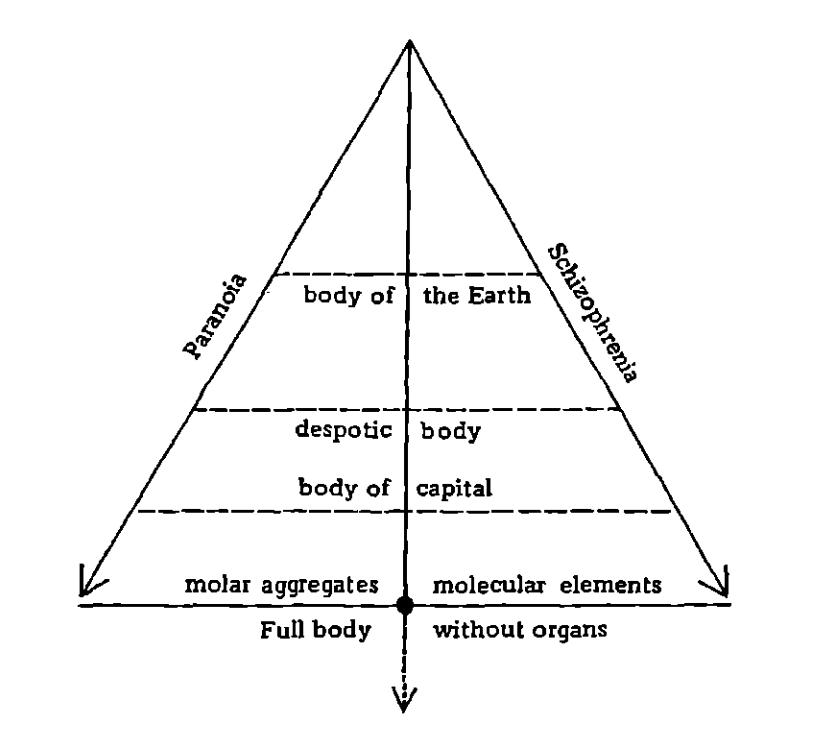
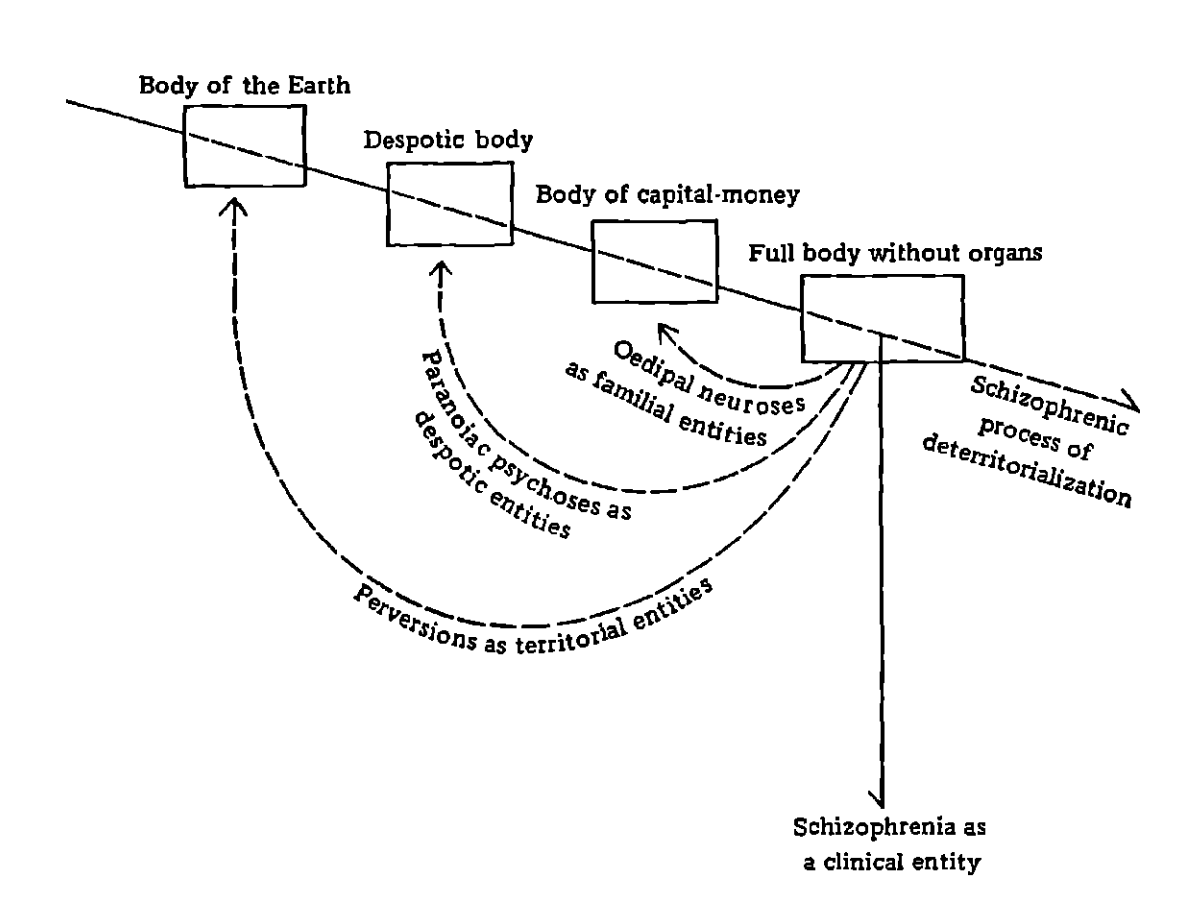
each of these planes there is a paranoiac dimension, another that is perverse, a kind of familial position, and a dotted line of escape or schizoid breakthrough. The major line ends at the body without organs, and there it either passes through the wall, opening onto the molecular elements where it becomes in actual fact what it was from the start: the schizophrenic process, the pure schizophrenic process of deterritorialization. Or it strikes the wall, rebounds off it, and falls back into the most miserably arranged territorialities of the modern world as simulacra of the preceding planes, getting caught up in the asylum aggregate of paranoia and schizophrenia as clinical entities, in the artificial aggregates or societies established by perversion, in the familial aggregate of Oedipal neuroses. Page 309
- [N] Universal clinical theory can view paranoia/schizophrenia as oscillations around the socius/body without organs (pivot between molar/molecular).
- [N] Alternatively, view as a single line arranging socius forms/aggregates.
- [N] On each plane of the line: paranoiac dimension, perverse dimension, familial position, schizoid dotted line of escape.
- [N] The major line ends at the body without organs.
- [N] At the body without organs, the line either passes through the wall (schizophrenic process of deterritorialization).
- [N] Or it strikes the wall, rebounds, falls back into miserable territorialities.
- [N] Rebounding leads to clinical entities (paranoia/schizophrenia), artificial aggregates (perversion), or familial aggregates (Oedipal neuroses).
Social and psychological phenomena can be understood through two models: either as oscillations of paranoia and schizophrenia around the body without organs (the pivot between molar and molecular), or as positions along a single line representing different forms of the socius. This line culminates at the body without organs, where one can either achieve the schizophrenic breakthrough of deterritorialization or rebound back into restricted territorialities and clinical/familial aggregates.
#on/socius #on/body-without-organs #on/schizoanalysis
2 I The Molecular Unconscious
The Unconscious as Physics and Machines
in reality the unconscious belongs to the realm of physics; the body without organs and its intensities are not metaphors, but matter itself. Page 309
In the unconscious there are only populations, groups, and machines. When we posit in one case an involuntariness (un involontaire) of the social and technical machines, in the other case an unconscious of the desiring-machines, it is a question of a necessary relationship between inextricably linked forces. Some of these are elementary forces by means of which the unconscious is produced; the others, resultants reacting on the first, statistical aggregates through which the unconscious is represented and already suffers psychic and social repression of its elementary productive forces. Page 309
- [N] The unconscious is material, belonging to physics, not metaphorical.
- [N] The unconscious is composed of populations, groups, and machines (desiring-machines).
- [N] A necessary relationship exists between elementary forces producing the unconscious and resultant statistical aggregates that represent and repress it.
This section posits the unconscious as a material reality, a realm of physics populated by machines and groups, emphasizing a necessary relationship between the elementary forces of its production and the resulting statistical aggregates that represent and repress it.
Mechanical and Biological Reproduction: Butler's Insights
"does anyone say that the red clover has no reproductive system because the bumble bee (and the bumble bee only) must aid and abet it before it can reproduce? No one. The bumble bee is a part of the reproductive system of the clover. Each one of ourselves has sprung from minute animalcules whose entity was entirely distinct from our own These creatures are part of our reproductive system; then why not we part of that of the machines? ... We are misled by considering any complicated machine as a single thing; in truth it is a city or a society, each member of which was bred truly after its kind. We see a machine as a whole, we call it by a name and individualize it; we look at our own limbs, and know that the combina-tion forms an individual which springs from a single centre of reproduc-tive action; we therefore assume that there can be no reproductive action which does not arise from a single center; but this assumption is unscientific, and the bare fact that no vapour-engine was ever made entirely by another, or two others, of its own kind, is not sufficient to warrant us in saying that vapour-engines have no reproductive system. The truth is that each part of every vapour-engine is bred by its own special breeders, whose function is to breed that part, and that only, while the combination of the parts into a whole forms another depart-ment of the mechanical reproductive system." Page 311
- [N] Samuel Butler in The Book of the Machines
In passing, Butler encounters the phenomenon of surplus value of code, when a part of a machine captures within its own code a code fragment of another machine, and thus owes its reproduction to a part of another machine: the red clover and the bumble bee; or the orchid and the male wasp that it attracts and intercepts by carrying on its flower the image and the odor of the female wasp. Page 311
- [N] Samuel Butler argues that mechanical reproduction, like biological reproduction involving multiple distinct entities (clover and bumblebee, human origins from animalcules), should not be viewed as arising from a single center but as a system where parts are bred by specialized breeders and then combined.
- [N] Butler identifies a "surplus value of code" where one machine's part reproduces based on code from another machine, illustrating interconnected reproductive systems across biological and mechanical realms.
Drawing on Samuel Butler, this section challenges the idea that reproduction requires a single center, arguing that both biological and mechanical systems involve interconnected parts bred by distinct entities. It highlights how code fragments can be captured and reproduced across different machines, leading to a "surplus value of code."
Beyond Structural Unity: Desire as Molecular Machine
What is essential is not in the passage to infinity itself-the infinity composed of machine parts or the temporal infinity of the animalcules-but rather in what this passage blossoms into. Once the structural unity of the machine has been undone, once the personal and specific unity of the living has been laid to rest, a direct Ii nk is percei ved between the machine and desire, the machine passes to the heart of desire, the machine is desiring and desire, machined. Desire is not in the subject, but the machine in desire-with the residual subject off to the side, alongside the machine, around the entire periphery, a parasite of machines, an accessory of vertebro-machinate desire. Page 311
In a word, the real difference is not between the living and the machine, vitalism and Page 311
mechanism, but between two states of the machine that are two states of the living as well. The machine taken in its structural unity, the living taken in its specific and even personal unity, are mass phenomena or molar aggregates; for this reason each points to the extrinsic existence of the other. And even if they are differentiated and mutually opposed, it is merely as two paths in the same statistical direction. But in the other more profound or intrinsic direction of multiplicities there is interpene-tration, direct communication between the molecular phenomena and the singularities of the living, that is to say, between the small machines scattered in every machine, and the small formations dispersed in every organism: a domain of nondifference between the microphysical and the biological, there being as many living beings in the machine as there are machines in the living. Page 312
The real difference is therefore between on the one hand the molar machines-whether social, technical, or organic-and on the other the desiring-machines, which are of a molecular order. Page 312
- [N] The focus shifts from infinite parts to the emergence of something new when structural/personal unity is undone.
- [N] A direct link is established between machine and desire; the machine is desiring, desire is machined.
- [N] Desire resides in the machine, with the subject positioned peripherally.
- [N] The true distinction is not between living and machine but between two states of the machine/living: molar (structural, unified, statistical) and molecular (multiplicities, desiring-machines).
- [N] At the molecular level, there is direct communication and interpene-tration between microphysical and biological phenomena, a domain of nondifference.
This section argues that the significant distinction is not between the living and the machine, but between the molar (unified, structural, statistical) and molecular (desiring-machines, multiplicities, singularities) states inherent to both. Desire is seen as residing within the molecular machine itself, not in a subject, highlighting a domain of nondifference between the microphysical and biological at this level.
#on/desire #on/molar-molecular
Characteristics of Desiring-Machines
Desiring-machines are the following: formative machines, whose very misfirings are functional, and whose functioning is indiscernible from theirformation; chronogeneous machines engaged in their own assembly (montage). operating by nonlocalizable intercommunications and dispersed locali-zations, bringing into play processes of temporalization, fragmented Page 312
formations, and detached parts, with a surplus value of code, and where the whole is itself produced alongside the parts, as a part apart or, as Butler would say, "in another department" that fits the whole over the other parts; machines in the strict sense, because they proceed by breaks and flows, associated waves and particles, associative flows and partial objects, inducing-always at a distance-transverse connections, inclusive disjunctions, and polyvocal conjunctions, thereby producing selections, detachments, and remainders, with a transference of individuality, in a generalized schizogenesis whose elements are the schizzes-flows, Page 313
- [N] Desiring-machines are formative; their misfirings and functioning are part of their formation.
- [N] They are chronogeneous, assembling themselves through nonlocalizable intercommunications.
- [N] They involve temporalization, fragmented formations, detached parts, and a surplus value of code.
- [N] The whole is produced alongside the parts, as a distinct part.
- [N] They operate through breaks and flows, associative waves/particles, flows/partial objects.
- [N] They create transverse connections, inclusive disjunctions, and polyvocal conjunctions.
- [N] Processes include selections, detachments, remainders, transference of individuality, and generalized schizogenesis.
This section describes the characteristics of desiring-machines: they are formative, self-assembling (chronogeneous), operate via decentralized intercommunications, process fragmented parts, utilize surplus value of code, produce wholes alongside parts, function through breaks/flows, and generate complex connections and disjunctions leading to a generalized schizogenesis.
#on/desiring-machines #on/machinic
Molar vs. Molecular: Statistical Manifestations of Desire
Subsequently-rather, we should say on the other hand-when the machines become unified at the structural level of techniques and institutions that give them an existence as visible as a plate of steel; when the living, too, become structured by the statistical unities of their persons and their species, varieties, and locales; when a machine appears as a single object, and a living organism appears as a single subject; when the connections become global and specific, the disjunctions exclusive, and the conjunctions biunivocal; then desire does not need to project itself into these forms that have become opaque. These forms are immediately molar manifestations, statistical determinations of desire and of its own machines. They are the same machines (there is no difference in nature): here, as organic, technical, or social machines apprehended in their mass phenomenon, to which they become subordinated; there, as desiring-machines apprehended in their submicroscopic singularities that subordinate the mass phenomena. That is why from the start we have rejected the idea that desiring-machines belong to the domain of dreams or the Imaginary, and that they stand in for the other machines. There is only desire and environments, fields, forms of herd instinct. Page 313
- [N] Molar forms (unified machines, living organisms as single objects/subjects) are statistical manifestations of desire's molecular machines.
- [N] Molar and molecular machines are the same in nature but differ in how they are apprehended and their relationship to mass phenomena vs. singularities.
- [N] Desiring-machines are not part of dreams or the Imaginary, nor do they stand in for other machines; they are the underlying reality.
- [N] The fundamental reality is desire interacting with environments, fields, and forms of organization.
This section contrasts the molecular operation of desiring-machines with their molar manifestations. It argues that unified, structural machines and organisms are statistical outcomes of the underlying molecular desiring-machines, emphasizing that these are the same machines operating differently rather than distinct entities or symbolic representations.
#on/molar-molecular #on/desire
Same Machines, Different Regimes: Molar and Molecular States
Stated differently, the molecular desiring-machines are in themselves the investment of the large molar machines or of the configurations that the desiring-machines form according to the laws of large numbers, * in either or both senses of subordination, in one sen~e and the other of subordination. Desiring-machines in one sense, but organic, technical, or social machines in the other: these are the same machines under determinate conditions. Page 313
These are therefore the same machines, but not at all the same regime, the same relationships of magnitude, or the same uses of syntheses. Page 314
- [N] Molecular desiring-machines constitute the investment of large molar machines or the configurations they form.
- [N] Organic, technical, and social machines are the same machines as desiring-machines, but under different conditions.
- [N] The difference lies in the regime of operation, relationships of magnitude, and uses of syntheses, not in the nature of the machines themselves.
This section clarifies that molar machines (organic, technical, social) and molecular desiring-machines are fundamentally the same, but they operate under different regimes, relationships of magnitude, and uses of syntheses. The molecular machines are the underlying basis for the molar configurations.
#on/molar-molecular #on/regimes
Functionalism at the Molecular Level
It is only at the sUbmicroscopic level of desiring-machines that there exists a functionalism-machinic arrangements, an engineering of desire; for it is only there that functioning and formation, use and assembly, product and production merge. All molar functionalism is false, since the organic or social machines are not formed in the same way they function, and the technical machines are not assembled in the same way they are used, but imply precisely the specific conditions that separate their own production from their distinct product. Page 314
- [N] True functionalism, where functioning/formation and use/assembly merge, only occurs at the submicroscopic level of desiring-machines.
- [N] Molar functionalism is false because formation/functioning and assembly/use are separated for organic, social, and technical machines.
- [N] The molecular level allows for an "engineering of desire" where production and product are inseparable.
This section argues that functionalism is only genuinely applicable at the molecular level of desiring-machines, where production and functioning, use and assembly are merged. Molar functionalism is deemed false because molar machines have a separation between their production/assembly and their functioning/use.
#on/functionalism #on/desiring-machines
Desiring-Machines: Beyond Representation and Meaning
Only what is not produced in the same way it functions has a meaning, and also a purpose, an intention. The desiring-machines on the contrary represent nothing, signify noth-ing, mean nothing, and are exactly what one makes of them, what is made with them, what they make in themselves. Page 314
- [N] Meaning, purpose, and intention are associated with things not produced in the same way they function (molar machines).
- [N] Desiring-machines do not represent, signify, or mean anything in themselves.
- [N] Desiring-machines are purely defined by what is made of, with, and in them; they are their own production.
This section contrasts molar machines, which have meaning/purpose due to the separation of production and function, with desiring-machines, which are purely productive and do not represent or signify anything; they are defined solely by their activity and what they make.
#on/meaning #on/representation
Regimes of Syntheses in Desiring-Machines
Desiring-machines work according to regimes of syntheses that have no equivalent in the large aggregates. Page 314
- [N] Desiring-machines operate via unique regimes of syntheses.
- [N] These syntheses are distinct from those found in large molar aggregates.
This brief section highlights that desiring-machines function through specific regimes of syntheses that are not present or equivalent in molar aggregates, further emphasizing the distinct nature of their operation.
#on/syntheses #on/desiring-machines
Molecular Evolution and Cybernetic Interconnections
the very gratuitousness of these systems, giving molecular evolution a practically limitless field for exploration Page 314
and experiment, enabled it to elaborate the huge network of cybernetic inter-connections. Page 315
-
[N] "Jacques Monod. Chance and Neeessil)' (see reference note 27), pp. 77-78. And pp. 90-98: "With the globular prorein we already have. at the molecular level. 8 veritable machine-a machine in its functional properties, but not. we DOW see, in its fundamental structure, where nothing but (he play of blind combinations can be discerned. Randomness caught On the wing, preserved. reproduced by the machinery of invariance and thus converted iOla order. rule, necessity:
-
[N] The "gratuitousness" or inherent potential of molecular systems allows for a vast field of exploration for molecular evolution.
-
[N] This exploration enabled the development of extensive cybernetic interconnections.
-
[N] Jacques Monod notes how randomness at the molecular level is preserved and reproduced by invariance machinery, converting chance into order and necessity, exemplified by proteins acting as molecular machines.
This section, referencing Jacques Monod, suggests that the inherent potential of molecular systems grants molecular evolution a limitless field for exploration, leading to the development of complex cybernetic interconnections. It highlights how biological machines operate based on randomness converted into necessity through reproductive invariance.
Common Participation: Biology, Schizophrenia, and Desiring-Machines
It is not a matter of biologizing human history, nor of anthropologizing natural history. It is a matter of showing the common participation of the social machines and the organic machines in the desiring-machines. At man's most basic stratum, the Id: the sChizophrenic cell, the schizo molecules, their chains and their jargons. There is a whole biology of schizophrenia; molecular biology is itself schizophrenic-as is microphysics. But inversely schizophrenia-the theory of schizophrenia-is biological, biocultural, inasmuch as it examines the machinic connections of a molecular order, their distribution into maps of intensity on the giant molecule of the body without organs, and the statistical accumulations that form and select the large aggregates. Page 315
- [N] The goal is to show the shared involvement of social and organic machines in desiring-machines, not to biologize history or anthropologize nature.
- [N] The deepest stratum of the Id is linked to schizophrenic cells, schizo molecules, and their processes.
- [N] Schizophrenia has a biology; molecular biology and microphysics are described as schizophrenic.
- [N] Schizophrenia theory is biological/biocultural as it studies molecular machinic connections, their intensity distribution on the body without organs, and how they form molar aggregates.
This section argues for a common participation of social and organic machines in desiring-machines, locating this at the molecular level of the Id. It suggests a 'biology of schizophrenia' where molecular processes are seen as 'schizophrenic', and inversely, that schizophrenia theory is biological/biocultural in its examination of molecular machinic connections that underlie both the body without organs and molar aggregates.
#on/schizophrenia #on/bioculture
Genes, Drives, and the Molecular Unconscious
The hereditary genes of drives therefore play the role of simple stimuli that enter into variable combinations following vectors that survey an entire social historical field-an analysis of destiny. Page 316
the truly molecular unconscious cannot confine itself to genes as its units of reproduction; these units are still expres-sive, and lead to molar formations. Page 316
- [N] Hereditary genes of drives act as simple stimuli that combine variably across the social-historical field.
- [N] The molecular unconscious is not limited to genes as reproductive units.
- [N] Genes are expressive units that lead to molar formations, unlike the molecular unconscious which operates at a different level.
This section discusses the role of genes in relation to the molecular unconscious, suggesting that genes act as stimuli within a wider social-historical field. It emphasizes that the molecular unconscious operates beyond genes, which are seen as expressive units leading to molar formations.
#on/genes #on/molecular-unconscious
Reich's Orgonomy: Libido's Double Pole and Expansive Sexuality
Reich concluded in favor of an intra-atomic cosmic energy-the orgone-generative of an electrical flux and carrying submicroscopic particles, the bions. This energy produced differences in potential or intensities distributed on the body considered from a molecular viewpoint, and was associated with a mechanics of fluids in this same body considered from a molar viewpoint. What defined the libido as sexuality was therefore the association of the two modes of operation, mechanical and electrical, in a sequence with two poles, molar and molecular (mechanical tension, electrical charge, electrical discharge, mechanical relaxation). Reich thought he had. thus overcome the alternative between mechanism and vitalism, since these functions, mechanical and electrical, existed in matter in general, but were combined in a particular sequence within the living. And above all he upheld the basic psychoanalytic truth, the supreme disavowal of which he was able to denounce in Freud: the independence of sexuality with regard to reproduction, the subordination of progressive or regressive reproduction to sexuality as a cycle. Page 317
any comparison of sexuality with cosmic phenomena such as "electrical storms," "the blue color of the sky and the blue-gray of atmospheric haze," the blue of the orgone, "St. Elmo's fire, and the bluish formations [of] sunspot activity," fluids and flows, matter and particles, in the end appear to us more adequate than the reduction of sexuality to the pitiful little familialist secret. We think that Lawrence and Miller have a more accurate evaluation of sexuality than Freud, even from the viewpoint of the famous scientificity. It is not the neurotic stretched out on the couch who speaks to us of love, of its force and its despair, but the mute stroll of the schizo, Lenz's outing in the mountains and under the stars, the immobile voyage in intensities on the body without organs, As to the whole of Reichian theory, it possesses the incomparable advantage of showing the double pole of the libido, as a molecular formation on the submicroscopic scale, and as an investment of the molar formations on the scale of social and organic aggregates. Page 318
- [N] Reich proposed 'orgone' as cosmic energy with molecular (intensities, electrical) and molar (fluids, mechanical) aspects in the body.
- [N] Reich saw libido defined by the molar-molecular sequence (tension, charge, discharge, relaxation), overcoming mechanism/vitalism.
- [N] Reich emphasized sexuality's independence from reproduction, subordinating reproduction to sexuality.
- [N] Comparing sexuality to cosmic phenomena (electrical storms, flows, particles) is more adequate than reducing it to familial secrets.
- [N] Lawrence and Miller's view of sexuality is favored over Freud's psychoanalytic model.
- [N] The experience of sexuality is better captured by the schizo's intense voyage on the body without organs than the neurotic's discourse.
- [N] Reichian theory highlights the libido's double pole: molecular formation and investment of molar aggregates.
This section explores Wilhelm Reich's concept of orgone energy as a manifestation of libido with both molecular (electrical charge/intensities) and molar (mechanical tension/fluids) poles. It highlights Reich's view of sexuality's independence from reproduction and argues that expansive, cosmic comparisons of sexuality are more accurate than reductionist familial views, preferring the schizo's experience of intense flows over the neurotic's discourse. Reich is praised for showing libido's operation at both molecular and molar scales.
Nomadic Desire and the Direct Investment of Worlds and Masses
desire does not take as its object persons or things, but the entire surroundings that it traverses, the vibrations and flows of every sort to which it is joined, introducing therein breaks and captures-an always nomadic and migrant desire, characterized first of all by its "gigantism" Page 318
In a word, the social as well as biological surroundings are the object of unconscious investments that are necessarily desiring or libidinal, in contrast with the preconscious investments of need or of interest. The libido as sexual energy is the direct investment of masses, of large Page 318
aggregates, and of social and organic fields. Page 319
The truth is that sexuality is everywhere: the way a bureaucrat fondles his records, a judge administers justice, a businessman causes money to circulate; the way the bourgeoisie fucks the proletariat; and so on. And there is no need to resort to metaphors, any more than for the libido to go by way of metamorphoses. Hitler got the fascists sexually aroused. Flags, nations, armies, banks get a lot of people aroused. A revolutionary machine is nothing if it does not acquire at least as much force as these coercive machines have for producing breaks and mobilizing flows. It is not through a desexualizing extension that the libido invests the large aggregates. On the contrary, it is through a restriction, a blockage, and a reduction that the libido is made to repress its flow.s in order to contain them in the narrow cells of the type "couple," "family," "person," "objects." And doubtless such a blockage is necessarily justified: the libido does not corne to consciousness except in relation to a given body, a given person that it takes as object. But our "object choice" itself refers to a conjunction of flows of life and of society that this body and this person intercept, receive, and transmit, always within a biological, social, and historical field where we are equally immersed or with which we communicate. The persons to whom our loves are dedicated, including the parental persons, intervene only as points of connection, of disjunction, of conjunction of flows whose libidinal tenor of a properly unconscious investment they translate. Thus no matter how well grounded the love blockage is, it curiously changes its function, depending on whether it engages desire in the Oedipal impasses of the couple and the family in the service of the repressive machines, or whether on the contrary it condenses a free energy capable of fueling a revolutionary machine. Page 319
But we always make love with worlds. And our love addresses itself to this libidinal property of our lover, to either close himself off or open up to more spacious worlds, to masses and large aggregates. There is always something statistical in our loves, and something belonging to the laws of large numbers. Page 320
- [N] Desire's object is not persons or things, but the entire traversed surroundings, vibrations, and flows; it is nomadic, migrant, and possesses "gigantism."
- [N] Social and biological surroundings are the objects of unconscious desiring investments (libido), contrasting with preconscious needs/interests.
- [N] Libido directly invests masses, large aggregates, and social/organic fields.
- [N] Sexuality is pervasive in social functions (bureaucracy, justice, finance) and broader forces (fascism, nations, banks).
- [N] Libido's investment of large aggregates is direct, not a desexualizing extension or metaphor.
- [N] Confinement of libido to "couple," "family," "person," "objects" results from restriction and blockage, repressing flows.
- [N] Object choice refers to persons as points intercepting/transmitting flows within a larger field.
- [N] The function of love blockage differs whether it serves repressive, Oedipal machines or fuels a revolutionary machine.
- [N] Love involves engaging with "worlds," masses, and large aggregates, having a statistical and large-numbers aspect.
This section argues against a person/object-oriented view of desire and sexuality, asserting that desire is nomadic, expansive ("gigantism"), and directly invests the entire social and biological surroundings, masses, and fields. It contends that sexuality is everywhere in social life and that its confinement to limited forms like the family is a result of restriction, contrasting this with the potential for libido to fuel revolutionary machines or engage with "worlds" and masses in love.
Sexuality and Desiring-Machines Are One
Sexuality and the desiring-machines are one and the same inasmuch as these machines are present and operating in the social machines, in their field, their formation, their functioning. Desiring-machines are the nonhuman sex, the molecular machinic elements, their arrangements and their syntheses, without which there would be neither a human sex specificaIJy determined in the large aggregates, nor a human sexuality capable of investing these aggregates. Page 320
- [N] Sexuality and desiring-machines are identical because desiring-machines operate within social machines.
- [N] Desiring-machines constitute the "nonhuman sex," the molecular machinic basis.
- [N] The existence of human sex and sexuality capable of investing molar aggregates depends entirely on these molecular desiring-machines.
This section asserts the fundamental identity between sexuality and desiring-machines, positioning the latter as the "nonhuman sex" – the molecular machinic foundation required for the existence of human sex and its ability to invest molar aggregates.
#on/sexuality #on/desiring-machines
Castration: The Anthropomorphic Illusion and Ideology of Lack
one does not by any means escape castra-tion. It is simply that castration, instead of being the principle of sex conceived as the masculine sex (the great castrated soaring Phallus), becomes the result of sex conceived as the feminine sex (the little hidden absorbed penis). We maintain therefore that castration is the basis for the anthropomorphic and molar representation of sexuality. Page 321
Castration is the universal belief that brings together and disperses both men and women under the yoke of one and the same illusion of consciousness, and makes them adore this yoke. Every attempt to determine the nonhuman nature of sex-for example, "the Great Other" in Lacan-while conserving myth and castration, is defeated from the start. Page 321
Anthropomorphic molar representation culmi-nates in the very thing that founds it, the ideology of lack. Page 321
- [N] Castration is the basis for the anthropomorphic and molar representation of sexuality, regardless of how sex is conceived (masculine Phallus or feminine absorbed penis).
- [N] Castration is presented as a universal belief and illusion of consciousness that subjects individuals to a symbolic yoke.
- [N] Attempts to understand the nonhuman nature of sex fail if they retain the myth of castration.
- [N] The anthropomorphic molar representation of sexuality ultimately rests upon the ideology of lack.
This section critiques the concept of castration, viewing it as the foundation for an anthropomorphic, molar, and ultimately flawed representation of sexuality rooted in the ideology of lack. It argues that castration is a universal illusion that prevents understanding the nonhuman, machinic nature of sex.
#on/castration #on/representation
The Molecular Unconscious: Beyond Castration, Towards Microscopic Transsexuality
The molecular unconscious, on the contrary, knows nothing of castration, because partial objects lack nothing and form free mUltiplicities as such; because the multiple breaks never cease producing flows, instead of repressing them, cutting them at a single stroke-the only break capable of exhausting them; because the syntheses constitute local and nonspecific connections, inclusive disjunctions, nomadic conjunctions: everywhere a microscopic transsexuality, resulting in the woman containing as many Page 321
men as the man, and the man as many women, all capable of entering-men with women, women with men-into relations of production of desire that overturn the statistical order of the sexes. Page 322
- [N] The molecular unconscious operates free from castration.
- [N] Partial objects within the molecular unconscious are complete in themselves and form free multiplicities.
- [N] Multiple breaks in the molecular unconscious produce flows rather than repressing them like a single, exhaustive cut (castration).
- [N] Molecular syntheses create local, nonspecific, inclusive, and nomadic connections.
- [N] This molecular level involves a "microscopic transsexuality" where individuals contain multiple sexes.
- [N] Molecular relations of desire production overturn the conventional statistical order of two sexes.
In contrast to the castration-bound molar view, this section describes the molecular unconscious as free from lack and castration. It is characterized by complete partial objects, flows produced by multiple breaks, and unique local syntheses. This leads to a "microscopic transsexuality" and relations of desire production that move beyond the binary statistical order of sexes.
#on/molecular-unconscious #on/transsexuality
n Sexes and Schizoanalytic Revolution
Making love is not just becoming as one, or even two, but becoming as a hundred thousand. Desiring-machines or the nonhuman sex: not one or even two sexes, but n sexes. Schizoanalysis is the variable analysis of the n sexes in a subject, beyond the anthropomorphic representation that society impos-es on this subject, and with which it represents its own sexuality. The schizoanalytic slogan of the desiring-revolution will be first of all: to each its own sexes. Page 322
- [N] Making love is seen as a process of becoming multiplicity, not unity or duality.
- [N] Desiring-machines represent the "nonhuman sex" which consists of 'n' sexes, not just one or two.
- [N] Schizoanalysis aims to analyze the variable multiplicity of sexes within a subject, moving beyond societal anthropomorphic representations.
- [N] A key slogan for the desiring-revolution is "to each its own sexes," advocating for the liberation of these multiple molecular sexes.
Concluding the discussion on molecular sexuality, this section proposes that desiring-machines embody an 'n' number of sexes (the nonhuman sex), contrasting with binary or unified views. Schizoanalysis is presented as the method to explore this multiplicity within the subject, with the revolutionary aim of affirming each individual's unique configuration of sexes.
#on/n-sexes #on/schizoanalysis
Psychoanalysis and Capitalism
3 I Psychoanalysis and Capitalism Page 322
Desire as Machinic Production vs. Psychoanalytic Representation
The schizoanalytic argument is simple: desire is a ma-chine, a synthesis of machines, a machinic arrangement-des iring-machines. The order of desire is the order of production; all production is at once desiring-production and social production. We therefore reproach psychoanalysis for having stifled this order of production, for having shunted it into representation. Far from showing the boldness of psychoanalysis, this idea of unconscious representation marks from the outset its bankruptcy or its abnegation: an unconscious that no longer produces, but is content to believe. The unconscious believes in Oedipus, it believes in castration, in the law. Page 322
Production can be that of labor or that of desire, it can be social or desiring, it calls forth forces that no longer permit themselves to be contained in representation, and it calls forth Hows and breaks that break through representation, traversing it through and through: "an immense expanse of shade" extended beneath the level of representation.1 Page 325
- [N] Schizoanalysis views desire as productive and machinic.
- [N] Psychoanalysis is criticized for reducing desire to representation rather than production.
- [N] Desire is linked to both social and desiring production, breaking through representation.
This section introduces the core schizoanalytic critique of psychoanalysis, arguing that desire is fundamentally productive and machinic, not merely representative. Psychoanalysis is seen as failing by limiting desire to representation (Oedipus, castration), thus stifling its true productive nature.
Critique of Psychoanalysis's Mythic and Representational Approach
The psychoanalyst parks his circus in the dumbfounded unconscious, a real P. T. Barnum in the fields and in the factory. That is what Miller, and already Lawrence, have to say against psychoanalysis (the living are not believers, the seers do not believe in myth and tragedy): "By retracing the paths to the earlier heroic life ... you defeat the very element and quality of the heroic. for the hero never looks backward, nor does he ever doubt his powers. Hamlet was undoubtedly a hero to himself, and for every Hamlet born the only true course to pursue is the very course which Shakespeare describes. But the question, it seems to me, is this: are we born Hamlets? Were you born Hamlet? Or did you not rather create the type in yourself? Whether this be so or not, what seems infinitely more important is-why revert to myth? ... This ideational rubbish out of which our world has erected its cultural edifice is now, by a critical irony, being given its poetic immolation, its mythos, through a kind of writing which, because it is of the disease and therefore beyoiJd, clears the ground for fresh superstructures. (In my own mind the thought of 'fresh superstructures' is abhorrent, but this is merely the awareness of a process and not the process itself.) Actually, in process, I believe with each line I write that I am scouring the womb, giving it the curette, as it were. Behind this process lies the idea not of 'edifice' and 'superstructure,' which is culture and hence false, but of continuous birth, renewal, life, life In the myth there is no life for us. Only the myth lives in the myth .... This ability to produce the myth is born out of awareness, out of ever-increasing consciousness. That is why, speaking of the schizophrenic nature of our age, I said-'until the process is completed the belly of the world shall be the Third Eye.' Now, Brother Ambrose, just what did I mean by that? What could I mean except that from this intellectual world in which we are swimming there must body Page 324
forth a new world; but this new world can only be bodied forth in so far as it is conceived. And to conceive there must first be desire, ... Desire is instinctual and holy: it is only through desire that we bring about the immaculate conception. " Page 325
- [N] Henry Miller from Hamlet
- [N] Psychoanalysis is criticized for relying on myth and tragedy instead of focusing on the production of life and desire.
- [N] The quote from Miller/Lawrence emphasizes creating new realities through desire, contrasting with psychoanalysis's focus on reinterpreting existing myths.
This section elaborates on the critique of psychoanalysis's reliance on myth and tragedy (like Oedipus and Hamlet) as interpretative frameworks. It argues that this approach hinders the creation of new realities and the understanding of desire as a productive, life-affirming force, as exemplified by the Henry Miller quote.
The Analytic Field: Desiring-Production and Social Formations
Desiring-production and machines, psychic apparatuses and machines of desire, desiring-machines and the assembling of an analytic machine suited to decode them: the domain of free syntheses where everything is possible; partial connections, included disjunctions, nomadic conjunctions, polyvocal flows and chains, transductive* breaks; the relation of desiring-machines as formations of the unconscious with the molar formations that they constitute statistically in organized crowds; and the apparatus of social and psychic repression resulting from these formations-such is the composition of the analytic field. Page 326
- [N] The analytic field is defined by desiring-machines and their relation to both molecular (free syntheses) and molar (social formations) levels.
- [N] The field includes the study of how social and psychic repression emerges from these formations.
This passage defines the analytic field according to schizoanalysis, emphasizing the interplay between desiring-machines (molecular) and social/molar formations, along with the mechanisms of repression that arise. It highlights the potential for free, non-standard syntheses within this field.
#on/analytic-field #on/machinic-synthesis
Psychoanalysis Decodes Flows by Referring to Subjective Libido
The psychoanalytic method is quite different: rather than referring symbolic representation to determinate objectities and to objective social conditions, psychoanalysis refers them to the SUbjective and universal essence of desire as libido. Thus the operation of decoding in psychoanalysis can no longer signify what it signifies in the sciences of man; the discovery of the secret of such and such a code. Psychoanalysis must undo the codes so as to attain the quantitative and qualitative flows of libido that traverse dreams, fanta-sies, and pathological formations as well as myth, tragedy, and the social formations. Page 327
- [N] Psychoanalysis decodes symbolic representations by linking them to subjective, universal desire (libido).
- [N] Its aim is to uncover the flows of libido traversing various formations (dreams, myths, social forms).
This section explains the psychoanalytic method of decoding, which differs from other sciences by referring representations back to a subjective, universal libido. The goal is to reach the flows of desire underlying various human and social expressions.
Psychoanalysis and Capitalism: Decoding and Deterritorialization
the link between psychoanalysis and capitalism is no less profound than that between political economy and capitalism. This discovery of the decoded and de territorialized flows is the same as that which takes place for political economy and in social production, in the form of subjective abstract labor, and for psychoanalysis and in desiring-production, in the form of subjective abstract libido. As Marx says, in capitalism the essence becomes sUbjective-the activity of production in general-and abstract labor becomes something real from which all the preceding social formations can be reinterpreted from the point of view of a generalized decoding or a generalized process of deterritorialization: "The simplest abstraction, then, which modern economics places at the head of its discussions, and which expresses an immeasurably ancient relation valid in all forms of society, nevertheless achieves practical truth as an abstraction only as a category of the most modern society." This is also the case for desire as abstract libido and as subjective essence. Not that a simple parallelism should be drawn between capitalist social production and desiring-production, or between the flows of money-capital and the shit-flows of desire. The relationship is much closer: desiring-machines are in social machines and nowhere else, so that the conjunction of the decoded flows in the capitalist machine tends to liberate the free figures of a universal subjective libido. In short, the discovery of an activity of production ill general and without distinction, as it appears in capitalism, is the identical discovery of both political economy and psychoanalysis, beyond the determinate systems of representation. Page 328
Thus subjective Page 329
abstract Labor as represented in private property has, as its correlate, subjective abstract Desire as represented in the privatized family. Psychoanalysis undertakes the analysis of this second term, as political economy analyzes the first. Psychoanalysis is the technique of application, for which political economy is the axiomatic. Page 330
- [N] Psychoanalysis and political economy share a connection to capitalism through the discovery of decoded, deterritorialized flows (abstract libido and abstract labor).
- [N] Capitalism reveals production in general as a subjective essence, which psychoanalysis analyzes in the form of abstract libido in the private family.
- [N] Psychoanalysis functions as a technique applying the axiomatic found in political economy under capitalism.
This section draws a significant parallel between psychoanalysis and political economy, both tied to capitalism through the discovery of abstract, deterritorialized flows (libido and labor). It argues that capitalism's move towards a subjective essence of production is analyzed by political economy in labor/private property and by psychoanalysis in desire/private family, positioning psychoanalysis as an application of capitalism's axiomatic.
#on/capitalism #on/psychoanalysis
Capitalism's Limits and Reterritorializations
capitalism indeed has as its limit the decoded flows of desiringproduction, but it never stops repelling them by binding them in an axiomatic that takes the place of the codes. Capitalism is inseparable from the movement of deterritorialization, but this movement is exorcised through factitious and artificial reterritorializations. Capitalism is constructed on the ruins of the territorial and the despotic, the mythic and the tragic representations, but it re-establishes them in its own service and in another form, as images of capital. Page 329
Marx summarizes the entire matter by saying that the subjective abstract essence is discovered by capitalism only to be put in chains all over again, to be subjugated and alienated-no longer, it is true, in an exterior and independent element as objectity, but in the element, itself subjective, of private property: "What was previously being external to oneself-man's externalization in the thing-has merely become the act of externalizing-the process of alienating." Page 329
It is, in fact, the form of private property that conditions the conjunction of the decoded flows, which is to say their axiomatization in a system where the flows of the means of production, as the property of the capitalists, is directly related to the flow of so-called free labor, as the "property" of the workers (so that the State restrictions on the substance or the content of private property do not at all affect this form). It is also the form of private property that constitutes thOe center of the factitious reterritorializations of capitalism. And tinally, it is this form that produces the images tilling the capitalist tield of immanence, "the" capitalist, "the" worker, etc. In other terms, capitalism indeed implies the collapse of the great objective determinate representations, for the benefit of production as the universal interior essence, but it does not thereby escape the world of representation. It merely performs a vast conversion of this world, by attributing to it the new form of an infinite subjective representation. Page 329
- [N] Capitalism is limited by decoded flows but contains them through axiomatization and artificial reterritorializations.
- [N] While destroying older representations, capitalism creates new ones based on subjective representation and private property.
- [N] Private property acts as the form that binds flows and creates artificial reterritorializations in capitalism.
Capitalism unleashes decoded flows but immediately contains them within an axiomatic based on private property. While dissolving older objective representations, it re-establishes representation in a new form of infinite subjective representation, essentially re-chaining the abstract essence it discovered.
#on/capitalism #on/reterritorialization
Psychoanalysis, the Family, and Subjective Representation
psycho-analysis disengages the second pole in the very movement of capitalism, which substitutes the infinite subjective representation for the large determinate objective representations. It is in fact essential that the limit of the decoded flows of desiring-production be doubly exorcised, doubly displaced, once by the position of immanent limits that capitalism does not cease to reproduce on an ever expanding scale, and again by the marking out of an interior limit that reduces this social reproduction to restricted familial reproduction. Page 330
Psychoanalysis does treat myth and tragedy, but it treats them as the dreams and the fantasies of private man, Homo familia-and in fact dream and fantasy are to myth and tragedy as private property is to public property. What acts in myth and tragedy at the level of objective elements is therefore reappropriated and raised to a higher level by psychoanalysis, but as an unconscious dimension of sUbjective representation (myth as humanity's dream). What acts as an objective and public element-the Earth, the Despot-is now taken up again, but as the expression of a subjective and private reterritorialization: Oedi-pus is the fallen despot-banished, deterritorialized-but a reterritoriali-zation is engineered, using the Oedipus complex conceived of as the daddy-mommy-me of today's everyman. Page 330
with one hand psychoanalysis undoes the system of objective representations (myth, tragedy) for the benefit of the subjective essence conceived as desiring-production, while with the other hand it reverses this production in a system of subjective representations (dream and fantasy, with myth and tragedy posited as their developments or projections). Images, nothing but images. What is left in the end is an intimate familial theater, the theater of private man, which is no longer either desiring-production or objective representation. The unconscious as a stage. A whole theater put in the place of production, a theater that disfigures this production even more than could tragedy and myth when reduced to their meager ancient resources. Page 331
- [N] Psychoanalysis facilitates the capitalist shift to subjective representation by confining the decoded flows of desire within the private, familial sphere.
- [N] Myth and tragedy are reinterpreted by psychoanalysis as subjective, familial representations (dreams/fantasies), turning objective public elements into private reterritorializations (e.g., Oedipus as daddy-mommy-me).
- [N] Psychoanalysis replaces desiring-production with a theater of subjective familial representation, disfiguring the productive unconscious.
This section argues that psychoanalysis aligns with capitalism's shift to subjective representation by confining desire within the private, familial sphere. It reinterprets public myths and tragedies as private dreams and fantasies (the "daddy-mommy-me" Oedipus complex), effectively replacing the unconscious as production with the unconscious as a familial stage of subjective images.
#on/psychoanalysis #on/family #on/representation
The Structural Unconscious and Lack
Myth, tragedy, dream, and fantasy-and myth and tragedy reinterpreted in terms of dream and fantasy-are the representative series that psychoanalysis substitutes for the line of production: social and desiring-production. A theater series, instead of a production series. Page 331
"Symbolic" thus no longer designates the relation of representation to an objectity as an element; it designates the ultimate elements of subjective representation, pure signiliers, pure nonrepresented representatives whence the subjects, the objects, and their relationships all derive. In this way the structure designates the unconscious of subjec-tive representation. The series of this representation now presents itself: (imaginary) infinite subjective representation-theatrical representation-structural representation. And precisely because the theater is thought to stage the latent structure, as well as to embody its elements and relations, it is in a position to reveal the universality of this structure, even in the objective representations that it salvages and reinterprets in terms of hidden representatives, their migrations and variable relations. All former beliefs are gathered up and revived in the name of a structure of the unconscious: we are still pious. Everywhere, the great game of the symbolic signifier that is embodied in the signifieds of the Imaginary-Oedipus as a universal metaphor. Page 332
Just how far will one go in the development of a lack of lack traversing the structure? Such is the structural operation: it distributes lack in the molar aggregate. The limit of desiring-production-the border line separating the molar aggregates and their molecular elements, the objective representations and the machines of desire-is now completely displaced. The limit now passes only within the molar aggregate itself, inasmuch as the latter is furrowed by the line of castration. The formal operations of the structure are those of extrapolation, application, and biunivocalization, which reduce the social aggregate of departure to a familial aggregate of destination, with the familial relation becoming "metaphorical for all the others" and hindering the molecular productive elements from following their own line of escape. Page 333
The structure is formed and appears only in terms of the symbolic term defined as a lack. The great Other as the nonhuman sex gives way, in representation, to a signifier of the great Other as an always missing term, the all-too-human sex, the phallus of molar castration.* Page 336
- [N] Lacan, Ecrits (see reference note 19), p. @.19: "For want of this signifier ,all the others wouJd represent no(hing:~ Serge Leclaire shows how the structure is organized around a missing term. or rather a signifier of lack: "It is the elective signifier of the absence of a link, the phallus, that we find again in the unique privilege of its relation to the essence of lack-an emblem of difference par excellence-the irreducible difference, the diH"erence between the sexes .... If man can talk, this is because at one point in the language system there is a guaranlor of Ihe irreducibility of lack: Ihe phallic signifier'· ("La realite du desir·· [see reference note 26J, p. 2SI). How strange all this is!
- [N] Psychoanalysis replaces the production series (social/desiring) with a theatrical, representative series (myth, tragedy, dream, fantasy).
- [N] The "Symbolic" becomes the elements of subjective representation (pure signifiers), forming a structural unconscious based on lack and castration.
- [N] The structural operation displaces the limit of desiring-production to within the molar aggregate, defined by castration, reducing social complexity to familial relations.
- [N] The structural unconscious relies on a symbolic term defined by lack, particularly the phallus as a signifier of castration.
Psychoanalysis substitutes a representational "theater series" (myth, dream, structure) for the productive series of desire. The "Symbolic" forms the basis of this structural unconscious, centered around the concept of lack and castration, which is used to reduce complex social relations to the limited familial model and displace the boundary of desiring-production.
#on/structure #on/lack #on/symbolic
Schizoanalysis: The Reverse Side of Structure and Production
This reverse side is the "real inorganization" of the molecular elements: partial objects that enter into indirect syntheses or interac-tions, since they are not partial (partie/s) in the sense of extensive parts, but rather partial ("partiaux")* like the intensities under which a unit of matter always fills space in varying degrees (the eye, the mouth, the anus as degrees of matter); pure positive multiplicities where everything is possible, without exclusiveness or negation, syntheses operating with-out a plan, where the connections are transverse, the disjunctions included, the conjunctions polyvocal, indifferent to their underlying support, since this matter that serves them precisely as a support receives no specificity from any structural or personal unity, but appears as the body without organs that fills the space each time an intensity fills it; signs of desire that compose a signifying chain but that are not themselves signifying, and do not answer to the rules of a linguistic game of chess, but instead to the lottery drawings that sometimes cause a word to be chosen, sometimes a design, sometimes a thing or a piece of a thing, depending on one another only by the order of the random drawings, and holding together only by the absence of a link (nonlocalizable connections), having no other statutory condition than that of being dispersed elements of desiring-machines that are themselves dispersed.t It is this entire reverse side of the structure that Lacan discovers, with the "0" as machine, and the "0" as nonhuman sex: schizophrenizing the analytic field, instead of oedipalizing the psychotic field. Page 335
- [N] Lacan. Eents (see reference note 19), pp. 657-59. Serge Leclaire has made a profound attempt to define within this perspective the reverse side of the structure as the "pure being of desire ,. ("La reaJit~ du desir" [reference nolc 26). pp. 242-49). In desire he sees a mulliplicily of prepersonal singularities. or indifferent elements that are defined precisely by the absence of a link. BUI this absence oC a Iink-and of a meaning-is positive. "it constitutes the specific force of coherence of this constelJation." Of course. meaning and link can always be re-established. if onfy by inserting fragments assumed to be forgotten: this is even the very function of Oedipus. But "if Ihe analysis ogoin discovers the link between two elements. this is a sign that they are not the lIilimate, imducible terms a/the unconscious ... It will be noticed here that Leclaire uses the exact criterion of real distinction in Spinoza and Leibniz: the ultimate elements (the infinite attributes) are attributable to God. because they do not depend on one another and do not tolerate any relation of opposition or contradiction among themselves. The absence of all direct links guarantees their common participation in the divine substance. Likewise for the partial objects and the body without organs: the body without organs is substance itself. and the partial objects, the ultimate attributes or elements of substance.
- [N] The reverse side of structure is the molecular "real inorganization" of partial objects and desiring-machines.
- [N] This realm is characterized by positive multiplicities, transverse connections, included disjunctions, and polyvocal conjunctions on the Body without Organs.
- [N] Signs of desire here are non-signifying, operating like a lottery rather than linguistic rules.
- [N] This perspective focuses on "schizophrenizing" the analytic field by attending to the productive, non-structural reality of desire.
This section describes the "reverse side" of psychoanalytic structure, which schizoanalysis explores. This is the realm of molecular, productive desiring-machines operating on the Body without Organs, characterized by positive multiplicities and non-linguistic signs, in contrast to the structural unconscious based on lack.
#on/schizoanalysis #on/body-without-organs
Schizoanalysis's Destructive Task: Rejecting Oedipus and Castration
What is this point of self-criticism? It is the point where the structure, beyond the images that fill it and the Symbolic that conditions it within representation, reveals its reverse side as a positive principle of nonconsistency that dissolves it: where desire is shifted into the order of production, related to its molecular elements, and where it lacks nothing, because it is defined as the natural and sellsuous objective being, at the same time as the Real is defined as the objective being of desire. For the unconscious of schizoanalysis is unaware of persons, aggregates, and Jaws, and of images, structures, and symbols. It is an orphan, just as it is an anarchist and an atheist. It is not an orphan in the sense that the father's name would designate all absence, but in the sense that the unconscious reproduces itself wherever the names of history designate present intensities ("the sea of proper names"). The unconscious is not figurative, since its figural is abstract, the figure-schizo It is not structur-al, nor is it symbolic, for its reality is that of the Real in its very production, in its very inorganization. It is not representative, but solely machinic, and productive. Page 337
Destroy, destroy. The task of schizoanalysis goes by way of destruction-a whole scouring of the unconscious, a complete curettage. Destroy Oedipus, the illusion of the ego, the puppet of the superego, guilt, the law, castration. It is not a matter of pious destructions, such as thos'e performed by psychoanalysis under the benevolent neutral eye of the analyst. For these are Hegel-style destructions, ways of conserving. Page 337
We are all the more "extricated" from Oedipus as we become a living example, an advertisement, a theorem in action, so as to attract our children to Oedipus: we have evolved in Oedipus, we have been structured in Oedipus, and under the neutral and benevolent eye of the substitute, we have learned the song of castration, the lack-of-being-that-is-Iife; "yes it is through castration/that we gain access/to Deeeeesire." What one calls the disappearance of Oedipus is Oedipus become an idea. Only the idea can inject the venom. Oedipus has to become an idea so that it sprouts each time a new set of arms and legs, lips and mustache: "In tracing back the 'memory deaths' your ego becomes a sort of mineral theorem which constantly proves the futility of living.''21 We have been triangulated in Oedipus, and will triangulate in it in turn. From the family to the couple, from the couple to the family. In actuality, the benevolent neutrality of the analyst is very limited: it ceases the instant one stops responding daddy-mommy. It ceases the instant one introduces a little desiring-machine-the tape-recorder-into the analyst's office; it ceases as soon as a flow is made to circulate that does not let itself be stopped by Oedipus, the mark of the triangle (they tell you you have a libido that is too viscous, or too liquid, contraindications for analysis). Page 338
- [N] Schizoanalysis reveals the productive, non-representational unconscious that lacks nothing and dissolves structure.
- [N] The schizoanalytic unconscious is machinic, productive, orphanic, anarchist, and atheist, operating through intensities and the Real.
- [N] The task of schizoanalysis is destructive: to destroy Oedipus, ego illusion, superego, guilt, law, and castration, unlike psychoanalysis's conservative destruction.
- [N] Oedipus becomes an idea that perpetuates triangulation and familial repetition.
- [N] Psychoanalytic neutrality fails when faced with desiring-machines and flows that escape Oedipal triangulation.
Schizoanalysis aims to destroy the Oedipal, structural unconscious based on lack and representation. It reveals a productive, machinic unconscious that lacks nothing. This destructive task targets the core concepts of psychoanalysis (Oedipus, castration, ego) which are seen as ideas perpetuating familial triangulation, contrasting with psychoanalysis's conservative approach.
#on/schizoanalysis #on/oedipus #on/destruction
Psychoanalysis Perpetuates Belief in Representation
Yes, Oedipus is indeed the displaced represented; yes, castration is indeed the representative, the displacing agency (Ie dep/U(;allt), the signifier-but none of that constitutes an unconscious material, nor does any of it concern the productions of the unconscious. Oedipus, castration. the signifier. etc., exist at the crossroads of two operations of capture: one where repressive social production becomes replaced by beliefs, the other where repressed desiring-production finds itself replaced by representa- Page 339
tions. To be sure, it is not psychoanalysis that makes us believe: Oedipus and castration are demanded, then demanded again, and these demands come from elsewhere and from deeper down. But psychoanalysis did find the following means, and fills the following function: causing beliefs to survive even after repudiation; causing those who no longer believe in anything to continue believing; reconstituting a private territory for them, a private Urstaat, a private capital (dreams as capital, said Freud). Page 340
schizoanalysis mLlst devote itself with all its strength to the necessary destructions. Destroying beliefs and representations, theatrical scenes. And when engaged in this task no activity will be too malevolent. Causing Oedipus and castration to explode, brutally intervening each time the subject strikes up the song of myth or intones tragic lines, carrying him back to tile factory. Page 340
- [N] Oedipus, castration, and the signifier are products of capture operations, replacing production with representation and social production with beliefs.
- [N] Psychoanalysis functions to perpetuate beliefs in Oedipus and castration and re-establish a private territory/capital for the subject.
- [N] Schizoanalysis must actively and malevolently destroy these beliefs and representations.
This section argues that psychoanalysis, while not solely responsible for the demands of Oedipus and castration, functions to keep these beliefs and representations alive, creating a private mental territory for the subject. Schizoanalysis, in contrast, must actively destroy these representations and beliefs.
#on/psychoanalysis #on/belief #on/representation
Desiring-Machines, Deterritorialization, and Reterritorialization
The decoded flows of desire form the free energy (libido) of the desiring-machines. The desiringmachines take form and train their sights along a tangent of deterritorial-ization that traverses the representative spheres, and that runs along the body without organs. Leaving, escaping, but while causing more es-capes. The desiring-machines themselves are the f1ows-schizzes or the breaks-flows that break and flow at the same time on the body without organs: not the gaping wound represented in castration, but the myriad little connections, disjunctions, and conjunctions by which every ma-chine produces a flow in relation to another that breaks it, and breaks a flow that another produces. Page 341
We are all little dogs, we need circuits, and we need to be taken for walks. Even those best able to disconnect, to unplug themselves, enter into connections of desiring-machines that re-form little earths. Page 341
there is no de territorialization of the flows of schizophrenic desire that is not accompanied by global or local reterritorializations, reterri-torializations that always reconstitute shores of representation. What is more, the force and the obstinacy of a deterritorialization can only be evaluated through the types of reterritorialization that represent it; the one is the reverse side of the other. Our loves are complexes of deterritorialization and reterritorialization. What we love is always a certain mulatto-male or female. The movement of deterritorialization can never be grasped in itself, one can only grasp its indices in relation to the territorial representations. Page 342
- [N] Desiring-machines utilize decoded flows as free energy, operating along a tangent of deterritorialization on the Body without Organs.
- [N] Desiring-machines function through a constant process of breaking and flowing, forming connections, disjunctions, and conjunctions.
- [N] Deterritorialization is always accompanied by reterritorializations, which can be local or global, often reconstituting representation.
- [N] The force of deterritorialization is seen in the nature of its accompanying reterritorializations.
This section describes desiring-machines operating through deterritorialization on the Body without Organs, characterized by flows and breaks. It emphasizes that deterritorialization is always accompanied by processes of reterritorialization, which reconstitute forms of representation and territoriality, highlighting the complex interplay between these movements.
#on/desiring-machines #on/deterritorialization #on/reterritorialization
Psychoanalysis vs. Schizoanalysis: Representation vs. Machinic Indices
Take the example of dreams: yes, dreams are Oedipal, and this comes as no surprise, since dreams are a perverse reterritorialization in relation to the deterritorialization of sleep and nightmares. But why return to dreams, why turn them into the royal road of desire and the unconscious, when they are in fact the manifestation of a superego, a superpowerful and superarchaized ego (the Urszene of the Urstaat)? Yet at the heart of dreams themselves-as with fantasy and delirium-machines function as indices of deterritorialization. In dreams there are always machines endowed with the strange property of passing from hand to hand, of escaping and causing circulations, of carrying and being carried away. The airplane of parental coitus, the father's car, the grandmother's sewing machine, the little brother's bicycle, all objects of flight and theft, stealing and stealing away-the machine is always infernal in the family dream. The machine introduces breaks and flows that prevent the dream from being reconfined in its scene and systematized within its representation. It makes the most of an irreducible factor of non-sense, which will develop elsewhere and from without, in the conjunctions of the real as such. Psychoanalysis, with its Oedipal stubbornness, has only a dim understanding of this; for one reterritorializes on persons and surroundings, but one de territorial-izes on machines. Page 342
Psychoanalysis settles on the imaginary and structural represen-tatives of reterritorialization, while schizoanalysis follows the machinic indices of deterritorialization. The opposition still holds between the neurotic on the couch-as an ultimate and sterile land, the last exhaust-ed colony-and the schizo out for a walk in a deterritorialized circuit. Page 342
- [N] Dreams are seen as Oedipal reterritorializations but contain machinic indices of deterritorialization.
- [N] Psychoanalysis focuses on reterritorialization (Oedipal dreams, persons, surroundings).
- [N] Schizoanalysis follows deterritorialization by focusing on machinic indices (machines in dreams, flows, breaks).
- [N] The difference is between the neurotic confined to representation (couch) and the schizo following deterritorialized circuits (walk).
This section contrasts the psychoanalytic focus on reterritorialization (seeing dreams as Oedipal, familial representations) with the schizoanalytic focus on deterritorialization (identifying machinic indices within dreams and other formations). It positions schizoanalysis as following the escape routes (machines, flows) while psychoanalysis remains fixated on representational territories (family, couch).
#on/psychoanalysis #on/schizoanalysis #on/dreams
Chaplin as an Index of Schizophrenic Deterritorialization
The following excerpt from an article by Michel Cournot on Chaplin helps us understand what schizophrenic laughter is, as well as the schizophrenic line of escape or breakthrough, and the process a Page 342
de territorialization, with its machinic indices: "The moment Charlie Chaplin makes the board fall a second time on his head-a psychotic gesture-he provokes the spectator's laughter. Yes, but what laughter is this? And what spectator? For example, the question no longer applies at all, at this point in the film, of knowing whether the spectator must see the accident coming or be surprised by it. It is as though the spectator, at that very moment, were no longer in his seat, were no longer in a position to observe things. A kind of perceptive gymnastics has lead him, progressively, not to identify with the character of Modern TImes, but to experience so directly the resistance of the events that he accompanies this character, has the same surprises, the same premonitions, the same habits as he. Thus it is that the famous eating machine, which in a sense, by its excess, is foreign to the film (Chaplin had invented it twenty-two years before the film), is merely the formal, absolute exercise that prepares for the conduct-also psychotic-Of the worker trapped in the machine, with only his upside-down head sticking out, and who has Chaplin feed him his lunch, since it is lunch time. If laughter is a reaction that takes certain circuits, it can be said that Charlie Chaplin, as the film's sequences unfold, progressively displaces the reactions, causes them to recede, level by level, until the moment when the spectator is no longer master of his own circuits, and tends to spontaneously take either a shorter path, which is not passable, which is barred, or else a path that is very explicitly posted as leading nowhere. After having suppressed the spectator as such, Chaplin perverts the laughter, which comes to be like so many short-circuits of a disconnect-ed piece of machinery. Critics have occasionally spoken of the pessimism of Modern Times and of the optimism of the final image. Neither term suits the film. Charles Chaplin in Modern Times sketches rather, on a very small scale, with a precise stroke, the finished design of several oppressive and fundamental manifestations. The leading character, played by Chaplin, has to be neither active nor passive, neither consenting nor insubordinate, since he is the pencil point that traces the design, he is the stroke itself. ... That is why the final image is without optimism. One does not see what optimism would be doing at the conclusion of this statement. This man and this woman seen from the back, all black, whose shadows are not projected by any sun, advance toward nothing. The wireless telegraph poles that run along the left side of the road, the barren trees that dot the right side, do not meet at the horizon. There is no horizon. The bald hills facing the spectator only form a line that merges with the void hanging over them. Anyone can see that this man and this woman are no longer alive. There is no pessimism here either. What had to happen happened. They did not kill each other. Page 343
They were not brought down by the police. And it will not be necessary to go looking for the alibi of an accident. Charles Chaplin did not dwell on this. He went quickly, as usual. He traced the finished design. " Page 344
- [N] The Chaplin example illustrates schizophrenic laughter and the line of escape/deterritorialization.
- [N] Chaplin's actions (like the board falling) create a kind of "psychotic" empathy in the spectator, displacing their usual observational circuits.
- [N] Machines in Chaplin (like the eating machine) serve as indices of deterritorialization, causing "short-circuits" in expected reactions (laughter).
- [N] Chaplin's character embodies the "stroke" or process of tracing oppressive systems' design, moving towards a deterritorialized horizonless void, which is neither optimistic nor pessimistic.
This section uses a passage on Charlie Chaplin's Modern Times to illustrate schizophrenic deterritorialization. Chaplin's use of machines and "psychotic" gestures is shown to break down the spectator's conventional circuits and expectations, embodying a line of escape towards a deterritorialized, non-representational space free from typical judgments like optimism or pessimism.
#on/cinema #on/deterritorialization
The Schizophrenic Process: Deterritorialization and Creating a New Earth
In its destructive task, schizoanalysis must proceed as quickly as possible, but it can also proceed only with great patience, great care, by successively undoing the representative territorialities and reterritorializations through which a subject passes in his individual history. Page 344
Schizophrenia as a process, de territorialization as a process, is inseparable from the stases that interrupt it, or aggravate it, or make it turn in circles, and reterritorialize it into neurosis, perversion, and psychosis. To a point where the process cannot extricate itself, continue on, and reach fulfillment, except insofar as it is capable of creating-what exactly?-a new land. In each case we must go back by way of old lands, study their nature, their density; we must seek to discover how the machinic indices are grouped on each of these lands that permit going beyond them. Page 344
The narrator continues his own affair, until he reaches the unknown country, his own, the unknown land, which alone is created by his own work in progress, the Search of Lost Time "in progress," Page 344
functioning as a desiring-machine capable of collecting and dealing with all the indices. He goes toward these new regions where the connections are always partial and nonpersonal, the conjunctions nomadic and polyvocal, the disjunctions included, where homosexuality and heterosexuality cannot be distinguished any longer: the world of transverse communications, where the finally conquered nonhuman sex mingles with the flowers, a new earth where desire functions according to its molecular elements and flows. Such a voyage does not necessarily imply great movements in extension; it becomes immobile, in a room and on a body without organs-an intensive voyage that undoes all the lands for the benefit of the one it is creating. Page 345
- [N] In Search of Lost Time by Proust
- [N] Schizoanalysis involves both rapid destruction and patient undoing of representational territorialities.
- [N] Schizophrenia/deterritorialization is a process prone to stases and reterritorializations into neurosis, perversion, and psychosis.
- [N] The fulfillment of the process requires creating a new land, not just escaping old ones.
- [N] This new land is created by the process itself, a "finished design," where escape marks out the land.
- [N] The voyage to the new land is an intensive one on the Body without Organs, marked by partial connections, nonpersonal relations, and polyvocal flows, leading to a "nonhuman sex" and molecular functioning of desire.
This section describes the schizophrenic process of deterritorialization as a patient but destructive task of undoing representational territories. It highlights that this process is often interrupted by reterritorializations but aims ultimately to create a new land or earth, not just escape the old. This creation happens through an intensive voyage on the Body without Organs, where desire operates molecularly and non-personally.
#on/schizophrenia #on/new-earth
The Politics of Psychiatry: Liberating Deterritorialized Flows
The only thing that can save us from these impasses is an effective politicization of psychiatry. Page 346
A true politics of psychiatry, or antipsychiatry, would consist therefore in the following praxis: (I) undoing all the reterritorializations that transform madness into mental illness; (2) liberating the schizoid movement of deterritorialization in all the /lows, in such a way that this characteristic can no longer qualify a particular residue as a flow of madness, but affects just as well the flows of labor and desire, ot' production, knowledge, and creation in their most profound tendency. Page 347
Here, madness would no longer exist as madness, not because it would have been transformed into "mental illness," but on the contrary because it would receive the support of all the other flows, including science and art-once it is said that madness is called madness and appears as such only because it is deprived of this support, and finds itself reduced to testifying all alone for deterritorialization as a universal process. It is merely its unwarranted privilege, a privilege beyond its capacities, that renders it mad. In this perspective Foucault announced an age when madness would disappear, not because it would be lodged within the controlled space of mental illness ("great tepid aquariums "), but on the contrary because the exterior limit designated by madness would be overcome by means of other flows escaping control on all sides, and carrying us along. Page 347
- [N] Michel Foucault, "La folie, l'absence d'oeuvre," La Table ronde, May 14: ".Everything that we experience today in the mode of the limit or of strangeness, or of the unbearable, will have joined again with the serenity of the positive."
- [N] An effective politics of psychiatry requires undoing reterritorializations that define madness as mental illness.
- [N] Antipsychiatry should liberate the schizoid deterritorializing movement across all flows (labor, desire, knowledge, creation).
- [N] Madness appears as such only because it is isolated; integrating it with other flows would make "madness" disappear.
- [N] Foucault suggests an age where madness disappears not by being contained, but by deterritorializing flows overcoming the limit it represents.
This section argues for a politicization of psychiatry (antipsychiatry) that aims to undo the reterritorializations that isolate "madness" as mental illness. The goal is to liberate the schizoid deterritorializing movement across all fields of production and creation, thereby dissolving "madness" by integrating it into the universal process of deterritorialization, as suggested by Foucault.
#on/antipsychiatry #on/madness
Pushing Deterritorialization to Create a New Earth
one can never go far enough in the direction of deterritorialization: you haven't seen anything yet-an irreversible process. And when we consider what there is of a profoundly artificial nature in the perverted reterritorializations, but also in the psychotic reterritorializations of the hospital, or even the familial neurotic reterritorializations, we cry out, "More perversion! More artifice!"-to a point where the earth becomes so artificial that the movement of deterritorialization creates of necessity and by itself a new earth. Page 347
A little additional effort is enough to overturn everything, and to lead us final\y toward other far-off places. The schizoanalytic flick of the finger. which restarts the movement, links Page 347
up again with the tendency. and pushes the simulacra to a point where they cease being artificial images to become indices of the new world. That is what the completion of the process is: not a promised and a pre-existing land. but a world created in the process of its tendency. its coming undone, its deterritorialization. The movement of the theater of cruelty; for it is the only theater of production. there where the flows cross the threshold of deterritorialization and produce the new landnot at all a hope, but a simple "finding," a "finished design," where the person who escapes causes other escapes, and marks out the land while de territorializing himself. An active point of escape where the revolu-tionary machine, the artistic machine, the scientific machine, and the (schizo) analytic machine become parts and pieces of one another. Page 348
- [N] Deterritorialization is an irreversible process that can always go further.
- [N] Pushing artificial reterritorializations (neurotic, psychotic, perverted) to an extreme creates the conditions for a new earth.
- [N] A "schizoanalytic flick" can restart the deterritorializing movement.
- [N] The completion of the process is the creation of a new world through deterritorialization, not reaching a pre-existing one.
- [N] This new earth is a "finished design" produced by the escaping subject, where various machinic processes (revolutionary, artistic, scientific, analytic) converge.
This final section emphasizes the need to push deterritorialization as far as possible, even through artificial reterritorializations, to the point where a new earth is created by the process itself. This creation is not a future hope but the result of intensified escape and the convergence of various productive machines (revolutionary, artistic, scientific, schizoanalytic).
#on/deterritorialization #on/new-earth #on/process
I The First Positive Task 4 of Schizoanalysis
I The First Positive Task 4 of Schizoanalysis Page 348
The First Positive Task: Discovering Desiring-Machines and Partial Objects
The first positive task consists of discover-ing in a subject the nature, the formation, or the functioning of his desiring-machines, independently of any interpretations. What are your desiring-machines. what do you put into these machines. what is the output, how does it work, what are your nonhuman sexes? The schizoanalyst is a mechanic, and schizoanalysis is solely functional. Page 348
Partial objects are what make up the parts of the desiring-machines; partial objects define the workil~g machine or the working parts, but in a state of dispersion such that one part is continually referring to a part from an entirely different machine, like the red clover and the bumble bee, the wasp and the orchid, the bicycle horn and the dead rat's ass. Page 349
Analysis should deal solely (except in its negative task) with the machinic arrangements grasped in the context of their molecu-lar dispersion. Page 349
Let us therefore return to the rule so clearly stated by Serge Leclaire, even if he sees this only as a fiction instead of the real-desire (reel-des;r): the elements or parts of the desiring-machines are recog-nized by their mutual independence, such that nothing in the one depends or should depend on something in the other. They must not be opposed determinations of a same entity, nor the differentiations of a single being, such as the masculine and the feminine in the human sex, but different or really-distinct things (des reellement-distincts), distinct "beings," as found in the dispersion of the nonhuman sex (the clover and the bee). Page 349
whether organs or fragments of organs, the partial objects do not refer in the least to an organism that would function phantasmatically as a lost unity or a totality to come. Their dispersion has nothing to do with a lack, and constitutes their mode of presence in the multiplicity they form without unification or totalization. With every structure dislodged, every memo-ry abolished, every organism set aside, every link undone, they function as raw partial objects, dispersed working parts of a machine that is itself dispersed. In short, partial objects are the molecular Junctions oj tile Ullcollscious. Page 350
- [N] Schizoanalysis focuses on functional mechanics, not interpretation.
- [N] Desiring-machines are defined by their parts, flows, and workings.
- [N] Partial objects are independent, dispersed, distinct parts of desiring-machines.
- [N] Partial objects are molecular junctions of the unconscious, not parts of an organism.
The first positive task of schizoanalysis is to understand the functioning of desiring-machines. This involves identifying their component parts, called partial objects, and how they interact. These partial objects are independent and dispersed, like distinct entities, and function as the molecular junctions of the unconscious, rather than referring to a unified organism. Schizoanalysis is presented as a mechanical and functional analysis focused on these machinic arrangements in their molecular dispersion.
#on/schizoanalysis #on/desiring-machines
Flows, Syntheses, and the Body Without Organs
If it is true that every partial object emits a flow, it is also the case that this flow is associated with another partial object and defines the other's potential field of presence, which is itself mUltiple (a multiplicity of anuses for the Page 350
Hows of shit). The synthesis of connection of the partial objects is indirect, since one of the partial objects, in each point of its presence within the field, always breaks the How that another object emits or produces relatively, itself ready to emit a flow that other partial objects will break. The flows are two-headed, so to speak, and it is by means of these flows that every productive connection is made, such as we have tried to account for with the notion of flow-schiz or break-flow. So that the true activities of the unconscious, causing to flow and breaking flows, consist of the passive synthesis itself insofar as it ensures the relative coexistence and displacement of the two different functions. Page 351
These syntheses necessarily imply the position of a body without organs. This is due to the fact that the body without organs is in no way the contrary of the organs-partial objects. It is itself produced in the Page 351
first passive synthesis of connection, as that which is going to neutralize-or on the contrary put into motion-the two activities, the two heads of desire. For as we have seen, it can be produced as the amorphous fluid of antiproduction, just as it can be produced as the support that appropriates for itself the flow production. It can as well repel the organs-objects as attract them, and appropriate them for itself. But in repulsion as in attraction, the body without organs is not in opposition to these organs-objects; it merely ensures its own opposition, and their opposition, with regard to an organism. The body without organs and the organs-partial objects are opposed conjointly to the organism. The body without organs is in fact produced as a whole, but a whole alongside the parts-a whole that does not unify or totalize them, but that is added to them like a new, really distinct part. Page 352
- [N] Partial objects emit and break flows, which connect them indirectly.
- [N] The unconscious operates through flows (causing and breaking) via passive synthesis.
- [N] Passive synthesis introduces the Body without Organs (BwO).
- [N] The BwO is produced alongside partial objects and acts as a support/surface for flows, mediating attraction/repulsion without forming an organism.
Partial objects are connected through flows, where each object emits a flow and breaks another, creating a dynamic synthesis. This flow-based activity of the unconscious requires the presence of a Body without Organs (BwO). The BwO is not the opposite of partial objects but is produced alongside them; it functions as a non-totalizing whole that can either repel or attract organs-objects, mediating the flows and preventing the formation of a unified organism.
BwO, Partial Objects, and Desire vs. The Organism
Desire indeed passes through the body, and through the organs, but not through the organism. That is why the partial objects are not the expression of a fragmented, shattered organism, which would presuppose a destroyed totality or the freed parts of a whole; nor is the body without organs the expression of a "de-differentiated" ("de-differencie ") organism stuck back together that would surmount its own parts. The organs-partial objects and the body without organs are at bottom one and the same thing, one and the same mUltiplicity that must be conceived as such by schizoanalysis. Partial objects are the direct powers of the body without organs, and the body without orgalls, the raw material of the partial objects. Page 352
The body without organs is the matter that always fills space to Page 352
given degrees of intensity, and the partial objects are these degrees, these intensive parts that produce the real in space starting from matter as intensity=O. The body without organs is the immanent substance, in the most Spinozist sense of the word; and the partial objects are like its ultimate attributes, which belong to it precisely insofar as they are really distinct and cannot on this account exclude or oppose one another. The partial objects and the body without organs are the two material elements of the schizophrenic desiring-machines: the one as the immo-bile motor, the others as the working parts; the one as the giant molecule, the others as the micromolecules-the two together in a relationship of continuity from one end to the other of the molecular chain of desire. Page 353
- [N] Desire operates through the body and organs, bypassing the organism.
- [N] Partial objects and the BwO are not parts of an organism but constitute a multiplicity.
- [N] The BwO is the immanent substance (matter at intensity 0), and partial objects are intensive degrees (attributes).
- [N] BwO (immobile motor) and partial objects (working parts) are the material elements of desiring-machines, continuous like a molecular chain.
Desire functions through the material components of the body—the organs and the Body without Organs (BwO)—but not through a unified, interpretive organism. Partial objects and the BwO are presented as a single multiplicity, distinct from an organism. The BwO is the underlying substance or matter (intensity 0), while partial objects are the intensive degrees that produce reality. They function together as the material basis (immobile motor and working parts) of the schizophrenic desiring-machine, connected in a molecular chain.
Chains, Disjunctions, and Decoding
the desiring-machine is inseparable both from the distribution of the partial objects on the body without organs, and from the leveling effect exerted on the partial objects by the body without organs, which results in appropriation. Page 353
The chain also implies another type of synthesis than the flows: it is no longer the lines of connection that traverse the productive parts of the machine, but an entire network of disjunction on the recording surface of the body without organs. Page 353
from the standpoint of the machine itself, there is no succession that ensures the strict coexistence of the chains and the flows, as well as of the body without organs and the partial objects. The conversion of a portion of the energy does not occur at a given moment, but is a preliminary and constant condition of the system. The chain is the network of included disjunctions on the body without organs, inasmuch as these disjunctions resect the productive connections; the chain causes them to pass over to the body without organs itself, thereby channeling or "codifying" the flows. Page 353
The very notions of code and axiomatic therefore seem to be valid only for the molar aggregates, where the signifying chain forms a given determinate configuration on a support that is itself specifically determined, and in terms of a detached signifier. These conditions are not fulfilled without exclusions forming and appearing in the disjunctive network-at the same time as the connective lines take on a global and specific meaning. Page 354
The function of the chain is no longer that of coding the flows on a full body of the earth, the despot, or capital, but on the contrary that of decoding them on the full body without organs. It is a chain of escape, and no longer a code. The signifying chain has become a chain of decoding and deterritorialization, which must be apprehended-and can only be apprehended-as the reverse of the codes and the territorialities. Page 354
This molecular chain is still signifying because it is composed of signs of desire; but these signs are no longer signifying, given the fact that they are under the order of the included disjunctions where everything is possible. These signs are points whose nature is a matter of indifference, abstract machinic figures that play freely on the body without organs and as yet form no structured configuration-or rather, they form one no longer. Page 354
It is precisely the ambiguity of what the biologists call a genetic code that enables us to understand this kind of situation: for if the corresponding chain effec-tively forms codes, inasmuch as it folds into exclusive molar configurations, it undoes the codes by unfolding along a molecular fiber that includes all the possible figures. Page 354
- [N] Desiring-machines involve chains of disjunction on the BwO, distinct from flow connections.
- [N] Chains on the BwO channel flows through "included disjunctions."
- [N] Codes and axiomatics typically apply to molar aggregates, involving exclusions and specific meanings.
- [N] The chain on the BwO functions as a chain of decoding and deterritorialization, the reverse of molar codes.
- [N] Molecular chains use signs of desire but these signs are non-signifying abstract figures allowing for all possibilities (included disjunctions).
- [N] The genetic code serves as an analogy, forming molar codes but also containing molecular possibilities.
Beyond the synthesis of flows, desiring-machines also involve a synthesis of disjunction through chains on the Body without Organs (BwO). This chain functions as a network of "included disjunctions" that channels flows, operating differently from how codes function in molar aggregates which rely on exclusions and fixed meanings. The chain on the BwO acts as a chain of decoding and deterritorialization, a molecular chain where signs of desire function not as signifiers with fixed meanings, but as abstract figures open to all possibilities, akin to the ambiguity of a genetic code that can form specific configurations while also containing the potential for all figures.
Death, BwO as Model, Functioning, and Experience
The body without organs is the model of death. As the authors of horror stories have understood so well, it is not death that serves as the model for catatonia, it is catatonic schizophrenia that gives its model to death. Zero intensity. The death model appears when the body without organs repels the organs and lays them aside: no mouth, no tongue, no teeth-to the point of self-mutilation, to the point of suicide. Page 355
Death is not desired, there is only death that desires, by virtue of the body without organs or the immobile motor, and there is also life that desires, by virtue of the working organs. There we do not have two desires but two parts, two kinds of desiring-machine parts, in the dispersion of the machine itself. Page 355
The functioning appears when the motor, under the preceding conditions-ie., without ceasing to be immobile and without forming an organism-attracts the organs to the body without organs, and appropriates them for itself in the aprarent objective movement. Repulsion is the condition of the Page 355
machine's functioning, but attraction is the functioning itself. That the functioning depends on repulsion is clear to us, inasmuch as it all works only by breaking down. Page 356
One is then able to say what this running or this functioning consists of: in the cycle of the desiring-machine it is a matter of constantly translating, constantly converting the death model into something else altogether, which is the experience of death. Converting the death that rises from within (in the body without organs) into the death that comes from without (on the body without organs). Page 356
The experience of death is the most common of occurrences in the unconscious, precisely because it occurs in life and for life, in every passage or becoming, in every intensity as passage or becoming. It is in the very nature of every intensity to invest within itself the zero intensity starting from which it is produced, in one moment, as that which grows or diminishes according to an infinity of degrees (as Klossowski noted, "an afflux is necessary merely to signify the absence of intensity"). Page 356
One might say that the unconscious as a real subject has scattered an apparent residual and nomadic subject around the entire compass of its cycle, a subject that passes by way of all the becomings corresponding to the included disjunctions: the last part of the desiring-machine, the adjacent part. These intense becomings and feelings, these intensive emotions, feed deliriums and hallucinations. But in themselves, these intensive emotions are closest to the matter whose zero degree they invest in itself. They control the unconscious experience of death, insofar as death is what is felt in every feeling, what never ceases and never finishes happenillg ill every becoming-in the becoming-another-sex, the becoming-god, the becoming-a-race, etc., forming zones of intensity on the body without organs. Every intensity controls within its own life the experience of death, and envelops it. And it is doubtless the case that every intensity is extinguished at the end, that every becoming itself becomes a becoming-death! Death, then, does actually happen. Page 356
Maurice B1anchot distinguishes this twofold nature clearly, these two irreducible aspects of death; the one, according to which the apparent subject never ceases to live and travel as a One-"one never stops and never has done with dying"; and the other, according to which this same subject, fixed as I, actually dies-which is Page 356
to say it finally ceases to die since it ends up dying, in the reality of a last instant that fixes it in this way as an I, all the while undoing the intensity, carrying it back to the zero that envelops iU Page 357
For the model itself is not the I either, but the body without organs. And I do·es not rejoin the model without the model starting out again in the direction of another experience. Always going from the model to the experience, and starting out again, returning from the model to the experience, is what schizophrenizing death amounts to, the exercise of the desiring-machines (which is their very secret, well understood by the terrifying authors). The machines tell us this, and make us live it, feel it, deeper than delirium and further than hallucination: yes, the return to repulsion will condition other attractions, other functionings, the setting in motion of other working parts on the body without organs, the putting to work of other adjacent parts on the periphery that have as much a right to say One as we ourselves do. "Let him die in his leaping through unheard-of and unnamable things: other horrible workers will come; they will begin on the horizons where the other collapsed !"29 The Eternal Return as experience, and as the deterritorialized circuit of all the cycles of desire Page 357
-
[N] Eternal Return
-
[N] The BwO is the model of death (zero intensity).
-
[N] Death desires via the BwO (immobile motor), life desires via working organs; these are machine parts, not two desires.
-
[N] Functioning is attraction (appropriation of organs by BwO), conditioned by repulsion (breaking down).
-
[N] Functioning involves converting the BwO death model (from within) into the experience of death (on the BwO, from without). This experience is the felt passage/transition within life's processes, referencing the zero point of intensity.
-
[N] The experience of death is inherent in every intensity, becoming, and feeling; it occurs in life and for life.
-
[N] The adjacent part (nomadic subject) experiences these intense becomings (becoming-death, etc.) on the BwO.
-
[N] Blanchot distinguishes the ceaseless 'dying' of the nomadic subject from the fixed 'I' that eventually dies a final death, ceasing intensity.
-
[N] Schizophrenizing death is the constant passage between the death model (BwO) and the experience of death (on the BwO), enabling the functioning of desiring-machines and the eternal return of desire's cycles.
The Body without Organs serves as the model of death, representing zero intensity. Desiring-machines function by constantly converting this internal death model into the experience of death, which is felt on the surface of the BwO and is inherent in every intensity and becoming. This experience is distinct from a final end and relates to the nomadic subject traversing intensities. Ultimately, desiring-machines operate through this dynamic interplay between the death model and the ongoing experience of death, propelling the cycles of desire and enabling new attractions and functionings, in a process akin to Eternal Return.
Death Instinct and the Critique of Psychoanalysis
there is no death instinct because there is both the model and the experience of death in the unconscious. Death then is a part of the desiring-machine, a part that must itself be judged, evaluated in the functioning of the machine and. the system of its energetic conversions, and not as an abstract principle. Page 358
It is Oedipus, the marshy earth, that gives off a powerful odor of decay and death; and it is castration, the pious ascetic wound, the signifier, that makes of this death a conservatory for the Oedipal life. Page 359
Sick desire stretches out on the couch, an artificial swamp, a little earth, a little mother. "Look at you, stumbling and staggering with no use in your legs .... And it's nothing but your wanting to be loved which does it. A maudlin crying to be loved, which makes your knees go all ricky."33 Just as there are two stomachs for the ruminant, there must also exist two abortions, two castrations for sick desire: once in the family, in the familial scene, with the knitting mother; another time in an asepticized clinic, in the psychoanalytic scene, with specialist artists who know how to handle the death instinct and "bring off" castration, "bring off" frustration. Page 360
"Lie down, then, on the soft couch which the analyst provides and try to think up something different ... if you realize that he is not a god but a human being like yourself, with worries, defects, ambitions, frailties, that he is not the repository of an all-encompassing wisdom [=code] but a wanderer, along the [deterritoriaIized) path, perhaps you will cease pouring it out like a sewer, however melodious it may sound to your ears, and rise up on your own two legs and sing with your own God-given voice [Numen]. To confess, to whine, to complain, to commiserate, always demands a toll. To sing it doesn't cost you a penny. Not only does it cost nothing-you actually enrich others (instead of infecting them) .... The phantasmal world is the world which bas not been fully conquered over. It is the world of the past, never of the future. To move forward clinging to the past is like dragging a ball and chain .... We are all guilty of crime, the great crime of not living life to the full.'' Page 360
- [N] Henry Miller - Sexus
You weren't born Oedipus, you caused it to grow in yourself; and you aim to get out of it through fantasy, through castration, but this in turn you have caused to grow in Oedipus-namely, in yourself: the horrible circle. Shit on your whole mortifying, imaginary, and symbolic theater. What does schizoanalysis ask? Nothing more than a bit of a relation to the outside, a little real reality. And we claim the right to a radical laxity, a radical incompetence-the right to enter the analyst's office and say it smells bad there. It reeks of the great death and the little ego. Page 360
- [N] The text argues against a death instinct, proposing death as a part of the desiring-machine's functioning.
- [N] Psychoanalysis is critiqued for creating a cycle where Oedipus and castration (linked to death and the signifier) maintain a 'sick desire' on the couch.
- [N] The psychoanalytic setup (couch, analyst) fosters confession and clinging to the past, contrasted with the liberation of singing/producing.
- [N] Psychoanalysis traps individuals in a "horrible circle" of self-created Oedipus/castration.
- [N] Schizoanalysis seeks real reality and a relation to the outside, rejecting the morbid atmosphere of the psychoanalytic session.
The concept of a death instinct is rejected in favor of death being a functional part of the desiring-machine. The text launches a strong critique of psychoanalysis, portraying it as a system that traps 'sick desire' within a self-perpetuating cycle of Oedipus and castration, linked to death and the signifier. The analytic setting is depicted as fostering a morbid clinging to the past, in contrast to the schizoanalytic desire for engagement with external reality and genuine life. Psychoanalysis is accused of reeking of "the great death and the little ego."
#on/psychoanalysis #on/critique
Death, Capitalism, and the Difference in Regimes
Absorbed, diffuse, immanent death is the condition formed by the signifier in capitalism, the empty locus that is everywhere displaced in order to block the schizophrenic escapes and place restraints on the flights. Page 361
The only modern myth is the myth of zombies-mortified schizos, good for work, brought back to reason. Page 361
We know that molar social production and molecular desiring-production must be evaluated both from the viewpoint of their identity in nature and from the viewpoint of their difference in regime. But it could be that these two aspects, nature and regime, are in a sense potential and are actualized only in inverse proportion. Which means that where the regimes are the closest, the identity in nature is on the contrary at its minimum; and where the identity in nature appears to be at its maximum, the regimes differ to the highest degree. Page 362
Death comes all the more from without as it is coded from within. This is especially true of the system of cruelty, where death is inscribed in the primitive mechanism of surplus value as well as in the movement of the finite blocks of debt. But even in the system of despotic terror, where debt becomes infinite and where death experiences an elevation that tends to make of it a latellt instinct, there nonetheless subsists a model in the overcoding law, and an experience for the overcoded subjects, at the same time as antiproduction remains separate as the share owing to the overlord. Page 363
Things are very different in capitalism. Precisely because the flows of capital are decoded and de territorialized flows; precisely because the subjective essence of production is revealed in capitalism; precisely because the limit becomes internal to capitalism, which continually reproduces it, and also continually occupies it as an internalized and displaced limit; precisely for these reasons, the identity in nature must appear for itself between social production and desiring-production. But in its turn, this identity in nature, far from favoring an affinity in regime between the two modes of production, increases the difference in regime in a catastrophic fashion, and assembles an apparatus of repression the mere idea of which neither savagery nor barbarism could provide us. This is because, on the basis of a general collapse of the large objectities, the decoded and de territorialized flows of capitalism are not recaptured or co-opted, but directly apprehended in a codeless axiomatic that consigns them to the universe of subjective representation. Now this universe has as its function the splitting of the subjective essence (the identity in nature) into two functions, that of abstract labor alienated in private property that reproduces the ever wider interior limits, and that of abstract desire alienated in the privatized family that displaces the ever narrower internalized limits. The double alienation-Iabordesire-is constantly increasing and deepening the difference in regime at the heart of the identity in nature. At the same time that death is decoded, it loses its relationship with a model and an experience, and becomes an instinct; that is, it effuses in the immanent system where each act of production is inextricably linked to the process of anti pro-duction as capital. There where the codes are undone, the death instinct lays hold of the repressive apparatus and begins to direct the circulation of the libido. A mortuary axiomatic. Page 363
One might then believe in liberated desires, but ones that, like cadavers, feed on images. Death is not desired, but what is desired is dead, already dead: images. Everything labors in death. everything wishes for death. In truth, capitalism has nothing to co-opt; or rather, its powers of co-option coexist more often Page 363
than not with what is to be co-opted, and even anticipate it. (How many revolutionary groups as such are already in place for a co-option that will be carried out only in the future, and form an apparatus for the absorption of a surplus value not even produced yet-which gives them precisely an apparent revolutionary position.) In a world such as this, there is no living desire that could not of itself cause the system to explode, or that would not make the system dissolve at one end where everything would end up following behind and being swallowed up-a question of regime. Page 364
- [N] In capitalism, death is diffuse, tied to the signifier, and used to block schizophrenic escape.
- [N] The modern myth is the zombie: a mortified schizo brought back for work.
- [N] Social and desiring production have an identity in nature and a difference in regime; these aspects relate inversely. Identity in nature appears maximal in capitalism.
- [N] Where identity in nature is maximal (capitalism), the difference in regime is also maximal.
- [N] Capitalism's decoded, deterritorialized flows reveal the subjective essence of production but are apprehended in a codeless axiomatic.
- [N] This leads to a split in subjective essence (identity in nature) into alienated abstract labor and alienated abstract desire.
- [N] This double alienation increases the difference in regime and establishes a powerful repressive apparatus.
- [N] Death, decoded in capitalism, becomes an instinct driving repression ("mortuary axiomatic").
- [N] Desire in capitalism is dead/imaged desire; everything tends towards death.
- [N] Capitalism's power of co-option is inherent and anticipatory.
- [N] No 'living desire' within capitalism can inherently explode or dissolve the system; it's a question of the regime.
Capitalism utilizes a diffuse, signifier-based death to control escape. The relationship between molar social production and molecular desiring-production is characterized by an inverse relationship between their identity in nature and difference in regime. In capitalism, their identity in nature is maximal (both deal with abstract flows/production), but this leads to a catastrophic difference in regime. Decoded flows and the subjective essence of production are trapped in a 'codeless axiomatic' and 'subjective representation,' resulting in a double alienation of labor and desire. This process makes death an instinct that directs repression, leading to a 'mortuary axiomatic' where desire is linked to images and death. The text concludes that capitalism inherently co-opts or anticipates potentially revolutionary desire, framing the issue as one of challenging the regime itself.
Desiring-Machine Components and Schizoanalysis's Task
Here are the desiring-machines, with their three parts: the working parts, the immobile motor, the adjacent part; their three forms of energy: Libido, Numen, and Voluptas; and their three syntheses: the connective syntheses of partial objects and flows, the disjunctive syntheses of singularities and chains, and the conjunctive syntheses of intensities and becomings. Page 364
The schizoanalyst is not an interpreter, even less a theater director; he is a mechanic, a micromechanic. There are no excavations to be undertaken, no archaeology, no statues in the unconscious: there are only stones to be sucked, it la Beckett, and other machinic elements belonging to deterritorialized constellations. The task of schizoanalysis is that of learning what a subject's desiring-machines are, how they work, with what syntheses, what bursts of energy in the machine, what constituent misfires, with what flows, what chains, and what becomings in each case. Moreover, this positive task cannot be separated from indispensable destructions, the destruction of the molar aggregates, the structures and representations that prevent the machine from functioning. Page 364
In the unconscious it is not the lilies oj pressure that matter, but on the contrary the lines of escape. Page 364
The unconscious does not apply pressure to consciousness; rather, con-sciousness applies pressure and strait-jackets the unconscious, to pre-vent its escape. Page 364
In contrast to psychoanalysis, which itself falls into the trap while causing the unconscious to fall into its trap, schizoanalysis follows the lines of escape and the machinic indices all the way to the desiring-machines. If the essential aspect of the destructive task is to undo the Oedipal trap of repression properly speaking, and all its dependencies, each time in a way adapted to the "case" in question, the essential aspect of the first positive task is to ensure the machinic conversion of primal repression, there too in an adapted variable manner. Which is to say: undoing the blockage or the coincidence on which the repression properly speaking relies; transforming the apparent opposition of repulsion (the body without organs/the machines-partial objects) into a condition of real functioning; ensuring this functioning in the forms of attraction and production of intensities; thereafter integrating the failures in the attractive functioning, as well as enveloping the zero degree in the intensities produced; and thereby causing the desiring-machines to start up again. Such is the delicate and focal point that fills the function of transference in schizoanalysis-dispersing, schizophrenizing the perverse transference of psychoanalysis. Page 365
- [N] Desiring-machines have three parts (working, immobile motor, adjacent), three energies (Libido, Numen, Voluptas), and three syntheses (connective, disjunctive, conjunctive).
- [N] The schizoanalyst is a mechanic focused on the functioning of desiring-machines.
- [N] Schizoanalysis studies flows, chains, becomings, energies, and misfires of desiring-machines.
- [N] The positive task includes destroying molar aggregates/representations that hinder machine function.
- [N] The unconscious is characterized by lines of escape, not pressure.
- [N] Consciousness represses the unconscious, preventing escape.
- [N] Schizoanalysis follows lines of escape to desiring-machines, unlike psychoanalysis which traps the unconscious.
- [N] Schizoanalysis's task involves undoing Oedipal repression and converting primal repression by enabling BwO/object functioning (repulsion as condition, attraction as function), integrating failures, and restarting machines.
- [N] This machinic conversion of repression is the core of schizoanalytic transference, dispersing psychoanalytic transference.
This section summarizes the components of desiring-machines (parts, energies, syntheses) and defines the role of the schizoanalyst as a mechanic. Schizoanalysis focuses on how these machines function, following the 'lines of escape' of the unconscious rather than the pressures imposed by consciousness or psychoanalytic structures like Oedipus. The core task involves not just destroying repressive structures but also enacting a positive machinic conversion of primal repression by transforming the relationship between the Body without Organs and its parts to restore functioning. This process of reactivating desiring-machines constitutes schizoanalytic transference, dispersing the conventional psychoanalytic model.
#on/schizoanalysis #on/desiring-machines
5 I The Second Positive Task
Molar and Molecular Formations and the Nature of Social Investments
There are fundamentally two poles; but we would not be satisfied if we had to present them merely as the duality of the molar formations and the molecular formations, since there is not one molecular formation that is not by itself an investment of a molar formation. There are no desiring-machines that exist outside the social machines that they form on a large scale; and no social machines without the desiring-machines that inhabit them on a small scale. Nor is there any molecular chain that does not intercept and reproduce whole blocks of molar code or axiomatic, nor any such blocks that do not contain or seal off fragments of molecular chain. A sequence of desire is extended by a social series, or a social machine contains desiring-machine parts within its workings. The desiring micromultiplicities are no less collective than the large social aggregates; they are strictly inseparable and constitute one and the same process of production. From this point of view, the duality of the poles passes less between the molar and the molecular than to the interior of the molar social investments, since ill allY case the molecular formations are such investments. Page 366
the first thesis of schizoanalysis is this: every investment is social, and in any case bears upon a sociohistorical field. Page 368
- [N] Molar (large aggregates, social machines) and molecular (desiring-machines, micromultiplicities) are inseparable and mutually invested.
- [N] The duality is less between molar and molecular, but within molar social investments.
- [N] Schizoanalysis's first thesis is that every investment is social and sociohistorical.
The text establishes the fundamental relationship between molar (large social aggregates) and molecular (desiring-machines, micromultiplicities) formations, asserting they are inseparable and mutually invested. It posits that the primary duality lies within molar social investments themselves, as molecular formations are always investments of molar ones. This leads to the first thesis of schizoanalysis: all investments are social and sociohistorical.
Escape and the Schizophrenic Process as Revolutionary Potential
At one of the poles the large aggregates, the large forms of gregariousness, do not prevent the flight that carries them along, and they oppose to it the paranoiac investment only as an "escape in advance of the escape." But at the other pole, the schizophrenic escape itself does not merely consist in withdrawing from the social, in living on the fringe: it causes the social to take Hight through the mUltiplicity of holes that eat away at it and penetrate it, always coupled directly to it, everywhere setting the molecular charges that will explode what must explode, make fall what must fall, make escape what must escape, at each point ensuring the conversion of schizophrenia as a process into an effectively revolutionary force. For what is the schizo, if not first of all the one who can no longer bear "all that": money, the stock market, the death furces, Nijinsky said-values, morals, homelands, religions, and private ~Arti tudes? Page 367
There is a whole world of difference between the schizo anll the revolutionary: the difference between the one who escapes, and the one who knows how to make what he is escaping escape, collapsing a filthy drainage pipe. causing a deluge to break loose, liberating a How. resecting a schizo The schizo is not revolutionary, but the schizophrenic process-in terms of which the schizo is merely the interruption, or the continuation in the void-is the potential for revolution. To those who say that escaping is not courageous, we answer: what is not escape and social investment at the same time? The choice is between one of two poles, the paranoiac counterescape that motivates all the conformist, reactionary. and fascisizing investments. and the schizophrenic escape convertible into a revolutionary investment. Page 367
- [N] Gregarious aggregates have a "paranoiac investment" as an "escape in advance of the escape".
- [N] Schizophrenic escape is not withdrawal, but causes the social to take flight via molecular holes and charges.
- [N] The schizophrenic process converts into a revolutionary force by attacking social norms and institutions ("all that").
- [N] There's a difference between the schizo (one who escapes) and the revolutionary (one who makes what they are escaping escape).
- [N] The schizo is not revolutionary, but the schizophrenic process is the potential for revolution.
- [N] All social investment involves escape; the choice is between paranoiac counterescape (conformist) and schizophrenic escape (revolutionary).
This section contrasts two poles of escape: the "paranoiac investment" of large aggregates (an escape that reinforces the system) and the "schizophrenic escape," which actively causes the social field to disperse and take flight through molecular disruptions, transforming into a revolutionary force. It distinguishes the individual schizo from the schizophrenic process, identifying the latter as the true potential for revolution. The text argues that all social investment involves a form of escape, framed by the choice between conformist counterescape and revolutionary escape.
Revolutionary Escape as a Common Lot
Maurice Blanchot speaks admirably of this revolutionary escape, this fall that must be thought and carried out as the most positive of events: "What is this escape? The word is poorly chosen to please. Courage consists, however, in agreeing to flee rather than live tranquilly and hypocritically in false refuges. Values, morals, homelands, religions, and these private certitudes that our vanity and our complacency bestow generously on us, have as many deceptive sojourns as the world arranges for those who think they are standing straight and at ease, among stable things. They know nothing of this immense Hight that transports them, ignorant of themselves, in the monotonous buzzing of their ever quickening steps that lead them impersonally in a great immobile movement. An escape in advance of the escape. [Consider the example of one of these men) who, having had the revelation of the mysterious drift, is no longer able to stand living in the false pretences of residence. First he tries to take this movement as Page 367
his own. He would like to personally withdraw. He lives on the fringe .... [But] perhaps that is what the fall is, that it can no longer be a personal destiny, but the common lot. " Page 368
- [N] Revolutionary escape ("this fall") is seen as a positive event.
- [N] Courage is agreeing to flee false refuges (values, morals, homelands, religions, private certitudes).
- [N] Those living conventionally are caught in an "escape in advance of the escape," unaware of their own immense flight.
- [N] Attempting to withdraw or live personally on the fringe may not capture the essence of this escape.
- [N] The "fall" (revolutionary escape) may be less a personal destiny and more a common lot.
Citing Maurice Blanchot, this section describes revolutionary escape as a courageous "fall" away from false societal refuges like conventional values and certitudes. It contrasts this active escape with the unconscious "escape in advance of the escape" of conforming individuals. Ultimately, it suggests that this profound escape or "fall" might transcend personal withdrawal to become a shared, collective destiny.
Selection, Gregariousness, and the Formation of Molar Aggregates
the statistical transformation of molecular mUltiplicity into a molar constellation is what organizes lack on a large scale. Such an organization belongs essentially to the biological or social organism-species or socius. There is no society that does not arrange lack in its midst, by variable means peculiar to it. (These means are not the same, for example, in a despotic type of society, or in a capitalist society where the market economy raises them to a degree of perfection unknown before capitalism.) This welding of desire to lack is precisely what gives desire collective and personal ends, goals or intentions-instead of desire taken in the real order of its production, which behaves as a molecular phenomenon devoid of any goal or intention. Page 368
When Nietzsche says that the selection is most often exerted in favor of the large number, he inaugurates a fundamental intuition that will inspire modern thought. For what he means is that the large numbers or the large aggregates do 110t exist prior to a selective pressure that mi.ght elicit singular lines from them, but that, quite on the contrary, these large numbers and aggregates are born of this selective pressure Page 368
that crushes, eliminates, or regularizes the singularities. Selection does not presuppose a primary gregariousness; gregariousness presupposes the selection and is born of it. "Culture" as a selective process of marking or inscription invents the large numbers in whose favor it is exerted. Page 369
forms of gregariousness are never indifferent: they refer back to the qualified forms that produce them by creative selection. The order is not: gregariousness ---'> selection, but on the contrary, molecular multiplicity ---'> forms of selection performing the selection ---'> molar or gregarious aggregates that result from this selection. Page 369
- [N] Molar constellations (large scale) organize lack from molecular multiplicity.
- [N] Societies arrange lack, welding desire to it to give it collective/personal ends.
- [N] Nietzsche's idea: large numbers/aggregates are born of selective pressure that regularizes singularities.
- [N] Gregariousness is not prior to selection, but presupposes and is born of it; culture invents the large numbers it favors.
- [N] The order of formation is molecular multiplicity -> selective pressure -> molar/gregarious aggregates.
This section explains how molar aggregates are formed and organize lack. It argues that the transformation from molecular multiplicity to molar constellations statistically creates lack, which societies then arrange to give desire specific ends. Drawing on Nietzsche, it asserts that large social aggregates are the result of a selective pressure that crushes singularities, rather than selection acting on a pre-existing gregariousness. The true order is from molecular multiplicity, through selection processes, to the resulting molar aggregates.
#on/selection #on/gregariousness
The Socius as Full Body and Formation of Sovereignty
What are these qualified forms- "formations of sovereignty," as Nietzsche said-that play the role of totalizing, unifying, signifying objectities, that assign organizations, lacks, and goals? The full bodies determine the different modes of the socius, veritable heavy aggregates of the earth, the despot, and capital. Full bodies or clothed substances, which are distinguished from the full body without organs or the naked matter of molecular desiring·production. Page 369
The form or quality of a given socius-the body of the earth, the body of the despot, the body of capital-money-depends on a state or degree of intensive development of the productive forces, insofar as these forces define a man-nature independent of all the social formations, or rather common to them all (what the Marxists term "the givens of useful labor"). The form or quality of the socius is therefore itself produced, but as the unengendered-that is, as the natural or divine precondition of production corresponding to a given degree to which it affixes a structural unity and apparent goals, to which it falls back, and whose forces it appropriates, thereby determining the selections, the accumulations, and the attractions without which these forces would not assume a social character. Page 369
- [N] "Formations of sovereignty" are "full bodies" (socius modes like earth, despot, capital) that totalize, unify, signify, assign lack/goals.
- [N] Full bodies are clothed substances, distinct from the "full body without organs" (molecular desiring-production).
- [N] The form of the socius (earth, despot, capital-money) is produced based on the development of productive forces (man-nature).
- [N] The socius functions as the unengendered precondition of production, affixing structural unity and goals, appropriating forces to give them social character.
This section defines "formations of sovereignty" as "full bodies" (the socius in different modes like earth, despot, or capital), which are molar aggregates that impose unity, meaning, and goals, including the organization of lack. These full bodies are distinguished from the molecular realm of the body without organs. The form of the socius itself is produced, depending on the state of productive forces, and acts as an unengendered precondition that gives social character to these forces.
The Absurdity of Power and Masking Purpose
As Klossowski says in his profound commentary on Nietzsche, a form of power is identical with the violence it exerts by its very absurdity, but it can exert this violence only by assigning itself aims and meanings in which even the most enslaved elements participate: "The sovereign formations will have no other purpose than that of masking the absence of a purpose or a meaning of their sovereignty by means of the organic purpose of their creation," and the purpose of thereby converting the absurdity into spirituality. Page 371
- [N] Forms of power are identical with the violence of their own absurdity.
- [N] This violence is exerted by assigning aims/meanings that mask the sovereignty's lack of inherent purpose.
- [N] Sovereign formations create organic purposes to mask their purposelessness and convert absurdity into spirituality.
Citing Klossowski's commentary on Nietzsche, this highlight describes how forms of power exert violence through their inherent absurdity. This violence is masked by assigning aims and meanings, thereby converting the sovereignty's fundamental lack of purpose into an appearance of spirituality through the "organic purpose" of its creation.
Social Production as Desiring-Production
social produc-tion is desiring-production itself under determinate conditions. These determinate conditions are thus the forms of gregariousness as a socius or full body, under whose effect the molecular formations constitute molar aggregates. Page 369
- [N] Social production is desiring-production under specific conditions.
- [N] These conditions are the forms of gregariousness (socius/full body).
- [N] The socius causes molecular formations to become molar aggregates.
This highlight states directly that social production is a manifestation of desiring-production, shaped by specific conditions. These conditions are the forms of gregariousness embodied by the socius or full body, which facilitates the organization of molecular formations into molar aggregates.
#on/socialproduction #on/desire
The Second Thesis: Libidinal vs. Preconscious Investment
the second thesis of schizoanalysis: within the social investments we will distinguish the unconscious libidinal investment of group or desire, and the preconscious investment of class or interest. The latter passes by way of the large social goals, and concerns Page 369
the organism and the collective organs, including the arranged vacuoles of lack. Page 370
A class is defined by a regime of syntheses, a state of global connections, exclusive disjunctions, and residual conjunctions that characterize the aggregate being considered. Membership in a class refers to the role in production or antiproduction, to the place in the inscription, to the portion that is due the subjects. The preconscious class interest itself thus refers to the selections of flows, to the detachments of codes, to the subjective remains or revenues. And from this viewpoint it is indeed true that an aggregate comprises practically only a single class, that class which has an interest in a given regime. The other class can constitute itself only by a counterinvestment that creates its own interest in terms of new social aims, new organs and means, a new possible state of social syntheses. Page 370
- [N] Second thesis: distinguish unconscious libidinal investment (desire) from preconscious investment (interest).
- [N] Preconscious investment concerns large social goals, the organism, collective organs, and organized lack.
- [N] Class is defined by a regime of syntheses and position within production/inscription.
- [N] Preconscious class interest relates to flow selections, code detachments, and subjective revenues.
- [N] A second class forms via counterinvestment based on new aims and syntheses.
The second thesis of schizoanalysis differentiates between unconscious libidinal investments (driven by desire and related to groups) and preconscious investments (driven by interest and related to class). The latter focuses on explicit social goals, collective structures, and the management of lack. Class itself is defined by its place in the social synthesis and production, with preconscious interest tied to the flow of resources and position. A counterinvestment is needed for a different class interest to emerge.
#on/investment #on/libido #on/interest #on/class
Desire, Interest, and the Nature of Investments
Revolutionaries often forget, or do not like to recognize, that one wants and makes revolution out of desire, not duty. Here as elsewhere, the concept of ideology is an execrable concept that hides the real problems, which are always of an organizational nature. Page 370
But everything is objective or subjective, as one wishes. That is not the distinction: the distinction to be made passes into the economic infrastructure itself and into its im'estmellts. Libidinal economy is no less objective than political economy, and the political no less subjective than the libidinal, even though the two correspond to two modes of different investments of the same reality as social reality. There is an unconscious libidinal investment of desire that does not necessarily coincide with the preconscious investments of interest, and that explains how the latter can be perturbed and perverted in "the most somber organization," below all ideology. Page 371
Libidinal investment does not bear upon the regime of the social syntheses, but upon the degree of development of the forces or the energies on which these syntheses depend. It does not bear upon the selections, detachments, and remainders effected by these syntheses, but upon the nature of the codes and the flows that condition them. It does not bear upon the social means and ends, but upon the full body as socius, the formation of sovereignty, or the form of power for itself, devoid of meaning and purpose, since the meanings and the purposes derive from it, and not the contrary. Page 371
the unconscious libidinal investment is what causes us to look for our interest in one place rather than another, to fix our aims on a given path, convinced that this is where our chances lie-since love drives us on. The manifest syntheses are merely the preconscious indicators of a degree of development; the apparent interests and aims are merely the preconscious exponents of a social full body. Page 371
- [N] Revolution is driven by desire, not duty; ideology is a poor concept hiding organizational problems.
- [N] The key distinction is in investments within the economic infrastructure, not objective vs. subjective.
- [N] Unconscious libidinal investment (desire) doesn't always align with preconscious investment (interest) and can perturb it.
- [N] Libidinal investment targets the forces/energies (codes/flows) conditioning syntheses and the socius/full body itself, not the syntheses regime or social means/ends.
- [N] Libidinal investment influences where we seek interest, as "love drives us"; interests/aims are preconscious expressions of the social full body.
This section emphasizes that desire, not duty, is the driving force behind revolutionary action, seeing ideology as a concept that obscures underlying organizational issues. It clarifies that the crucial distinction lies between types of investment within the economic infrastructure (libidinal vs. preconscious), not subjective vs. objective. Libidinal investment targets the fundamental forces, flows, and the socius itself, often determining where preconscious interests are directed, highlighting how underlying desires shape perceived interests and aims.
#on/desire #on/interest #on/investment
Desire, the Socius-Machine, and Repression
Flows that run on the porous full body of a socius-these are the object of desire, higher than all the aims. It will never flow too much, it will never break or code enough-and in that very way! Oh how beautiful the machine is! The officer of "In the Penal Colony" demonstrates what an intense libidinal investment of a machine can be, a machine that is not only technical but social, and through which desire desires its own repression. Page 372
- [N] Flows on the socius's full body are the object of desire, surpassing explicit aims.
- [N] Desire is intensely invested in the social machine, desiring its own repression.
Desire finds its object in the flows traversing the socius's full body, valuing this above specific aims. The text highlights intense libidinal investment in the social machine, exemplified by Kafka's "In the Penal Colony," where desire perversely desires its own repression through the machine's workings.
#on/desire #on/machine #on/repression
Capitalism, Antiproduction, and Libidinal Investment
Antiproduction effuses in the system: antiproduction is loved for itself, as is the way in which desire represses itself in the great capitalist aggregate. Repressing desire, not only for others but in oneself, being the cop for others and for oneself-that is what arous...ing, and it is not ideology, it is economy. Capitalism garners and possesses the force of the aim and the interest (power), but it feels a disinterested love for the absurd and nonpossessed force of the ma-chine. Oh, to be sure, it is not for himself or his children that the capitalist works, but for the immortality of the system. A violence without purpose, a joy, a pure joy in feeling oneself a wheel in the machine, traversed by flows, broken by schizzes. Placing oneself in a Page 372
pOSitIOn where one is thus traversed, broken, fucked by the socius, looking for the right place where, according to the aims and the interests assigned to us, one feels something moving that has neither an interest nor a purpose. A sort of art for art's sake in the libido, a taste for a job well done, each one in his own place, the banker, the cop, the soldier, the technocrat, the bureaucrat, and why not the worker, the trade-unionist. Desire is agape. Page 373
- [N] Antiproduction and the repression of desire are loved within the system, particularly capitalism.
- [N] The drive to repress desire (being a cop for oneself/others) is eroticized, a matter of economy, not ideology.
- [N] Capitalism has interests/aims (power) but loves the absurd force of the machine itself for its own sake (immortality of the system).
- [N] People find joy and intense libidinal satisfaction in being part of the social machine, traversed and broken by its flows, regardless of personal interest or purpose.
- [N] This participation is a form of "art for art's sake" in the libido, a "taste for a job well done" in one's assigned place.
- [N] Desire is described as "agape" (unconditional love).
This section delves into the nature of libidinal investment within capitalism, arguing that antiproduction and the repression of desire are perversely loved. It contends that the eroticization of repression is an economic rather than ideological phenomenon. Capitalism, while operating on aims and interests, is characterized by a "disinterested love" for the machine-system itself, driving individuals (from bankers to workers) to find joy and intense satisfaction in being parts of the system, traversed and broken by its flows, regardless of personal interest or purpose, describing this deep, unconditional investment as "agape."
#on/capitalism #on/libido #on/desire
Two Types of Revolution
The preconscious revolution refers to a new regime of social production that creates, distributes, and satisfies new aims and interests. But the unconscious revolution does not merely refer to the socius that conditions this change as a form of power; it refers within this socius to the regime of desiring-production as an overthrown power on the body Page 373
without organs. If. is not the same state of flows and schizzes: in one case the break is between two forms of socius, the second of which is measured according to its capacity to introduce the flows of desire into a new code or a new axiomatic of interest; in the other case the break is within the socius itself, in that it has the capacity for causing the flows of desire to circulate following their positive lines of escape, and for breaking them again following breaks of productive breaks. The most general principle of schizoanalysis is that desire is always constitutive of a social field. Page 374
a group can be revolutionary from the standpoint of class interest and its preconscious investments, but not be so-and even remain fascist and police-like-from the standpoint of its libidinal investments. Truly revolutionary preconscious interests do not necessarily imply unconscious investments of the same nature; an apparatus of interest never takes the place of a machine of desire. Page 374
- [N] Preconscious revolution changes the social production regime, creating new aims/interests (break between forms of socius).
- [N] Unconscious revolution is a change within the socius, related to desiring-production as an overthrown power on the body without organs (flows circulate positively, productive breaks).
- [N] The principle of schizoanalysis: desire constitutes the social field.
- [N] A group can be preconsciously revolutionary (interest) but unconsciously reactionary (libidinal).
- [N] Revolutionary interest doesn't guarantee revolutionary unconscious investment; an apparatus of interest isn't a machine of desire.
This section distinguishes two types of revolution: preconscious and unconscious. Preconscious revolution involves changing the social production regime and its interests, representing a break between different forms of the socius. Unconscious revolution, however, signifies a break within the socius itself, relating to the liberation and circulation of desiring-production's flows along positive lines of escape. It clarifies that a group can be preconsciously revolutionary based on interests while remaining unconsciously reactionary in its libidinal investments, as the apparatus of interest is distinct from the machine of desire.
#on/revolution #on/desire #on/investment
Subjugated Groups vs. Subject-Groups
A revolutionary group at the preconscious level remains a subjugat-ed grOltp, even in seizing power, as long as this power itself refers to a form of force that continues to enslave and crush desiring-production. The moment it is preconsciously revolutionary, such a group already presents all the unconsciolls characteristics of a subjugated group: the subordination to a socius as a fixed support that attributes to itself the productive forces, extracting and absorbing the surplus value therefrom; the effusion of antiproduction and death-carr}'ing elements within the system, which feels and pretends to be all the more immortal; the phenomena of group "superegoization," narcissism, and hierarchy-the mechanisms for the repression of desire. Page 374
A subject-group, on the contrary, is a group whose libidinal investments are themselves revolutionary; it causes desire to penetrate into the social field, and subordi-nates the socius or the form of power to desiring-production; productive of desire and a desire that produces, the subject-group invents alw Page 374
mortal formations that exorcise the effusion in it of a death instinct; it opposes real coefficients of transversality to the symbolic determina-tions of subjugation, coefficients without a hierarchy or a group superego. Page 375
- [N] A group revolutionary on the preconscious level (interest) is still a "subjugated group" if its power form enslaves desire.
- [N] Subjugated groups exhibit unconscious traits like subordination to the socius, effusion of antiproduction/death, superegoization, narcissism, hierarchy, and desire repression.
- [N] A "subject-group" has revolutionary libidinal investments (desire).
- [N] Subject-groups cause desire to penetrate the social field and subordinate the socius/power to desiring-production.
- [N] Subject-groups are productive of desire, invent immortal formations (opposing death instinct effusion), and use transversality over symbolic subjugation (no hierarchy/superego).
This section distinguishes between "subjugated groups" and "subject-groups." Subjugated groups may be politically revolutionary but remain unconsciously tied to forms of power that repress desire, displaying characteristics like subordination to the socius, internal repression, and hierarchy. Subject-groups, conversely, have revolutionary libidinal investments; they actively integrate desire into the social field, subordinating power to desiring-production, operating through transversality without rigid hierarchy or superego structures.
#on/groups #on/subjugation #on/desire
The Dynamics of Group Transition
A revolutionary group can already have reassumed the form of a subjugated group, yet be determined under certain conditions to continue to play the role of a SUbject-group. One is continually passing from one type of group to the other. Subject-groups are continually deriving from subjugated groups through a rupture of the latter: they mobilize desire, and always cut its flows again further on, overcoming the limit, bringing the social machines back to the elementary forces of desire that form them. Page 375
- [N] On the group and its rupture or schiz , see Jean·Pierre Faye, "Eclats," Change, no. 7, p. 217: "What counts, what is effective in our opinion, is not such and such a group, but rather the dis~rsion or the Diaspora produced by their splinterings (eclats)." Also pp. 212-13, on 'he necessanly polyvocal character of subject-groups and their writing.
But inversely, they are also continually closing up again, remodeling themselves in the image of subjugated groups: re-establishing interior limits, reforming a great break that the flows will not pass through or overcome, subordinating the desiring-machines to the repressive aggregate that they constitute on a large scale. Page 375
- [N] Groups transition between subjugated and subject types.
- [N] Subject-groups emerge from subjugated groups via rupture, mobilizing desire and pushing flows beyond limits.
- [N] Subject-groups can revert to subjugated forms, re-establishing limits and subordinating desiring-machines to the repressive aggregate.
- [N] The effectiveness is in the dispersion/Diaspora produced by group splinterings (rupture/schiz), not the groups themselves (existing note).
- [N] Subject-groups are polyvocal (existing note).
This section describes the dynamic transition between subjugated and subject-groups. Subject-groups emerge from ruptures within subjugated groups, mobilizing and pushing desire's flows beyond established limits. However, they can also regress back into subjugated forms by re-establishing internal limits and subordinating desiring-machines to the repressive social aggregate.
#on/groups #on/rupture #on/dynamics
The Task of Schizoanalysis
The task of schizoanalysis is therefore to reach the investments of unconscious desire of the social field, insofar as they are differentiated from the preconscious investments of interest, and insofar as they are not merely capable of counteracting them, but also of coexisting with them in opposite modes. Page 376
- [N] The goal of schizoanalysis is to access unconscious desire investments in the social field.
- [N] This involves differentiating unconscious desire from preconscious interest.
- [N] Unconscious desire investments can counteract or coexist with preconscious interest investments in opposing ways.
The primary task of schizoanalysis is defined as accessing the unconscious libidinal investments within the social field. This requires differentiating them from preconscious investments of interest and understanding how they can either oppose or coexist with those interests in contradictory modes.
#on/schizoanalysis #on/desire #on/investment
Schizoanalysis Indices: Sexuality and its Confinement
It seems that schizoanalysis can make use only of indices-the machinic indices-in order to discern, at the level of groups or individu-als, the libidinal investments of the social field. Now in this respect it is sexuality that constitutes the indices. Not that the revolutionary capaci-ty can be evaluated in terms of the objects, the aims, or the sources of the sexual drives animating an individual or a group; assuredly perver-sions, and even sexual emancipation, give no privilege as long as sexuality remains confined within the framework of the "dirty little secret." Page 376
sexual repression, more insistent than ever, wiII survive alI the publications, demonstrations, emancipations, and protests concerning the liberty of sexual objects, sources, and aims, as long as sexuality is kept-consciously or not-within narcissistic, Oedipal, and castrating co-ordinates that are enough to ensme the triumph of the most rigorous censors, the gray gentlemen mentioned by Lawrence. Page 377
- [N] Schizoanalysis uses machinic indices (sexuality) to discern libidinal social investments.
- [N] Revolutionary capacity isn't judged by sexual objects/aims/sources or emancipation if sexuality is confined.
- [N] Sexuality remains confined as a "dirty little secret" when within narcissistic, Oedipal, and castrating co-ordinates.
- [N] Sexual repression persists as long as sexuality is kept within these limiting coordinates.
This section asserts that schizoanalysis uses sexuality as a primary "machinic index" to understand unconscious libidinal investments in the social field. However, it cautions that sexual liberation or specific practices are not indicators of revolutionary potential if sexuality remains confined within restrictive narcissistic, Oedipal, and castrating coordinates, which serve as a "dirty little secret" that perpetuates repression.
#on/sexuality #on/schizoanalysis #on/repression
Critique of Oedipal/Castrating Co-ordinates and Fixed Roles
For example, no "gay liberation movement" is possible as long as homosexuality is caught up in a relation of exclusive disjunction with heterosexuality, a relation that ascribes them both to a common Oedipal and castrating stock, charged with ensuring only their differentiation in two noncom-municating series, instead of bringing to light their reciprocal inclusion and their transverse communication in the decoded flows of desire Page 376
(included disjunctions, local connections, nomadic conjunctions). Page 377
Lawrence attacks the poverty of the immutable identical images, the figurative roles that are so many tourniquets cutting off the flows of sexuality: "fiancee, mistress, wife, mother"-one could just as easily add "homosexuals, heterosexuals ," etc.-alI these roles are distributed by the Oedipal triangle, father-mother-me, a representative ego thought to be defined in terms of the father-mother representations, by fixation, regression, assumption, sublimation-and all of that according to what rule? The law of the great Phallus that no one possesses, the despotic signifier prompting the most miserable struggle, a common absence for al/ the reciprocal exclusions where the flows dry up, drained by bad conscience and resselltiment. " ... sticking a woman on a pedestal, or the reverse, sticking her beneath notice; or making a 'model' housewife of her, or a 'model' mother, or a 'model' help-meet. All mere devices for avoiding any contact with her. A woman is not a 'model' anything. She is not even a distinct and definite personality .... A woman is a strange soft vibration on the air, going forth unknown and unconscious, and seeking a vibration of response. Or else she is a discordant, jarring, painful vibration, going forth and hurting everyone within range. And a man the same. " Page 377
- [N] Liberation movements like gay liberation are hampered by being framed by Oedipal/castrating coordinates (e.g., exclusive disjunction between homo/heterosexuality).
- [N] True liberation involves reciprocal inclusion and transverse communication in decoded flows of desire (included disjunctions, local connections, nomadic conjunctions).
- [N] Lawrence critiques fixed, identical figurative roles (fiancee, mother, homo/heterosexual) as cutting off sexual flows.
- [N] These roles are distributed by the Oedipal triangle and the law of the Phallus (a despotic signifier representing a common lack).
- [N] Fixed roles lead to reciprocal exclusions and drying up of flows due to bad conscience/resentment.
- [N] Lawrence describes individuals not as fixed roles/personalities, but as vibrations seeking response.
This section critiques the limitations imposed by Oedipal and castrating coordinates on sexuality and liberation movements. Using gay liberation as an example, it argues that liberation fails when framed by exclusive categories derived from this system (like hetero/homosexuality) rather than embracing the interconnectedness and transverse communication of decoded desire flows. Citing D.H. Lawrence, it attacks fixed, figurative roles assigned by the Oedipal triangle and the Phallus as restrictive forces that drain the vitality of sexual flows, advocating instead for understanding individuals as dynamic "vibrations" beyond rigid identities.
#on/oedipus #on/sexuality #on/liberation
Schizoanalysis vs. Psychoanalysis
The fundamental difference between psychoanalysis and schizoanalysis is the fol/owing: schizoanalysis attains a non figura-tive and nonsymbolic unconscious, a pure abstract figural dimension ("abstract" in the sense of abstract painting), flows-schizzes or realdesire, apprehended below the minimum conditions of identity. Page 377
- [N] Psychoanalysis deals with a figurative and symbolic unconscious (Oedipal).
- [N] Schizoanalysis accesses a non-figurative, non-symbolic unconscious.
- [N] Schizoanalysis apprehends pure abstract figural dimensions, flows, schizzes, and real desire below identity.
This highlight presents the core distinction between psychoanalysis and schizoanalysis: psychoanalysis operates within a figurative and symbolic understanding of the unconscious (typically Oedipal), while schizoanalysis accesses a non-figurative, non-symbolic unconscious, dealing directly with flows and desiring-production below the level of established identities.
#on/schizoanalysis #on/psychoanalysis
Libido's Social Investment and the Index of Love
what the libido invested, through its loves and sexuality, was the social field itself in its economic, political, historical, racial, and cultural determinations: in delirium the libido is continually re-creating History, continents, kingdoms, races, and cultures. Not that it is advisable to put historical representations in the place of the familial representations of the Freudian unconscious, or even the archetypes of a collective unconscious. It is merely a question of ascertaining that our choices in matters of love are at the crossroads of "vibrations," which is to say that they express connections, disjunc-tions, and conjunctions of flows that cross through a society, entering and leaving it, linking it up with other societies, ancient or contemporary, remote or vanished, dead or yet to be born. Africas and Orients, always following the underground thread of the libido. Not geohistorical figures or statues, although our apprenticeship is more readily accom-plished with these figures, with books, histories, and reproductions, than with our mommy. But flows and codes of socius that do not portray anything, that merely designate zones of libidinal intensity on the body without organs, and that are emitted, captured, intercepted by the being that we are then determined to love, like a point-sign, a singular point in the entire network of the intensive body that responds to History, that vibrates with it Page 378
In short, our libidinal investments of the social field, reactionary or revolutionary, are so well hidden, so unconscious, so well masked by the preconscious investments, that they appear only in our sexual choices of lovers. A love is not reactionary or revolutionary, but it is the index of the reactionar or revolutionar character of the social investments of Page 378
indicators, this time unconscious, of libidinal investments of the social field. Every loved or desired being serves as a collective agent of enunciation. And it is certainly not, as Freud believed, the libido that must be desexualized and sublimated in order to invest society and its flows; on the contrary, it is love, desire, and their flows that manifest the directly social character of the non sublimated libido and its sexual investments. Page 379
- [N] The libido, through love/sexuality, invests the social field (economic, political, historical, cultural).
- [N] This is not about historical representations but about choices in love expressing connections/disjunctions of social flows, linking societies.
- [N] Love choices indicate zones of libidinal intensity on the body without organs, singular points in the intensive body responding to History.
- [N] Libidinal social investments (reactionary/revolutionary) are hidden by preconscious investments.
- [N] Libidinal social investments are revealed only through sexual choices of lovers.
- [N] Love/a loved being acts as an index of the social investments' character and serves as a collective agent of enunciation.
- [N] Love/desire/their flows manifest the non-sublimated libido's direct social character, rather than libido needing desexualization for social investment.
This final section clarifies how the libido invests the social field: not through representations of history or archetypes, but via choices in love and sexuality. These choices reflect the complex flow-connections within and between societies, indicating zones of libidinal intensity on the body without organs. The text argues that unconscious libidinal investments in the social field, which are often masked by preconscious interests, are most clearly revealed through our sexual choices of partners. Thus, love serves as a crucial index for diagnosing the reactionary or revolutionary nature of these social investments, demonstrating the inherently social character of non-sublimated libido and desire.
#on/libido #on/love #on/socialfield
Primacy of the Social Field over the Familial and Oedipus
Class struggle goes to the heart of the ordeal of desire. The familial romance is not a derivative of Oedipus; Oedipus is a drift of the familial romance, and thereby of the social field. Page 381
For whether the mother works or not, whether the mother is from a richer or poorer background than the father, etc., has to do with breaks and flows that traverse the family, but that overreach it on all sides and are not familial. Page 381
From the point of view of libidinal investment, parents not only open to the other, they are themselves countersected and divided by the other who defamilializes them according to the laws of social production and desiring-production: the mother herself functions as rich woman or poor woman, maid or princess, pretty girl or old lady, animal or Blessed Virgin, and all at once. Everything passes into the machine that causes the properly familial determinations to disintegrate. What the orphan libido invests is a field of social desire, a field of production and antiproduction with its breaks and flows, where the parents are apprehended in nonparental functions and roles confronting other roles and other functions. Page 381
parents are stimuli having all indifferent value that trigger the allocation of gradients or zones of intensity on the body without organs: it is in relation to the parents that in each case wealth or poverty will be situated, the relative richest or poorest, as empirical forms of social difference-so that within this difference the parents again appear, allocated to such and such a zone, but under a different rubric from that of parents. And the organizer is the social field of desire, which alone designates the zones of intensity, with all the beings that populate these Page 381
zones and determine their libidinal investment. Page 382
the parents as parents are terms of application that express the reduction of the social field invested by the libido to a finite aggregate of destination, where the destination finds nothing but impasses and blockages consonant with the mechanisms of psychic and social repression active in this field: Oedipus, such is Oedipus. Page 382
the third thesis of schizoanalysis posits the primacy of the libidinal investments of the social field over the familial investment, both in point of fact and by statute: an indifferent stimulus at the beginning, an extrinsic result at the point of arrival. The relation to the nonfamilial is always primary: in the form of sexuality of the field in social production, and the nonhuman sex in desiring-production (gigantism and dwarfism). Page 382
the economic situation, the relation to the outside, is what the libido invests and counterinvests as sexual libido. One gets off on flows and the breaks in these flows. Page 382
- [N] Class struggle relates directly to desire.
- [N] Oedipus is a consequence of the familial romance, which is itself shaped by the social field.
- [N] Non-familial factors (economic, social) traverse and overreach the family.
- [N] Parents are divided by social production and desiring-production, functioning in non-parental social roles.
- [N] Libido invests the social field directly, apprehending parents within social roles, not primarily familial ones.
- [N] Parents function as stimuli for allocating intensity on the body without organs based on social differences like wealth.
- [N] The social field organizes desire and designates zones of intensity.
- [N] Familial investments (Oedipus) are a reduction and result of primary socio-desiring investments, leading to impasses.
- [N] The third thesis of schizoanalysis states the primacy of social field investment over familial investment.
- [N] The economic situation and the outside are primary objects of libidinal investment.
Schizoanalysis posits the primacy of the social field's libidinal investment over the familial. The family and Oedipus are effects or reductions of this primary social investment, where parents are perceived through social roles and economic differences rather than purely familial ones. Desire is directly invested in the economic and social flows and breaks that traverse the family, not solely within the familial triangle.
#on/schizoanalysis #on/oedipus
Critique of Psychoanalysis and the Phallus
Let us consider for a moment the motivations that lead someone to be psychoanalyzed: it involves a situation of economic dependence that has become unbearable for desire, or full of conflicts for the investment of desire. The psychoanalyst, who says so many things about the necessity for money in the cure, remains supremely indifferent to the question of who is footing the bill. For example, the analysis reveals the unconscious conflicts of a woman with her husband, but the husband is paying for his wife's analysis. This isn't the only time we encounter the duality of money, as a structure of external financing and as a means of internal payment, along with the objective "dissimulation" that it comprises, essential to the capitalist system. But it is interesting to find this essential concealment, miniaturized, occupying a place of honor in the analyst's office. The analyst talks about Oedipus, about castration and the phallus, about the necessity of assuming one's sex, as Freud says, the human sex, and the necessity for the woman to renounce her desire for the penis and for the man to renounce his male protest. Page 382
We maintain that there is not one woman-more particularly, not one child-who can as such "assume" her or his situation in a capitalist society, precisely because this situation has nothing to do with the Page 382
phallus and castration, but directly concerns an unbearable economic dependence. And the woman and the children who succeed in "assuming" do so only by detours and determinations completely distinct from their being-woman and their being-child. Nothing to do with the phallus, but much to do with desire, with sexuality as desire. For the phallus has never been either the object or the cause of desire, but is itself the castrating apparatus, the machine for putting lack into desire, for drying up all the 1I0ws, and for making all the breaks from the outside and from the Real into one and the same break with the outside, with the Real. Page 383
desire does not survive cut off from the outside, cut off from its economic and social investments and counterinvestments. And if there is, to use Freud's terms, a "purely erotic motive," it is certainly not Oedipus that harbors it, nor the phallus that actuates it, nor castration that transmits it. The erotic, the purely erotic motive pervades the social field, wherever desiring-machines are agglutinated or dispersed in social machines, and where love-object choices occur at the meeting place of the two kinds of machine, following lines of escape or integration. Will Aaron leave with his lIute, which is not a phallus, but a desiring-machine and a process of deterritorialization? Page 383
- [N] Psychoanalysis ignores the economic dependence often underlying patient motivations, despite charging money.
- [N] The focus on phallus and castration in psychoanalysis misses the direct impact of economic dependence on individuals, especially women and children, in capitalism.
- [N] Assuming one's situation in capitalism is unrelated to the phallus; it involves navigating economic dependence.
- [N] The phallus is seen as a "castrating apparatus" that introduces lack and blocks the flow of desire.
- [N] Desire is inseparable from economic and social investments.
- [N] The "purely erotic motive" is found in the social field, in the interplay of desiring-machines and social machines, not in Oedipus, the phallus, or castration.
This section critiques psychoanalysis for its focus on familial dynamics, particularly Oedipus, the phallus, and castration, while ignoring the primary role of economic and social factors, such as unbearable economic dependence, in shaping desire and psychological distress. The phallus is seen as an apparatus that represses the free flow of desire, which is argued to be fundamentally tied to social and economic investments. The true "erotic motive" is located within the social field and the interaction of desiring-machines with social machines.
#on/psychoanalysis #on/critique
Social and Metaphysical Process
It is indeed true that the social and the metaphysical arrive at the sam,e time, in accordance with the two simultaneous meanings of process, as the historical process of social production and as the metaphysical process of desiring-production. But they do not come afterward. Page 384
- [N] The social (historical process of production) and the metaphysical (process of desiring-production) occur simultaneously as two meanings of "process."
The text notes that the social and metaphysical dimensions, understood as simultaneous processes of historical production and desiring-production, co-exist and do not follow one another sequentially.
Oedipus as a Machine for Death and Neuroticization
we speak of an Oedipal-narcissistic machine, at the end of which the ego encounters its own death, as the zero term of a pure abolition that has haunted oedipalized desire from the start, and that is identified now, at the end, as Thanatos. 4, 3, 2, 1, O--Oedipus is a race for death. Page 385
what is essential: that society is schizophrenizing at the level of its infrastructure, its mode of production, its most precise capitalist economic circuits; and that the libido invests this social field, not in a form where it would be expressed and translated by means of a family-microcosm, but in the form where it causes its nonfamilial breaks and flows, invested as such, to enter into the family; hence, that the familial investments are always a result of the sociodesiring libidinal investments, which alone are primary; finally, that mental alienation refers directly to these investments and is no less social than social alienation, which refers for its part to the preconscious investments of interest. Page 387
For one attempts to neuroticize everything. And doubtless one thus conforms to the family's mission, which is to produce neurotics by means of its oedipalization, its system of impasses, its delegated psychic repression, without which social repression would never find docile and resigned subjects, and would not succeed in choking off the flows' lines of escape. Page 387
- [N] Oedipus is described as a machine leading to the death of the ego (Thanatos).
- [N] Capitalist society's infrastructure is schizophrenizing, and libido invests this social field directly.
- [N] Nonfamilial social flows and breaks enter the family, not the other way around.
- [N] Familial investments are secondary results of primary socio-desiring investments.
- [N] Mental alienation is social, directly related to these primary investments, similar to social alienation linked to preconscious interests.
- [N] There is an attempt to neuroticize everything, which is seen as the family's function via oedipalization.
- [N] Oedipalization produces neurotics by creating impasses and delegated psychic repression.
- [N] Neuroticization (via oedipalization) is necessary for social repression to create docile subjects and block lines of escape.
This section further develops the critique of Oedipus, viewing it as an "Oedipal-narcissistic machine" linked to death and a tool for neuroticization. This neuroticization is presented as a function of the family, essential for delegated psychic repression, which in turn supports social repression by creating docile subjects and blocking the escape of flows from the social field. The analysis reinforces that familial investments and mental alienation are effects of primary socio-desiring investments in a schizophrenizing capitalist society.
Schizoanalysis vs. Psychoanalysis: Disintegrating the Ego and Liberating Flows
schizoanalysis would come to nothing if it did not add to its positive tasks the constant destructive task of disintegrating the normal ego. Lawrence, Miller, and then Laing were able to demonstrate this in a profound way: it is certain that neither men nor women are clearly defined personalities, but rather vibrations, flows, schizzes, and "knots." The ego refers to personological co-ordinates from which it results, persons in their turn refer to familial co-ordinates, and we shall see what the familial constellation refers to in order to produce individuals in its turn Page 388
The task of schizoanalysis is that of tirelessly taking apart egos and their presuppositions; liberating the prepersonal singularities they enclose and repress; mobilizing the flows they would be capable of transmitting, receiving, or intercepting; establishing always further and more sharply the schizzes and the breaks well below conditions of identity; and assembling the desiring-machines that coun-tersect everyone and group everyone with others. For everyone is a little group (un groupuscule) and must live as such-or rather, like the Zen tea box broken in a hundred places, whose every crack is repaired with cement made of gold, or like the church tile whose every fissure is accentuated by the layers of paint or lime covering it (the contrary of castration, which is unified, molarized, hidden, scarred, unproductive). Schizoanalysis is so named because throughout its entire process of treatment it schizophrenizes, instead of neuroticizing like psychoanalysis. Page 388
everything is process, schizophrenia as process, since it is against schizophrenia that everything is measured; its peculiar trajectory, its neurotic arrests, its perverse continuations in the void, its psychotic finalizations. Page 389
- [N] Schizoanalysis includes the destructive task of disintegrating the normal ego.
- [N] Individuals are better described as flows, vibrations, schizzes, and knots, rather than defined personalities or egos.
- [N] The ego is a result of personological and familial coordinates.
- [N] The task of schizoanalysis is to dismantle egos, liberate prepersonal singularities and flows, establish breaks below identity, and assemble desiring-machines.
- [N] Individuals are seen as "little groups" or broken-but-repaired objects (like the Zen tea box), contrasting with unified concepts like castration.
- [N] Schizoanalysis "schizophrenizes" the process of treatment, unlike psychoanalysis which "neuroticizes."
- [N] Everything is understood as process, with schizophrenia as the fundamental process against which other forms (neurotic, psychotic) are measured.
Contrasting itself with psychoanalysis's tendency to neuroticize, schizoanalysis aims to disintegrate the ego and conventional notions of personality. It views individuals as dynamic flows and singularities rather than fixed identities. The therapeutic task involves dismantling the ego, liberating prepersonal flows, and assembling desiring-machines, embracing a "schizophrenizing" process that reveals underlying processes and breaks, treating schizophrenia itself as a fundamental process against which other psychic states are measured.
The Paranoiac Pole: Investment in Molar Aggregates and Delirium
The paranoiac engineers masses, and is continually forming large aggregates, inventing heavy apparatuses for the regimentation and the repression of the desiring-machines. Page 390
The explanation is that, beneath preconscious goals and interests, a uniquely unconscious investment rises up that embraces a full body for itself, independently of all aims, and a degree of development for itself, independently of all reason: that very degree and no other, don't take another step; that very socius and no other, hands off. A disinterested love of the molar machine, a veritable enjoyment, with all the hatred it contains for those who do not submit to the molar machine: the entire libido is at stake. Page 390
As machines of subjugation, the social machines give rise to incomparable loves, which are not explained by their interests, since interests derive from them instead. At the deepest level of society there is delirium, because delirium is the investment of a Page 390
socius as such, beyond goals. And it is not merely the despot's body to which the paranoiac lovingly aspires, but the body of capital-money as weB, or a new revolutionary body, the moment it becomes a form of power and gregariousness. To be possessed by this body as well as possessing it; to engineer subjugated groups for which one becomes so many cogs and parts; to insert oneself into the machine to find there at last the enjoyment of the mechanisms that pulverize desire-such is the paranoiac experience. Page 391
Inasmuch as the paranoiac investment enslaves desiring-production, it is very important for it that the limit of this production be displaced, and that it pass to the interior of the socius, as a limit between two molar aggregates, the social aggregate of departure and the familial subaggregate of arrival that supposedly corresponds to it, in such a way that desire is caught in the trap of a familial psychic repression that comes to double the weight of social repression. The paranoiac applies his delirium to the family-and to his own family-but it is first of all a delirium of races, ranks, classes, and universal history. Page 391
From the standpoint of schizoanalysis, the analysis of Oedipus therefore consists in tracing back from the son's confused feelings to the delirious ideas or the Jines of investment of the parents, of their internalized representatives and their substitutes: not in order to attain the whole of a family, which is never more than a locus of application and reproduction, but in order to attain the social and political units of libidinal investment. Page 391
- [N] The paranoiac creates large aggregates and apparatuses to repress desiring-machines.
- [N] Unconscious libidinal investment is primarily in the "full body" of the socius (the social machine), independent of conscious goals or reason.
- [N] There is a "disinterested love" and enjoyment of the molar social machine, including hatred for non-conformists.
- [N] Social machines of subjugation produce intense "loves" or investments not based on individual interests.
- [N] Delirium is the deepest level of society, representing the investment of the socius itself beyond specific goals.
- [N] Paranoiac desire invests in bodies of power/gregariousness, like the body of capital-money, seeking to be part of and find enjoyment in the machine that pulverizes desire.
- [N] Paranoiac investment displaces the limits of desiring-production into the family (a familial subaggregate) to trap desire in psychic repression that reinforces social repression.
- [N] The paranoiac's delirium is primarily about social categories (races, classes, history) before being applied to the family.
- [N] Schizoanalysis analyzes Oedipus by tracing back to the parents' delirious investments in social and political units, not just family dynamics.
This section introduces the "paranoiac pole" of libidinal investment, characterized by an unconscious, often delirious love for large, "molar" social aggregates and machines of subjugation, such as the body of capital. This investment overrides individual interests and seeks enjoyment in conforming to and maintaining these machines, even those that repress desire. The paranoiac projects this social delirium onto the family, trapping desire in familial repression to reinforce social control. Schizoanalysis, in contrast to traditional psychoanalysis, analyzes Oedipus by tracing it back to these underlying social and political libidinal investments, not stopping at the family unit.
#on/paranoia #on/social_investment
The Revolutionary Pole: Non-Figurative Loves and Anoedipal Singularities
There are no revolutionary or reactionary loves, which is to say that loves are not defined by their objects, any more than by the sources and aims of the desires and the drives. But there are forms of love that Page 391
are the indices of the reactionary or the revolutionary character of the investment made by the libido of a sociohistorical or geographic field, from which the loved and desired beings receive their definition. Oedipus is one of these forms, the index of a reactionary investment. Page 392
Persons are simulacra derived from a social aggregate whose code is unconsciously invested for itself. That is why love and desire exhibit reactionary, or else revolutionary, indices; the latter emerge on the contrary as nonfigurative indices, where persons give way to decoded flows of desire, to lines of vibration, and where the cross-sections of images give way to schizzes that constitute singular points, points-signs with several dimensions causing flows to circulate rather than canceling them. Nonfigurative loves, indices of a revolutionary investment of the social field, and which are neither Oedipal nor pre-oedipal since it all amounts to the same thing, but innocently anoedipal, and which give the revolutionary the right to say, "Oedipus? Never heard of it." Undoing the form of persons and the ego, not in behalf of a pre-oedipal undifferentiated, but in behalf of anoedipal lines of singularities, the desiring-machines. For there is indeed a sexual revolution, which does not concern objects, aims, or sources, but only machinic forms or indices. Page 392
- [N] Loves and desires are not defined by their objects but by the nature (reactionary or revolutionary) of the libido's investment in the sociohistorical field.
- [N] Oedipus is identified as an index of a reactionary investment.
- [N] Persons are seen as "simulacra" resulting from unconscious investment in a social aggregate's code.
- [N] Revolutionary loves are "nonfigurative indices" where persons dissolve into decoded flows and singular points (schizzes).
- [N] These revolutionary loves are "anoedipal" and represent a liberation from Oedipal and pre-Oedipal frameworks.
- [N] The goal is to undo fixed persons/egos in favor of anoedipal lines of singularities and desiring-machines.
- [N] A sexual revolution concerns machinic forms or indices of investment, not objects, aims, or sources of desire.
This section introduces the "revolutionary pole" of libidinal investment, contrasting it with the reactionary pole indexed by Oedipus. Revolutionary loves are characterized as "nonfigurative," involving direct investment in decoded flows of desire and singularities ("schizzes") rather than fixed persons or the ego. This represents an "anoedipal" mode of relating that moves beyond conventional psychoanalytic frameworks and points towards a sexual revolution defined by the liberation of machinic forms of desire.
The Fourth Thesis: Two Poles of Social Libidinal Investment
The fourth and final thesis of schizoanalysis is therefore the distinction between two poles of social libidinal investment: the paranoiac, reactionary, and fascisizing pole, and the schizoid revolutionary pole. Page 392
- [N] The fourth thesis of schizoanalysis distinguishes two poles of social libidinal investment: paranoiac/reactionary/fascisizing and schizoid/revolutionary.
The fourth and final thesis of schizoanalysis posits a fundamental distinction between two opposing poles of social libidinal investment: the paranoiac, which is reactionary and tends towards fascism, and the schizoid, which is revolutionary.
Defining the Two Poles and Revolutionary Potential
The two poles are defined, the one by the enslavement of production and the desiring-machines to the gregarious aggregates that they constitute on a large scale under a given form of power or selective sovereignty; the other by the inverse subordination and the overthrow of power. Page 392
T7le one by these molar structured aggregates that crush singularities, select them, and regularize those that they retain in codes or axiomatics; the other by the molecular mUltiplicities of singularities Page 392
that on the contrary treat the large aggregates as so many useful materials for their own elaborations. Page 393
The one by the lines of integration and territorialization that arrest the flows, constrict them, turn them back, break them again according to the limits interior to the system, in such a way as to produce the images that come to fill the field of immanence peculiar to this system or this aggregate, the other by lines of escape that follow the decoded and deterritorialized flows, inventing their own nonfigurative breaks or schizzes that produce new flows, always breaching the coded wall or the territorialized limit that separates them from desiring-production. Page 393
And to summarize all the preceding determinations: the one is defined by subjugated groups, the other by subject-groups. Page 393
Even the most overt fascism speaks the language of goals, of law, order, and reason. Even the most insane capitalism speaks in the name of economic rationality. And this is necessarily the case, since it is in the irrationality. of the full body that the order of reasons is inextricably fixed, under a code, under an axiomatic that determines it. Page 393
the bringing to light of the unconscious reactionary investment as if devoid of an aim, would be enough to transform it completely, to make it pass to the other pole of the libido, i.e., to the schizorevolutionary pole, since this action could not be accomplished without overthrowing power, without reversing subordination, without retuming production itself to desire: for it is only desire that lives from having no aim. Molecular desiring-production would regain its liberty to master in its turn the molar aggregate under an overturned form of power or Sovereignty. Page 393
- [N] The paranoiac pole enslaves desiring-machines to large molar aggregates of power.
- [N] The schizoid pole involves the inverse subordination, overthrowing power and aggregates.
- [N] The paranoiac pole is characterized by molar aggregates that crush singularities and are governed by codes/axiomatics.
- [N] The schizoid pole is characterized by molecular multiplicities of singularities that utilize large aggregates as material.
- [N] The paranoiac pole involves lines of integration/territorialization that arrest flows and produce images.
- [N] The schizoid pole involves lines of escape that follow decoded flows, creating nonfigurative breaks and new flows.
- [N] The poles are defined by subjugated groups (paranoiac) vs. subject-groups (schizoid).
- [N] Even fascism/capitalism uses the language of reason, goals, and law, which are fixed by the irrationality of the "full body" under an axiomatic.
- [N] Making unconscious reactionary investment conscious can shift it to the schizorevolutionary pole.
- [N] This shift involves overthrowing power, reversing subordination, and returning production to desire, as desire is aimless.
- [N] Molecular desiring-production can then master the molar aggregate under a new form of sovereignty.
This section elaborates on the distinction between the paranoiac and schizoid poles. The paranoiac pole is characterized by the enslavement of desire to large, structured "molar" aggregates, which crush singularities and operate via codes and lines of territorialization, producing "subjugated groups." The schizoid pole is characterized by molecular multiplicities of singularities that utilize aggregates, follow lines of escape and deterritorialization, and form "subject-groups." The text suggests that revealing the unconscious, aimless nature of reactionary investment can shift it to the revolutionary pole, overthrowing power and allowing molecular desiring-production to master the molar.
Klossowski Quote on Sovereign Formations, Science, and Art
"Every sovereign formation would thus have to foresee the destined moment of its disintegration .... No formation of sovereignty, in order to crystal-ize, will ever endure this prise de conscience: for as soon as this formation becomes conscious of its immanent disintegration in the individuals who compose it, these same individuals decompose it .... By way of the circuitous route of science and art, human beings have many times revolted against this fixity; this capacity notwithstanding, the gregarious impulse in and by science caused this rupture to fail. The day humans are able to behave as intentioniess phellomena-for every intention at the level of the human being always obeys the laws of its conservation, its continued existence-on that day a new creature will declare the integrity of existence .... Science demonstrates by its very method that the means that it constantly elaborates do no more than reproduce, on the outside, an interplay of forces by themselves without aim or end whose combinations obtain such and such a result. ... However, no science can develop outside a constituted social grouping. In order to prevent science from calling social groups back in question, these groups take science back in hand . . . [integrate it] into the diverse industrial schemes; its autonomy appears strictly inconceivable. A conspiracy joining together art and science presupposes a rupture of all our institutions and a total upheaval of the means of production .... If some conspiracy, according to Nietzsche's wish, were to use science and art in a plot whose ends were no less suspect, industrial society would seem to foil this conspiracy in advance by the kind of mise en scene it offers for it, under pain of effectively suffering what this conspiracy reserves for this society: i.e., the breakup of the institutional structures that mask the society into a plurality of experimental spheres finally revealing the true face of modernity-an ultimate phase that Nietzsche saw as the end result of the evolution of societies. In this perspective. art and science would then emerge as sovereign formations that Nietzsche said constituted the object of his countersociology-art and science establishing themselves as dominant powers, on the ruins of institutions. " Page 394
-
[N] Klossowski
-
[N] Sovereign formations inevitably face disintegration, but self-awareness of this prevents crystallization.
-
[N] Humans have used science and art to revolt against social fixity, but this has been hampered by the gregarious impulse and integration into social/industrial schemes.
-
[N] A "new creature" will emerge when humans can behave as "intentionless phenomena."
-
[N] Science reveals aimless forces but is constrained and integrated by social groups to prevent questioning existing structures.
-
[N] A truly revolutionary "conspiracy" of art and science would require rupturing institutions and means of production.
-
[N] Industrial society attempts to co-opt such a conspiracy but risks its own breakup into experimental spheres, as envisioned by Nietzsche.
-
[N] Art and science could potentially become dominant, "sovereign" forces on the ruins of institutions.
This is a quote attributed to Klossowski, discussing the inherent tendency towards disintegration in sovereign formations and the potential role of science and art in revolting against social fixity. It suggests that true revolutionary potential lies in becoming "intentionless phenomena" and that a conspiracy of art and science could break institutional structures, although industrial society attempts to prevent this by integrating them.
Art and the Two Poles
art, as soon as it attains its own grandeur, its own genius, creates chains of decoding and deterritorialization that serve as the foundation for desiring-machines, and make them function. Page 394
Take the example of the Venetian School in painting: at the same t.ime that Venice develops the most powerful commodity capital Page 394
toward the middle of the fifteenth century, when Venetian capitalism confronts the first signs of its de-cline, something breaks out in this painting: what would appear to be another world opens up, an other art, where the lines are deterritorialized, the colors are decoded, and now only refer to the relations they entertain among themselves, and with one another. A horizontal or transverse organization of the canvas is born, with lines of escape or breakthrough. Christ's body is engineered on all sides and in all fashions, pulled in all directions, playing the role Qf a full body without organs, a locus of connection for all the machines of desire, a locus of sadomasochistic exercises where the artist's joy breaks free. Even homosexual Christs. Organs become direct powers of the body without organs, and emit flows on it that the myriad wounds, such as Saint Sebastian's arrows, come to cut and cut again in such a way as to produce other flows. Persons and organs cease to be coded according to hierarchized collective investments; each person, each organ has a merit all its own, and tends to its own affairs: the infant Jesus looks from one side while the Virgin Mary listens from the other, Jesus stands for all the desiring children, the Virgin stands for all the desiring women, a joyous activity of profanation extends beneath this generalized privatization. A painter such as Tintoretto paints the creation of the world like a race represent-ed in its whole length with God Himself on the sidelines, giving the starting signal across the track as the figures speed away in a transversal direction. Suddenly a painting by Lotto surges forth that could just as easily be from the nineteenth century. And of course this decoding of the flows of painting, these schizoid lines of escape that form desiring-machines on the horizon, are taken up again in scraps from the old code, or else introduced into new codes, and first of all into a properly pictorial axiomatic that chokes off the escapes, closes the whole constellation to the transversal relations between lines and colors, and reduces it to archaic or new territorialities (perspective, for example). So true is it that the movement of deterritorialization can only be grasped as the reverse side of territorialities, even the residual, artificial, or factitious ones. But at least something arose whose force fractured the codes, undid the signifiers, passed under the structures, set the flows in motion, and effected breaks at the limits of desire: a breakthrough. Page 395
from the moment there is genius, there is something that belongs to no school, no period, something that achieves a breakthrough-art as a process without goal, but that attains completion as such. Page 396
The codes and their signifiers, the axiomatics and their structures, the imaginary figures that come to occupy them as well as the purely symbolic relationships that gauge them, constitute properly aesthetic molar formations that are characterized by goals, schools, and periods. They relate these aesthetic formations to greater social aggregates, findi.ng in them a field of application, and everywhere enslave art to a great castrating machine of sovereignty. There is a pole of reactionary investment for art as well, a somber paranoiac-Oedipal-narcissistic organization. Page 396
on the other, the schizorevolutionary, pole, the value of art is no longer measured except in terms of the decoded and deterritorialized flows that it causes to circulate beneath a signifier reduced to silence, beneath the conditions of identity of the parameters, across a structure reduced to impotence; a writing with pneumatic, electronic, or gaseous indifferent supports, and that appears all the more difficult and intellectual to intellectuals as it is accessible to the infirm, the illiterate, and the schizos, embracing all that flows and counterflows, the gushings of mercy and pity knowing nothing of meanings and aims (the Artaud experiment, the Burroughs experiment). It is here that art accedes to its Page 396
authentic modernity, which simply consists in liberating what was present in art from its beginnings, but was hidden underneath aims and objects, even if aesthetic, and underneath recodings or axiomatics: the pure process that fulfills itself, and that never ceases to reach fulfillment as it proceeds-art as "experimentation." Page 397
- [N] Art, at its most powerful ("genius"), creates chains of decoding and deterritorialization fundamental to desiring-machines.
- [N] Venetian painting during capitalism's decline serves as an example of art where lines and colors become deterritorialized and decoded, creating transverse relations and lines of escape.
- [N] This revolutionary art treats figures (like Christ) as a body without organs, a site for desiring-machines and flows, where persons/organs are privatized and disconnected from coded investments.
- [N] This breakthrough, setting flows in motion and fracturing codes, can be re-coded or integrated into new pictorial axiomatics (like perspective).
- [N] True artistic genius achieves a breakthrough as a process without goal, completing itself as it proceeds.
- [N] There is a reactionary pole in art: aesthetic formations (codes, structures, figures) characterized by goals/periods, related to social aggregates, and enslaved by sovereignty/castration (paranoiac-Oedipal-narcissistic organization).
- [N] The schizorevolutionary pole values art by its decoded/deterritorialized flows, liberating a pure process of "experimentation" present from art's beginnings but often hidden by aims and codes.
- [N] This art is accessible to those outside conventional norms (infirm, illiterate, schizos) because it embraces flows beyond meaning and aims.
Art also operates along the two poles of social libidinal investment. The reactionary pole treats art as molar formations defined by goals, periods, and styles, integrated into social aggregates and subjected to sovereignty. The schizorevolutionary pole, exemplified by moments like the Venetian School, involves art as a process that creates decoding and deterritorialization, liberating flows and singularities ("schizzes") below the level of representation and fixed forms. Artistic "genius" is found in this pure, aimless process of experimentation, which makes art accessible to those outside conventional structures and opposes the castrating, paranoiac organization of art.
Science and the Two Poles
And the same will be said of science: the decoded flows of knowledge are first bound in the properly scientific axiomatics, but these axiomaties express a bipolar hesitation. Page 397
One of the poles is the great social axiomatic that retains from science what must be retained in terms of market needs and zones of technical innovation: the great social aggregate that makes the scientific subaggregates into so many applications that are characteristic of and that correspond to it-in short, the set of methods that is not content to bring scientists back to "reason" but anticipates any deviance on their part, imposes a goal on them, and makes scientists and science into an agency perfectly subjugated to the formation of sovereignty Page 397
But the other pole is the schizoid pole, in whose proximity flows of knowledge schizophrenize. and not only flee across the social axiomatic, but pass beyond their own axiomaties, generating increasingly deterritorialized signs, figuresschizzes that are no longer either figurative or structured, and reproduce or produce an interplay of phenomena without aim or end: science as experimentation, as previously defined. Page 397
- [N] Science, like art, has a bipolar hesitation regarding its decoded flows of knowledge within scientific axiomatics.
- [N] One pole is the great social axiomatic, which subjugates science to market needs, technical innovation, and the formation of sovereignty, imposing goals and preventing deviance.
- [N] The other pole is the schizoid pole, where knowledge flows "schizophrenize," escaping beyond axiomatics, generating deterritorialized signs and "figure-schizzes."
- [N] At the schizoid pole, science becomes "experimentation," producing an aimless interplay of phenomena.
Science, similarly to art, exhibits a bipolar tension. Its flows of knowledge are captured within scientific axiomatics, which can lean towards a social axiomatic that subjugates science to economic needs and sovereignty (the reactionary pole). However, science also has a schizoid pole where knowledge flows escape axiomatics, becoming deterritorialized and generating an aimless, experimental process that produces phenomena without fixed goals.
Analysis of the Capitalist Machine as a Mad, Subjugating Formation
In the capitalist formation of sovereignty-the full body of capital-money as the socius-the great social axiomatic has replaced the territorial codes and the despotic overcodings that characterized the preceding formations; and a molar, gregarious aggregate has formed, whose mode of subjugation has no equal. We have seen on what foundations this aggregate operated: a whole field of immanence that is reproduced on an always larger scale, that is continually mUltiplying its axioms to suit its needs, that is filled with images and with images of images, through which desire is determined to desire its own repression (imperialism); an unprecedented decoding and deterritorialization, which institutes a combination as a system of differential relations between the decoded and deterritorialized flows, in such a way that social inscription and repression no longer even need to bear directly upon bodies and persons, but on the contrary precede them (axiomatic: regulation and application); a surplus value determined as a surplus value of flux, whose extortion is not brought about by a simple arithmetical difference between two quantities that are homogeneous and belong to the same code, but precisely by differential relations between heterogeneous magnitudes that are not raised to the same power: a flow of capital and a flow of labor as human surplus value in the industrial essence of capitalism, a flow of financing and a flow of payment or incomes in the monetary inscription of capitalism, a market flow and a flow of innovation as machinic surplus value in the operation of capitalism (surplus value as the first aspect of its immanence), a ruling class that is all the more ruthless as it does not place the machine in its service, but is the servant of the capitalist machine: in this sense, a single class, content for its part with drawing incomes that, however enormous, differ only arithmetically from the workers' wages-income, whereas this class functions on a more profound level as creator, regulator, and guardian of the great nonappropriated, nonpossessed flow, incommensurable with wages and profits, which marks at every step along the way the interior limits of capitalism, their perpetual displacement, and their reproduction on an always larger scale (the movement of interior limits as the second aspect of the capitalist field of immanence, defined by the circular relationship "great flux of financing-reflux of incomes in wages-afflux of raw profit''); the effusion of antiproduction within production, as the realization or the absorption of surplus value, in such a way that the military, bureaucratic, and police apparatus finds itself grounded in the economy itself, which directly Page 398
produces libidinal investments for the repression of desire (antiproduction as the third aspect of capitalist immanence, expressing the twofold nature of capitalism: production for production's sake, but under the conditions of capital). Page 399
The capitalist machine does not run the risk of becoming mad, it is mad from one end to the other and from the beginning, and this is the source of its rationality. Marx's black humor, the source of Capital, is his fascination with such a machine: how it came to be assembled, on what foundation of decoding and deterritorialization; how it works, always more decoded, always more deterritorialized; how its operation grows more relent; less with the development of the axiomatic, the combination of the flows; how it produces the terrible single class of gray gentlemen who keep up the machine; how it does not run the risk of dying all alone, but rather of making us die, by provoking to the very end investments of desire that do not even go by way of a deceptive and subjective ideology, and that lead us to cry out to the very end, Long live capital in all its reality, in all its objective dissimulation! Page 399
The reproduction of the interior limits of capitalism on an always wider scale has several consequences: it permits increases and improvements of standards at the center, it displaces the harshest forms of exploitation from the center to the periphery, but also mUltiplies enclaves of overpopUlation in the center itself, and easily tolerates the so-called socialist formations. (It is not kibbutz-style socialism that troubles the Page 399
Zionist state, just as it is not Russian socialism that troubles world capitalism.) There is no metaphor here: the factories are prisons, they do not resemble prisons, they are prisons. Page 400
- [N] Capitalism is a formation of sovereignty ("full body of capital-money") characterized by a social axiomatic replacing previous codes/overcodings.
- [N] Capitalism forms a unique molar aggregate with an unprecedented mode of subjugation.
- [N] Capitalism operates on a field of immanence that reproduces itself and multiplies axioms, producing images that make desire desire its own repression (imperialism).
- [N] Capitalism relies on unprecedented decoding and deterritorialization, organizing flows through differential relations (axiomatic).
- [N] Social inscription and repression in capitalism precede and operate upon flows before bodies/persons.
- [N] Surplus value is a "surplus value of flux," derived from differential relations between heterogeneous flows (capital, labor, finance, market, innovation).
- [N] The ruling class serves the capitalist machine, acting as creators/guardians of the great unappropriated flow, defining internal limits.
- [N] Antiproduction (military, police) is integrated into production, directly generating libidinal investments for desire's repression (production for production under capital's conditions).
- [N] The capitalist machine is inherently "mad," which is the source of its rationality.
- [N] Its operation is relentless, producing a ruling class of "gray gentlemen."
- [N] Capitalism risks making us die, not dying itself, by generating desire investments that lead people to support it despite repression.
- [N] Capitalism reproduces its limits, displacing exploitation outwards but also creating enclaves of overpopulation within the center.
- [N] Capitalism can tolerate certain "socialist" forms that don't fundamentally challenge it.
- [N] Factories are literally prisons under capitalism.
This extensive section analyzes the capitalist formation of sovereignty as a "mad" but rational machine. It replaces previous social codes with a dynamic social axiomatic that operates through unprecedented decoding and deterritorialization of flows. Capitalism extracts surplus value as a "surplus value of flux" from differential relations between heterogeneous flows and maintains itself through a ruling class that serves the machine, constantly reproducing its internal limits. Antiproduction is integrated into the economy, directly producing libidinal investments for repression. The machine is inherently subjugating, reducing even factories to prisons, and is capable of provoking desire for its own continuation despite its destructive nature.
Capitalism's Axiomatic and Territoriality
Everything in the system is insane: this is because the capitalist machine thrives on decoded and deterritorialized Hows; it decodes and deterrltorializes them still more, but while causing them to pass into an axiomatic apparatus that combines them, and at the points of combination produces pseudo codes and artificial reterritorializations. It is in this sense that the capitalist axiomatic cannot but give rise to new territorial-ities and revive a new despotic Urstaat. The great mutant How of capital is pure deterritorialization, but it performs an equivalent reterritorializa-tion when converted into a reflux of means of payment. The Third World is deterritorialized in relation to the center of capitalism but belongs to capitalism, being a pure peripheral territoriality of capitalism. Page 400
- [N] Capitalism operates through decoding and deterritorializing flows.
- [N] It uses an axiomatic apparatus to recombine flows, creating pseudo-codes and artificial reterritorializations.
- [N] The capitalist axiomatic generates new territorialities and revives a despotic structure.
- [N] Capital's deterritorialization flow is balanced by reterritorialization via means of payment.
- [N] The Third World is a peripheral territoriality of capitalism, deterritorialized relative to the core.
Capitalism maintains itself by constantly decoding and deterritorializing flows, then re-encoding them through its axiomatic system, creating artificial reterritorializations and new forms of territoriality, including peripheral ones like the Third World.
Capitalist Investment: Profit vs. Libidinal Desire
The system teems with preconscious investments of class and of interest. And capitalists first have an interest in capitalism. A statement as commonplace as this is made for another purpose: capitalists have an interest in capitalism only through the tapping of profits that they extract from it. But no matter how large the extraction of profits, it does not define capitalism. And for what does define capitalism, for what conditions profit, theirs is an investment of desire whose nature-unconscious-libidinal-is altogether different, and is not simply explained by the conditioned profits, but on the contrary itself explains that a small-time capitalist, with no great profits or hopes, fully maintains the entirety of his libidinal investments: the libido investing the great How that is not convertible as such, not appropriated as such-"nonpossession and nonwealth," Page 400
In short, a truly unconscious libido, a disinterested love: this machine is fantastic. Page 400
capitalism is like the Christian religion, it lives precisely from a lack of belief, it does not need it-a motley painting of all that has been believed. Page 401
- [N] Capitalism involves preconscious investments of class and interest, particularly the capitalist's interest in profit extraction.
- [N] Profit extraction doesn't fully define capitalism; its basis lies in an unconscious, libidinal investment of desire.
- [N] This unconscious desire, a "disinterested love" for the flow of capital, explains investment beyond mere profit motive, even for small capitalists.
- [N] Capitalism operates effectively without needing belief, much like the Christian religion.
While capitalists invest in the system for profit, the fundamental driver of capitalism is an unconscious, libidinal investment of desire in the flow of capital itself, a "disinterested love" that transcends simple economic interest. Like certain religions, capitalism functions without requiring explicit belief from its participants.
Levels of Revolutionary Investment: Preconscious, Subject-Groups, Rupture with Causality
The new socius invested by the libido as a fuJI body can very well function as an autonomous territoriality, but one that is caught and wedged in the capitalist machine, and is localizable in the field of its market. For the great flow of mutant capital repels its limits, adds new axioms, and maintains desire within the mobile framework of its expanded limits. There can be a preconscious revolutionary break, with no real libidinal and unconscious revolutionary break. Or rather the order of things is as follows: there is first a real libidinal revolutionary break, which then shifts into the position of a simple revolutionary break with regard to aims and interests, and finally re-forms a merely specific reterritoriality, a specific body on the full body of capital. Subjugated groups are continually deriving from revolutionary subject-groups. One more axiom. Page 401
In the subjugated groups, desire is stilI defined by an order of causes and aims, and itself weaves a whole system of macroscopic relations that deter-mine the large aggregates under a formation of sovereignty. Subject-groups on the other hand have as their sole cause a rupture with causality, a revolutionary line of escape; and even though one can and must assign the objective factors, such as the weakest links, within causal series that made such a rupture possible, only what is of the order of desire and its irruption accounts for the reality this rupture assumes at a given moment, in a given place. Page 403
In reality, everything coexists: still hesitant preconscious investments in the case of some people who do not believe in this possibility; revolutionary preconscious investments in those who "see" the possibility of a new socius but maintain it in an order of molar causality tha Page 403
already makes of the party a new form of sovereignty; and finally unconscious revolutionary investments that perform a real rupture with causality in the order of desire. And in the same people the most varied kinds of investments can coexist at such and such a moment, the two kinds of groups can interpenetrate. This is because the two groups are like determinism and freedom in Kant's philosophy: they indeed have the same "object"-and social production is never anything other than desiring-production, and vice versa-but they don't share the same law or the same regime. Page 404
- [N] A new social body (socius) invested by libido can be autonomous but is often trapped within the capitalist market.
- [N] Capital adds axioms and expands limits to contain desire within its framework.
- [N] Revolutionary breaks can be preconscious (based on aims/interests) or real (libidinal/unconscious).
- [N] A real libidinal break can shift, becoming a break of aims/interests, or form a specific reterritoriality on capital's body.
- [N] Subjugated groups derive from revolutionary subject-groups.
- [N] Subjugated groups' desire is tied to causality and macroscopic relations supporting sovereignty.
- [N] Subject-groups' core cause is a rupture with causality, a revolutionary line of escape driven by desire.
- [N] Different levels of investment (hesitant preconscious, revolutionary preconscious, unconscious revolutionary) coexist and can interpenetrate.
- [N] Revolutionary preconscious investment may see a new socius but stay within molar causality (e.g., party as new sovereignty).
- [N] Unconscious revolutionary investment performs a real rupture with causality via desire.
- [N] Subjugated and subject groups deal with the same object (production) but operate under different laws/regimes, like Kantian determinism and freedom.
Different levels of revolutionary investment coexist, from hesitant preconscious interests to real unconscious libidinal breaks that rupture with causality. While the desire of subjugated groups is structured by existing causal orders and sovereignty, subject-groups are characterized by desire as a force that breaks from causality via revolutionary lines of escape.
The Revolutionary Break: Lines of Escape, Schiz, Desire as Rupture
Capitalism is continually cutting off the circulation of flows, breaking them and deferring the break, but these same flows are continually overflowing, and intersecting one another according to schizzes that turn against capitalism and slash into it. Capitalism, which is always ready to expand its interior limits, remains threatened by an exterior limit that stands a greater chance of coming to it and cleaving it from within, in proportion as the interior limits expand. That is why the lines of escape are singularly creative and positive: they constitute an investment of the social field that is no less complete, no less total than the contrary investment. The paranoiac and the schizoid investments are like two opposite poles of unconscious libidinal investment, one of which subordinates desiring-production to the formation of sovereignty and to the gregarious aggregate that results from it, while the other brings about the inverse subordination, overthrows the established power, and subjects the gregarious aggregate to the molecular mUltiplicities of the productions of desire. And if it is true that delirium is coextensive with the social field, these two poles are found to coexist in every case of delirium, and fragments of schizoid revolutionary investment are found to coincide with blocks of paranoiac reactionary investment. The oscillation between the two poles is a constituent aspect of the delirium. Page 402
it is not enough to construct a new socius as full body; one must also pass to the other side of this social full body, where the molecular formations of desire that must master the new molar aggregate operate and are inscribed. Only by making this passage do we reach the revolutionary break and investment of the libido. This cannot be achieved except at the cost of, and by means of a rupture with, causality. Desire is an exile, desire is a desert that traverses the body without organs and makes us pass from one of its faces to the other. Never an individual exile, never a personal desert, but a collective exile and a collective desert. It is only too obvious that the destiny of the revolution is linked solely to the interest of the dominated and exploited masses. Page 403
While the schiz is possible without the order of causes, it becomes real only by means of something of another order: Desire, the desert-desire, the revolutionary -investment of desire. And that is indeed what under-mines capitalism: where will the revolution come from, and in what form within the exploited masses? It is like death-where, when? It will be a decoded flow, a deterritorialized flow that runs too far and cuts too sharply, thereby escaping from the axiomatic of capitalism. Will it come in the person of a Castro, an Arab, a Black Panther, or a Chinaman on the horizon? A May '68, a home-grown Maoist planted like an anchorite on a factory smokestack? Always the addition of an axiom to seal off a breach that has been discovered; fascist colonels start reading Mao, we won't be fooled again; Castro has become impossible, even in relation to himself; vacuoles are isolated, ghettos created; unions are appealed to for help; the most sinister forms of "dissuasion" are invented; the repression of interest is reinforced-but where will the new irruption of desire come from?5 Page 404
- [N] Capitalism tries to control flows but is threatened by overflowing flows ("schizzes") that disrupt it.
- [N] Lines of escape are creative and positive, representing a deep investment in the social field.
- [N] Unconscious libidinal investment has two poles: paranoiac (subordinates desire to sovereignty/aggregate) and schizoid (inverts this, subjects aggregate to molecular desire).
- [N] These poles coexist in delirium; oscillation between them is fundamental to delirium.
- [N] A true revolutionary break requires passing beyond the social body to the molecular formations of desire.
- [N] This passage requires a rupture with causality, driven by Desire as a collective exile/desert.
- [N] The schiz (deterritorialized flow) becomes revolutionary reality through the investment of Desire.
- [N] Capitalism is undermined by such decoded, deterritorialized flows that escape its axiomatic.
- [N] Capitalism tries to contain these irruptions by adding axioms, isolating "vacuoles," and reinforcing repression.
- [N] The source of the new irruption of desire is unpredictable, like the form of the revolution.
While capitalism attempts to contain and control flows, it is constantly challenged by "schizzes" and lines of escape representing revolutionary investments of desire. These investments operate at a molecular level, rupturing with causality and potentially overthrowing molar structures. This collective, deterritorialized Desire is the unpredictable force that truly threatens and undermines the capitalist axiomatic.
#on/schizoanalysis #on/revolution
Revolutionary Potential in Art/Science and the Power of Desire
we hold in the first place that art and science have a revolutionary potential, and nothing more, and that this potential appears all the more as one is less and less concerned with what art and science mean, from the standpoint of a signifier or signifieds that are necessarily reserved for specialists; but that art and science cause increasingly decoded and deterritoriaJized flows to circulate in the socius, flows that are perceptible to everyone, which force the social axiomatic to grow ever more complicated, to become more saturated, to the point where the scientist and the artist may be determined to rejoin an objective revolutionary situation in reaction against authoritarian designs of a State that is incompetent and above all castrating by nature. (For the State imposes a specifically artistic Oedipus, a specifically scientific Oedipus.) Page 405
if we put forward desire as a revolutionary agency, it is because we believe that capitalist society can endure many manifestations of interest, but not one manifestation of desire, which would be enough to make its fundamental structures explode, even at the kindergarten level. We believe in desire as in the irrational of every form of rationality, and not because it is a lack, a thirst, or an aspiration, but because it is the production of desire: desire that produces-real-desire, or the real in itself. Page 405
- [N] Art and science possess revolutionary potential by circulating decoded and deterritorialized flows.
- [N] This potential increases when viewed beyond specialist-driven meanings (signifiers/signifieds).
- [N] These flows make the social axiomatic more complex and saturated.
- [N] Artists and scientists may join revolutionary situations in reaction against the State's authoritarian, castrating nature (imposing its own "Oedipus").
- [N] Desire is the revolutionary agency because capitalism can tolerate interest but not a manifestation of desire.
- [N] Desire is the irrational core of rationality.
- [N] Desire is revolutionary not as lack but as production, producing reality itself.
Art and science hold revolutionary potential by circulating decoded flows that challenge the social axiomatic and may push creators to resist state control. Fundamentally, desire itself is the potent revolutionary force, not as a lack but as a productive capacity, because capitalism cannot tolerate its manifestation in the way it tolerates mere interest.
#on/art #on/science #on/desire
Schizophrenic Process vs. Paranoiac Method
The schizophrenic process (the schizoid pole) is revolu Page 405
tionary, in the very sense that the paranoiac method is reactionary and fascist; and it is not these psychiatric categories, freed of all familialism, that will allow us to understand the politico-economic detenninations, but exactly the opposite. Page 406
- [N] The schizophrenic process, as the schizoid pole, is revolutionary.
- [N] This contrasts with the paranoiac method, which is reactionary and fascist.
- [N] Understanding these politico-economic forces helps understand the psychiatric categories (when freed from familialism), not the other way around.
The schizophrenic process is inherently revolutionary, serving as the counter-pole to the reactionary paranoiac method. These psychological poles are better understood through their manifestation in politico-economic structures than vice versa.
#on/schizophrenia #on/politics
Schizoanalysis: Scope, Machines, and Tasks
Everything revolves around desiring-machines and the production of desire. Schizoanalysis as such does not raise the problem of the nature of the socius to come out of the revolution; it does not claim to be identical with the revolution itself. Given a socius, schizoanalysis only asks what place it reserves for desiring-production; what generative role desire enjoys therein; in what forms the conciliation between the regime of desiring-production and the regime of social production is brought about, since in any case it is the same production, but under two different regimes; if, on this socius as a full body, there is thus the possibility for going from one side to another, i.e., from the side where the molar aggregates of social production are organized, to this other side, no less collective, where the molecular multiplicities of desiring-production are formed; whether and to what extent such a sociu.s can endure the reversal of power such that desiring-production subjugates social production and yet does not destroy i.t, since it is the same production working under the difference in regime; if there is, and how there comes to be, a formation of subject-groups; etc. Page 406
Schizoanalysis merely asks what are the machinic, social. and technical indices on a socius that open to desiring-machines. that enter into the parts. wheels, and motors of these machines, as much as they cause them to enter into their own parts, wheels, and motors. Everyone knows that a schizo is a machine; all schizos say this. and not just little Joey. The question to be asked is whether schizophrenics are the living machines of a dead labor, which are then contrasted to the dead machines of living labor as organized in capitalism. Or whether instead desiring, technical, and social machines join together in a process of schizophrenic production that thereafter has no more schizophrenics to produce. Page 407
In her Lettre aux ministres, Maud Mannoni writes: "One of these adolescents, declared unfit for studies, does admirably well in a third-level class, provided he works some in mechanics. He has a passion for mechanics. The man in the garage has been his best therapist. If we take mechanics away from him he will become schizo-phrenic again."s2 Her intention is not to praise ergotherapy or the virtues of social adaptation. She marks the point where the social machine, the technical machine, and the desiring-machine join closely together and bring their regimes into communication. She asks if our society ca.n handle that, and what it is worth if it can't. And this is indeed the direction the social, technical, scientific, and artistic machines take when they are, revolutionary: they form desiring-machines for which they are already the index in their own regime, at the same time that the desiring-machines form them in the regime that is theirs, and as a position of desire. Page 407
We have seen how the negative task of schizoanalysis must be violent, brutal: defamiliarizing, de-oedipalizing, decastrating; undoing theater. dream, and fantasy; decoding, de territorializing-a terrible curettage, a malevolent activity. But everything happens at the same time. For at the same time the process is liberated-the process of desiring-production, following its molecular Page 407
lines of escape that already define the mechanic's task of the schizoanaIyst. And the lines of escape are still full molar or social investments at grips with the whole social field: so that the task of schizoanalysis is ultimately that of discovering for every case the nature of the libidinal investments of the social field, their possible internal conflicts, their relationships with the preconscious investments of the same field, their possible conflicts with these-in short, the entire interplay of the desiring-machines and the repression of desire. Completing the process and not arresting it, not making it turn about in the void, not assigning it a goal. We'll never go too far with the deterritorialization, the decoding of flows. For the new earth ("In truth, the earth will one day become a place of healing'') is not to be found in the neurotic or perverse reterritorializations that arrest the process or assign it goals; it is no more behind than ahead, it coincides with the completion of the process of desiring-production, this process that is always and already complete as it proceeds, and as long as it proceeds. It therefore remains for us to see how, effectively, simultaneously, these various tasks of schizoanalysis proceed. Page 408
- [N] Schizoanalysis centers on desiring-machines and desire production, without dictating the post-revolutionary socius or being identical to the revolution.
- [N] It asks how a socius accommodates desiring-production, its generative role, and the conciliation with social production.
- [N] Schizoanalysis explores the possibility of moving between molar social production and molecular desiring-production.
- [N] It questions if a socius can tolerate desiring-production subjugating social production without destroying it (as it's the same production under different regimes).
- [N] Schizoanalysis identifies machinic, social, and technical indices that interact with desiring-machines.
- [N] It questions whether schizophrenics are "living machines of dead labor" or if machines join a schizophrenic production process that transcends individual diagnoses.
- [N] Revolutionary social, technical, scientific, and artistic machines form desiring-machines and are formed by them (Mannoni example).
- [N] Schizoanalysis has a violent, negative task (decoding, deterritorializing, undoing familialism/Oedipus).
- [N] Simultaneously, it liberates the desiring-production process along molecular lines of escape.
- [N] The ultimate task is to uncover the libidinal investments of the social field, their conflicts, and the interplay with repression.
- [N] The goal is completing, not arresting or assigning goals to, the process of desiring-production.
- [N] The "new earth" is not a future state but coincides with the ongoing completion of this process.
Schizoanalysis focuses on the interplay of desiring-machines and social production, examining how different regimes of production coexist and potentially lead to the formation of subject-groups and a reversal of power. It identifies how social, technical, and aesthetic domains interact with desiring-machines, viewing even schizophrenia itself through this machinic lens. The task involves a critical "curettage" to liberate flows and uncover the libidinal investments governing the social field, aiming to complete the process of desiring-production rather than directing it towards a fixed goal.